
Fifty-two minutes on the subway. A one-thousand-won ticket. A 5.7-kilometre stone wall you can actually walk all the way around. Suwon Hwaseong is the most bookable day trip from Seoul — the payoff is the only fully intact walled city left in Korea, built on top of one of the most tragic family stories in Joseon history, and most travellers still haven’t heard of it.
I’ll cover both ways to do it. If you want to DIY the trip you can be at Paldalmun inside an hour from central Seoul and skip the tour entirely. But if you want the Korean Folk Village bundled in, or you want transport from your hotel door, or you want someone to tell you why the fortress exists in the first place — there are three tours I’d actually book, and I’ll be honest about which one is worth paying more for.
- Short on time? Book one of these
- Why the fortress even exists (and why it matters for how you visit)
- Three tours I’d actually book
- 1. Seoul: Suwon Hwaseong Fortress & Korean Folk Village Tour — around
- 2. From Seoul: UNESCO Suwon Hwaseong Fortress Tour — around
- 3. Beyond Seoul: Starfield Library + Hwaseong + Cave Quest — around
- DIY from Seoul: how to do Suwon without a tour
- The transport
- From Suwon Station to the fortress
- A sensible DIY route
- The four gates, in walking order
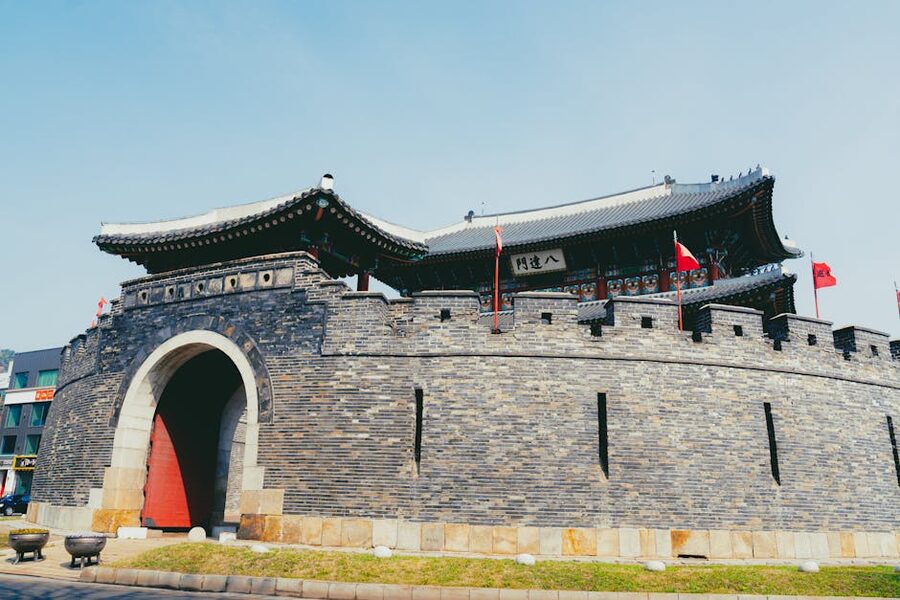
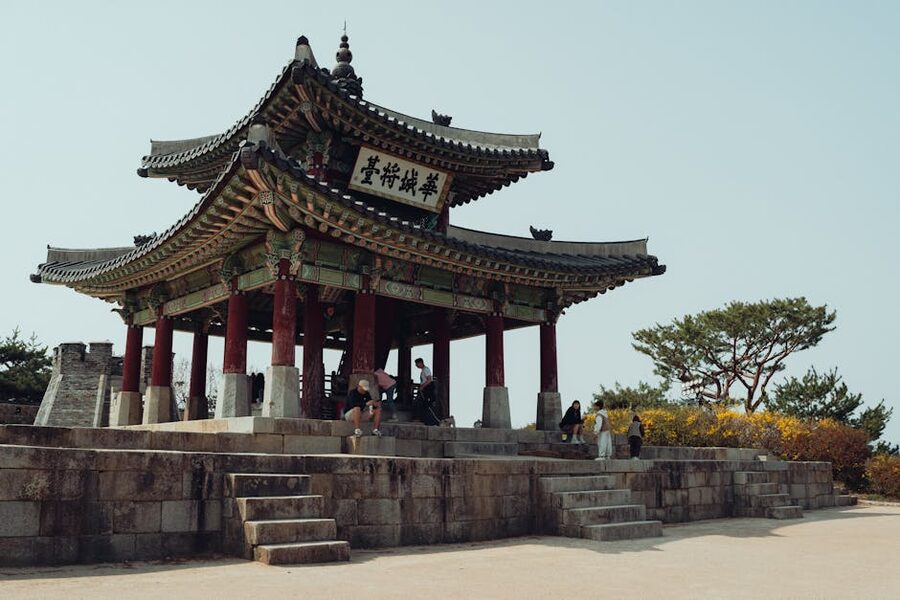
- Paldalmun (South Gate)
- Seojangdae & Seonodae (the western command post)
- Hwaseomun (West Gate)
- Janganmun (North Gate)
- The wall walk: what it’s actually like
- The rest stops that matter
- When to go
- Opening hours & tickets
- Suwon beyond the walls
- Korean Folk Village (Yongin)
- Starfield Library Suwon
- The Hwaseong Haenggung martial arts performance
- The Hwaseong Trolley
- Tour vs DIY — which one’s right for you
- Where to eat in Suwon
- What to skip
- Practical bits
- The October festival window
- Pairing Suwon with other Korea trips
- Three things I’d tell a friend
- Other day trips I’d pair this with
Short on time? Book one of these
If you just want the booking link and you’ll read the rest later, these are the three I’d hand a friend.
- Seoul: Suwon Hwaseong Fortress & Korean Folk Village Tour — around $74: The full-day flagship. Hotel pickup in Seoul, the Korean Folk Village first, Hwaseong Fortress after lunch, a local market stop on the way back. 10-11 hours door-to-door. Check availability
- From Seoul: UNESCO Suwon Hwaseong Fortress Tour — around $52: The half-day fortress-only pick. 4-8 hour window, small group, focused on the walls and Haenggung Palace — no folk village, no amusement park detour. Check availability
- Beyond Seoul: Starfield Library + Hwaseong Fortress + Cave Quest — around $69: The modern-meets-ancient combo. Suwon’s new Starfield Library first, then the fortress, then Gwangmyeong Cave for an underground afternoon. Seven hours, one minibus. Check availability
Why the fortress even exists (and why it matters for how you visit)
Skip this section if you just want the booking info — but the history is genuinely part of what makes the day trip worth doing, not padding.
In the 1760s a Joseon crown prince named Sado was ordered by his own father to climb into a wooden rice chest in the middle of July. It took him eight days to die of starvation and heat. The reason it had to happen that way was ceremonial — royal bodies couldn’t be defiled, and Sado had three children who would have been branded as criminals if their father had been executed conventionally.
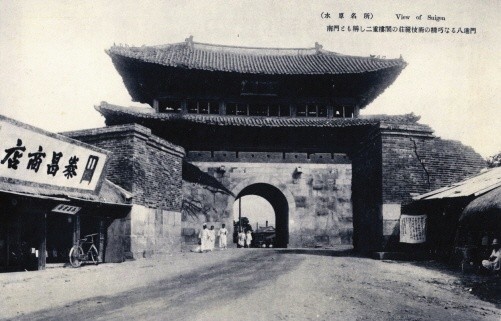
Sado’s son Jeongjo was ten years old when it happened. When he later became king, almost the first thing he did was move his father’s grave to Suwon and start building a brand new walled city around it. That’s Hwaseong. He wanted to shift the entire capital out of Seoul to be closer to the tomb. He never quite pulled it off, but the fortress he built between 1794 and 1796 is what you’re walking around today.
Two things about that matter for your visit. First — most of what you see is reconstructed. The Japanese occupation, the Korean War, and general neglect trashed huge sections. The rebuild in the 1970s used the original blueprint, a lavishly illustrated royal manual called the Hwaseong Seongyeokuigwe, which is the only reason the fortress could be restored authentically. UNESCO liked that so much they listed the place in 1997.
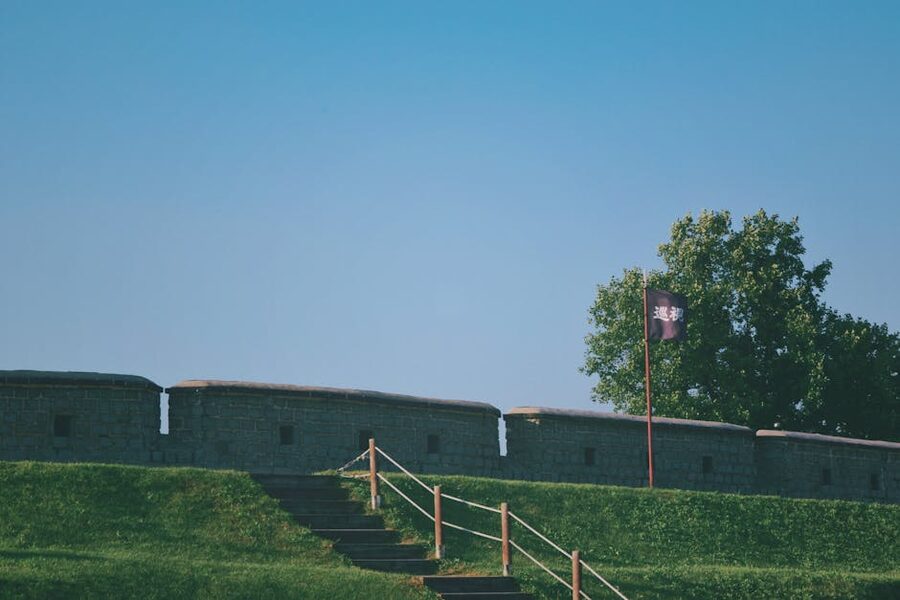
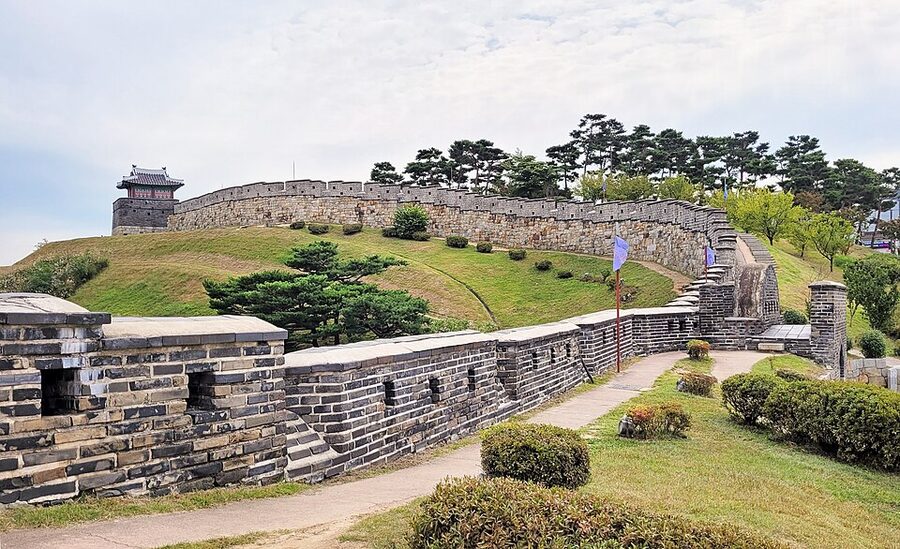
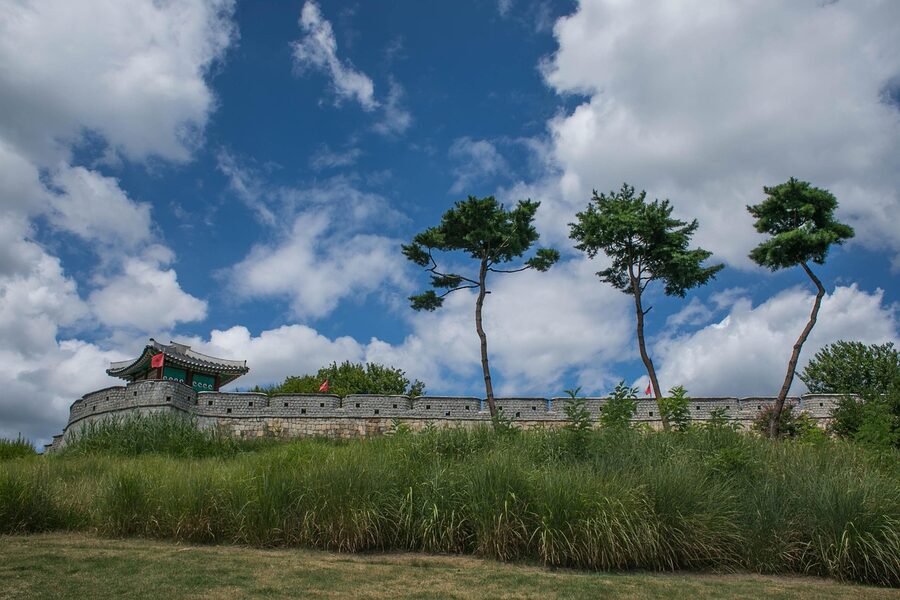
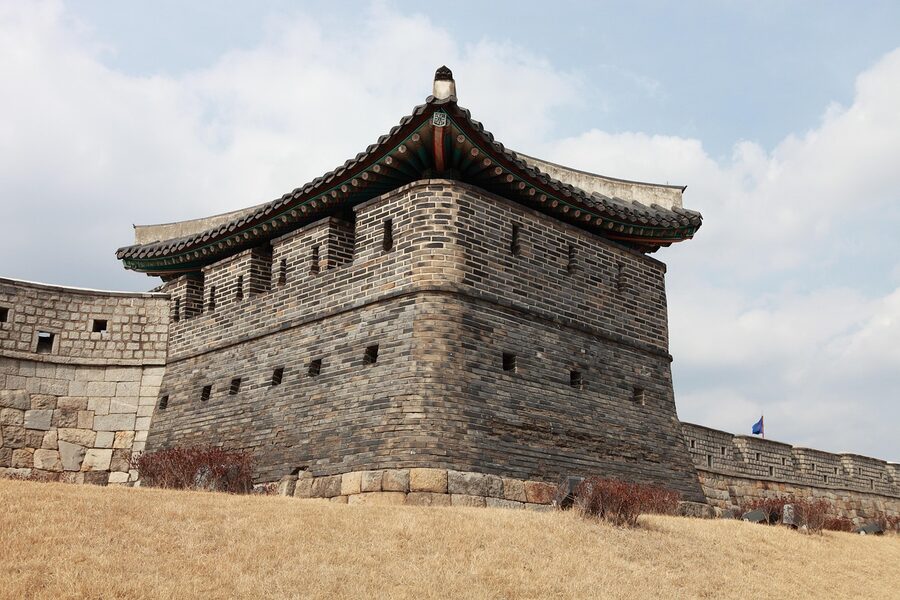
Second — this isn’t a symbolic walled ruin. You can walk the whole perimeter. All 5.7 kilometres of it. Four main gates, forty-eight towers and bastions, and a palace (Hwaseong Haenggung) tucked inside the wall that Jeongjo used as his Suwon base. That’s a big day out on foot.
Three tours I’d actually book
There’s a lot of Suwon product on GetYourGuide and Viator — folk village combos, cave combos, fortress-only, night tours, tours with Everland tacked on. I’ve worked through our review database and these are the three that consistently come back well from real visitors, and that I’d recommend for different kinds of traveller.
1. Seoul: Suwon Hwaseong Fortress & Korean Folk Village Tour — around $74
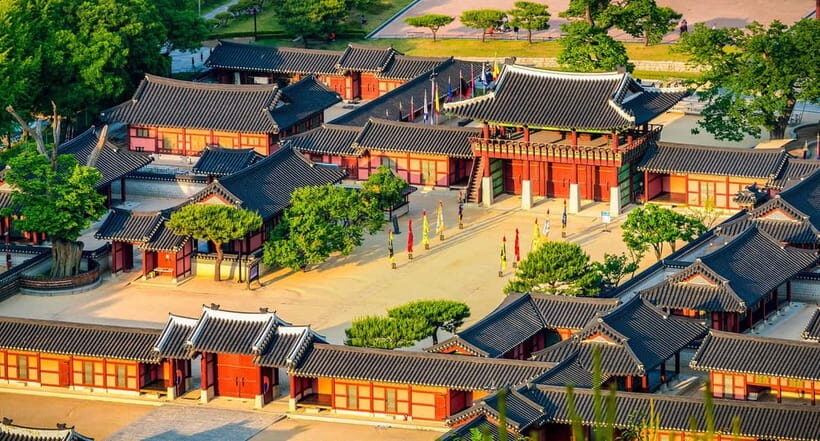
This is the tour to book if you only have one day for Suwon and you want the whole Joseon experience packaged up. It’s 10-11 hours, hotel pickup in Seoul, the Korean Folk Village first (an open-air museum of traditional houses), lunch, then the fortress walls and Hwaseong Haenggung Palace — our full review goes into exactly which villages and gates you hit. Guides like John, Laura and Sally are named repeatedly in visitor feedback for actually making the history stick. The downside is the length — if you’re jet-lagged or have kids under eight, the pace can feel long.
2. From Seoul: UNESCO Suwon Hwaseong Fortress Tour — around $52
If the folk village sounds like filler to you, book this one instead. It’s a 4-8 hour small group focused entirely on Hwaseong — the walls, the gates, Haenggung Palace, and a guide who actually knows Joseon history. Our review has more on how the guides handle the Sado-Jeongjo story without turning it into a lecture. The price is lower because you’re back in Seoul by mid-afternoon, leaving the evening free for Myeongdong or Hongdae. Best pick if you’re a second-time Korea visitor or you’ve already seen a folk village in Yongin.
3. Beyond Seoul: Starfield Library + Hwaseong + Cave Quest — around $69
This is the combo pick for anyone who wants a modern-vs-ancient contrast in one day. Suwon’s Starfield Library (the seven-storey bookshelf atrium) first, Hwaseong Fortress and the walls in the middle, then Gwangmyeong Cave — a former gold mine turned underground theme park — after lunch. Seven hours end-to-end. Our write-up on this one flags the ~160 cave steps as the main reason to skip it if you’re travelling with anyone mobility-limited. Otherwise it’s the most varied day of the three.
DIY from Seoul: how to do Suwon without a tour
This is the cheapest, most flexible option. Here’s the full routing I’d use.
The transport
From central Seoul, Suwon is 40 minutes to an hour, and it’s on the Seoul Metro. Three real options:
- Seoul Metro Line 1 (blue). The cheapest — about 1,850 won with a T-money card. Insadong to Suwon Station is around 52 minutes. Get a T-money at any convenience store or airport if you don’t already have one. Trains every few minutes.
- KTX high-speed rail. Seoul Station to Suwon in about 25-30 minutes. Costs 8,400-9,000 won depending on time of day. Worth it if you’re staying near Seoul Station and want every extra minute in Suwon.
- Taxi or Kakao T. Roughly 40,000-50,000 won. Only makes sense if you’re a group of four and splitting it.
From Suwon Station to the fortress
Suwon Station is not at the fortress. You’ll want to take a local bus from the stop right outside the main exit — buses 11, 13, 36, 39, 82-1 or any other heading to Paldalmun all work. It’s about five stops, roughly 10 minutes, and it costs another 1,450 won on your T-money card. Get off at Paldalmun (팔달문). You’ll see the gate itself the second you step off the bus.
If buses intimidate you, a taxi from Suwon Station to Paldalmun is 5,000-7,000 won and takes about eight minutes. Worth it if it’s hot or you’re tired.
A sensible DIY route
I’d do it in this order:
- 10:15 — arrive at Paldalmun. Walk straight through the gate toward the palace (5-10 minutes). Feels backwards at first. It isn’t.
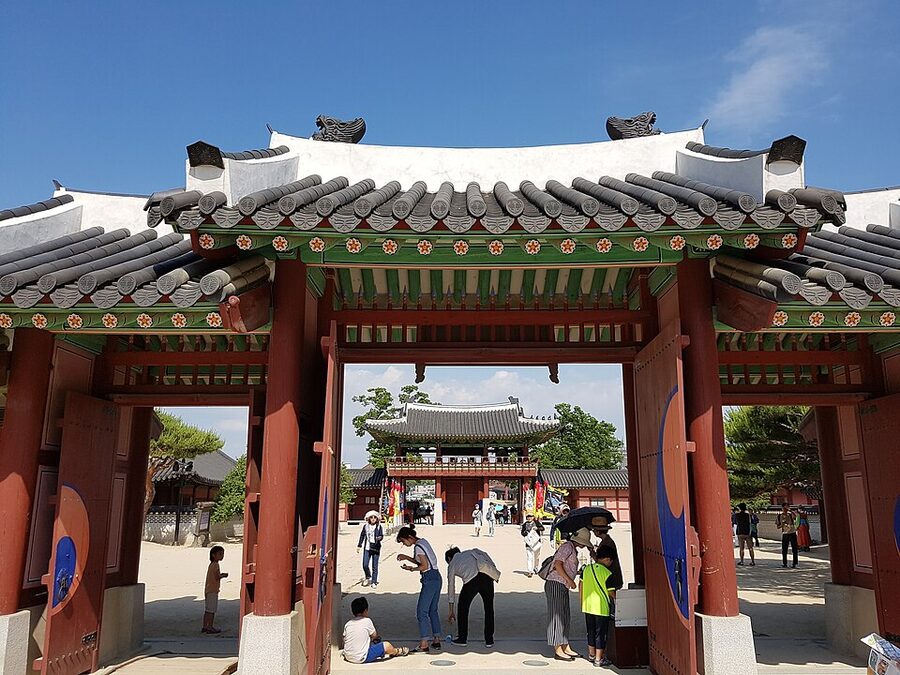
- 10:45 — buy your palace ticket (1,500 won) and walk in.
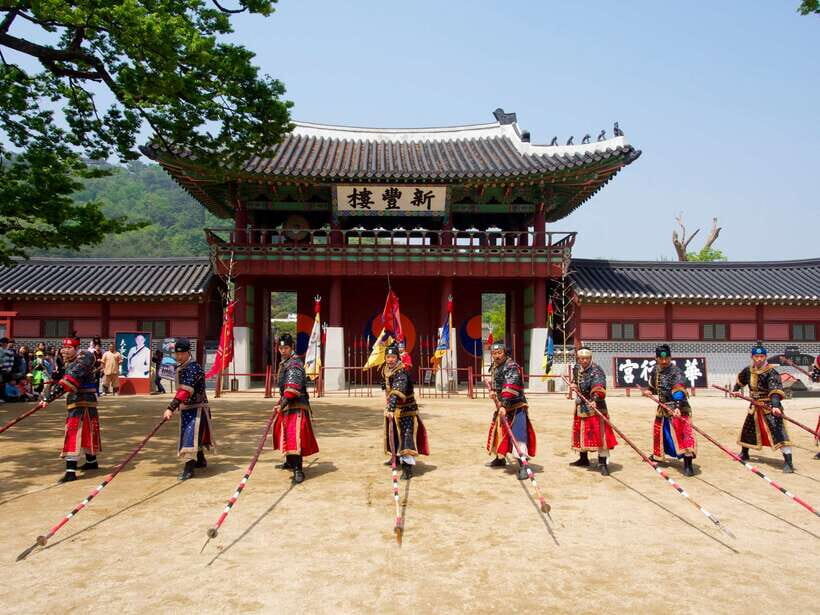
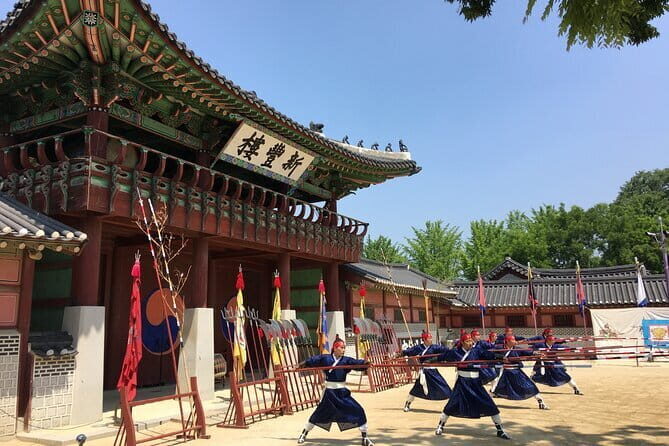
- 11:00 — watch the 24 Martial Arts Performance at Sinpungnu. Every day except Monday. It’s a live demo of the 1790 combat manual Muyedobotongji — swords, spears, two-handed moves, some improbable acrobatics. 18 of the 24 disciplines (they skip the horse-mounted ones). About 30 minutes and far better than you’d expect from a free palace performance.
- 11:30 — wander Haenggung and pop over to Daeseungwon, the giant gold Buddha on the slope behind the palace. You can’t cut through, you have to walk out and back in — worth it anyway.
- 12:30 — lunch near Rodeo Street, the tidy pedestrianised block a couple of minutes from the palace. Naengmyeon (cold buckwheat noodles) if it’s warm, galbitang (short rib soup) if it’s cold.
- 13:30 — buy your fortress ticket (1,000 won) at the steps just east of Paldalmun and start the wall walk. Keep the ticket — they check twice.
- 13:30-17:00 — walk the wall. Seonamammun, Seojangdae, Hwaseomun, Janganmun, Hwahongmun. Roughly three hours with stops.
- 17:00 — finish at Hwahongmun (the water gate over Suwon River) and either walk to Haenggung-dong Mural Village for coffee or bus back to Paldalmun for Seoul.
The four gates, in walking order
The wall is a rough loop, and you can start and finish at any of the four gates. I’d start at Paldalmun and work clockwise — here’s what to actually look for at each one.
Paldalmun (South Gate)
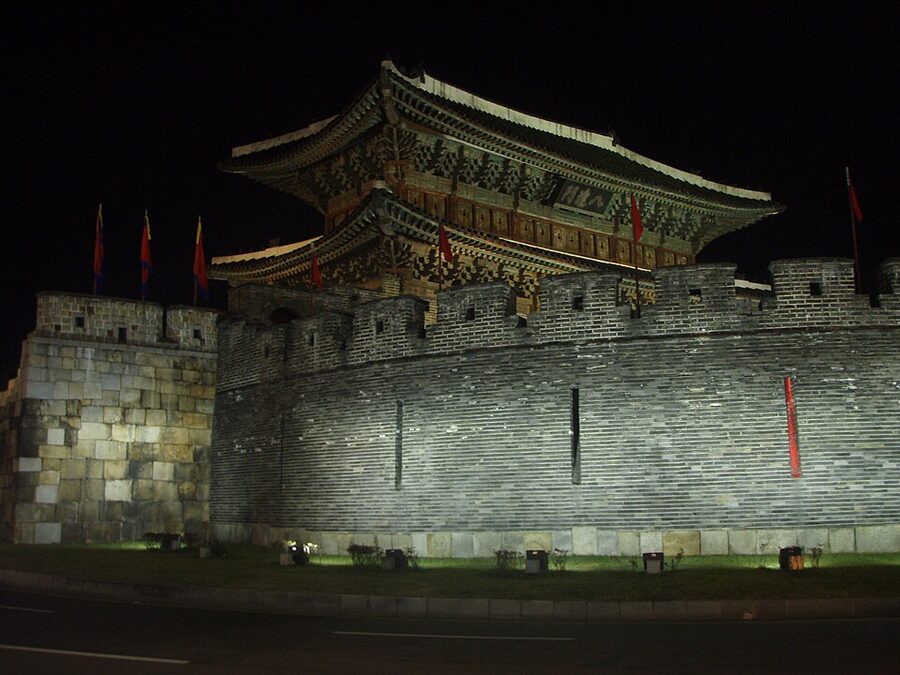
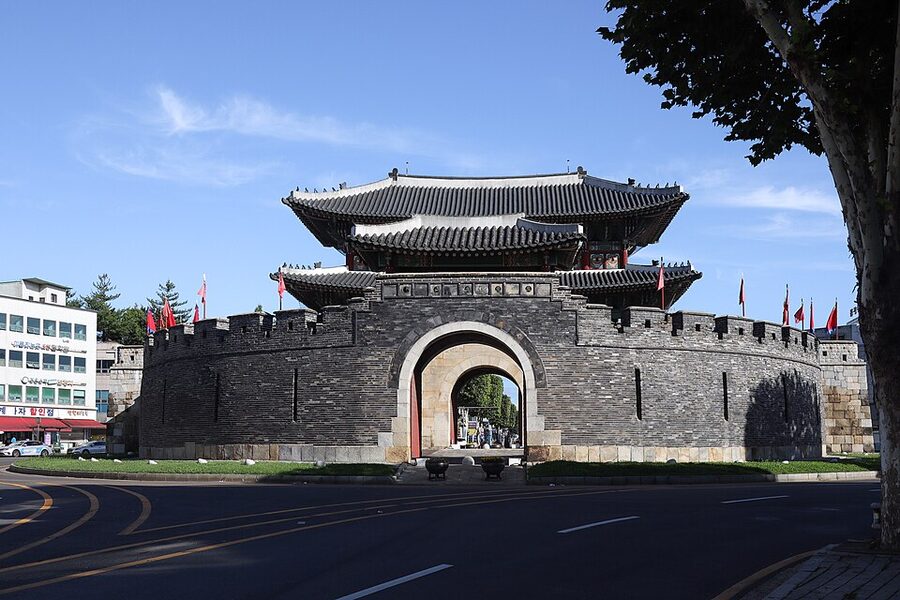
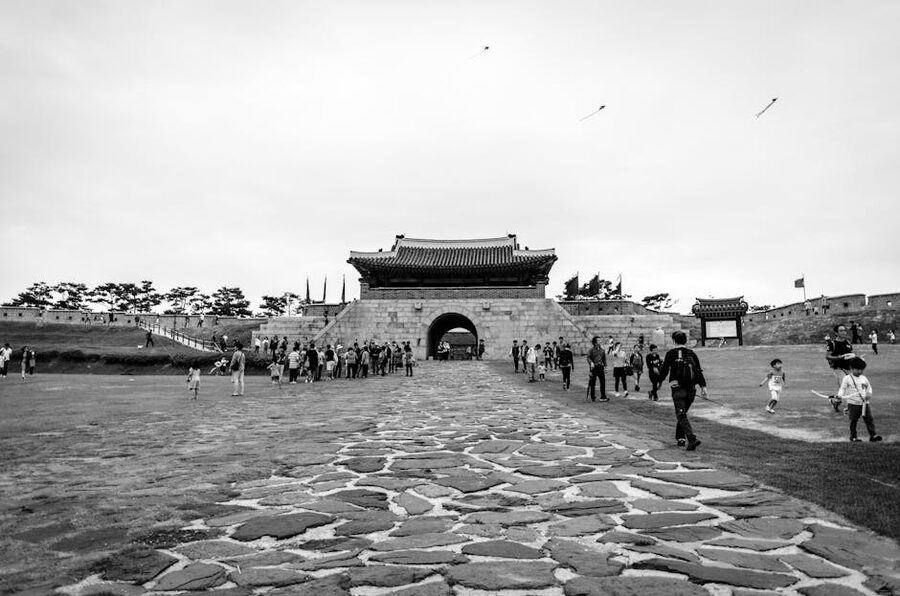
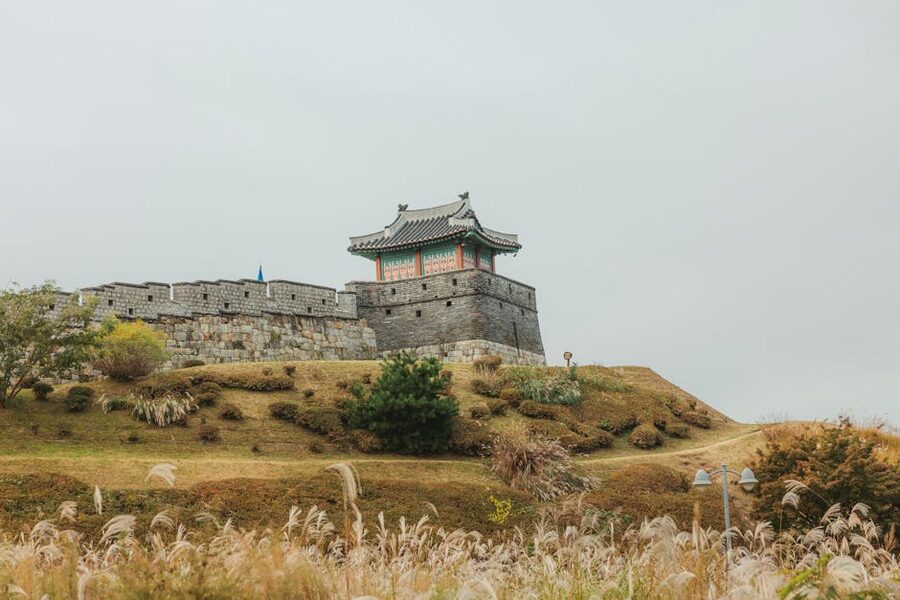
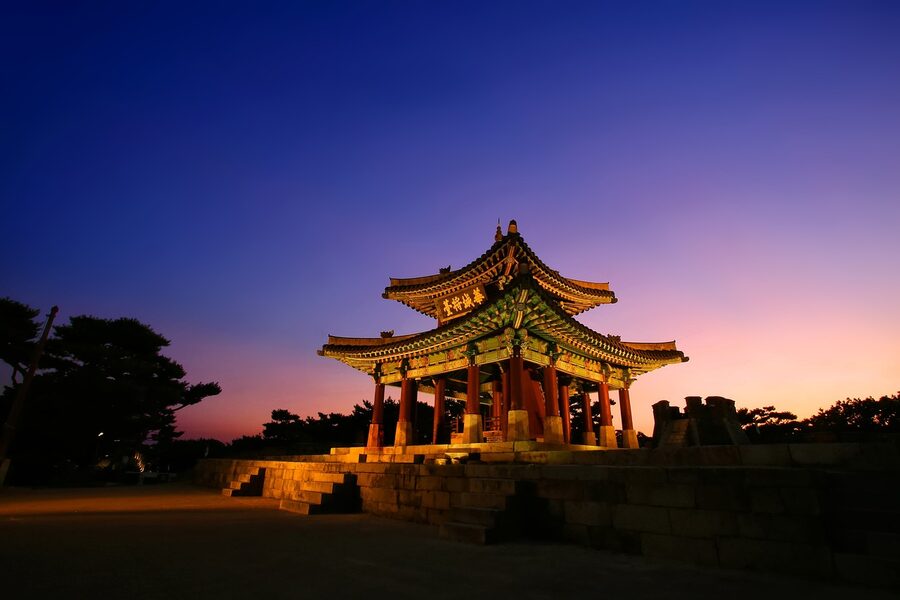
The south gate. Your starting point if you come in by bus. It sits directly in the middle of a modern roundabout, which is a lot more striking than it sounds — traffic streams past an 18th-century gatehouse while a man sells chestnuts out the back. The gate itself is surrounded by a crescent-shaped defensive wall (called an ongseong) which attackers would have had to breach before they could get to the main gate. Only Paldalmun and Janganmun have these. They’re the oldest intact ongseongs in Korea.
Seojangdae & Seonodae (the western command post)
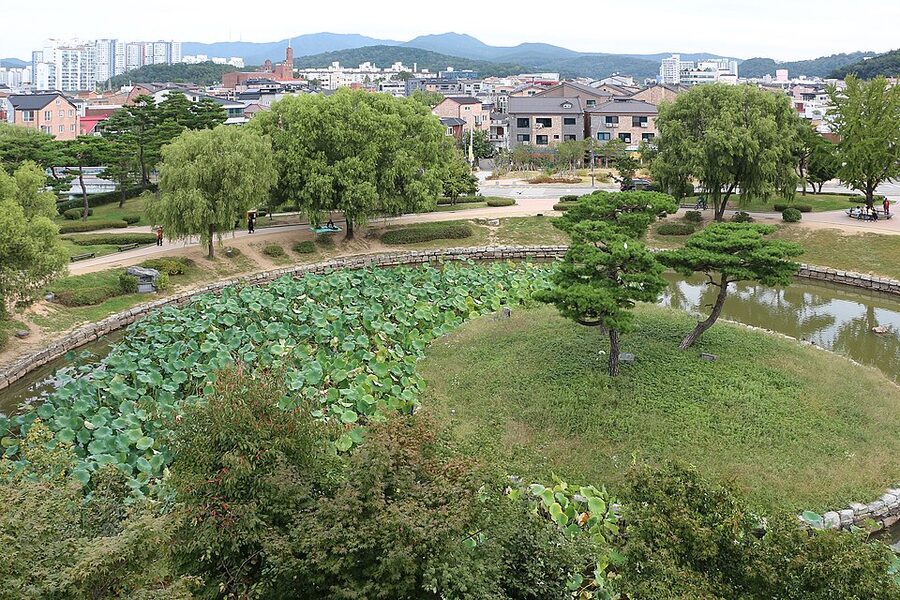
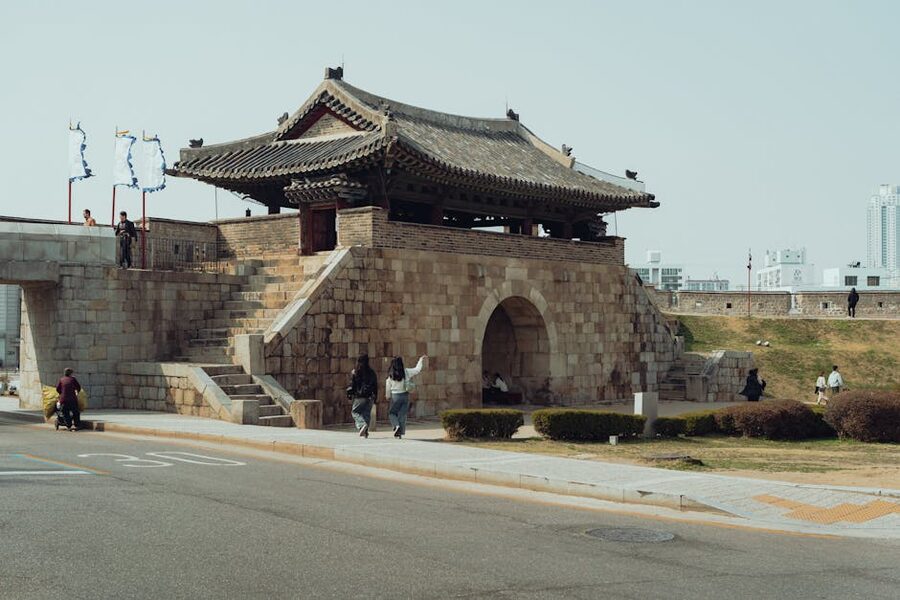
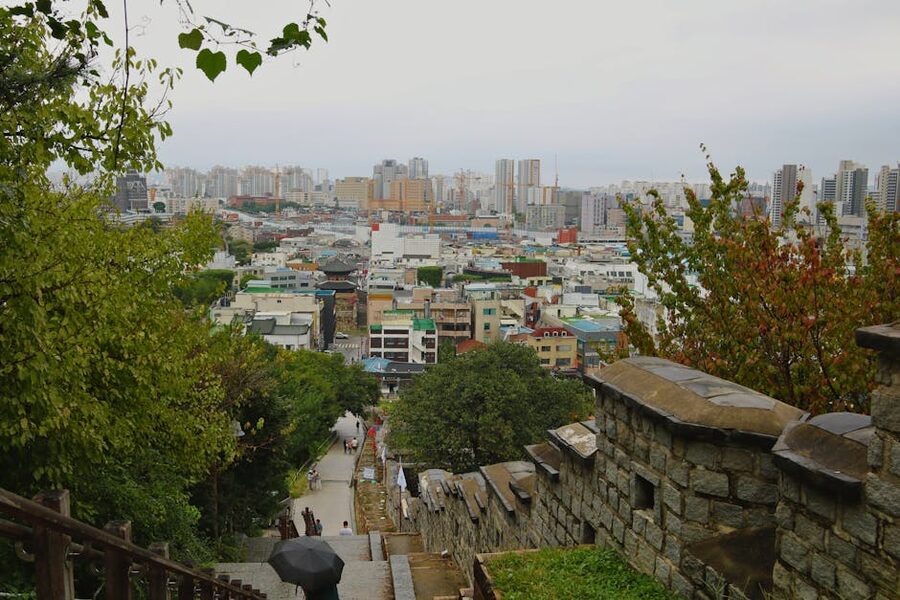
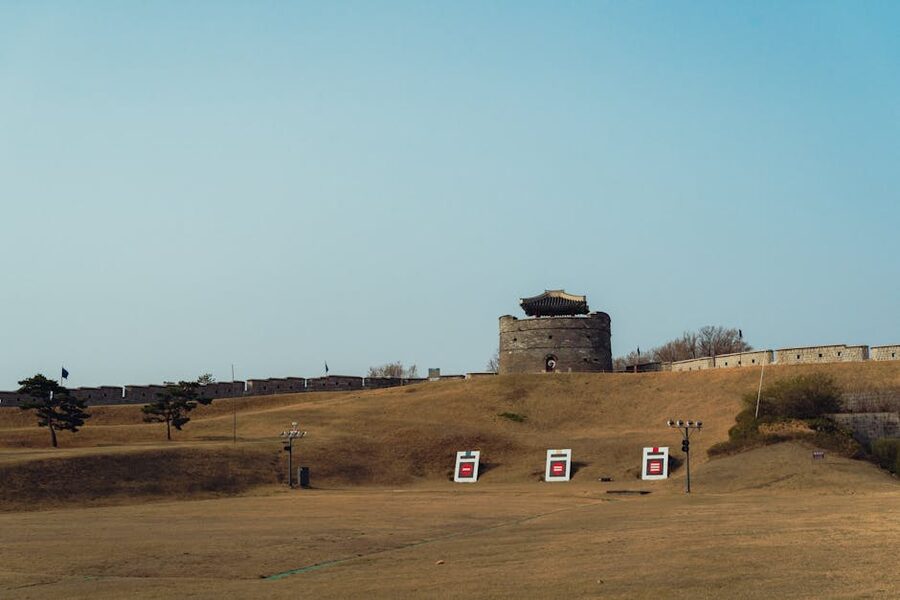
Above the wall on Paldalsan, the small mountain the fortress wraps around. Seojangdae is the command pavilion — Joseon’s equivalent of a military watchtower. Right next to it is Seonodae, a circular raised platform for crossbow training. This is the highest point of the fortress and the first view that actually makes the wall look huge. Come up here before lunch if you can — the light on the city is better in the morning.
Hwaseomun (West Gate)
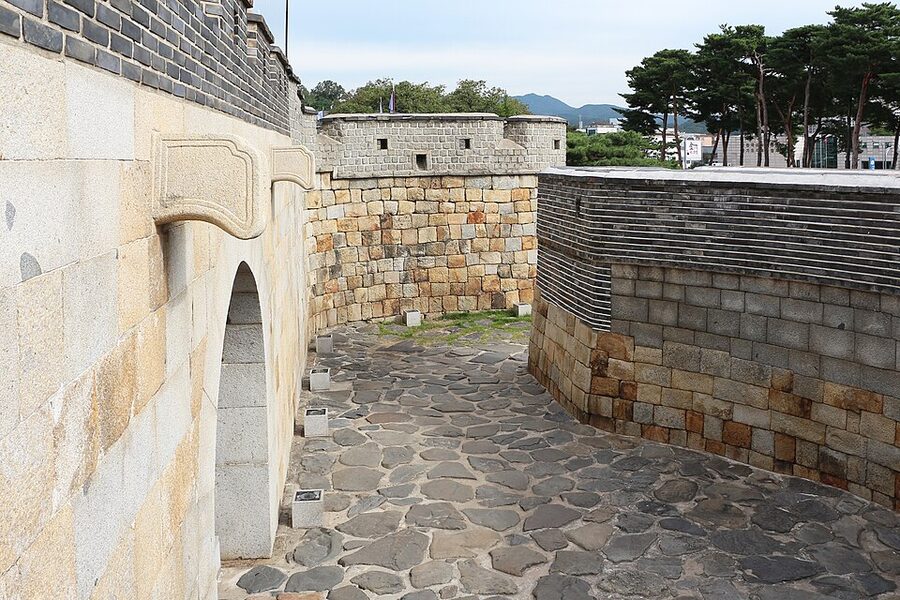
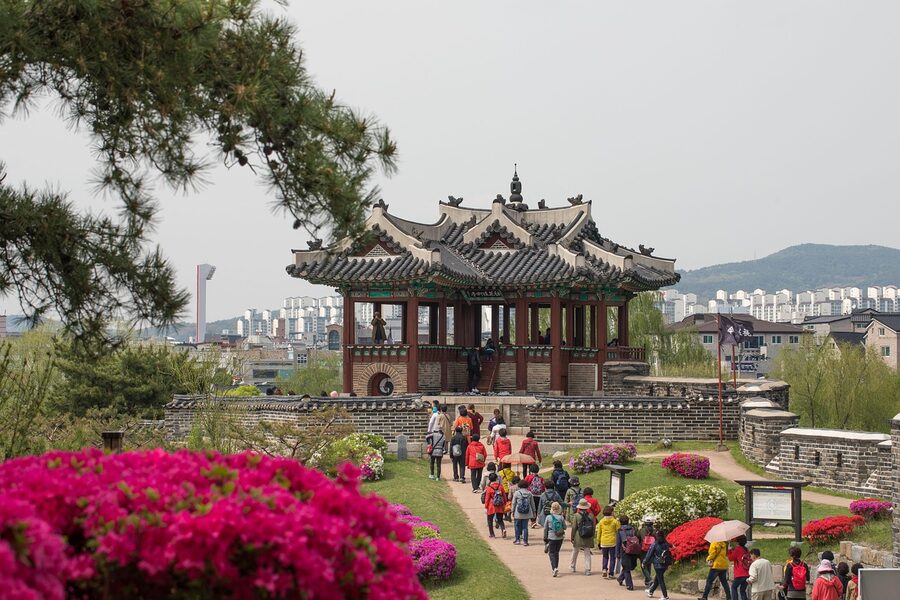
The smallest of the four main gates. Not dramatic like Paldalmun, but it has the best photo angle because nobody else bothers to stop here. The wooden gate tower has its original wooden doors — you can see the iron studs they used for reinforcement in the 1790s.
Janganmun (North Gate)
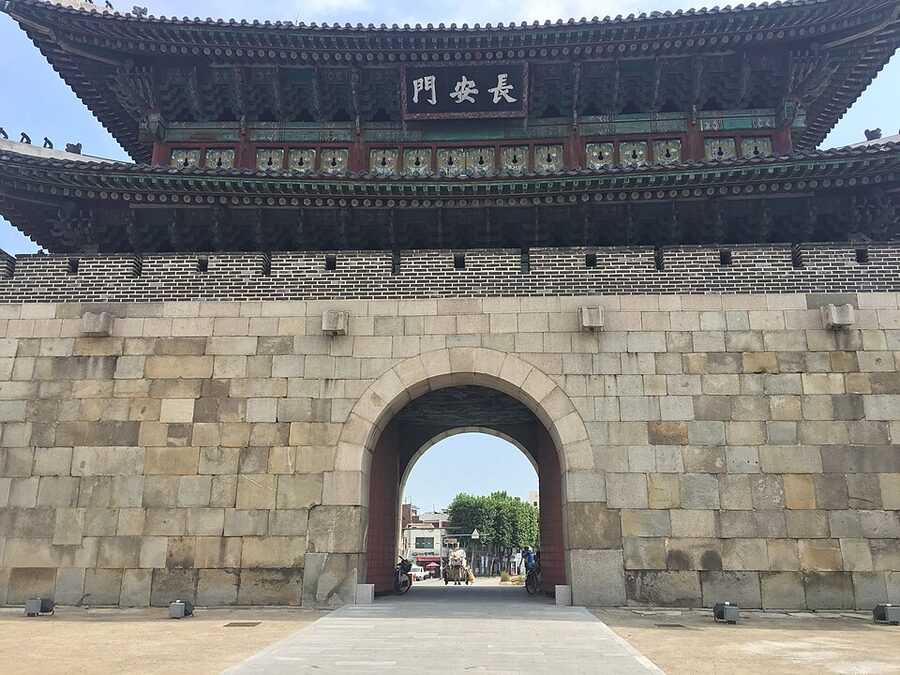
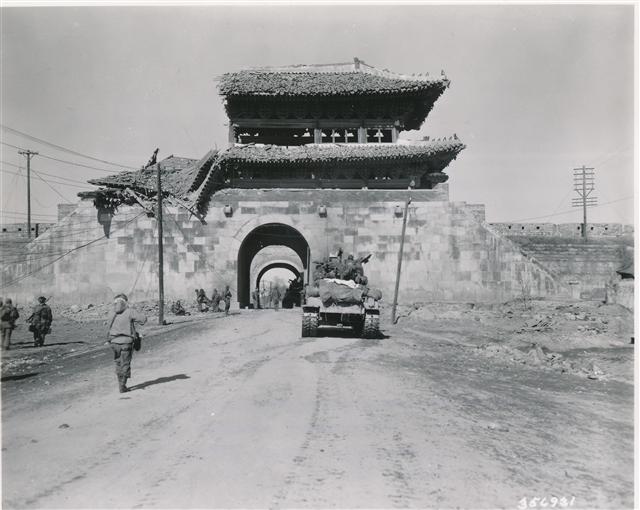
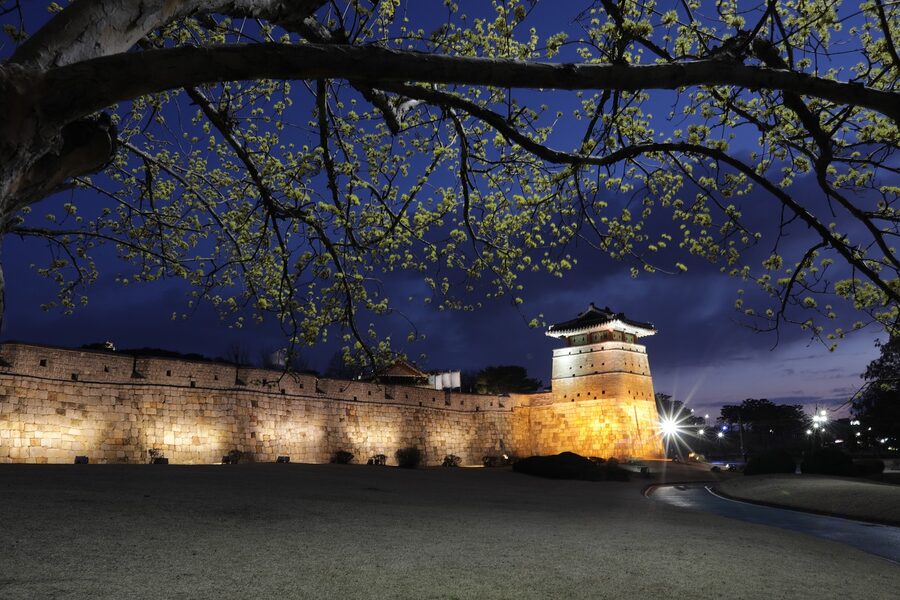
The north gate — and the biggest gate in the whole country. Even Seoul’s Sungnyemun and Heunginjimun are smaller. The two-storey gatehouse on top had a specific job: royal proclamations were read out from the upper balcony to the Suwon residents below. King Jeongjo intended this to be a future capital, remember, so the gate had to out-grand everything in Seoul.
The wall walk: what it’s actually like
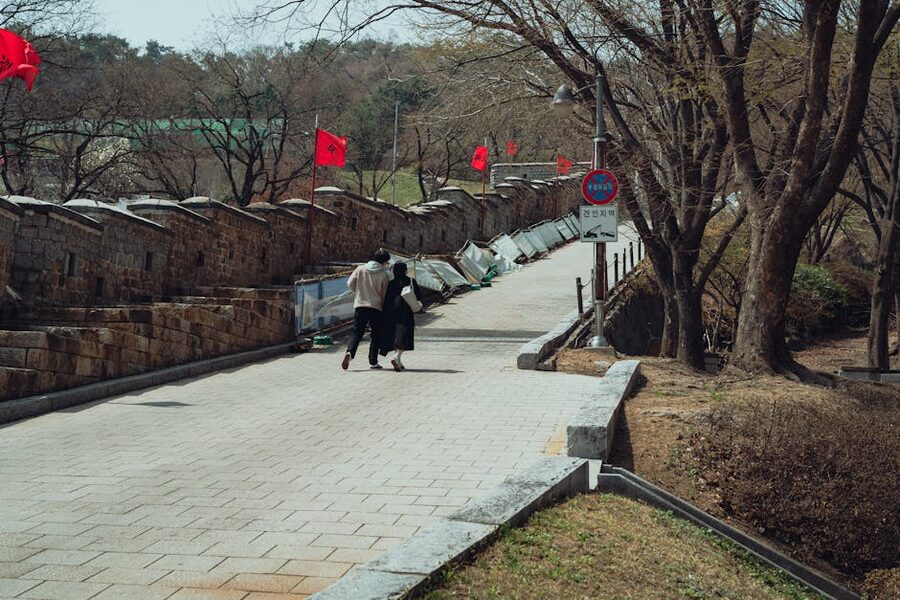
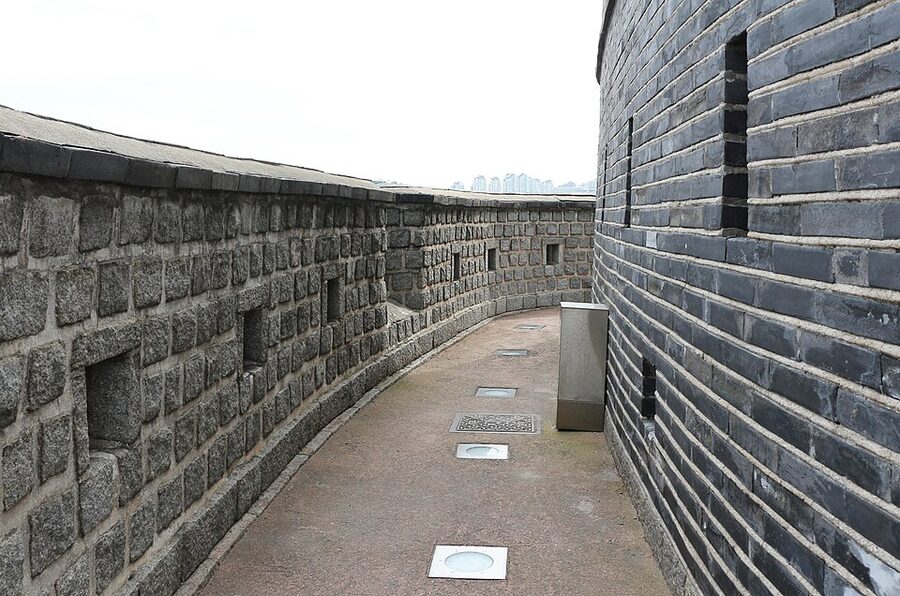
The total loop is 5.74 km. Sounds short. The catch is the first kilometre from Paldalmun up to Seojangdae — it climbs Paldalsan and you’re on stone steps for most of it. It’s not dangerous and it’s not technical, but it is a hill. After that you’re either flat or descending the rest of the way.
Realistic timings:
- Fit walker, no stops: 90 minutes end to end.
- Normal pace with photo stops: 2 to 2.5 hours.
- With kids, or pausing at every bastion: 3 to 3.5 hours.
- Half loop only (Paldalmun to Janganmun via Seojangdae): about 75 minutes, which is the stretch I’d pick if you only have half a day.
The rest stops that matter
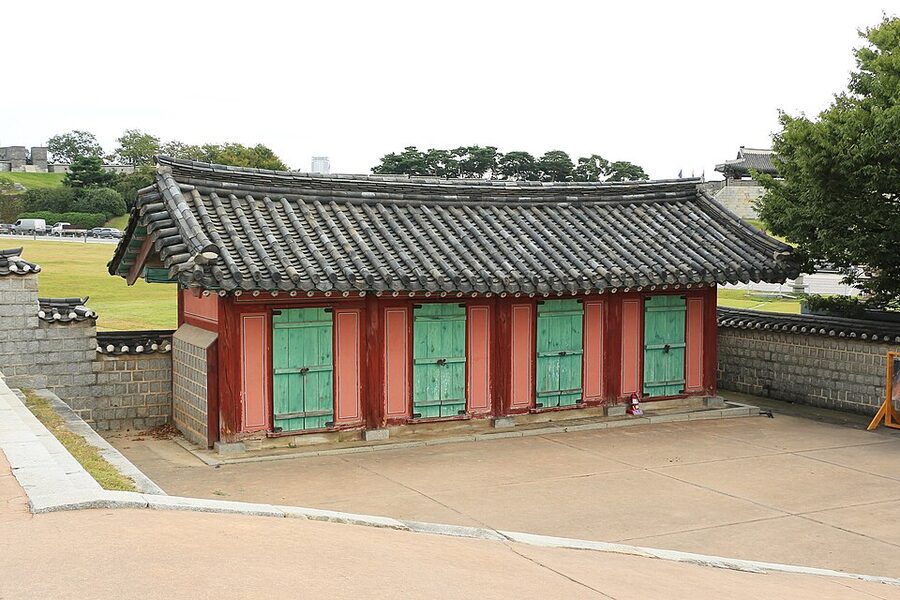
- Seonamammun (Secret Gate). Just after the hardest climb. Through the gate itself is a side pavilion — Seonamgangnu — where you can sit in the shade. Trees block the view but it’s a good lunch spot if you’ve brought a kimbap.
- Hyowon’s Bell. Near Seojangdae. 1,000 won to ring the bell and make a wish honouring King Jeongjo. Yes, you should do it.
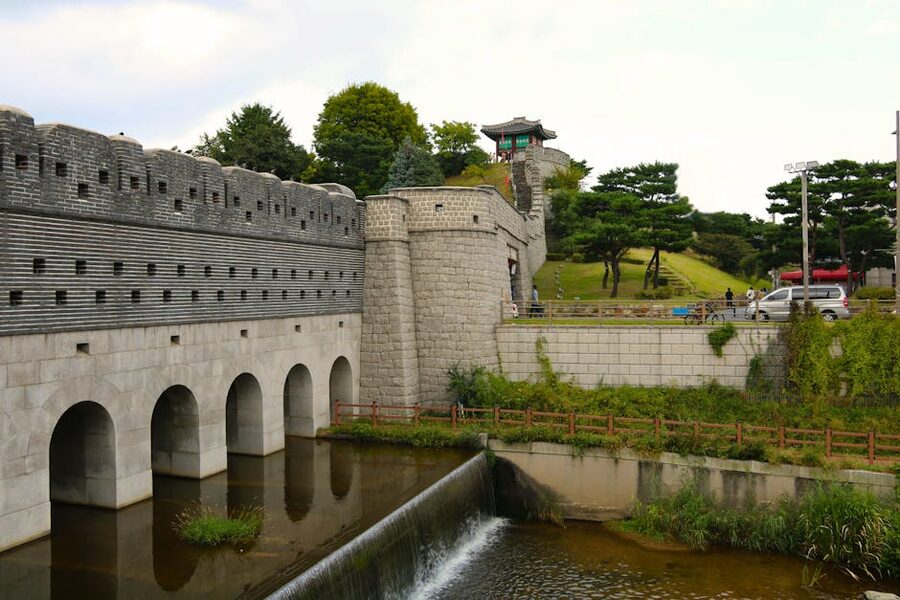
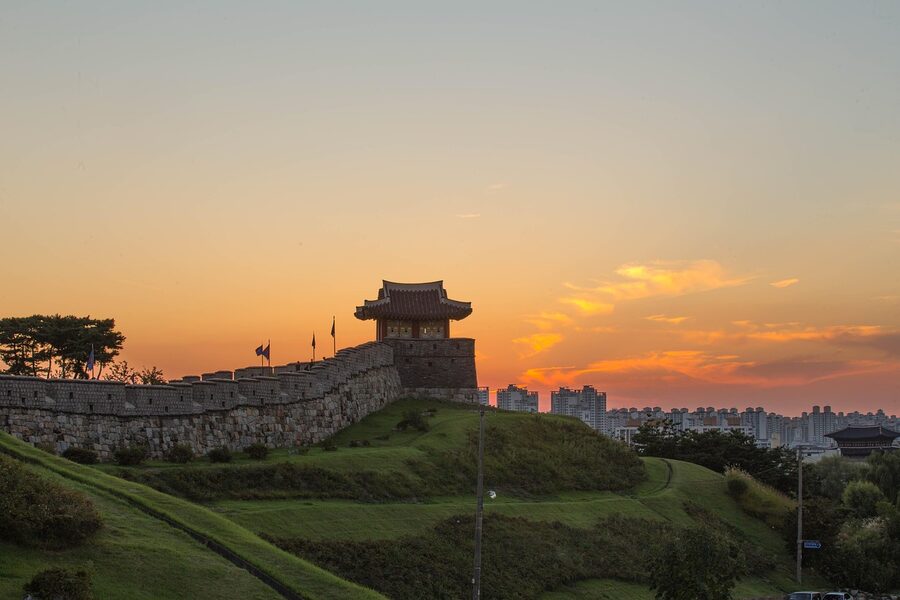
- Hwahongmun (water gate). The north-east end. Seven arches over Suwon River, with a pavilion (Banghwasuryujeong) on the east bank that’s the single prettiest spot in the fortress. Pack a coffee and sit for 20 minutes here before you leave.
When to go
The fortress is open year-round. That said:
- Best: mid-April to mid-May, and mid-October to early November. Cherry blossoms on the south wall in April, full autumn colour on Paldalsan in October-November. This is also when the evening light-up programme runs.
- Avoid: July and August. There’s almost no shade on the top of the wall. Humidity is brutal. You’ll finish the walk soaked through and regretting every choice you made. If you have no flexibility, start at 7am and be off the wall by 10.
- Winter (December-February): snow on the wall is genuinely spectacular but you’ll need proper gloves and waterproof footwear — the stone steps freeze and Korea doesn’t grit them.
- Weekday vs weekend: always a weekday if you can. Tuesday and Thursday are quietest. Saturday afternoons are when Korean families do the wall walk and the popular sections at Seojangdae get clogged.
Opening hours & tickets
Opening times shift by season:
- March to October: 9:00 to 18:00.
- November to February: 9:00 to 17:00.
Tickets are cheap — 1,000 won for the fortress walls, 1,500 won for Haenggung Palace, 3,500 won for a combined ticket that also includes the Suwon Hwaseong Museum if you want the deep dive. Children and seniors get discounts. Credit cards accepted at both ticket booths.
Suwon beyond the walls
If you finish the wall before mid-afternoon, or you’re staying overnight, Suwon has more going on than just the fortress. Worth knowing about:
Korean Folk Village (Yongin)
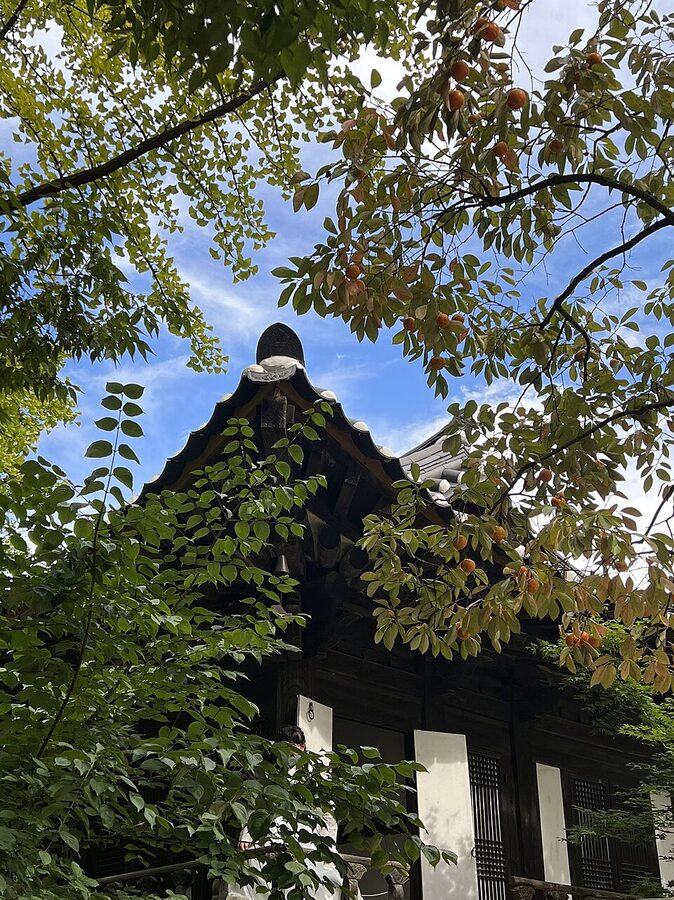
Technically not in Suwon — it’s in Yongin, about 30 minutes away by bus (route 37 from Suwon Station). But almost every Suwon tour packages it in, and if you’re here for a day anyway, it’s worth the detour. 270 traditional Korean houses, an amusement park section for kids, and regular performances of folk music, seesaw jumping (much more athletic than it sounds), and tightrope walking. Entry is 20,000 won for adults. Plan two hours minimum.
Starfield Library Suwon
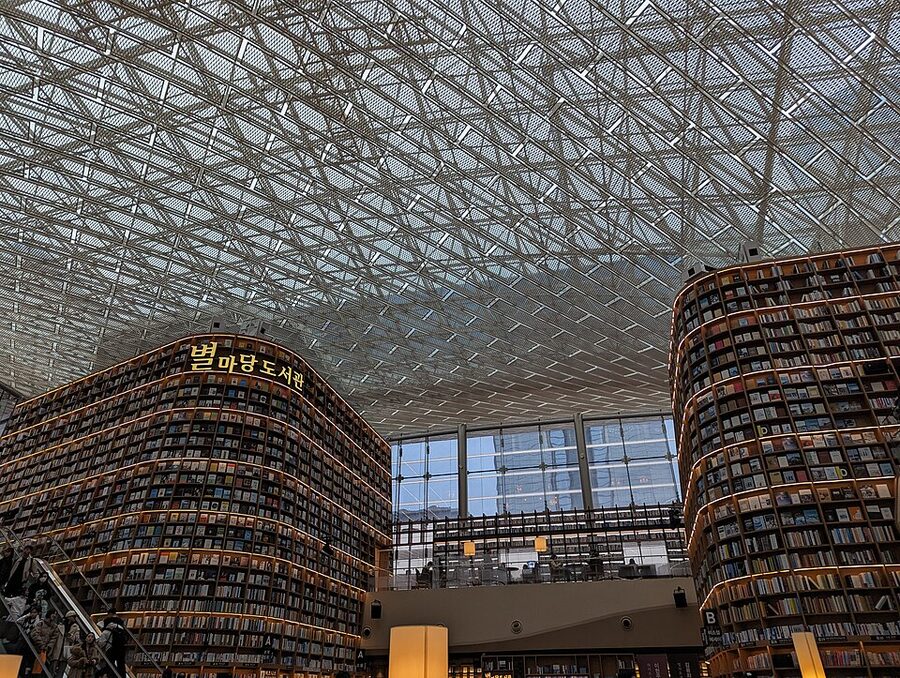
Suwon’s Starfield mall opened its own Starfield Library in 2024 — the biggest one in Korea, a seven-storey vertical bookshelf in an atrium with a glass roof. It’s free to walk into, air-conditioned, and the Suwon version has some books you can actually pull down and read (unlike the COEX flagship in Seoul where most are fake). Twenty minutes by bus from Paldalmun. Great place to cool down after the wall walk in summer.
The Hwaseong Haenggung martial arts performance
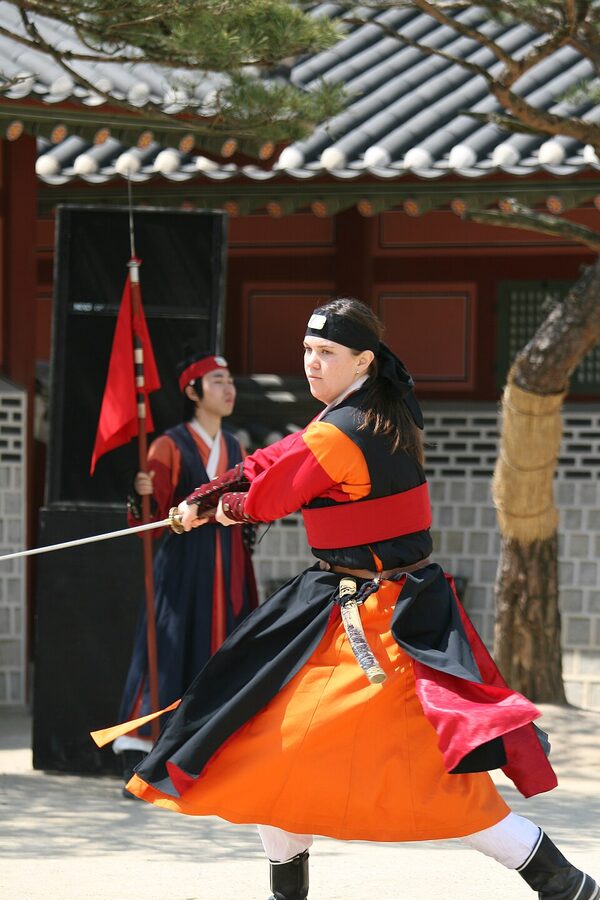
The free 11am demonstration at Sinpungnu Gate inside the palace. If you’re doing a DIY day, time your arrival to catch this — it’s the most authentically Joseon 30 minutes you’ll spend in Suwon. The 24 martial arts come from the 1790 Muyedobotongji manual and range from swords to spears to two-person choreographed combat. The performers are genuine martial artists, not reenactors.
The Hwaseong Trolley
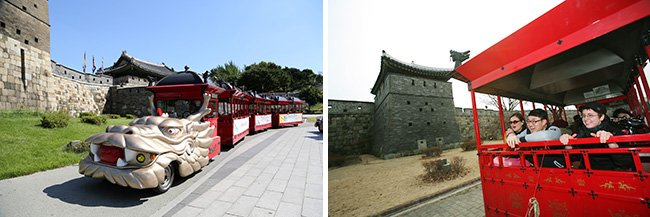
There’s a small tourist trolley that loops around the main fortress landmarks — Haenggung Palace, up to Yeonmudae (the training ground), and back via Paldalmun. Costs 4,000 won. It’s a terrible substitute for walking the wall but a good rescue option if you’re travelling with older family or small kids and want to cover ground fast.
Tour vs DIY — which one’s right for you
I’d do DIY if:
- You’ve been to Korea before and you’re comfortable on Seoul Metro.
- You speak or read a little Hangul — the signage inside the palace is Korean-first.
- You want to walk the full wall at your own pace.
- Your budget is tight (under $20 including transport and all tickets).
I’d book a tour if:
- This is your first Korea trip and you want the Sado-Jeongjo backstory told out loud.
- You want the Korean Folk Village without the extra transfer faff.
- You’re staying in a Seoul hotel outside the Line 1 catchment.
- You’re travelling in July/August and want air-conditioned transfers instead of a crowded train.
- Your Korean isn’t great and you want a guide to help with lunch.
Where to eat in Suwon
Suwon’s signature dish is galbi — specifically wangalbi or king short ribs, cut thicker than the Seoul version and grilled with a sweeter marinade. The local claim is that wangalbi was invented in Suwon in the 1940s and every Korean food writer agrees. Three places worth knowing about:
- Yeonpo Galbi (연포갈비). The most famous wangalbi restaurant in Suwon. Family-run since 1945. About 10 minutes from Paldalmun by taxi. Not cheap — expect 35,000-45,000 won per person — but the meat is the best I’ve had in the city.
- Bonsuwon Galbi (본수원갈비). The budget-friendly option near Haenggung Palace. Same style, smaller portions, around 25,000 won per person.
- Tongdak Street (통닭거리). Near Paldalmun. A couple of blocks of Korean fried chicken shops — Yongseong Tongdak and Jinmi Tongdak are the two originals. Get a whole chicken and a liter of beer for about 20,000 won for two. The perfect end to a wall walk.
What to skip
A few things that show up on tour add-on lists or DIY blog posts and that I’d actually skip:
- Flying Suwon (the hot air balloon). 18,000 won for a tethered-balloon view from 150 metres up. If you’ve walked the wall you’ve already got the better view from Seojangdae, for free.
- Toilet Museum (Haewoojae). It’s a museum about toilets shaped like a toilet. It’s in a completely different part of Suwon. Fun as a novelty but a 40-minute detour for a 20-minute visit.
- Everland combos. Some tours bolt an Everland theme park visit onto the fortress. Don’t. Give Everland a proper full day or skip it entirely — tacking it on at 4pm means you get neither experience properly.
- The Suwon World Cup Stadium. Unless you’re a football obsessive, there’s no reason to cross the city for it.
Practical bits
A few last things worth knowing before you go:
- Cash vs card. The fortress and palace ticket booths take cards. Most Suwon restaurants take cards. But street food vendors near Paldalmun are cash-only. Carry 20,000-30,000 won in small bills.
- T-money. If you’re DIY-ing, you need a T-money card for the subway, bus from Suwon Station, and the return trip. Our Incheon airport SIM and T-money guide has the full breakdown on getting one as soon as you land.
- Water & shade. There are two vending machines along the 5.7 km wall loop — one at Seojangdae, one at Hwahongmun. Carry a 500ml bottle minimum. In summer, carry a litre.
- Toilets. At Haenggung Palace, at Seojangdae, and near Hwahongmun. That’s it. Plan accordingly.
- Luggage. Suwon Station has small lockers (2,000-4,000 won). Paldalmun has none. Don’t try to walk the wall with a big backpack — it’s hot, the steps are narrow, and you’ll hate yourself.
- Phone signal. Korean 5G works everywhere on the wall. Offline maps.me is still worth downloading because the Naver-vs-Google Maps confusion gets worse when you’re tired.
- Accessibility. The wall walk has significant stairs. Haenggung Palace is mostly flat and wheelchair-accessible. The trolley (4,000 won) is a workable alternative for mobility-limited visitors who still want to see the fortress.
The October festival window
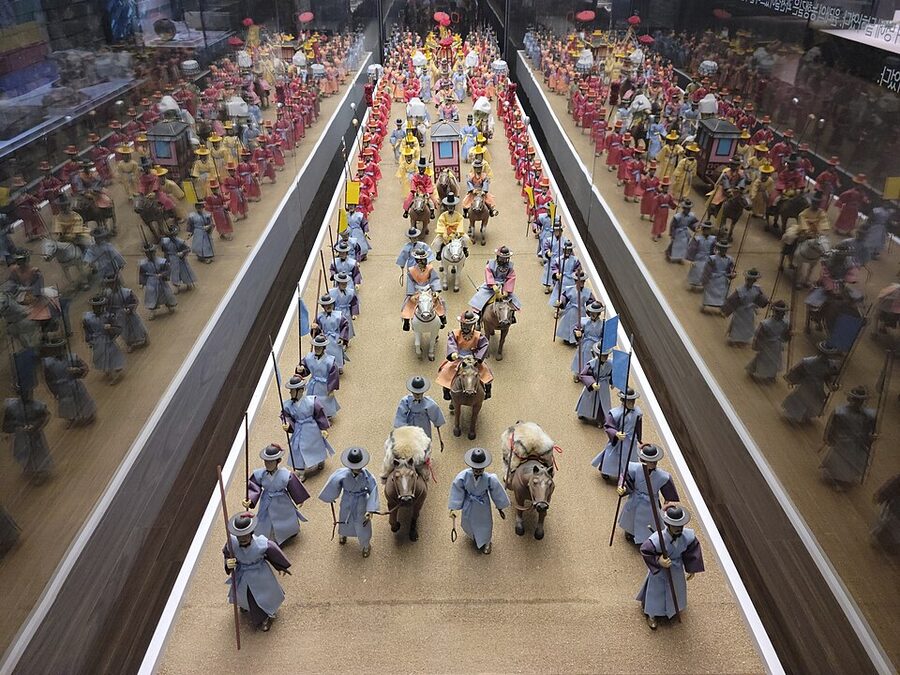
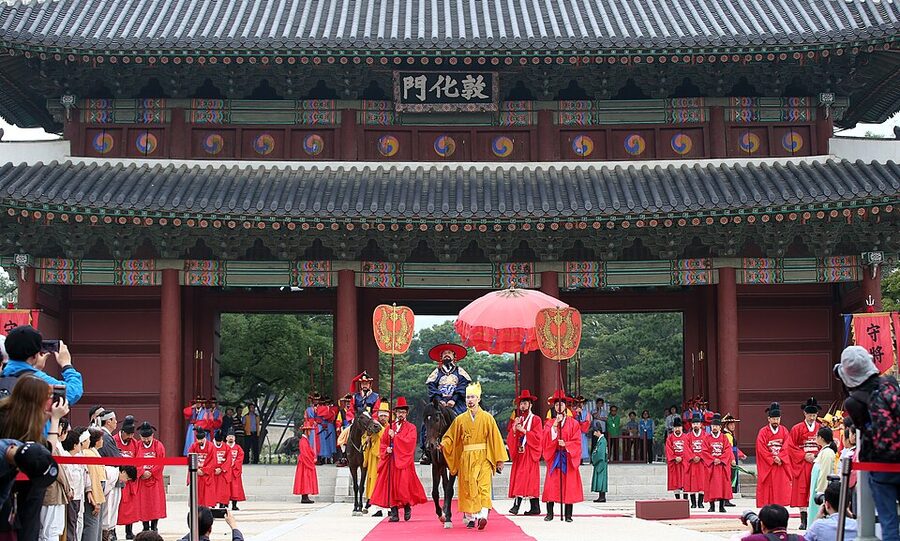
For one week in October, usually the third or fourth, the Suwon Hwaseong Cultural Festival takes over the whole fortress. The headline event is the Royal Procession — a full re-enactment of King Jeongjo’s 1795 journey from Seoul’s Changdeokgung Palace to his father’s tomb in Suwon. In the real version, 1,779 people and 779 horses made the eight-day journey. The modern version is condensed to one day but still involves hundreds of costumed participants walking through central Suwon.
The festival also runs night light-ups of the fortress walls, street food markets outside Paldalmun, and free traditional music performances at Haenggung Palace. If you’re choosing a week to visit Suwon and have any flexibility, this is the one. Accommodation gets tight — book four weeks ahead.
Pairing Suwon with other Korea trips
Suwon sits south of Seoul on the Line 1 corridor, which makes it easy to chain with other day trips. A few combinations that work well:
If you’re keen on the Joseon historical side of Korea, pair the Suwon day with a visit to the royal tombs and palaces in central Seoul — our Gyeongbokgung and Bukchon walking tour guide covers the palace complex that was the original capital Jeongjo tried to move away from.
For a tour-heavy Korea week, Suwon also combines naturally with the DMZ — both are day trips north or south of Seoul that you can do on successive days without burning yourself out. Our DMZ tour booking guide lays out which operators to use if you want the JSA vs just the demilitarized zone.
If you’re trying to fit Suwon into a packed itinerary and want someone else to handle all the logistics, a private Seoul tour operator will usually let you swap out one of the city days for a Suwon run. Our Jeju private tour guide covers how the same booking pattern works on the island side.
Three things I’d tell a friend
If I were boiling the whole guide down to three lines of advice for someone texting me before they leave the hotel:
- Start at 10am, not 9am. The martial arts performance is 11am and you want to lead with that, not backfill around it.
- Do the whole loop clockwise from Paldalmun. That puts the hard climb first while your legs are fresh and the downhill last when they’re not.
- Don’t skip Hwahongmun. The water gate and Banghwasuryujeong pavilion on the river is the single prettiest corner of the whole fortress and a solid quarter of day-trippers miss it because it’s past the end of the most-walked stretch.
Other day trips I’d pair this with
If you liked the idea of doing Suwon as a structured day from Seoul and you’ve got more days to fill, the Busan-to-Gyeongju day trip is the natural next step — another walled-city world heritage site but six hundred years older than Hwaseong. For a totally different flavour of day-from-Seoul, the Nami Island and Garden of Morning Calm tour is all countryside and forest walks rather than stone walls. If you want to spend an evening in Seoul instead, the Seoul night market food tour is the city counter-programme to a quiet historic day out in Suwon — and our guides on booking a hanbok rental in Seoul and booking a Gangnam tour cover two more tight half-day slots you can fit around the Suwon day.