
On my first trip to Seoul I walked out of Incheon Arrivals, past a row of telco counters, and made a beeline for the AREX. Bad idea. I sat down on the train with a dead SIM, no T-money card, and no working map. I had to get off at Hongik, hunt down a convenience store, and start the whole setup from scratch. Do not do what I did — sort both cards before you leave the airport.
This guide walks you through booking a SIM and T-money card in advance, picking them up at Incheon, and avoiding the small mistakes that cost me ninety minutes of my first night.

- In A Hurry? My Top Picks
- The Mistake Most First-Timers Make
- Why Book In Advance Instead Of Winging It
- How To Book Before You Fly
- Picking Up At Incheon Terminal 1 (Most Airlines)
- Picking Up At Incheon Terminal 2
- What’s Actually In The Envelope
- Topping Up The T-money Card
- Where You Can Actually Use T-money
- Getting From Incheon To Seoul After Pickup
- How To Check Your Balance
- Refunding Leftover Balance Before You Fly Home
- The 3 Traveler SIM + T-money Bundles Worth Booking
- 1. Incheon Airport: Traveler SIM and T-money Transportation Card — from
- 2. Gimpo Airport: Traveler SIM and T-money Transportation Card — from
- 3. Busan Airport: Traveler SIM and T-money Transportation Card — from
- eSIM Vs Physical SIM — Which To Book
- Korea Tour Card Vs Regular T-money
- Common Mistakes I See Every Trip
- What It Costs For A Week In Seoul
- Pairing This With The Rest Of Your Seoul Plans
In A Hurry? My Top Picks
- Incheon Airport: Traveler SIM and T-money Card — from $12. Pre-book, pick up at the LG U+ counter, done in five minutes. The one I tell every first-timer to get. Check availability.
- Gimpo Airport: Traveler SIM and T-money Card — from $12. Same bundle, same counter chain, for travellers flying in via Gimpo from Tokyo, Osaka, Beijing or domestic legs. Check availability.
- Busan Airport: Traveler SIM and T-money Card — from $12. The smart pick if you’re starting in Busan and flying home from Seoul. Check availability.
The Mistake Most First-Timers Make

Korea is a nearly cashless country. Buses in Seoul have gone cash-free on about a quarter of routes, and more city buses drop cash every year. The subway still takes cash at the ticket machines, but queuing at a crowded Hongik Ipgu station with a roller bag is exactly what you don’t want after a long flight.
The T-money card fixes that. It’s a rechargeable contactless card you tap on a reader when you board a bus or walk through a subway gate. Fares come out automatically. You save on every ride because T-money fares are set lower than cash fares. You can also tap it in 7-Eleven, CU, GS25, at vending machines, in some taxis, and even for small purchases at major attractions.

The SIM card is the other half of the equation. Without data you can’t get Naver Maps or KakaoMap directions, you can’t book a taxi, and you can’t use Papago to translate a menu. Pre-booking a traveller SIM plus a T-money card as one bundle is the single best five-minute decision you can make before landing.
The mistake to avoid: don’t buy the SIM at a random pop-up kiosk in the arrival hall before checking whether your booked bundle already includes one. I almost did that on my second trip. You end up with two active SIMs, a wasted voucher, and a phone that refuses to pick the right profile.
Why Book In Advance Instead Of Winging It

You can buy everything at the airport without a reservation. The telco desks have walk-in slots, CU and 7-Eleven in Terminal 2 sell T-money cards, and the Transit Centre on floor B1 has vending machines for the Korea Tour Card. Walk-in works. It’s just slower and more expensive.
Pre-booking wins on three fronts:
- Price is locked in lower. The pre-book bundle is around $12 for unlimited 4G plus a T-money card. Buying the SIM walk-in from the same counter can run closer to $25–$40 depending on duration.
- The queue is shorter. Pre-booked pickup has its own lane at the LG U+ counter. Walk-in has one queue that handles first-time price quotes, plan changes, activation problems, and tourists asking questions.
- Free cancellation is built in. The bundle lets you cancel up to 24 hours before pickup for a full refund. If your flight gets delayed a day, you reschedule instead of re-buying.
You also walk out of the terminal with a working phone number, unlimited data, and a transit card that already pays for your AREX ride into Seoul. That matters when you’re running on five hours of sleep and a time zone your body doesn’t recognise.
How To Book Before You Fly

The process takes under five minutes on your phone:
- Open the Incheon Airport Traveler SIM and T-money Card listing and pick your duration. Options run from 3 days to 60 days — the 10-day and 15-day plans are the sweet spots for most first-timers.
- Select your arrival terminal. Incheon has Terminal 1 and Terminal 2. Check your airline’s terminal assignment before you book — Korean Air and Delta use T2, most other carriers use T1.
- Enter passport name, phone model, and a rough arrival time. You are not locked in — the voucher works any time that day.
- Pay. You’ll get an email voucher with a QR code and pickup instructions. Save it offline. Airport Wi-Fi works, but I like having the PDF in Apple Wallet just in case.
Free cancellation is enabled by default. If your flight gets cancelled or rescheduled, log back into GetYourGuide and move the date before the 24-hour window.
Picking Up At Incheon Terminal 1 (Most Airlines)

Terminal 1 is the older and busier terminal. Most international carriers arrive here — Asiana, Singapore Airlines, Cathay, Emirates, Qatar, ANA, JAL, most low-cost carriers, and anyone flying in from Southeast Asia.
Once you clear immigration and collect your bags, here’s the short version of how to find the Incheon SIM and T-money pickup counter:
- Walk out through the customs gate. You’ll be in the arrival hall on floor 1.
- Look for Gate 6 or Gate 14. The LG U+ SIM pickup counter sits between them. Signs are in English and have small telco logos.
- Show the QR voucher, hand over your passport, and pick a plan if the booking lets you choose data speed or validity.
- Staff inserts the nano SIM for you, checks the signal, and hands you the T-money card in the same envelope.
Total time is usually five to ten minutes. Worst case I’ve had is fifteen minutes on a Saturday morning when three flights from Jakarta landed inside half an hour.
Picking Up At Incheon Terminal 2
Terminal 2 handles Korean Air, Delta, Air France, KLM, Aeroflot, Alitalia, and a few others in the SkyTeam alliance. T2 is newer, less chaotic, and has wider signage in English.

Pickup at T2:
- Exit the arrival hall and look for the Transportation Center sign — it points down to B1.
- The LG U+ counter is on floor 1 of the terminal near Gate 4. Different number from T1, same flow. Signs are clear.
- If you can’t see the counter, ask at the information desk in the centre of the arrival hall. They’ll walk you to it.
- Show voucher, hand over passport, staff sets up your SIM.
T2 is less cramped than T1 and the counter staff speak good English. Good choice for first-time visitors if your airline offers it.
What’s Actually In The Envelope
The bundle I book every time gives you:
- A nano SIM card sized to fit modern iPhones, Galaxies, and Pixels (2016 and newer).
- Unlimited 4G LTE data for the duration you picked. No throttling on the standard plan.
- Hotspot/tethering enabled by default — useful if you’re travelling with someone who isn’t on the same plan.
- A Korean phone number you can use to verify accounts or register for delivery apps like Coupang Eats.
- A T-money transportation card, either a blank card or the branded Korea Tour Card. Both work identically at readers.
- A printed how-to card with the top-up instructions in English.
The T-money card is not pre-loaded. You’ll need cash or a Korean debit card to add balance — more on that in the next section. If you’re worried about that, a few SIM+T-money bundles ship with W5,000 or W10,000 pre-charged. Check the inclusions line on the booking page before you hit confirm.
Topping Up The T-money Card

Topping up takes ninety seconds once you know where the button is. The options:
- Subway station machines. Every Seoul Metro station has at least one reload machine. Tap the card on the reader, insert cash, confirm. Bills only — W1,000, W5,000, W10,000, W50,000 all work. You get a paper receipt with your remaining balance.
- Convenience stores. 7-Eleven, CU, GS25, Emart24 all top up T-money at the register. Hand the card to the cashier, say “T-money chungjeon” (top up) or point at the card, say an amount in thousands of won, hand over the cash.
- Bus ticket offices at the airport. Both Incheon terminals have kiosks near the arrival exits that reload T-money. Useful if you didn’t want to walk to a subway station yet.
- Dedicated T-money top-up machines. Scattered around transit hubs and large shopping centres. Accept bills and some accept debit cards.
My load strategy: I top up W20,000 on arrival, then another W20,000 when that runs low. Trying to guess exact spend is a waste of mental energy — you can refund the balance at the airport before you fly home (see the refund section below).
Where You Can Actually Use T-money

The T-money card works on more than buses and trains. Places I’ve tapped mine in the past two years:
- All subway lines in Seoul, Busan, Daegu, Daejeon, Gwangju, and Incheon.
- Every city bus across the country, including the long-distance airport limousine buses from Incheon into central Seoul.
- Most taxis — look for the T-money logo sticker on the dashboard or rear window. Tap at the end of the ride.
- KTX high-speed rail for small purchases in the onboard shop, though you still need to buy the ticket separately at Seoul Station or via the Korail app.
- 7-Eleven, CU, GS25, Emart24, Ministop, and most chain convenience stores.
- Some chain cafes and fast food — Ediya, A Twosome Place, Lotteria.
- Vending machines at subway stations and inside Lotte Mart, E-mart, and Homeplus.
- Entrance fees at certain attractions including some national parks and museums.
Anywhere you see the T-money logo, it works. Look for the little green T inside a circle — it’s printed on thousands of readers across the country.
Getting From Incheon To Seoul After Pickup

Once you have the SIM and T-money, you’ve got three sensible ways into Seoul. The T-money card covers the first two.
AREX All Stop train. My default. Follows the “Airport Railroad” blue sign to B1. Tap in with T-money, tap out at Seoul Station or any intermediate stop. Fare to Seoul Station is around W4,750. Runs every 12 minutes, takes 59 minutes. It stops at Hongik University, Gongdeok, and Arex Incheon along the way — handy if your hotel is near any of those.
Airport Limousine bus. Slower but drops you closer to your hotel. Route 6001 goes to Dongdaemun, 6002 to Hongdae and Myeongdong, 6003 to Gangnam Express Bus Terminal, 6015 to Myeongdong direct. Tap T-money at the door. Fare is around W17,000 and it takes 60-90 minutes depending on Seoul traffic.
Private transfer or taxi. Book a private Incheon-to-Seoul transfer if you’re jet-lagged and travelling with kids or bags. Taxis cost W60,000-W90,000 depending on your destination and take about an hour with light traffic.
How To Check Your Balance

Your remaining balance shows on the reader display every time you tap. You’ll see it at subway gates, on the bus reader, and on every convenience store checkout screen.

For a deeper check, use any subway station’s ticket machine. Select “Check Balance” (it’s on the English menu), tap the card, and the screen shows current balance plus the last three transactions with fare amounts. Good for catching a taxi that overcharged or a bus where you missed the tap-off.
Refunding Leftover Balance Before You Fly Home
Before my first trip I assumed whatever cash I put on the card was gone. Not true. T-money refunds work like this:
- If your balance is under W20,000, any convenience store across Korea will refund the balance in cash, minus a W500 processing fee.
- If your balance is over W20,000, you need to go to a T-money service desk. The closest ones to Incheon are inside the Airport Express stations and at Seoul Station.
- The Korea Tour Card version of T-money can sometimes be refunded at participating counters with the original receipt — not guaranteed, so don’t overload it.
My rule: never load more than W30,000 at a time. Top up again when the balance drops below W5,000. That way I’m never walking onto my return flight with W40,000 stranded on a card I can’t use for 11 months.
The 3 Traveler SIM + T-money Bundles Worth Booking

1. Incheon Airport: Traveler SIM and T-money Transportation Card — from $12
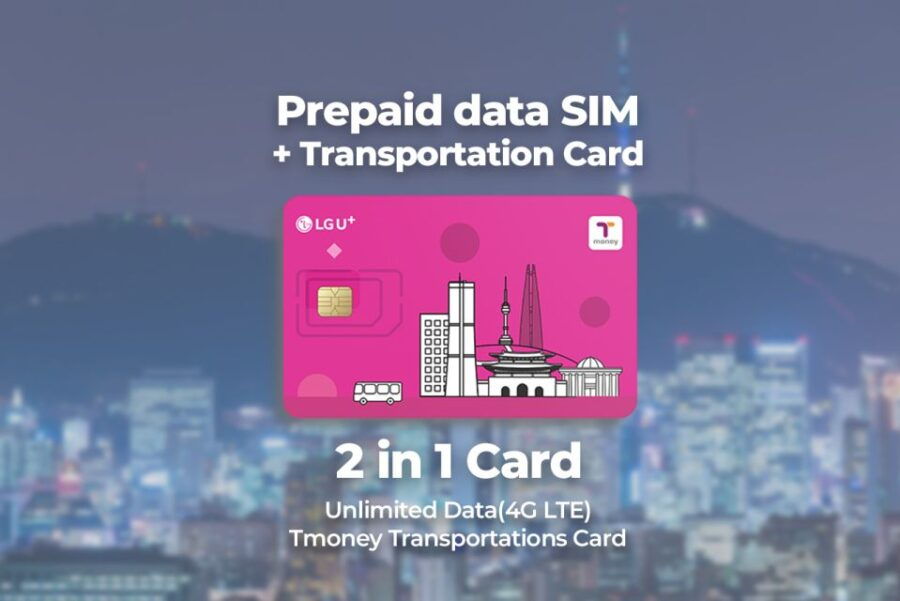
This is the booking I hand-hold every first-timer through. Unlimited 4G LTE from day one, hotspot enabled, a T-money card in the same envelope, and pickup at the LG U+ counter between Gates 6 and 14 in Terminal 1. Duration options run from 3 days to 2 months at a flat daily rate. Our full review covers the speed test results and what to do if your phone refuses the profile on first boot.
2. Gimpo Airport: Traveler SIM and T-money Transportation Card — from $12

Flying into Gimpo from Haneda, Kansai, Beijing, or on a domestic Jeju flight? This is the same bundle but collected at Gimpo’s LG U+ counter. Our review notes that Gimpo’s counter is faster than Incheon’s — I’ve picked up in under three minutes on a weekday morning. The SIM and T-money card are identical product, so the choice is purely about your flight path.
3. Busan Airport: Traveler SIM and T-money Transportation Card — from $12
If you’re starting your Korea trip in Busan — and a lot of repeat visitors do — this matches the Incheon bundle exactly, collected at Gimhae International Airport. Our review covers what to expect at the counter and why the Busan pickup tends to be faster than Incheon’s. Same T-money card works seamlessly when you move up to Seoul.
eSIM Vs Physical SIM — Which To Book

Physical SIM + T-money bundle is what I book 95% of the time. The price is lower, unlimited data is standard, and you physically hold the T-money card — you’re not juggling a digital transit pass on your phone battery.
eSIM makes sense if:
- Your phone has no physical SIM tray (recent US iPhones).
- You want to keep your home number active for SMS verifications.
- You’re arriving late at night and don’t want to hunt for a counter.
If you go eSIM, you still need a T-money card. You can buy a blank card at any convenience store for W4,000 — it just won’t be pre-bundled with the SIM. If that’s your situation, the Gimpo Traveler SIM and T-money bundle is still worth checking, since some Gimpo inventory is eSIM-ready.
Korea Tour Card Vs Regular T-money
When you pick up the SIM bundle at Incheon, you’ll sometimes get handed a Korea Tour Card instead of a plain T-money card. Don’t worry — they work at the same readers with the same tap. The Korea Tour Card is aimed at tourists and adds a handful of bonuses:
- Duty-free shop discounts at Lotte, Shilla, and Hyundai stores.
- Small admission discounts at a rotating list of attractions — N Seoul Tower, Everland, and a few palaces.
- Slightly higher one-off card fee (W4,000 vs W3,000 for a plain T-money).
For a first visit, either card is fine. The discounts are useful if you’re planning a duty-free haul on the way home, less so if your focus is street food and hiking.
Common Mistakes I See Every Trip

- Forgetting to unlock your phone before the trip. US and UK carrier-locked phones can’t take a Korean SIM until you request a network unlock. Do this a week before you fly.
- Putting the T-money card in a wallet with another transit card. If you’ve got an Octopus, Suica, or PASMO in the same slot, the subway gate reads both and throws an error. Keep T-money in a separate pocket or the envelope it came in.
- Loading too much on the first top-up. You can’t refund more than W20,000 at a convenience store, so keep the balance trim.
- Missing the tap-off on the bus. Seoul buses charge by distance and expect two taps — on at the front door, off at the back door. Miss the off-tap and the system charges you the maximum zone fare.
- Using the wrong airport bus stop. At Incheon, airport limousine bus stops are on the kerb outside the arrival gates. They are not the same as the free inter-terminal shuttle. Check the route number on the printed ticket before you board.
What It Costs For A Week In Seoul
Rough numbers from my last trip:
- SIM + T-money card pre-booked: W17,000 (~$12).
- T-money top-up over 6 days: W45,000. Covers AREX round trip (W9,500), about 10 subway rides (W14,500), 4 buses, one taxi back to the hotel at midnight, and a few convenience store bottles of water.
- Leftover balance refunded at the airport 7-Eleven: W7,200 (~$5), thanks to the Busan SIM + T-money bundle I topped up again for a short Busan leg.
Total transport cost for the week: under $35. Compare that to a week of taxis in Tokyo or rideshare in Bangkok and Seoul is a bargain.
Pairing This With The Rest Of Your Seoul Plans

Once the SIM and T-money are sorted, you’ve cleared the two biggest arrival-day obstacles and can get on with actually enjoying Seoul. A few pairings I recommend from my own recent trips: book a private Seoul tour on your first full morning so a local guide can orient you around the palaces and hanok villages without the language friction. Follow that with a Seoul night walking tour once the sun goes down — the light hits differently around Gwanghwamun, and the tours tend to end near a late-night food street. If you’re adding Busan to the itinerary, the Busan full-day city tour guide walks through the sensible way to book that leg. The T-money card you pick up at Incheon works on every one of those metro systems, so you’re set from the first tap onwards.

One last practical note: don’t throw the SIM packaging away. The back of the card has your temporary Korean phone number printed on it. You’ll need that number if you install KakaoTalk, Coupang Eats, or set up an account at any Korean service. Tuck it into your passport pocket for the trip.
Once the SIM is active and you’ve tapped through a Seoul subway gate, the rest of the trip opens up. Most visitors’ first day trip is a DMZ tour from Seoul. Seoul city sightseeing covers the Gyeongbokgung + Bukchon core. A Korean cooking class fills a half-day indoors for under $50. And if you extend beyond Seoul, Jeju Island day tours cover the southern UNESCO route — Jeju needs its own T-money card the first time you ride the local buses there.