
The Salone dei Cinquecento, the giant hall in the middle of Palazzo Vecchio, was meant to display two of the greatest unfinished battle frescoes in art history. Michelangelo and Leonardo da Vinci were both commissioned to paint opposing walls in the early 1500s. Neither finished. Leonardo’s fresco was wrecked when his experimental hot wax paint melted, and Michelangelo bailed for Rome before he got past the sketches.
What you see in there now is Vasari’s later ceiling-and-walls overhaul, plus a swirl of art-history conspiracy theories about whether Leonardo’s lost work is hiding under Vasari’s plaster. The Palazzo is full of stories like that. Below is how I’d actually book a visit, plus the rooms worth your time and the practical stuff most guides skip.
In a Hurry? Top Picks
- Entrance Ticket and Audioguide: $37. The default route. Skip-the-line plus a five-language multimedia audioguide on your phone. Check availability
- Guided Tour, 1.5 hours: $52. Pick this if it is your first visit and you want a real guide explaining who poisoned whom. Check availability
- Skip-the-Line Entry plus Secret Passages: $37. Same price as a basic ticket, but a small-group tour into the rooms normal admission cannot reach. Check availability
- In a Hurry? Top Picks
- How Tickets Actually Work
- The Tour I’d Actually Book
- 1. Florence: Palazzo Vecchio Entrance Ticket and Audioguide:
- 2. Florence: Palazzo Vecchio Guided Tour, 1.5 hours:
- 3. Skip-the-Line Entry and Secret Passage Tour, 75 minutes:
- What’s Actually Inside
- The Salone dei Cinquecento
- The Studiolo of Francesco I
- Apartments of the Elements and Eleonora
- Sala dei Gigli
- The Hall of Geographical Maps
- Sala dell’Udienza, Easy to Walk Past
- The Tower: Worth It, With One Catch
- Piazza della Signoria: The Free Outdoor Museum
- A Brief, Useful History
- Getting There and Practical Stuff
- Smart Pairings With Other Florence Tickets
- More Florence Booking Guides
How Tickets Actually Work
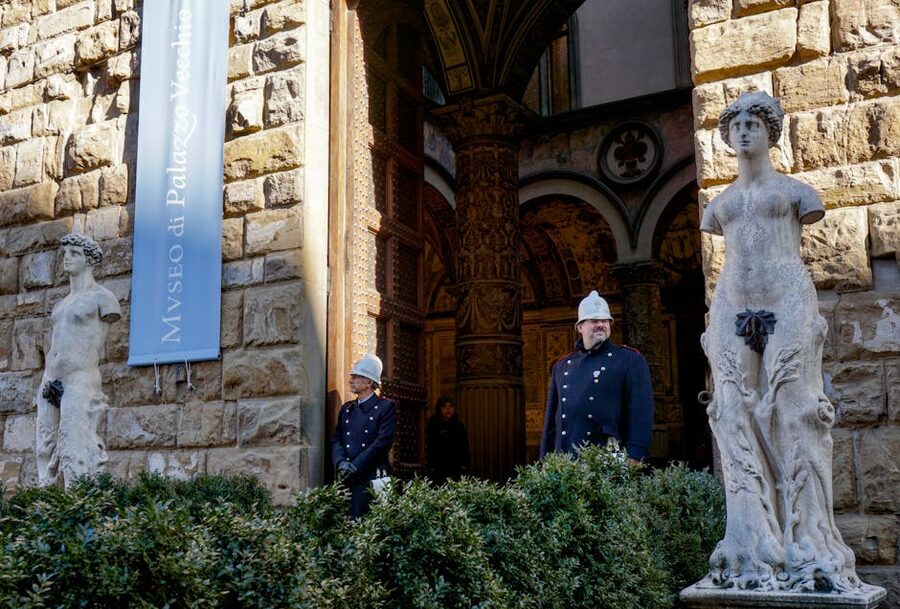
Palazzo Vecchio runs on timed-entry tickets. There is no walk-up line that moves at a sensible speed, and no way to talk yourself in for free past the first courtyard. Three things to know before you buy:
- The official ticket office is at ticketsmuseums.comune.fi.it. Cheapest base price, run by the Florence civic museums network. The interface is fine in English but a bit utilitarian.
- GetYourGuide and Viator resell skip-the-line tickets for a couple of dollars more, with the voucher on your phone and English customer support. Most readers prefer this even at the small markup, especially if a guided option is on the table.
- Tower tickets are bookable separately from museum tickets. They sell out faster than the museum, so book those first if you want them. More on that below.
Unlike the Uffizi a few minutes away, Palazzo Vecchio rarely has a punishing line outside, but the inside fills up by mid-morning and the audioguide rooms get crowded. If you can move things around, go right at opening or after 4pm.
The Tour I’d Actually Book
If you only have time for one option, go with the audioguide ticket route. It is the most-booked Palazzo Vecchio option on the market by a long way and the audio actually does a decent job at the storytelling. But the secret passages tour is the one I keep recommending to people who care about Renaissance political intrigue, because that is exactly what those rooms were built for.
1. Florence: Palazzo Vecchio Entrance Ticket and Audioguide: $37
This is the default route and the option more readers go for than any other. Skip-the-line entry, multimedia audioguide on your phone in five languages, and you self-pace through the staterooms. My full review of this ticket goes deeper into what the audio covers, and what it skips. Pick this one if you are happy moving at your own speed and you do not want a stranger setting your timing.
2. Florence: Palazzo Vecchio Guided Tour, 1.5 hours: $52

The licensed guide sets a steady pace through the Salone dei Cinquecento, the Apartments of the Elements, and Eleonora’s rooms. Fifteen minutes shorter than the Secret Passages tour but it covers more of the public Monumental Quarters. Tour starts inside, so the skip-the-line aspect is built in. Reserve-now-pay-later is also on offer, which makes this easier to lock in early without committing your card.
3. Skip-the-Line Entry and Secret Passage Tour, 75 minutes: $37
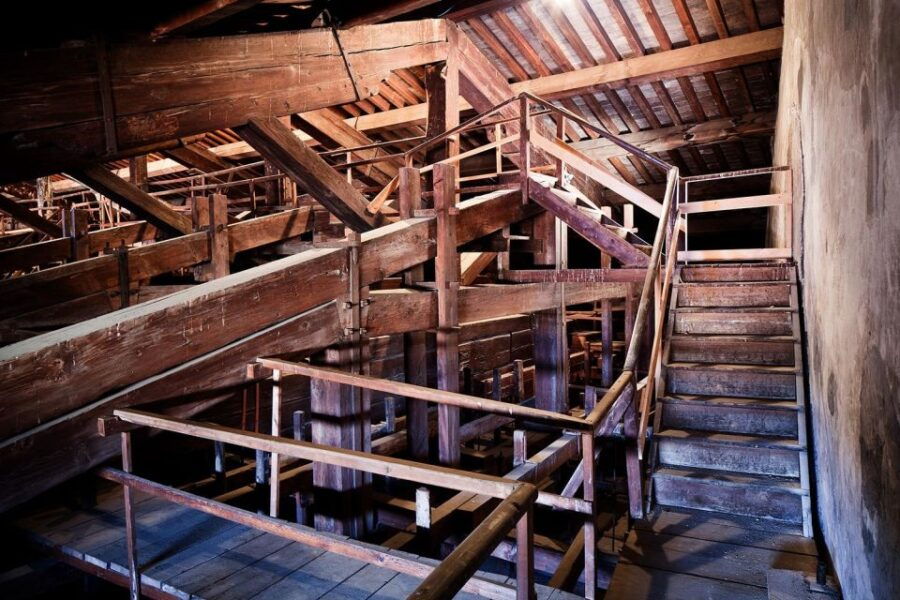
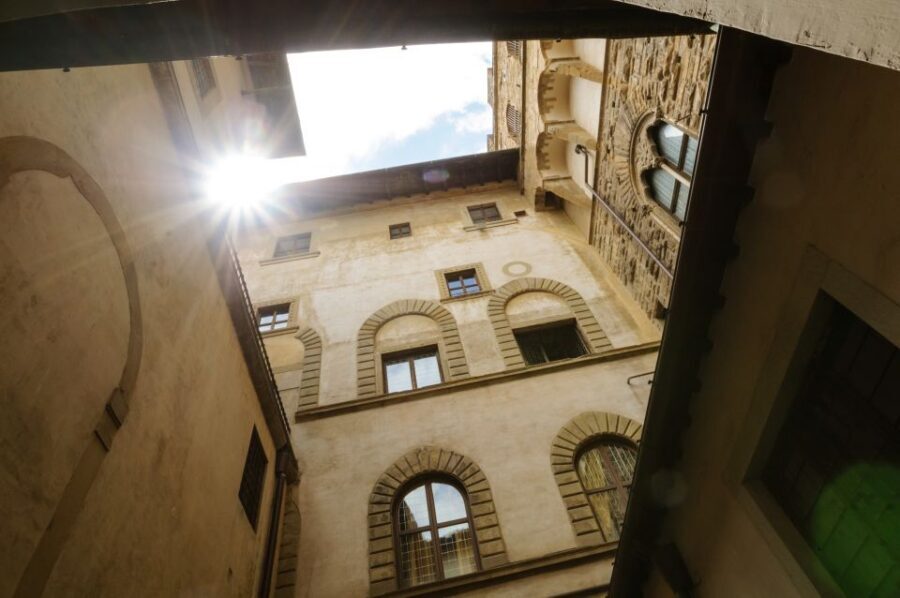
This one accesses the off-limits corridors that staff used to move through the building unseen, plus the cube-shaped Studiolo of Francesco I. The price is identical to a basic ticket which makes it absurdly good value, but the catch is the small group size sells out fast in summer. Best booked at least a week ahead. The same operator runs a few timed slots a day.
What’s Actually Inside
The palace has six floors and decisive opinions about your time. Most visitors spend two to three hours, more if you tack on the tower. Here is the actual route map of what you will see and what is worth lingering over.
The Salone dei Cinquecento
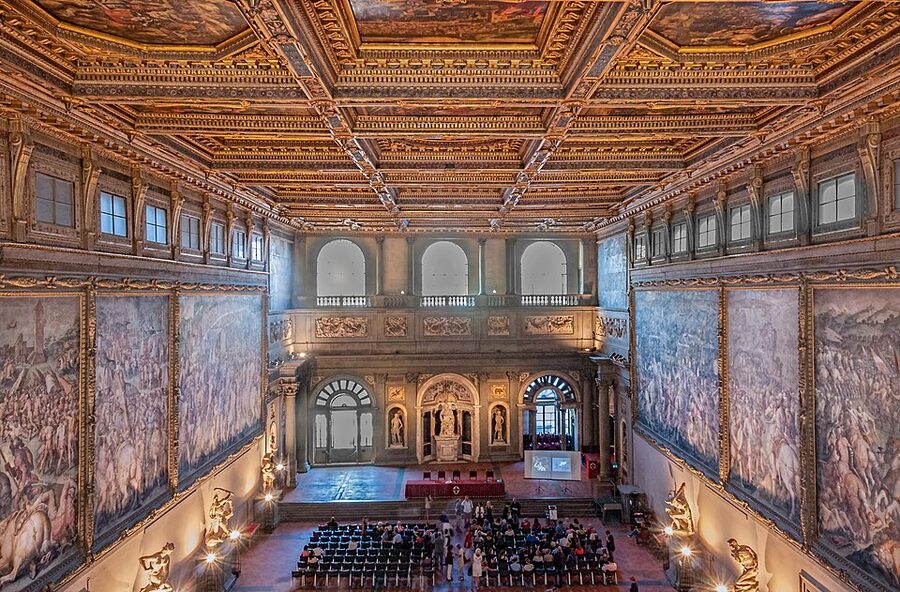
Built in 1494 under Friar Savonarola, who briefly toppled the Medici and tried to run Florence through a 500-member council. After Cosimo I de Medici took the city back, he had Vasari turn it into a propaganda machine for the Medici regime. The wall frescoes celebrate Florentine victories over Pisa and Siena. The Labors of Hercules sculptures by Vincenzo de Rossi line one wall. There are statues of two Medici popes, Leo X and Clement VII, by Bandinelli.
This is where the Leonardo-Michelangelo legend lives. Both started competing battle scenes in 1503 and 1504, and neither finished. Leonardo experimented with encaustic, melted his own paint, and walked away. Michelangelo went to Rome to work on the Pope’s tomb and never came back to it. Vasari painted over both, and a few researchers think Leonardo’s Battle of Anghiari may still be intact behind a Vasari wall.
The Studiolo of Francesco I
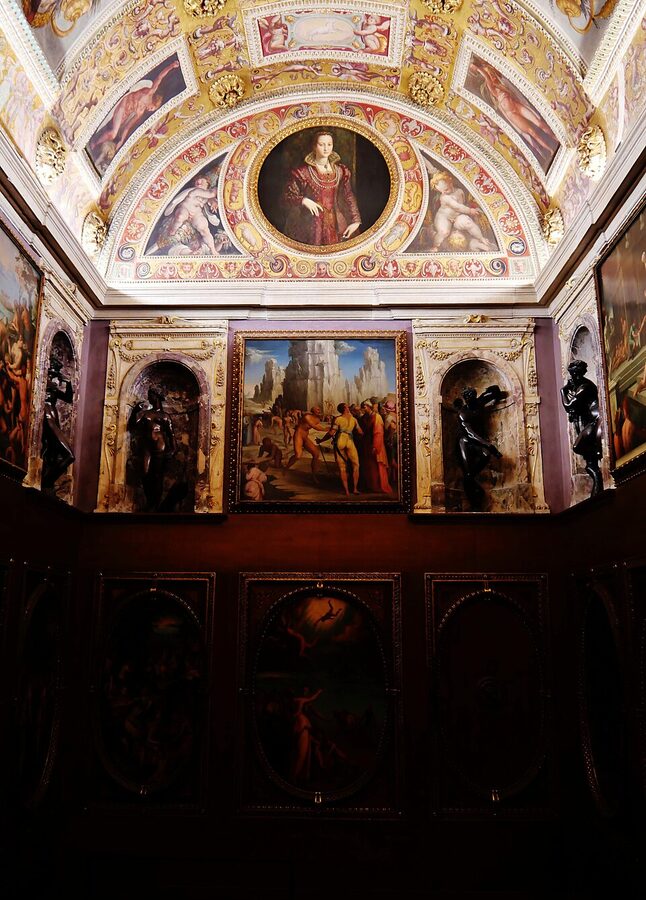
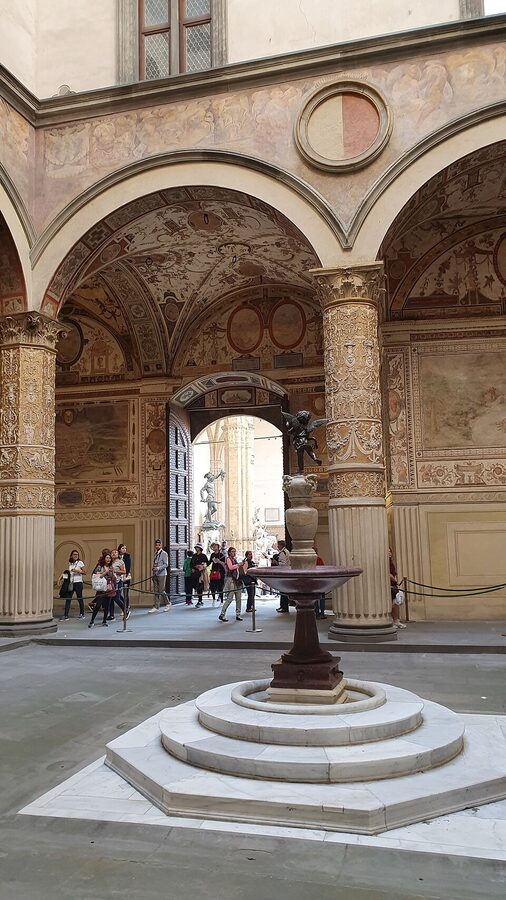
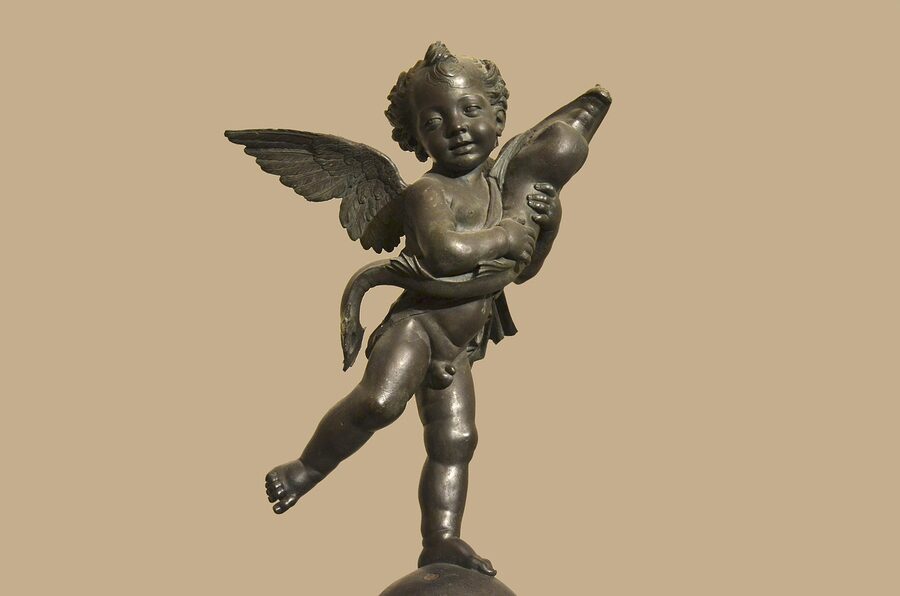
34 paintings cover the walls floor to ceiling, organised by element and subject. This is also where the original putto-with-dolphin by Verrocchio used to live before they moved it to the courtyard. The room is small, dim, and one of the most concentrated bursts of Mannerist weirdness you will see in Florence. Worth fighting for a slot on a tour that goes inside.
Apartments of the Elements and Eleonora
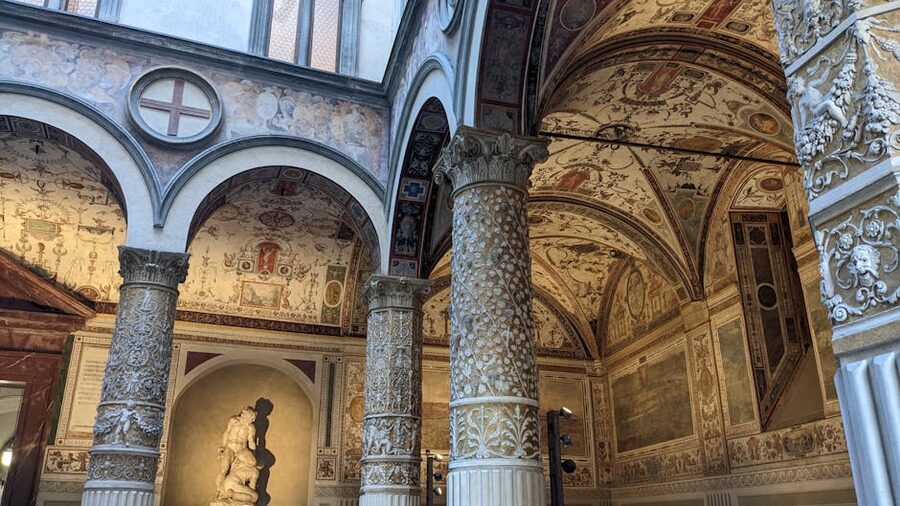
Second floor, two apartments side by side. The Apartments of the Elements were Cosimo I’s quarters, with five rooms decorated in mythological allegories of air, water, fire, and earth. Eleonora of Toledo’s apartments are next door and feel different. They are more private, more lived-in, and her Sala Verde marks the start of the Vasari Corridor that runs to the Uffizi and on across the Ponte Vecchio.
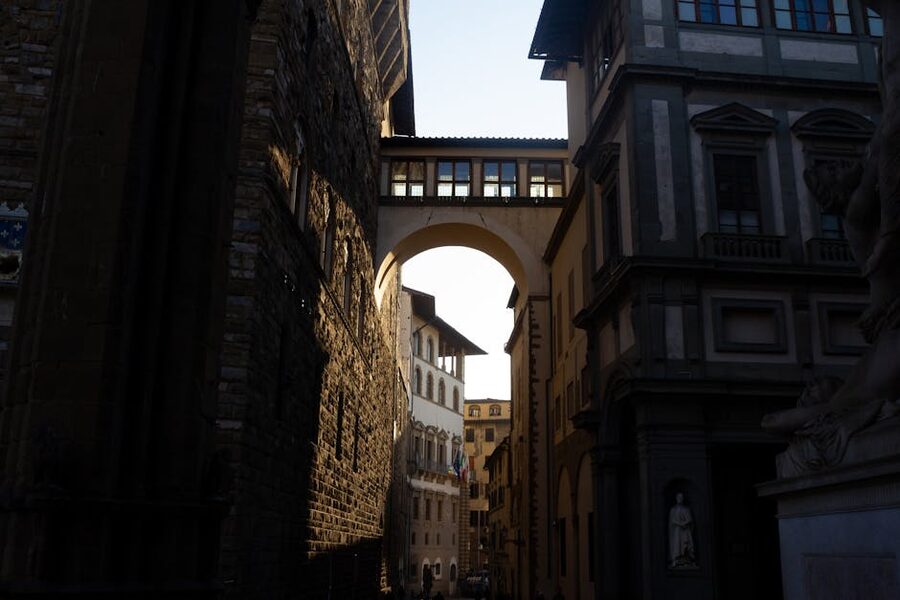
Cosimo and Eleonora basically built their power grid out of corridors. They could move from Palazzo Vecchio to the Uffizi to Palazzo Pitti without ever stepping onto a public street. If you are visiting Pitti as well, look for the Sala Verde first. Knowing where the corridor begins changes how you read both palaces.
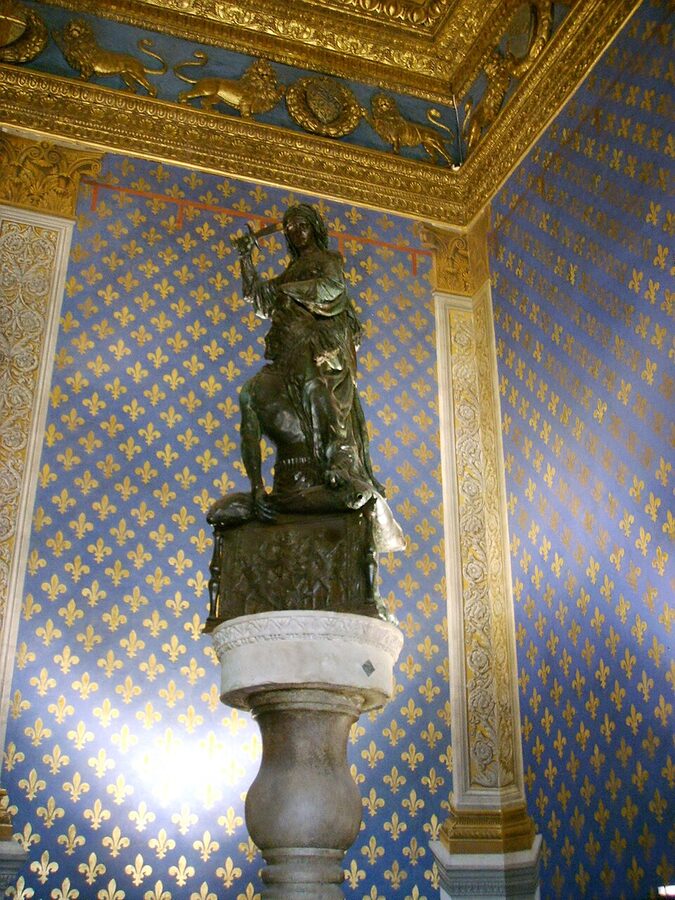
Sala dei Gigli
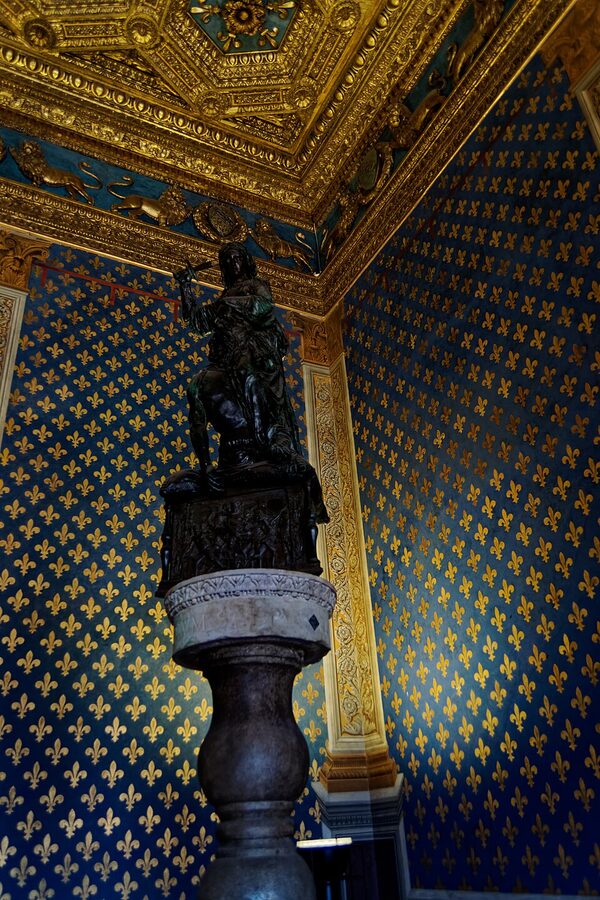
The lily is an old Florentine symbol. The whole room is covered in them. The standout though is the bronze inside.
The Hall of Geographical Maps
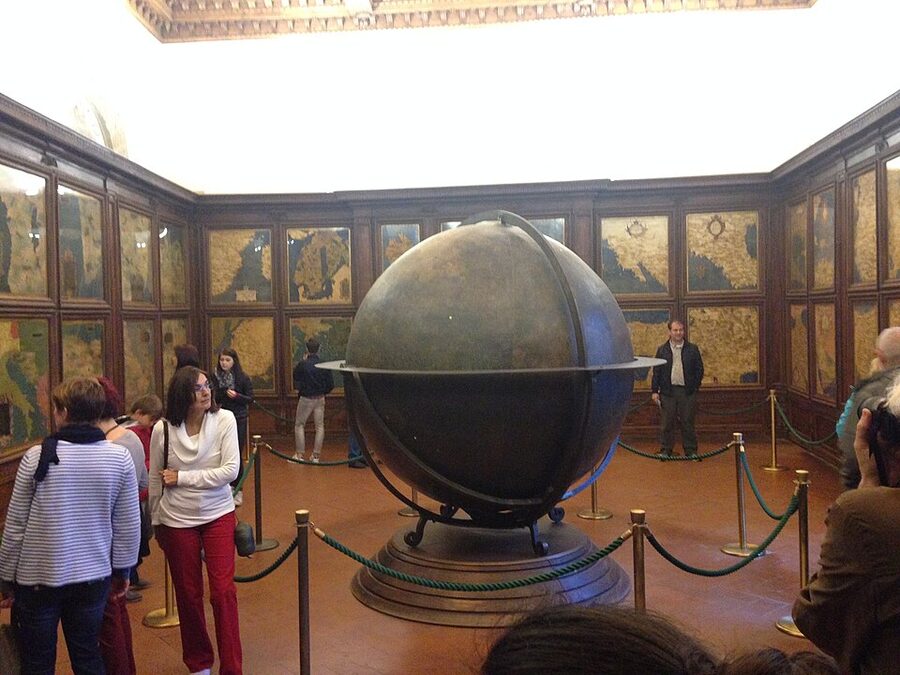
Easy to miss because it sits off a corridor on the second floor. Some routes through the museum bypass it entirely. If your audioguide does not call it out, ask a staff member for the Sala delle Carte Geografiche. Mappa Mundi is in there and it is enormous.
Sala dell’Udienza, Easy to Walk Past
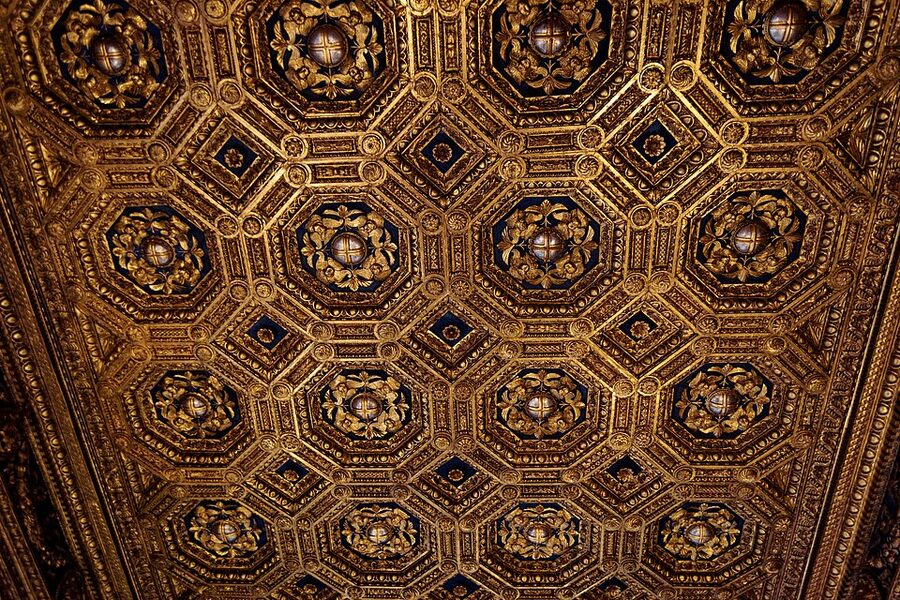
This is where the Priori, the city’s medieval guild leaders, met to vote on trade and arts decisions. The room is small and most visitors blow through it on the way to bigger halls. If you slow down, the carved wood ceiling is one of the technical high points of 15th-century Florentine craftsmanship.
The Tower: Worth It, With One Catch
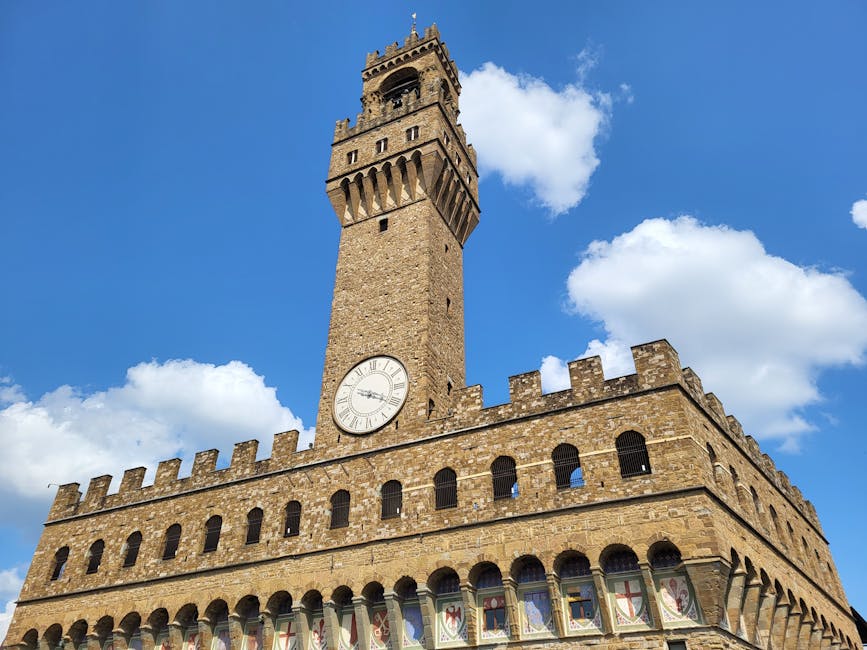
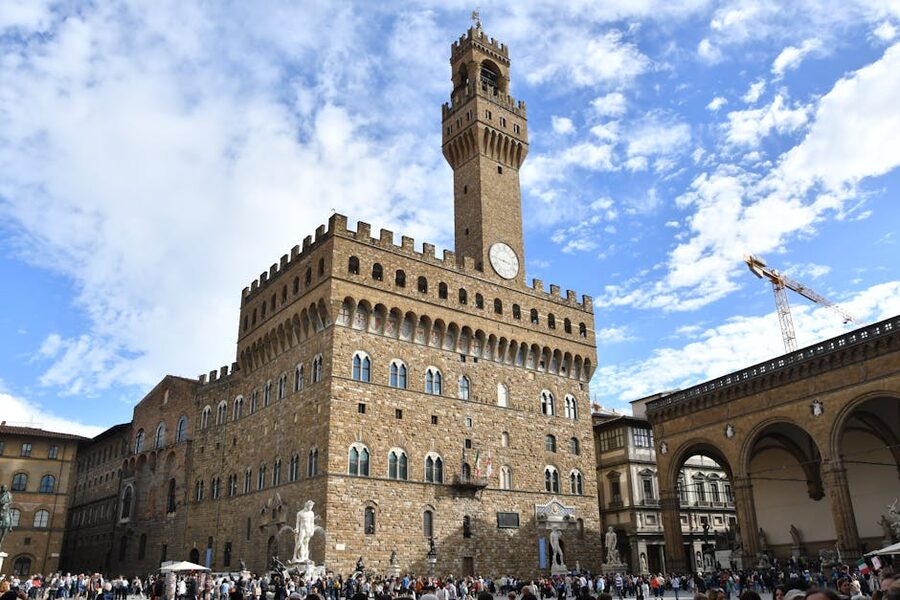
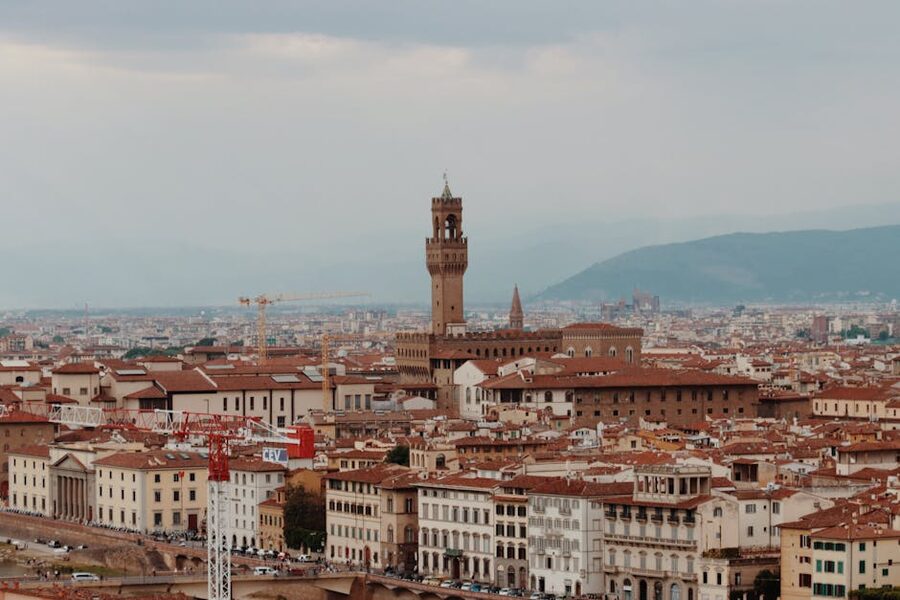
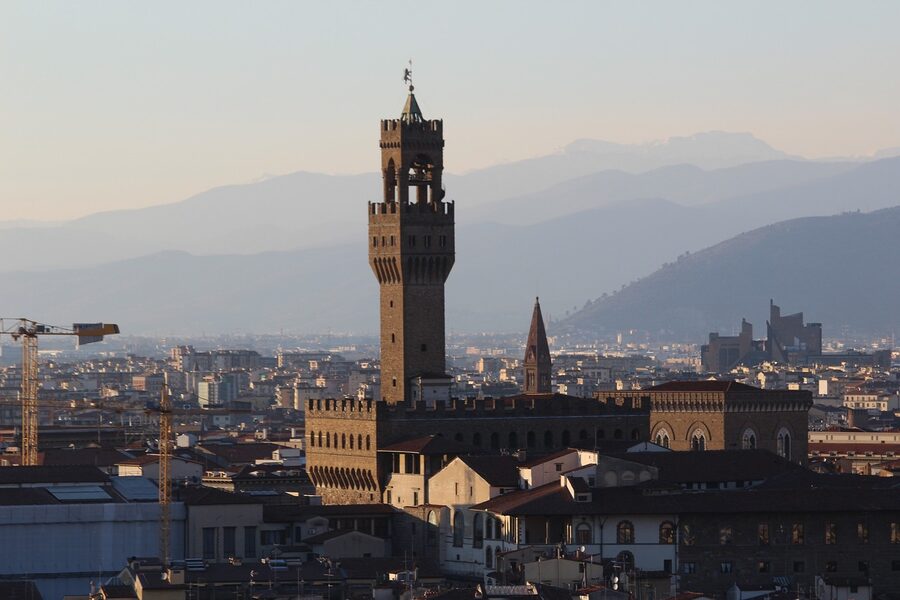
Arnolfo’s Tower stands at 95 metres and is still the tallest tower in the centre of Florence. 223 steps to the top. Sounds like a lot but it goes up in stages, with rest landings. If you can do the Duomo’s dome climb at 463 steps, you can do this with energy to spare.
Three things to know:
- It is a separate ticket, with timed slots. Book this before you book the museum. Maximum 30 people per slot. It almost always sells out before the museum does, especially in summer.
- If it rains, the tower closes and your ticket is gone. No refund, no rebook. The fine print says you can use the ticket to walk the Walkway of Ronda along the parapet instead, which is fine but not what you came for.
- Check in at the dedicated tower ticket desk, not the main museum entrance. The two queues do not merge and people lose their slot getting it wrong.
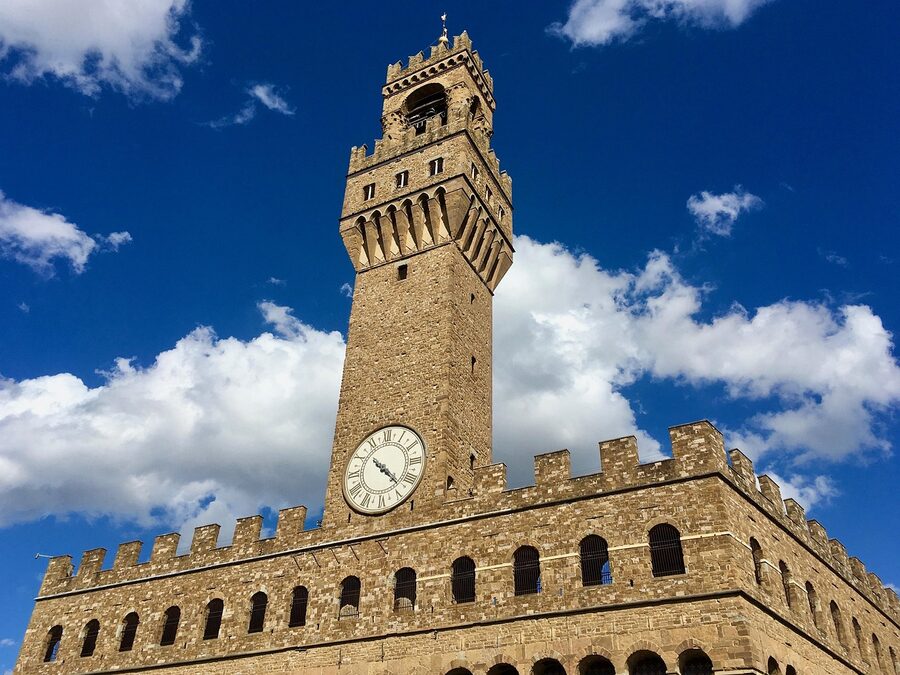
The tower view is the cleanest one of Brunelleschi’s dome in the city, partly because you are at the same elevation. From the dome, you look across Florence and see this tower. From this tower, you look across and see the dome. Pick one, do both if you can.
Piazza della Signoria: The Free Outdoor Museum
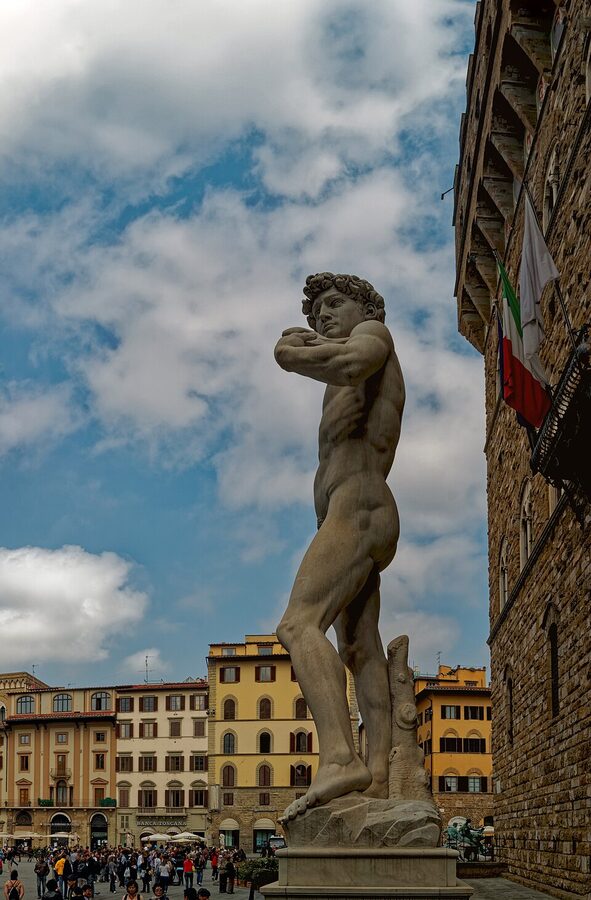
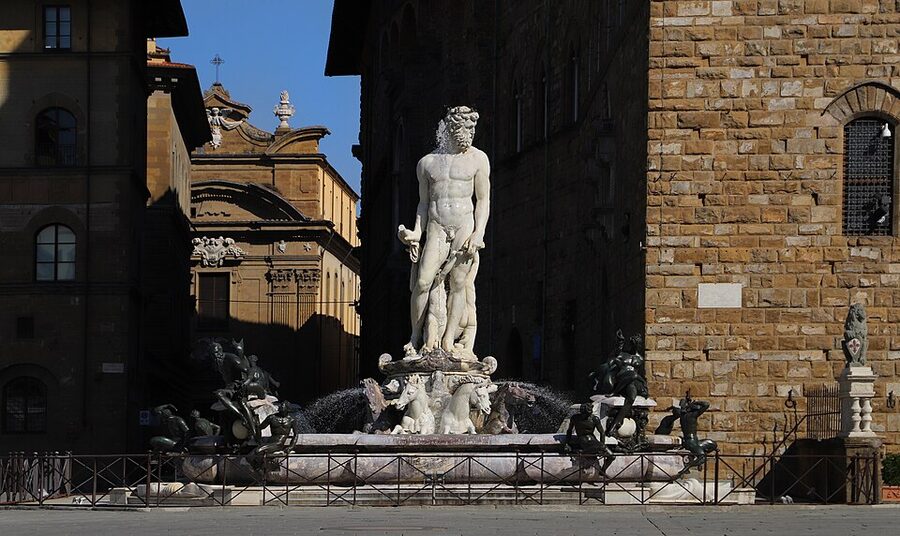
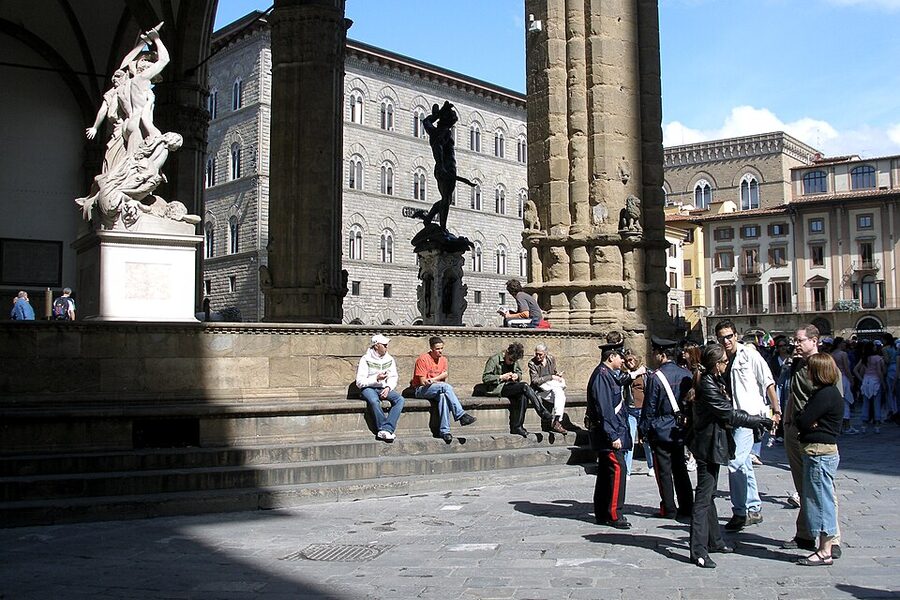
Outside the main door, the replica of Michelangelo’s David stands roughly where the original stood from 1504 to 1873. The original is in the Accademia now. An equestrian Cosimo I de Medici by Giambologna, unveiled in 1594, sits in the centre of the square. The Neptune Fountain is the marble one with the very white sea god most tourists call hideous and Florentines kind of agree.
A Brief, Useful History
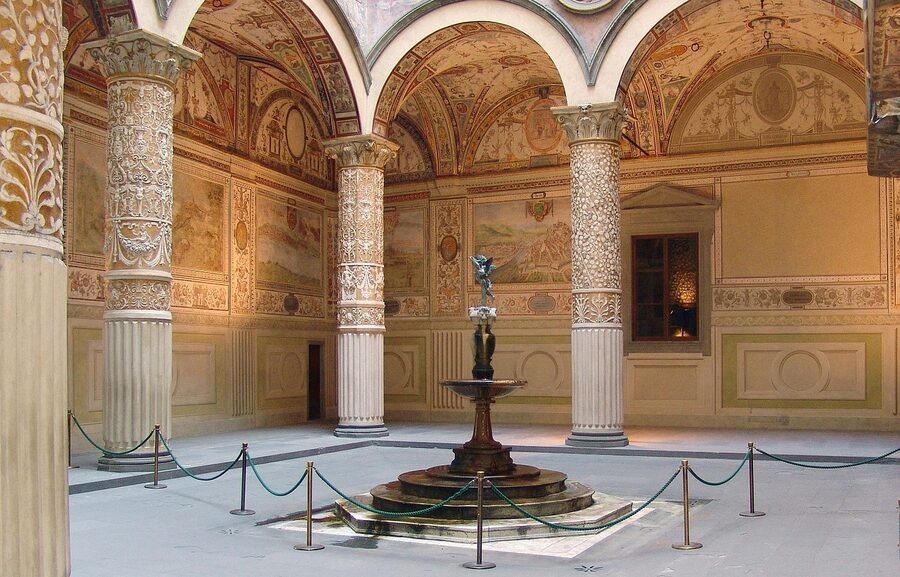
Julius Caesar founded Florence in 59 BCE and built a Roman theatre right where the palace now stands. You can still see part of the cavea, the seating, in the basement archaeological site. They charge a small extra fee but it is a quick add-on and you walk down into the original stone.
The medieval city built the palace on top of the destroyed houses of the Ghibelline faction in the late 1290s. Arnolfo di Cambio, the same architect working on the Duomo and Santa Croce, designed the cube-shaped fortress in rusticated stone with two rows of Gothic windows. He also designed the lower part of the tower. It opened in 1314 and the city government, the signoria, moved in.
In 1540 Cosimo I de Medici moved his official seat here to lock in his power. He renovated everything. Then in 1549 he moved his actual residence to Pitti Palace and this became the old palace, hence the name. Cosimo had Vasari build the corridor from here to Pitti, passing through the Uffizi and over the Ponte Vecchio, so the family could move between palaces unseen by the people who supposedly worked for them.
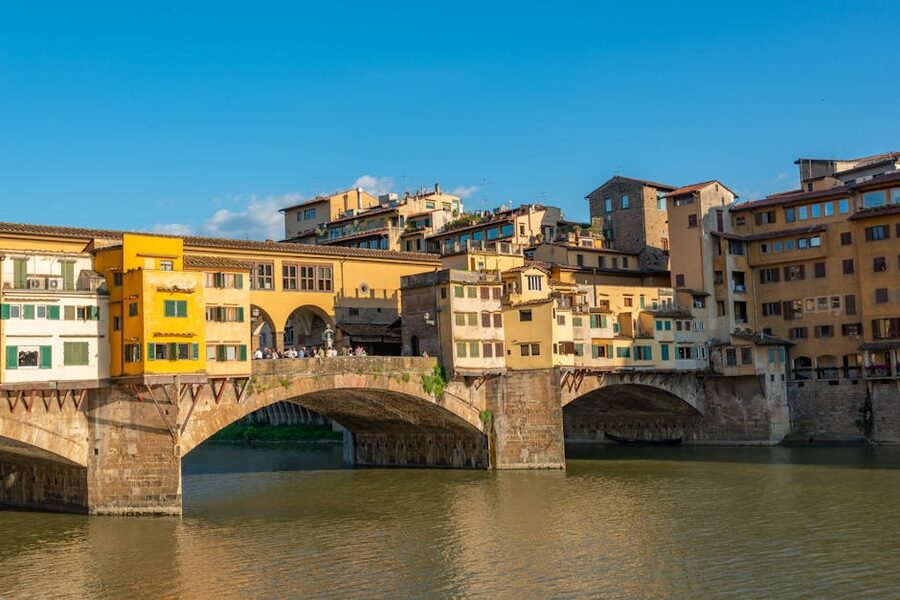
It became Florence’s town hall in 1865. From 1865 to 1871 it served as the Chamber of Deputies for the new Kingdom of Italy when Florence was briefly the capital. The City Council still uses some rooms today. The Mayor of Florence’s official seat has been here since 1872. The museum opened in 1960. So when you walk through, you are walking through a working civic building that also happens to be one of the most important Renaissance interiors in Europe.
It has a Dan Brown moment too, if that is your kind of thing. Inferno, Brown’s 2013 novel and the 2016 movie, set a chase scene through the Palazzo and the Vasari Corridor. The bookstore by the entrance still sells copies.
Getting There and Practical Stuff
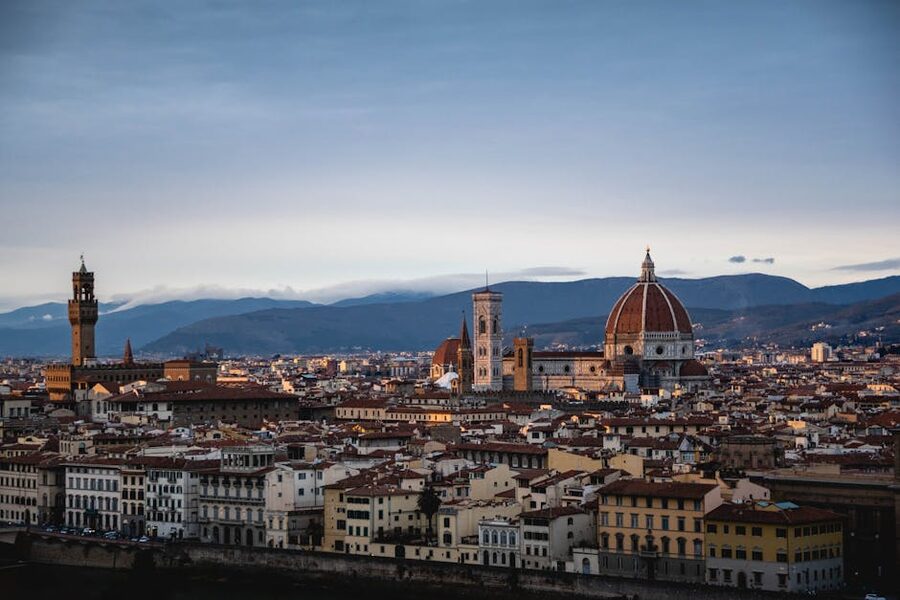
The Palazzo is at Piazza della Signoria, in the heart of the historic centre. About 20 minutes on foot from Santa Maria Novella, the main train station. There are bus routes if your feet are gone, but Florence is so walkable in the centro storico that buses do not actually save much time.
Hours: 9am to 7pm every day except Thursday, when everything closes at 2pm. The tower keeps shorter hours, 9am to 5pm, also closing at 2pm Thursdays. The ticket office shuts an hour before closing.
Plan two to three hours for the museum, plus another 45 minutes if you are doing the tower. Audioguide visits often run longer than guided tours because you can linger.
If a special exhibition is on, the standard ticket price goes up. They host them three or four times a year, usually for a few months at a time. Check the official site if budget is tight.
Smart Pairings With Other Florence Tickets
Florence has a way of stacking up museum tickets that get expensive fast. Two pairings that genuinely work:
- Palazzo Vecchio plus Pitti Palace. Cosimo and Eleonora’s two seats of power, connected by the Vasari Corridor. The Pitti Palace audioguide ticket is similar in format and price, and seeing both palaces in two days makes the corridor make sense in a way nothing else does. Boboli Gardens behind Pitti is the green half of the same complex.
- Palazzo Vecchio plus Uffizi. The Uffizi were the Medici offices, named after the Tuscan word for offices, and Vasari designed both. If you do the Uffizi the same trip, look at the Vasari Corridor crossing the Ponte Vecchio from the Uffizi side, then go find Eleonora’s Sala Verde inside Palazzo Vecchio. Different feeling, same architect, same family.
More Florence Booking Guides
If you have a few days in Florence, the museum tickets you do not regret booking are the Accademia for David, the Duomo complex with the dome climb, and the Leonardo Interactive Museum if you have kids or anyone vaguely interested in how the man’s machines actually worked. Skip the cumulative passes unless you are doing five or six things, the math rarely beats single tickets at this price level.