
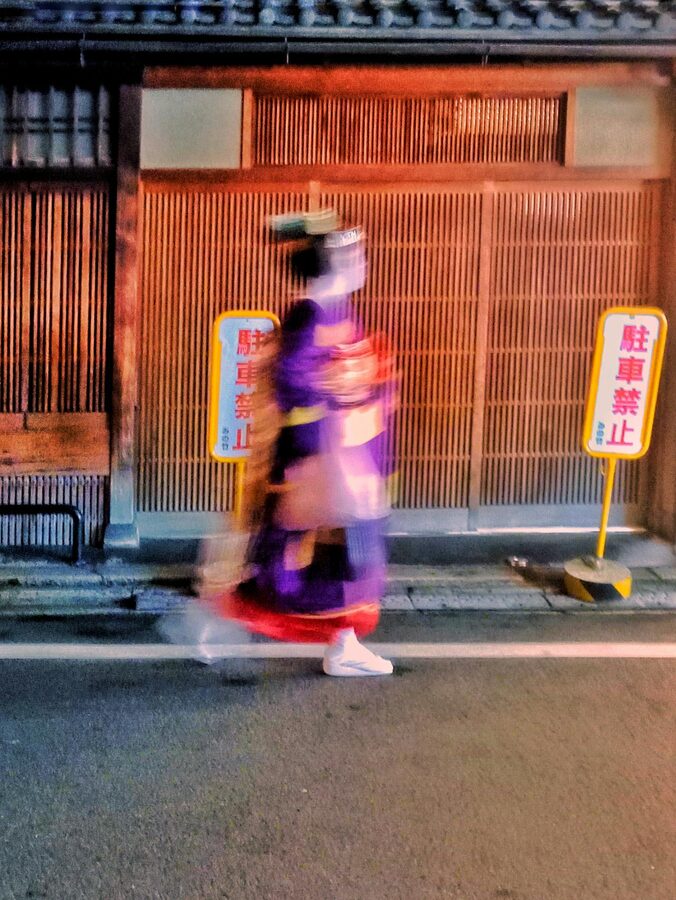
You hear her before you see her. A wooden pokkuri sandal makes a distinctive sound on stone — a hollow clack with a slight scuff at the trailing edge — and on a quiet Gion evening the sound travels. Our guide stopped mid-sentence. Everyone on the walking tour instinctively lowered their phones. A young maiko rounded the corner from Shirakawa-dori, crossed the cobbled lane in about twelve steps, and disappeared into a teahouse doorway with a black-lacquered nameplate. The whole encounter took forty seconds. Our guide waited until she was gone, then said quietly, “That’s the experience — if you’re lucky.”
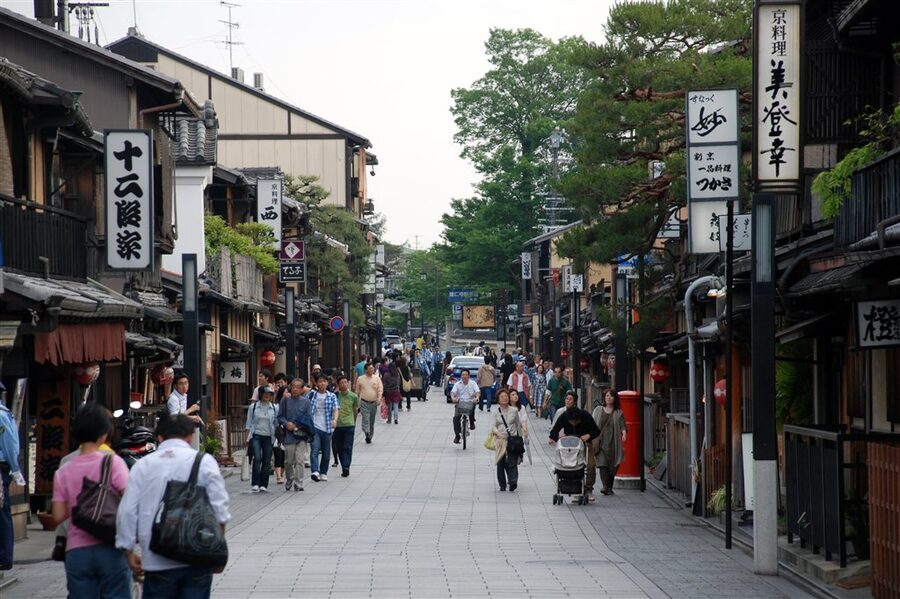
Gion walking tours are the most-booked guided experience in Kyoto, and that’s mostly because of what’s above — the possibility of that forty-second encounter, and the specific kind of human who can explain what you just saw. A geiko isn’t a “geisha” in the Western sense. The word geisha means artist, and what they’re artists of takes a lifetime of training to understand. A good walking guide can compress the essentials into an hour while you’re actually in the district where it all happens.
Five tours run this format in Gion, with broadly similar routes and three to four differences in timing and emphasis. The rest of this guide covers which to pick.
Short on time? Here are my top picks:
Best all-rounder: Kyoto: Gion Geisha District & Hidden Gems Walking Tour — the most-booked Gion walking tour. Evening start, covers the main district plus backstreet spots most travellers miss.
Best evening experience: Kyoto: Gion Magical Night Walking Tour with Geisha Trivia — story-led format, 90 minutes, focuses on the geisha world specifically rather than the broader district.
Best late option: Gion: Night Owl Walking Tour — starts at 9pm when the geiko are actually moving between appointments. Your best odds of an actual sighting.
- What Gion Actually Is
- The 3 Best Gion Walking Tours
- 1. Kyoto: Gion Geisha District & Hidden Gems Walking Tour —
- 2. Kyoto: Gion Magical Night Walking Tour with Geisha Trivia —
- 3. Gion: Night Owl Walking Tour —
- Geiko and Maiko: What You’re Actually Looking At
- What the Walking Route Actually Covers
- Gion Matsuri — The Festival That Built the District
- Etiquette — What to Actually Do if You Spot a Geiko
- Timing Your Visit
- What Else Pairs With a Gion Walking Tour
- Practical Booking
- More Kyoto Experiences
What Gion Actually Is
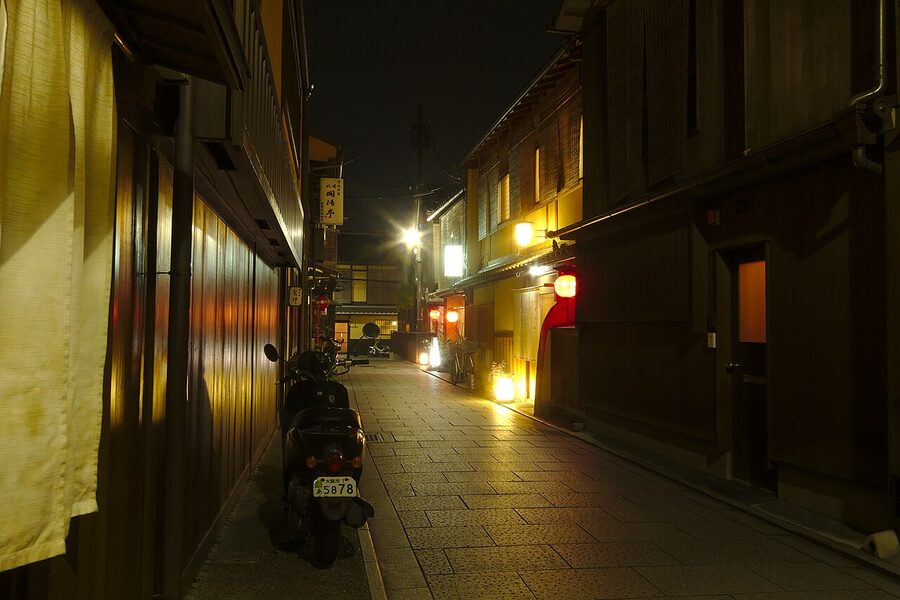
The Gion district — properly Gion-kagai, “Gion entertainment quarter” — sits immediately east of the Kamo River in Kyoto, running up the gentle slope toward Yasaka Shrine at its eastern end. It’s been Kyoto’s primary entertainment district since around 1700, when the area developed to serve pilgrims arriving at Yasaka for its summer festival. What started as tea stalls for shrine visitors evolved over a century into teahouses hosting evening entertainment — shamisen music, poetry, dance — performed by trained artists.
The district is still structured around teahouses (ochaya). There are roughly 70 in the modern Gion area, most of them private, and collectively they employ around 70-80 geiko and 20-25 maiko at any given time. These numbers have held roughly steady for decades, though they’ve declined from the pre-war peak of several hundred geiko in Gion alone. The teahouses don’t accept walk-in visitors — the system has always been introduction-based, and the fee structure assumes a relationship between the teahouse and its regular patrons.
Which means that as a visitor walking through the district, you’re essentially outside the closed economic system. You can look at the buildings, you can potentially glimpse a geiko moving between appointments, and you can eat at the restaurants that line the periphery of the district. But the tea houses themselves — what actually happens inside them, the lanterns glowing behind paper screens on a quiet lane at 8 pm — stays private. A walking tour is how you come to understand what you’re looking at rather than just seeing a picturesque street.
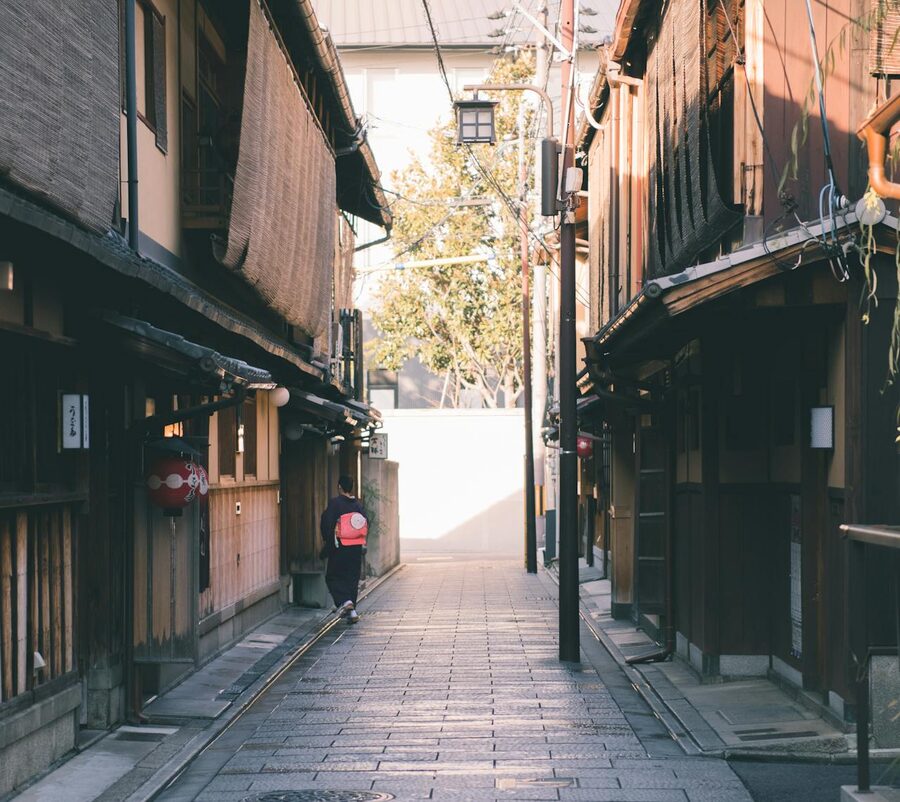
The 3 Best Gion Walking Tours
1. Kyoto: Gion Geisha District & Hidden Gems Walking Tour — $25
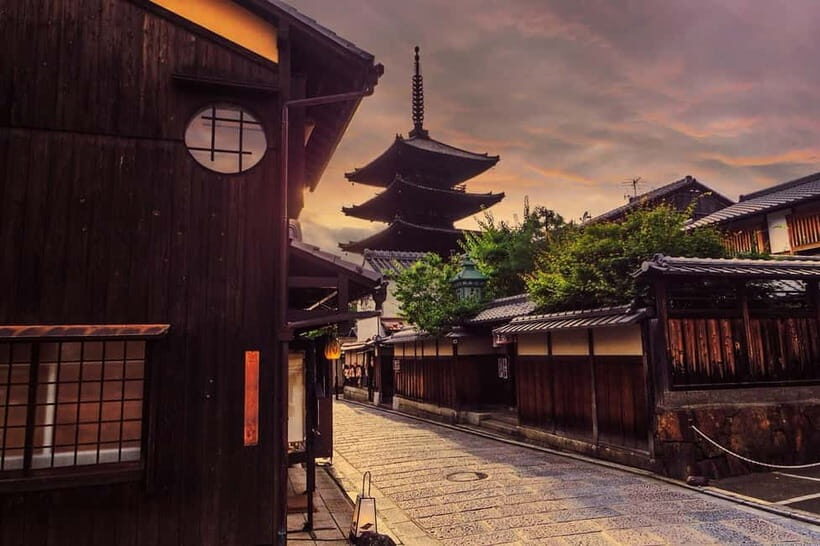
This is the default starter option. You meet at Yasaka Shrine around 5:30 pm, walk into the quarter as the evening lanterns come on, and spend about 90-120 minutes following a small-group circuit through the central Gion district. The guide narrates the district’s history as you walk — where the tea house system comes from, why the buildings look the way they do, what you should and shouldn’t photograph. Unlike the food-tour version, you don’t stop to eat; the whole experience is about context and observation. The “hidden gems” part of the title refers to specific backstreet locations the guide knows — the old geisha training school, the canal where maiko are often photographed at dawn, the tucked-away shrine where performers traditionally prayed before their debut. Small group, usually 8-15 people. English throughout. Our full review covers the specific route.
2. Kyoto: Gion Magical Night Walking Tour with Geisha Trivia — $24

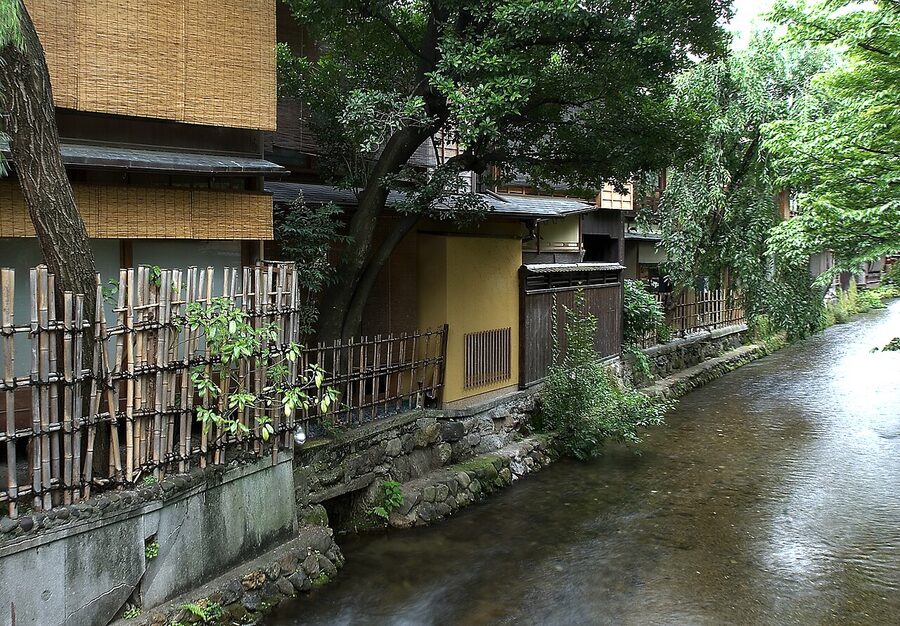
The positioning of this one is different. Where Tour 1 is a guided walk through Gion with geisha culture as one topic among several, this one is a guided talk about geisha culture that happens to take place in Gion. The guide spends more time on specific stories — the training path from maiko to geiko, the apprenticeship system, the differences between Gion’s geiko and Tokyo’s geisha, what a typical teahouse evening actually looks like from the inside. You walk past fewer sites and stand in one place longer. Good if you’ve already spent time in Gion or you’re more interested in the culture than the geography. 90 minutes, usually starts 6 or 7 pm. Small group. Our review compares the two formats head-to-head.
3. Gion: Night Owl Walking Tour — $24
The late-start format is the under-the-radar pick for this district. Geiko are working during normal evening hours — their appointments typically run from 6 pm to 10 pm — which means between the second and third courses at 9 pm, they’re often walking from one teahouse to another. A 5-6 pm walking tour sees an empty stage; a 9 pm tour sees the actual performance cycle in progress. This tour leans into that timing: smaller groups, quieter atmosphere (most other visitors have left the district), and a guide who focuses on the details you can’t see earlier. Ends around 10:30 pm. Only downside: most Gion restaurants close by then, so plan dinner before rather than after. Our review covers whether the late start is worth the later dinner.
Geiko and Maiko: What You’re Actually Looking At
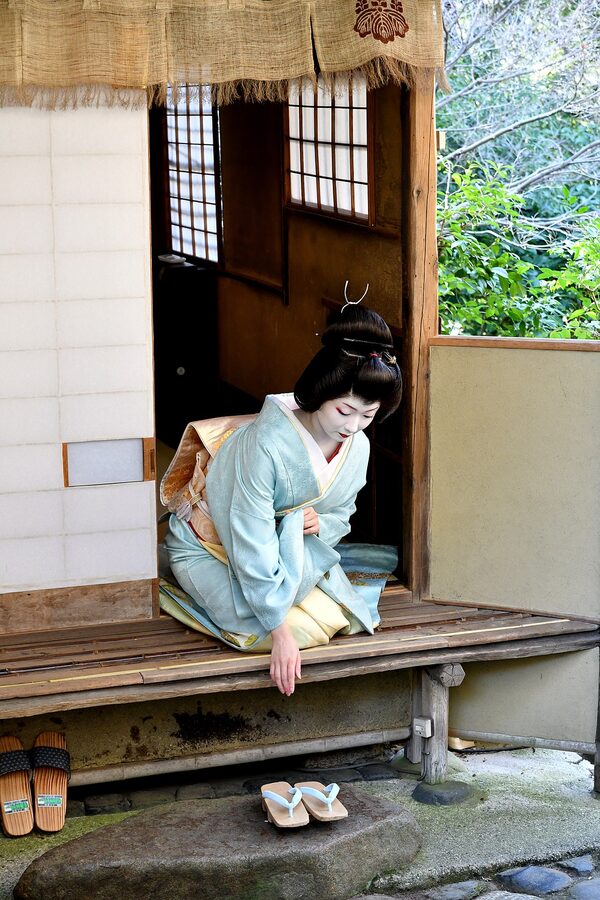
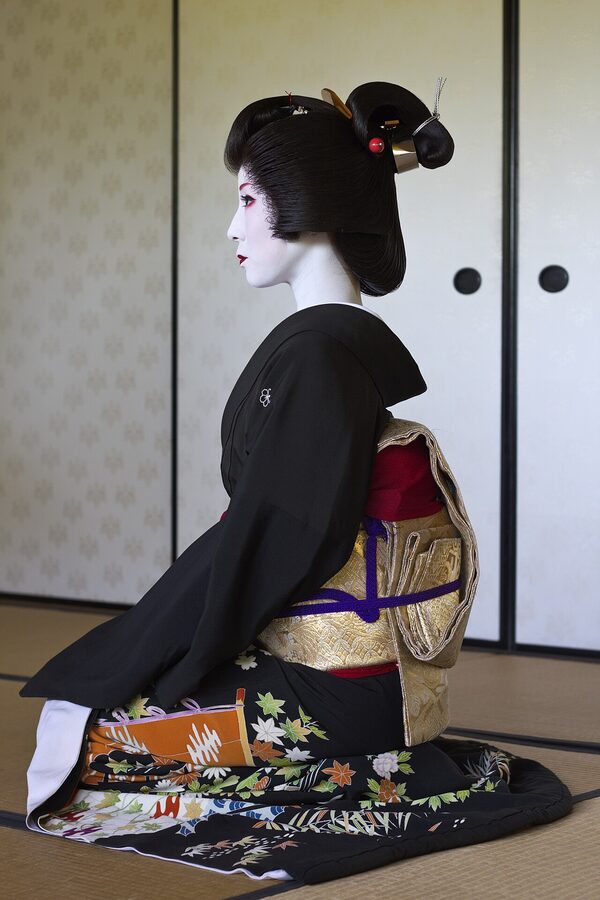
The word “geisha” is the general term; in Kyoto, the specific word is geiko. The distinction matters to people who train in the profession. A maiko is an apprentice — usually between 15 and 20 years old — who lives in an okiya (a boarding house associated with a teahouse) and spends her days studying dance, shamisen, poetry, tea ceremony, traditional etiquette, and the protocols of entertaining. A geiko is the title she graduates into, usually around her twentieth birthday, after four to five years of apprenticeship. From that point she can work independently, live outside the okiya if she chooses, and build her own career.
The visible differences are deliberate. A maiko wears elaborate flower hairpins (kanzashi), a trailing darari-style obi that hangs almost to the floor, and vivid colours — she’s being shown as young and still in training. A geiko wears a simpler wig, a shorter obi, and darker, more restrained colours. Her makeup is less painted. When you spot a Kyoto woman in traditional dress on the street, her clothing alone tells you whether she’s a maiko still learning, a geiko in her prime, or — increasingly commonly — a visitor who has rented a kimono for the day and is cosplaying the role without any training behind it.
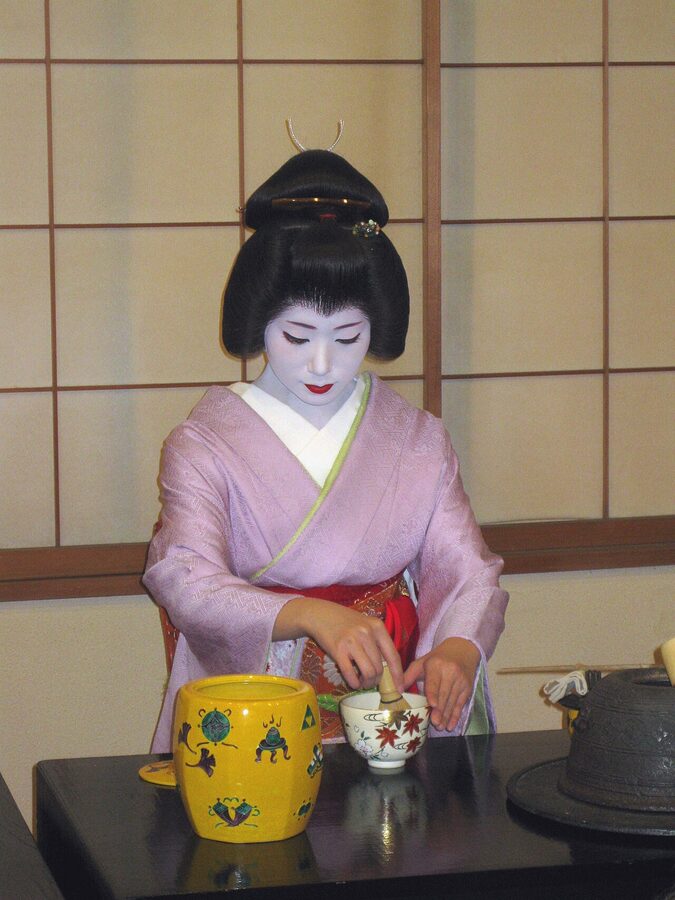
What geiko and maiko actually do is perform at private evening engagements called ozashiki — a meal plus entertainment hosted in a teahouse or a ryotei restaurant, attended by patrons who’ve booked through their established relationship with the venue. An ozashiki isn’t a stage show; it’s a structured dinner conversation facilitated by the performers, with music and dance punctuating the meal. The protocol is a hundred specific rules, almost none of which are written down. The geiko knows them because she was taught them by the one before her.
What the Walking Route Actually Covers
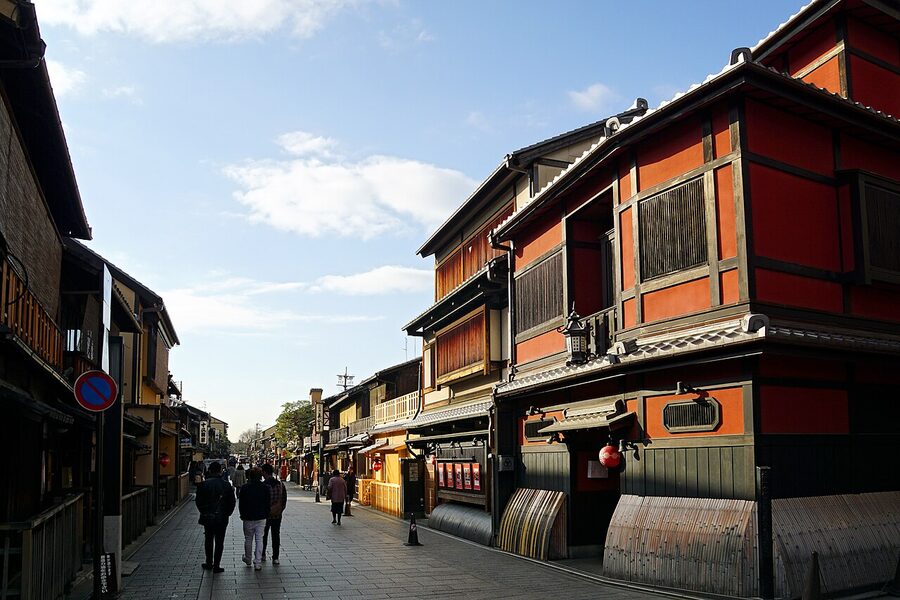
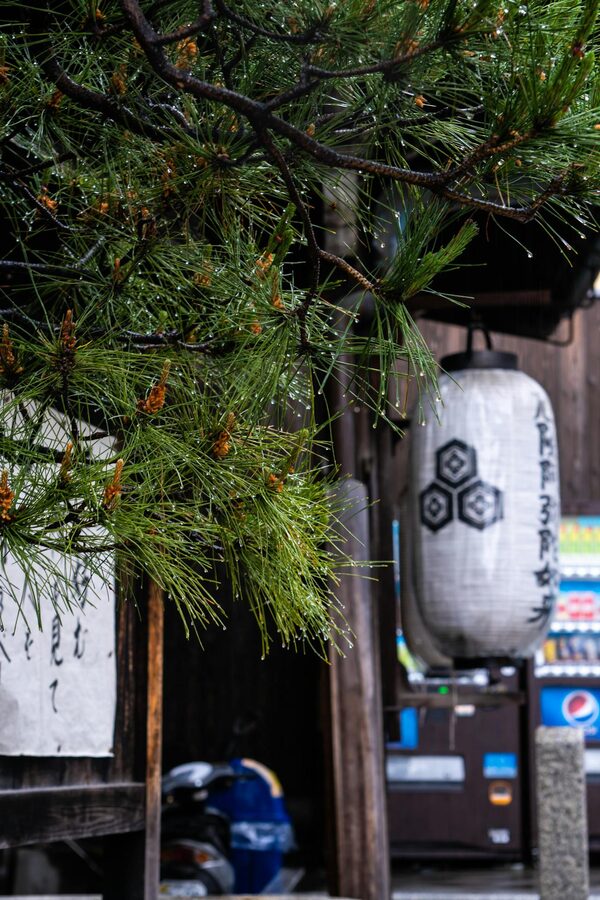
All three tours cover the core Gion loop, which takes about 90 minutes at a walking pace with stops. The circuit begins at Yasaka Shrine at the eastern edge of the district, runs west on Shijo-dori past the main temple gate, turns south into Hanamikoji-dori for the quintessential Gion lane, crosses over to Shirakawa-dori and the canal that everyone photographs, and loops back toward the shrine via the backstreet alleys. A good guide adds two or three “hidden” stops specific to their own knowledge — a specific teahouse where a famous geiko from the 1950s trained, a stone marker noting where a famous patron died, a side lane that hosts a minor shrine only locals visit.
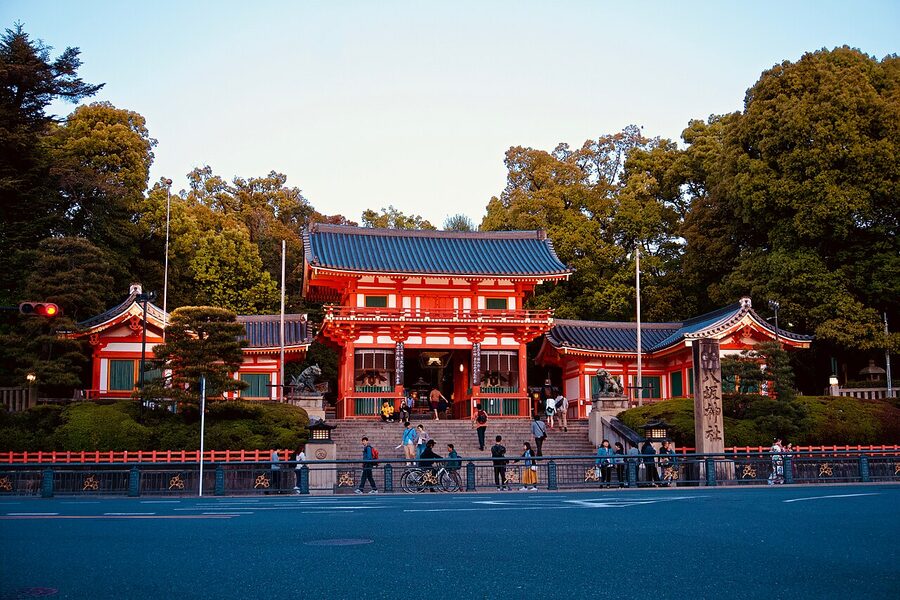
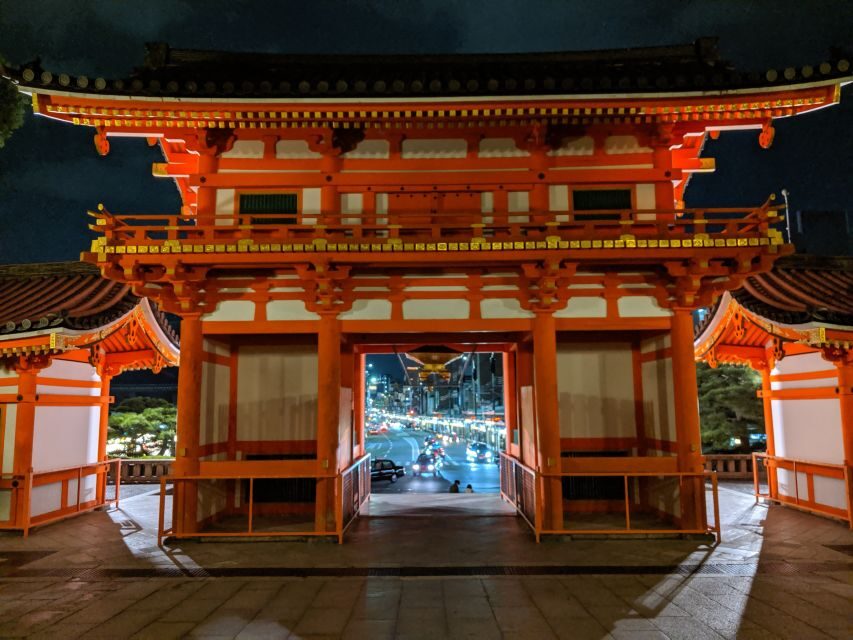
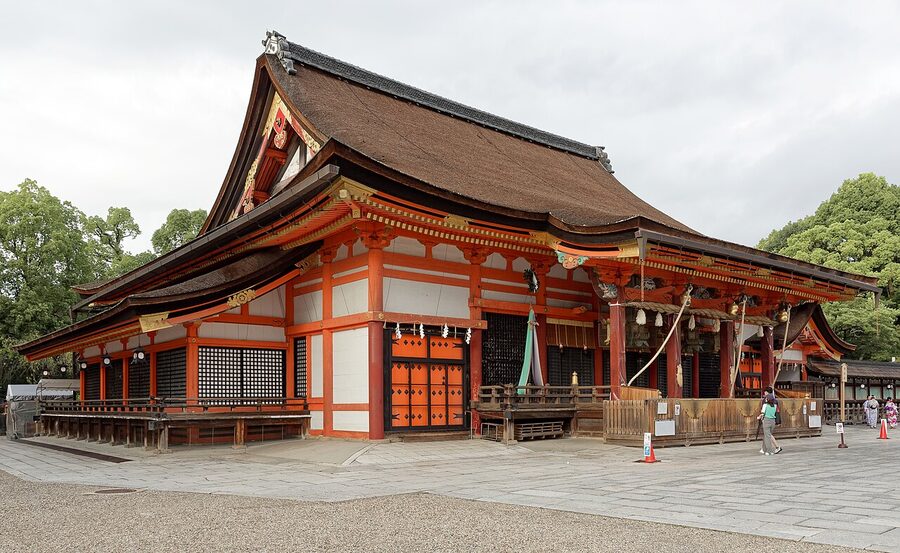
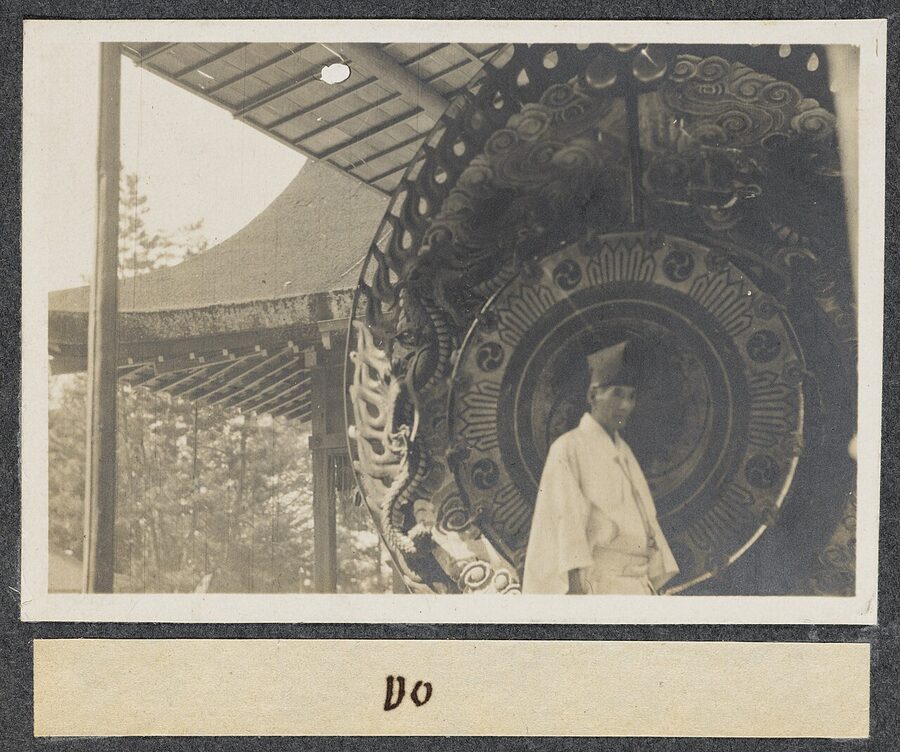
Yasaka Shrine itself deserves about 15 minutes at the start or end of the walk. It’s a large shrine complex — central hall, secondary shrines, a pair of stone lanterns tall enough to see from a block away. The main hall houses the deities of Gion Matsuri, Kyoto’s biggest festival, which has run every July for over a thousand years. Most walking tours pass through the shrine but don’t linger; if you want a proper look, arrive 20-30 minutes before your tour starts.
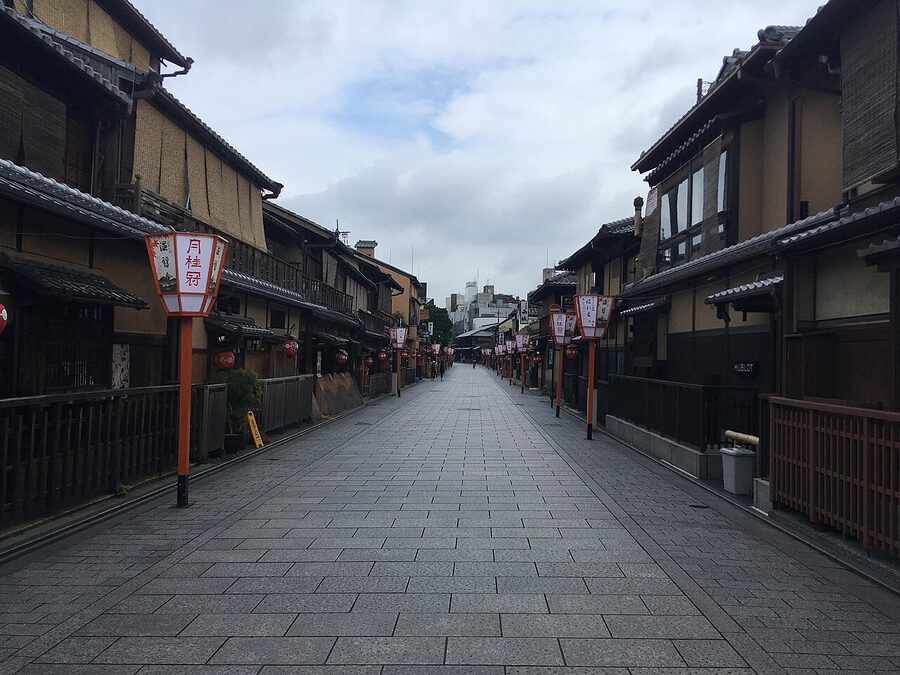
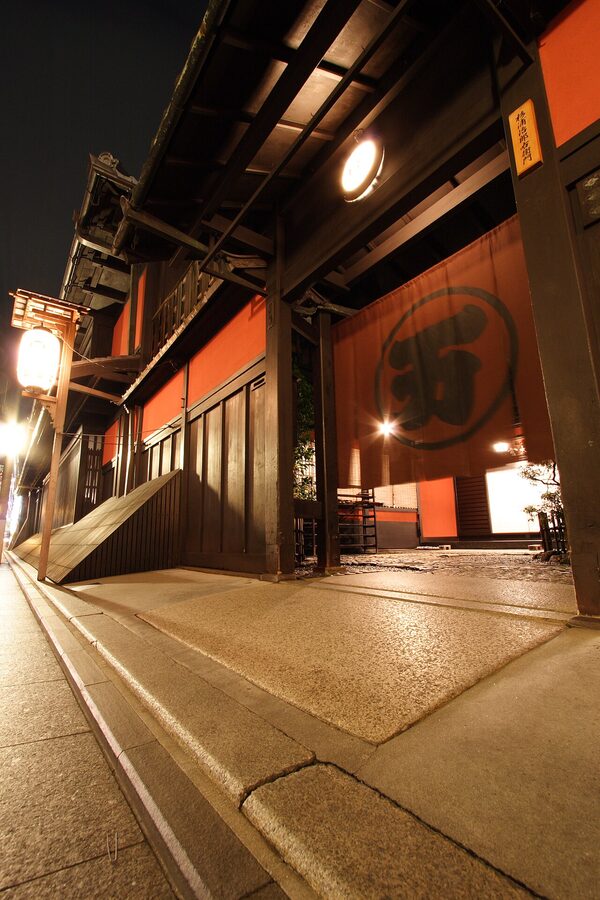
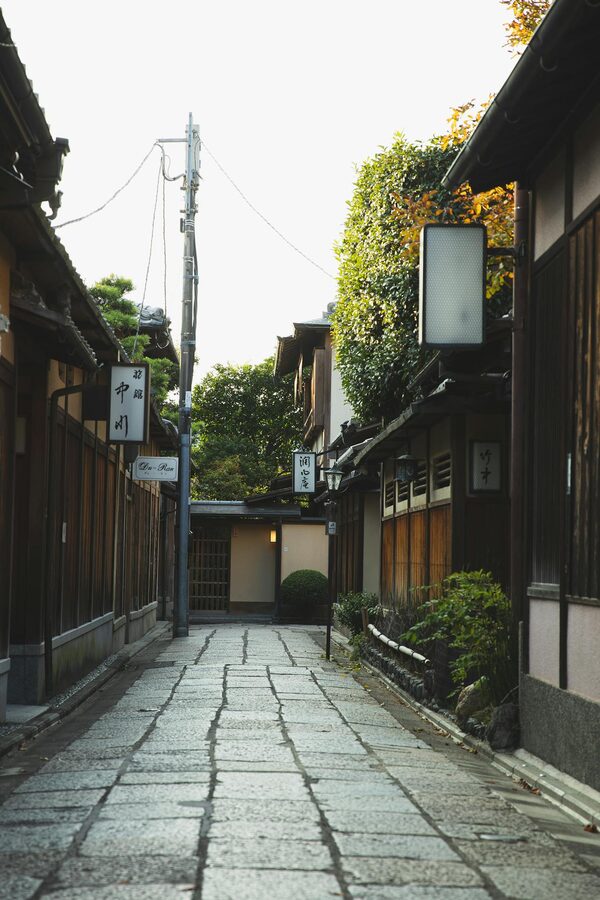
Hanamikoji-dori is the walking-tour showpiece. The street is roughly 500 metres long, running south from Shijo-dori to Kennin-ji temple. Every building on the east side is a machiya-style townhouse — many of them active teahouses, identifiable by the small lantern at the entrance. You’ll be asked not to photograph directly into doorways; the guide will explain the etiquette. The lane is cobblestone, the lighting is low, and on a good evening walking down it is the closest most travellers get to time travel in any city.
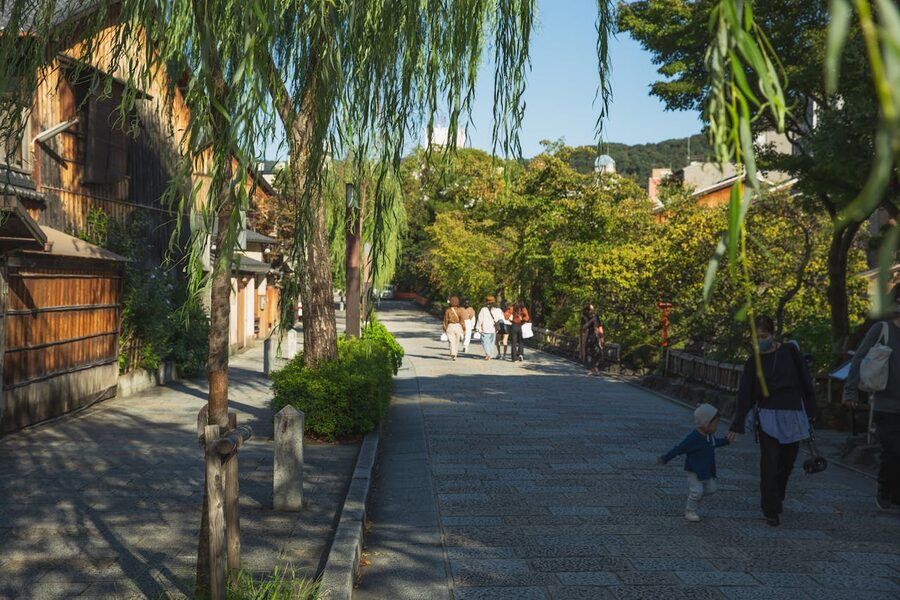
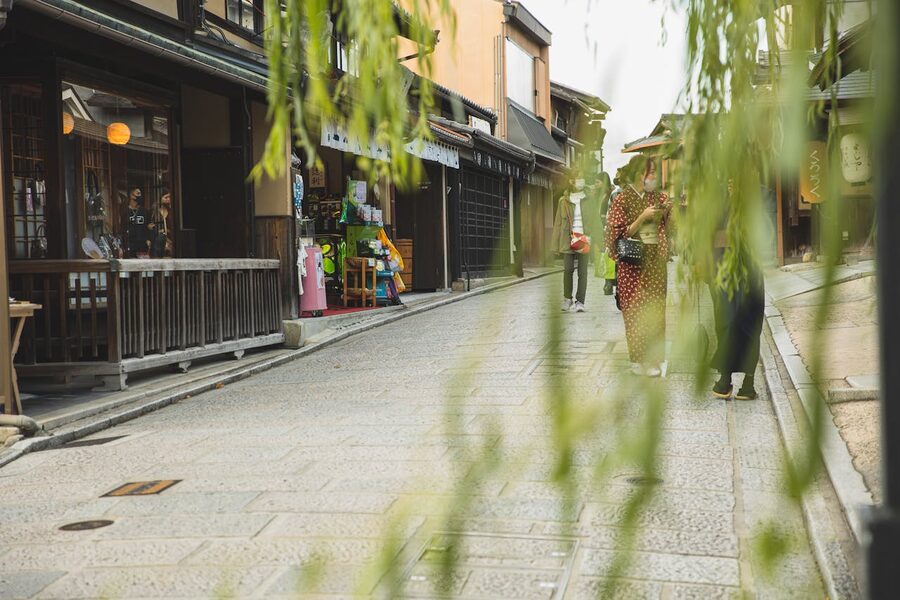
The Shirakawa canal runs along the north edge of Gion, between Shijo-dori and Sanjo-dori. The canal is stone-lined, narrow, crossed by small arched bridges, and lined with weeping willows and cherry trees. A 19th-century photographer would recognise it immediately. The south bank is solid teahouses; the north bank is a more mixed commercial strip. Walking tours usually spend 15-20 minutes here, and in late March-early April this stretch is the district’s most crowded cherry blossom corridor.
Gion Matsuri — The Festival That Built the District
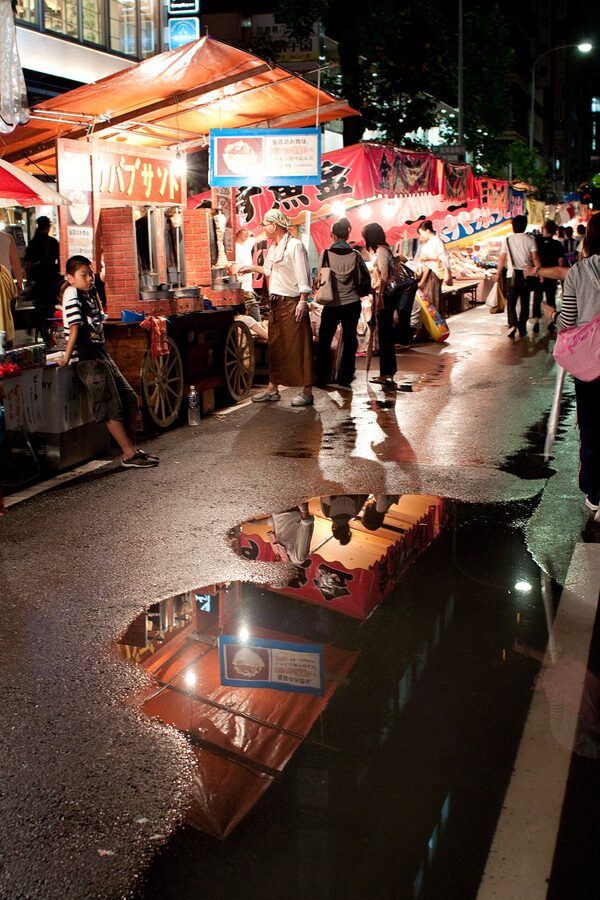
Gion Matsuri is the reason the district exists. The festival dates to 869 AD, when Kyoto was hit by an epidemic and the city’s emperor ordered a purification procession to ask the spirits for mercy. The procession — which involved wheeling large ceremonial spears through the streets — became an annual event, and over the centuries evolved into the most elaborate festival in Japan. Today Gion Matsuri runs the whole month of July, with the main parade on July 17 featuring 33 enormous wheeled floats called yamaboko, some of which are over a thousand years old.
The district grew up around the festival. As pilgrims arrived for July celebrations, teahouses opened to serve them; the teahouses hired entertainers; the entertainers needed training; the training created the geiko tradition. A walking tour will mention the festival at Yasaka Shrine, but if you’re visiting Kyoto in mid-July specifically, the festival itself is a substantial extra consideration — the district is unrecognisable during peak Matsuri days.
Etiquette — What to Actually Do if You Spot a Geiko
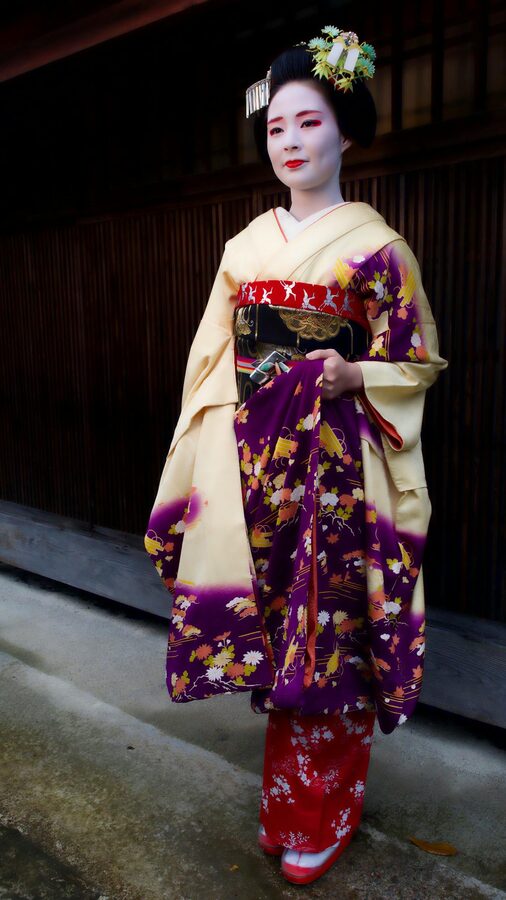
The Kyoto tourism board and the geiko unions have been publishing etiquette guidelines since about 2019, mostly in response to increasing numbers of visitors behaving poorly in the district. The list is short and worth actually following. Don’t grab, don’t follow, don’t photograph directly into teahouse doorways, and don’t touch a geiko or her kimono under any circumstances. If you want a photograph, take it from at least three metres away and let her pass without trying to speak with her.
The reason matters. A geiko walking to her appointment is at work — her kimono has been wrapped in a process that takes 45-60 minutes, the hair is an hour’s styling, and the whole compostion can be dismantled by being bumped or touched. She’s not rude for walking past you without acknowledging you; she’s being professional. The right behaviour from the visitor side is to acknowledge that this is a working space, not a photo opportunity.
The tour guides cover all of this at the start of the walk, which is one of the reasons the tours are worth booking. Reading the protocols in the abstract isn’t the same as having someone point to the actual teahouse door 10 metres from you and explain what happens inside.
Timing Your Visit
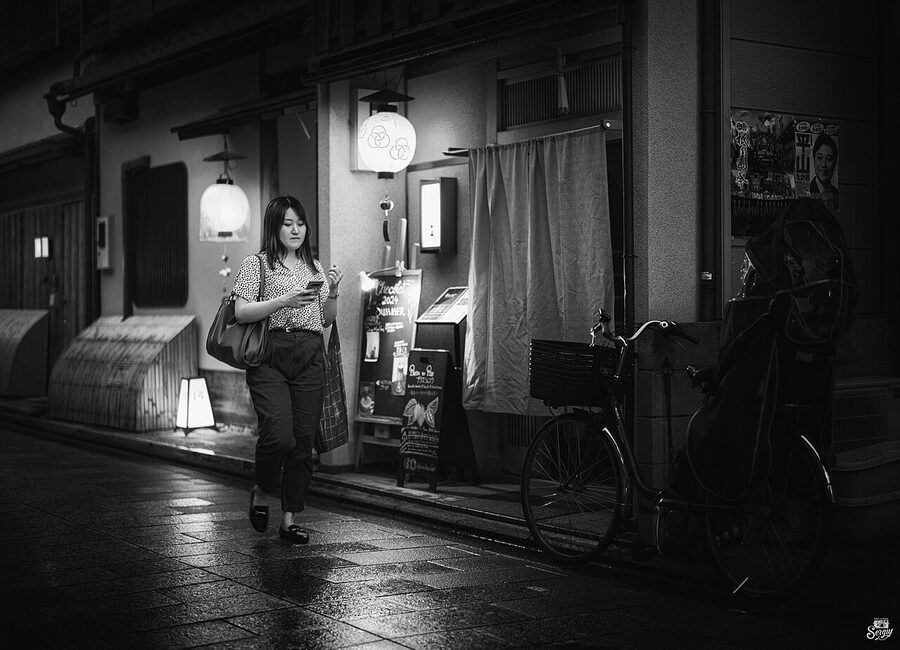
Morning Gion is quiet and photographically clean, but there’s no geiko activity to see — the district is essentially asleep. A walking tour in the morning would show you empty lanes and closed doorways. Most of the tours start in the early evening for good reason: the district transforms twice on a typical day, once at sunset when the lanterns come on, and once around 9-10 pm when the first round of ozashiki ends and performers begin moving between teahouses.
Tour 1 catches the sunset transition. Tour 3 catches the 9-10 pm movement. Tour 2 is a middle-of-evening option that emphasises narrative over sightings. If you’re only doing one, pick based on which you care about more: atmosphere and architecture (Tour 1) or possible geiko sightings (Tour 3).
Seasonally, Gion’s busiest months are March-April (cherry blossom at Shirakawa canal) and October-November (autumn colour at Yasaka Shrine). These are also the months when the walking tours have the longest advance-booking requirements — reserve 2-3 weeks out. Winter months (December-February) have thinner crowds and better odds of a quiet walk, though the early sunset means the lantern transition happens earlier than in summer.
What Else Pairs With a Gion Walking Tour
Gion walking tours cover the district but don’t feed you. A lot of visitors book the walk immediately before or after dinner at a nearby restaurant. Our Kyoto Gion food tour guide is a natural companion — different format, same district, focused on the sit-down eating that the walking tour doesn’t touch. Many travellers end up doing both: food tour one evening, walking tour another.
If you want to see an actual geiko performance, the closest you can get without an introduction to a teahouse is a staged performance. Our Kyoto geisha show guide covers the ticketable evening performances — Gion Corner is the most famous, but there are several alternatives. It’s not the authentic ozashiki experience, but it’s the closest proxy a foreign visitor can realistically access, and a good show is genuinely worthwhile.
For morning Kyoto, our Kyoto early morning tours cover the temples that sit near Gion and are best visited before crowds arrive. Pair an early morning temple walk with an evening Gion walking tour for the complete contrast — quiet stone gardens in the morning, low lamplight and whispered geisha stories at night.
Practical Booking
Book one to two weeks ahead for most months; three to four weeks for cherry blossom and autumn peak. The tours are small-group (usually 8-15) and the most-reviewed departures fill first. All three main tours offer free cancellation up to 24 hours before.
On the day, wear comfortable shoes — you’ll walk 2-3 kilometres on cobbles and stone paving. Dress modestly; the district isn’t a temple, but visitors who show up in shorts and flip-flops stand out poorly. Bring a phone for photos (with the etiquette restrictions above) and enough cash for a post-tour drink or snack (most Gion restaurants accept cards but many small places prefer cash).
The meeting point for most tours is the main gate of Yasaka Shrine — easy to find, served by bus and the Keihan line’s Gion-Shijo station. Give yourself 15 minutes to locate the guide; Yasaka is busy at the standard 5-6 pm start time and finding a specific small-group tour can take a moment.
More Kyoto Experiences
A Gion walking tour is one of several ways to connect with Kyoto’s traditional-culture layer. Our Kyoto Gion food tour covers the sit-down dinner version; Kyoto geisha show covers the staged performance format. For the broader Kyoto day, Kyoto Nishiki Market food tour is the daytime food counterpart and Kyoto early morning tours covers the temple-before-the-crowds option. Our kimono rental and tea ceremony guide is the dress-up counterpart to watching geiko walk past — you’ll have a different appreciation of what they’re wearing after you’ve put on a kimono yourself. Kyoto bar hopping in Pontocho is the across-the-river evening alternative. Kyoto matcha tea museum connects to the geiko tradition through the tea ceremony. For deeper Kyoto context, Kyoto zen meditation and Kyoto samurai kenbu sword dance cover the quieter and more martial sides of the same traditional-arts ecosystem. Arashiyama ghost night tour is the atmospheric equivalent in the western edge of the city. Most travellers who book a Gion walking tour do it on their first or second evening in Kyoto — it calibrates everything else you see in the city for the rest of your stay.