
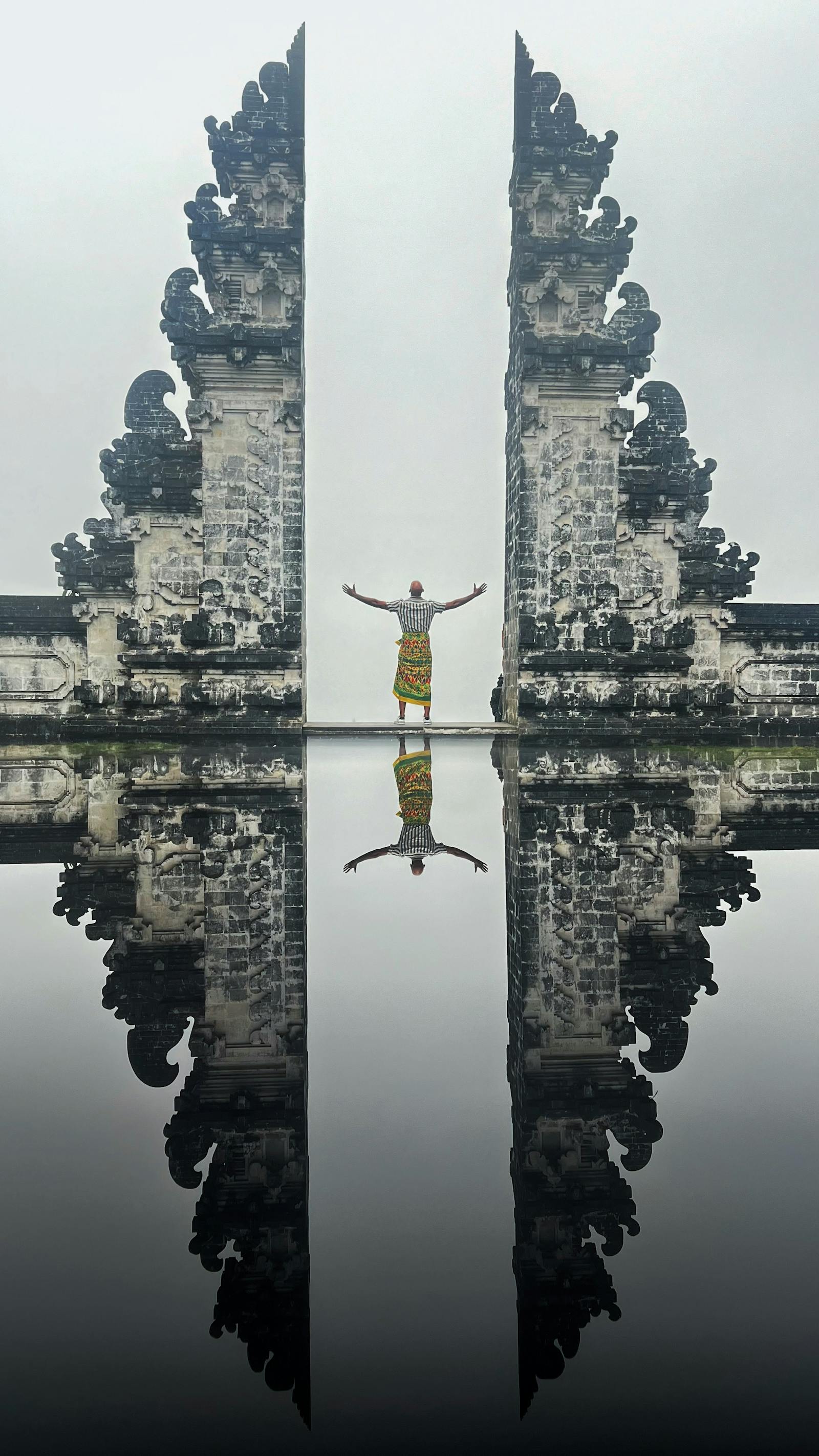
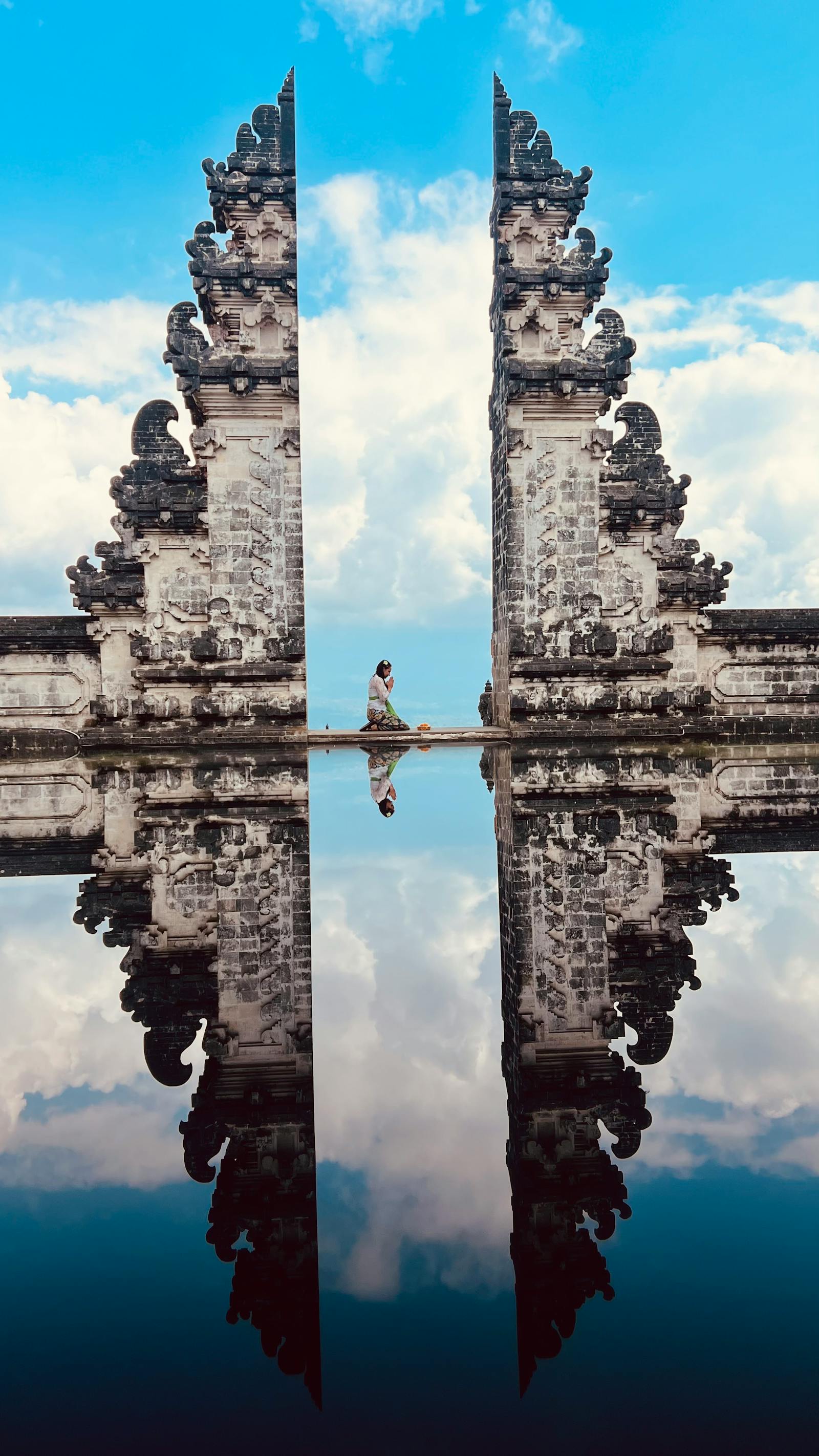
Before you book anything, there is one thing you should know about the Gates of Heaven at Lempuyang. That “reflection” in every viral photo — the glass-smooth water pooling at the base of the gate, the sky doubled back on itself, the person standing impossibly still at the center of the universe — is a phone. It is a phone held flat on a small piece of glass by a temple attendant.
He holds it a few inches below his camera lens and aims it at the gate so the screen catches the sky. Everyone who makes the trip up there discovers this within the first two minutes of their turn in the queue, and then everyone posts the photo anyway.
I am not saying this to ruin it. I am saying it because the Gates of Heaven is still worth going to, but the tour you book and the time you arrive will matter more than you’d think — this is one of the most Instagrammed spots in all of Bali and the queue to stand between the gates can run three hours long in the middle of the day.
A good tour gets you up there before the queue forms, and a bad one drops you off at 11am with fifty other people who all want the same photo and the same gap in the crowd.
I have been up to Lempuyang three times now, across three trips to Bali, and booked through most of the big platforms. This is my honest take on how to see the Gates of Heaven without standing in a three-hour queue, and which East Bali day tour is worth your time.
Short on time? Here are my top 3 picks:
Best overall: Bali Besakih Temple and Lempuyang Temple Gates of Heaven Tour — $35. Over 3,200 five-star reviews on GetYourGuide. Both Besakih and Lempuyang in one day. The price per person is honestly silly at this level.
Best for skipping the queue: Bali Lempuyang Quick Access Waterfall, Water Palace and More — $30. The “quick access” in the name is the whole point — you skip the shuttle queue at the base and go straight up.
Best for a proper private day: East Bali Tour: Gate of Heaven, Water Palace and Sleeping Gajah — $100. Small private group on Viator, 5.0 stars, slower pace, room for the hidden stops most tours never add.
- How the Lempuyang Queue Actually Works
- Private Tour vs Group Tour — Which to Book
- The Best Lempuyang Tours to Book
- 1. Bali Besakih Temple and Lempuyang Temple Gates of Heaven Tour —
- 2. East Bali Tour: Gate of Heaven, Water Palace and Sleeping Gajah — 0
- 3. Bali Lempuyang Quick Access Waterfall, Water Palace and More —
- When to Leave, and Why It Matters More Than Usual
- What’s Actually on the Tour — Stop by Stop
- Pura Lempuyang — The Gates of Heaven
- Tirta Gangga Water Palace
- Taman Ujung Water Palace
- Besakih Mother Temple
- The Waterfalls (On the Quick-Access Tour)
- What to Wear and What to Bring
- Is the Gates of Heaven Worth It?
- Combining Lempuyang With Other Bali Day Trips
- A Few Things the Tour Descriptions Don’t Tell You
- The Short Version, If You Skipped to the Bottom
How the Lempuyang Queue Actually Works
Here is what nobody explains before you book. Pura Penataran Agung Lempuyang — the Gates of Heaven temple — is not at the top of a mountain. It is on the side of Mount Lempuyang, about two-thirds of the way up a road in East Bali, and the temple itself sits in a courtyard with the famous split gate at the front. The mountain and the queue make everything complicated.
Cars are not allowed to drive all the way up. Every visitor parks at a lower lot and takes a shuttle truck — a small, converted pickup with benches in the bed — up the final 10 minutes of the road. That shuttle costs around 60,000 rupiah per person round trip and runs on demand, not on a fixed schedule.
At busy times there is a queue for the shuttle itself, and then a second queue at the temple gate for your photo, with an attendant who takes the reflection shot on your phone.
In peak season (July, August, the week around Nyepi, Christmas and New Year), that temple queue hits 200 to 300 people. If you arrive at 11am from Seminyak on a standard tour, you are joining the back of that queue. The attendant takes one shot per group and moves you along — there is no posing, no do-overs, no second go. You’ll wait three hours for a twenty-second photo.
This is why the tour you pick matters. The right tour gets you into the shuttle queue before 8am, meaning you’re at the gate itself by 8:30 and the photo queue is eight or ten people deep instead of two hundred. The wrong tour arrives at 11 and you may never actually get the photo at all, because tours have a fixed return time and drivers have to leave before some people reach the front.
Private Tour vs Group Tour — Which to Book
I will say it plainly. For Lempuyang, the pickup time matters more than the private vs group question. A group tour that leaves Seminyak at 5am is better than a private tour that leaves at 8am. Check the pickup time before you book anything else.
That said, all else being equal, I still lean private. A group bus with fifteen people at Lempuyang is chaos — the attendant has to move everyone through in order and the slow people eat into your margin. A private driver with two or three people gets in, gets the photo, and gets out in under an hour.
The prices on GetYourGuide right now run about $30 to $35 per person for group Lempuyang day tours that include Besakih or the water palaces, and $80 to $120 per person for proper private tours. In that range, the private option is genuinely worth the difference if you care about the photo and you only have one day.
If you are on a tighter budget or travelling solo, the $35 group tour from GetYourGuide is the obvious pick — the reviews are relentlessly five-star and the pickup is early enough to beat the worst of the queue. Just confirm the pickup time when you book.
The Best Lempuyang Tours to Book
These are the three tours I would actually send friends to. I’ve used them, or I’ve compared them against what I used, and the reviews and the pickup times both check out.
1. Bali Besakih Temple and Lempuyang Temple Gates of Heaven Tour — $35
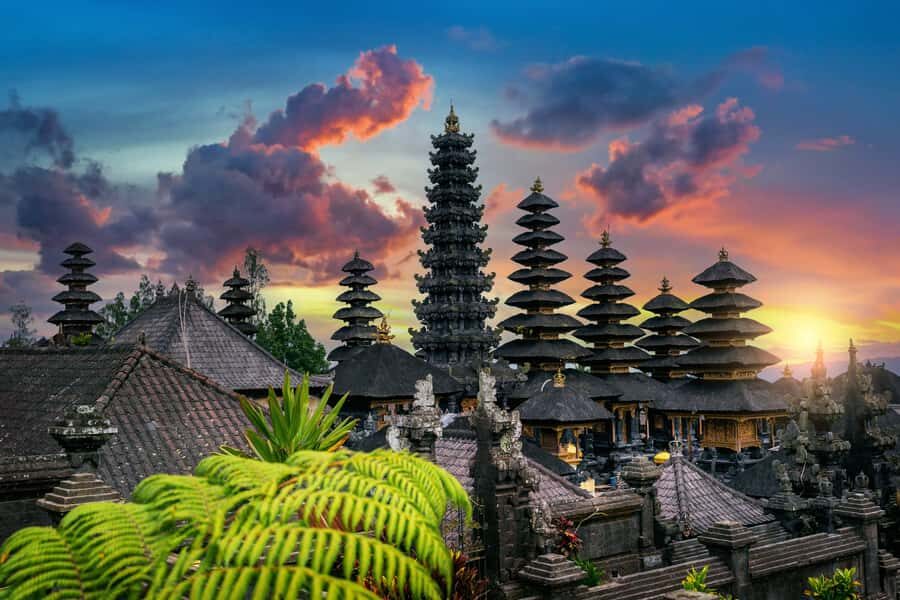
This is the tour I recommend to most people, and honestly it’s probably the one you should book before you read any further. $35 per person for a 9-to-10-hour day trip that covers both Besakih — Bali’s Mother Temple — and the Gates of Heaven at Lempuyang, with hotel pickup from anywhere in the south. Over 3,200 reviews averaging 4.8 stars on GetYourGuide. That volume of feedback makes the whole booking feel low-risk.
The pickup time on this one is usually 6am or 6:30am from the south Bali hotels, which is exactly what you want. That puts you at Lempuyang around 9am, ahead of the worst of the queue. You do Besakih on the way back down when the photo crowds there have died off — a smart reversal most group tours get wrong.
What you give up for the low price: it’s a group van tour, not private. That means you wait for the group at each stop, lunch is at a driver-chosen restaurant, and you don’t get to change the route. None of that matters much if you’re here for the photos and the highlights. At $35, the math just works.
2. East Bali Tour: Gate of Heaven, Water Palace and Sleeping Gajah — $100
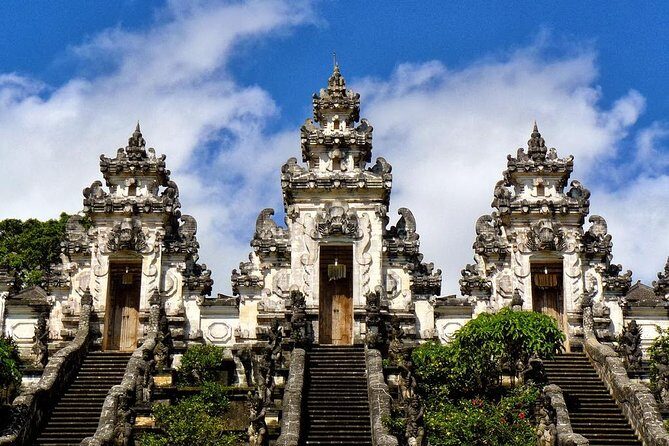
If you want the proper private experience with time to breathe — and you want to see the water palaces and the Sleeping Gajah statue most group tours skip — this is the one. $100 per person on Viator, 5.0-star average across 2,000-plus reviews, private car, full day.
What you get at three times the price is mostly time. The group tour at $35 spends 30 minutes at Lempuyang, 30 at Tirta Gangga, and 45 at Besakih.
This one spends 90 minutes at Lempuyang (so the queue doesn’t become a deal-breaker), an hour and a half at Tirta Gangga to actually walk the gardens, and adds the Taman Ujung Water Palace and the Sleeping Gajah — two photogenic stops that almost nobody visits because they aren’t on the Instagram list yet. You’ll see about half as many other travellers all day.
The caveat: at $100 per person, this only makes financial sense if you’re a couple or a trio sharing the cost. Solo travellers should go with the $35 group option. Two people at $100 each feels like the sweet spot.
3. Bali Lempuyang Quick Access Waterfall, Water Palace and More — $30
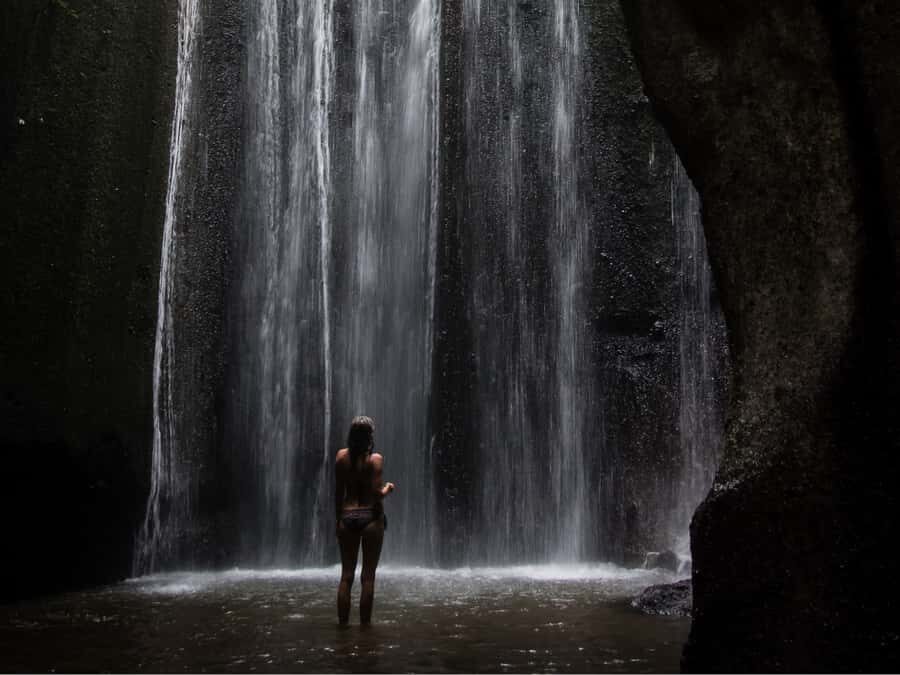
This is the budget pick, and it’s the one I’d book if the $35 Besakih tour was sold out or if I specifically wanted a waterfall in the mix instead of Besakih. $30 per person on GetYourGuide, 13.5-hour day, 1,072 reviews averaging 4.7 stars, and the key feature is right there in the name — “quick access.”
Here is what “quick access” means in practice. At the base of Lempuyang there is a shuttle-truck queue I mentioned earlier that can run 30 to 60 minutes long at peak times. This tour pre-books the shuttle so you skip straight to the front. Ten to fifteen minutes saved on the way up, and the same on the way down. It adds up, especially if the photo queue at the temple itself is long.
You visit Tukad Cepung or Tibumana waterfall (driver’s choice based on the season and crowds), Tirta Gangga Water Palace, and Lempuyang itself. No Besakih. The 13.5-hour day is long — that’s the other caveat — because East Bali is two hours from Seminyak each way and the waterfall adds another two hours round trip on top of the main loop.
For $30, I think it is excellent value. Bring a book for the drive and do not, under any circumstances, try to also fit a big dinner in Seminyak at the end of this one. You will not have the energy.
When to Leave, and Why It Matters More Than Usual
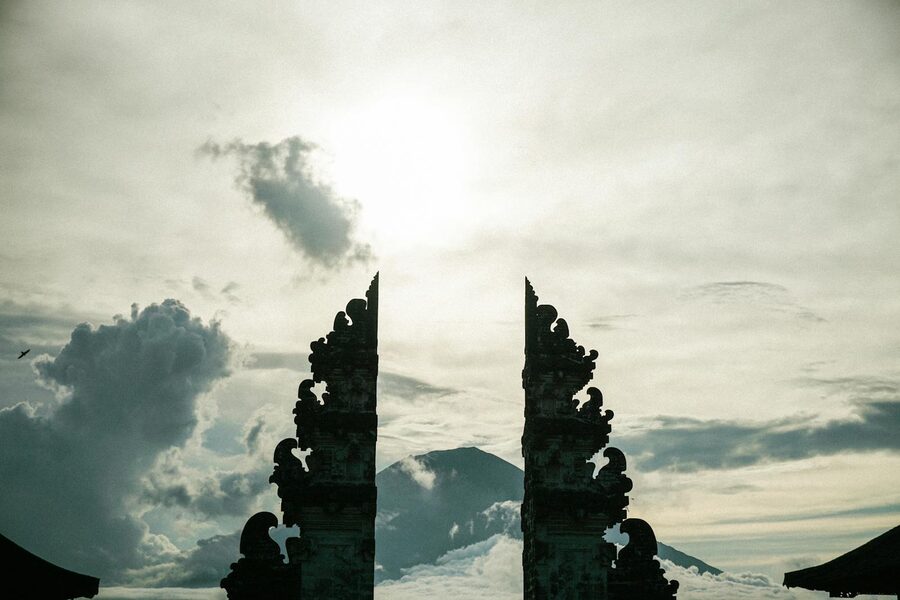
For Lempuyang, the departure time is the single most important decision you make. A 5am pickup from Seminyak puts you at the shuttle queue by 7:15am and at the gate by 7:45. At that hour the queue is maybe 20 people long on a normal day and the light is warm and sideways — the best photos of the trip. A 7am pickup puts you there around 9:15 and the queue has climbed to 80 or 90 people, which is still workable. After 10am I genuinely would not bother.
The $35 Besakih tour usually pickups up between 6am and 6:30am, which is the sweet spot. The private $100 tour will do an earlier pickup if you request it at booking — put it in the special requests field. The $30 quick-access tour has a slightly later default pickup (7am) but the quick-access shuttle skip makes up for most of it.
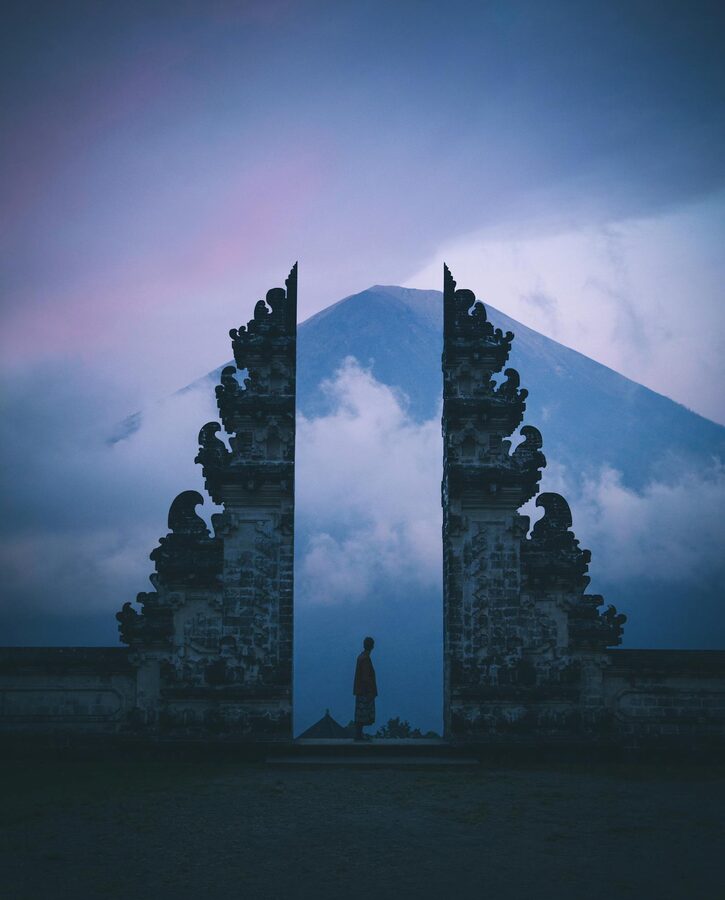
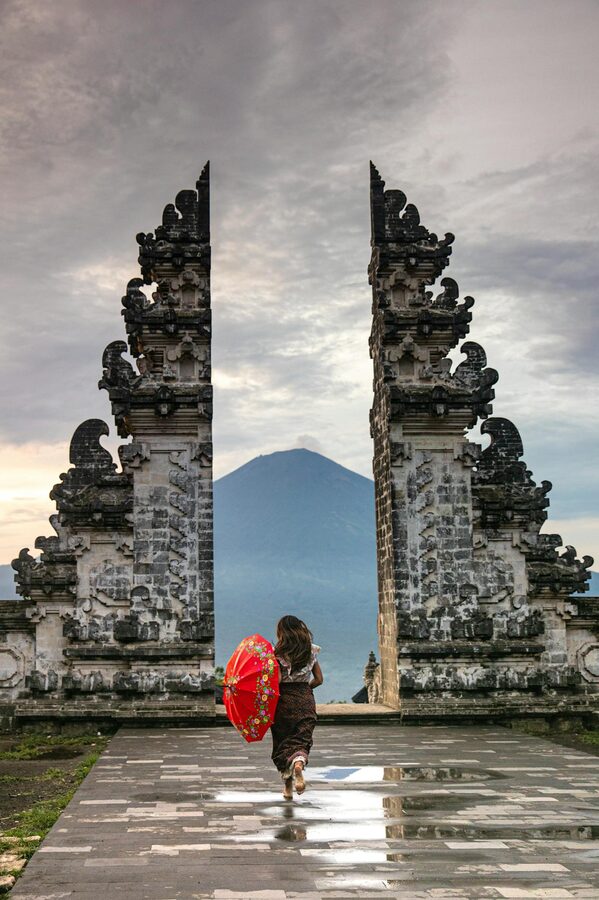
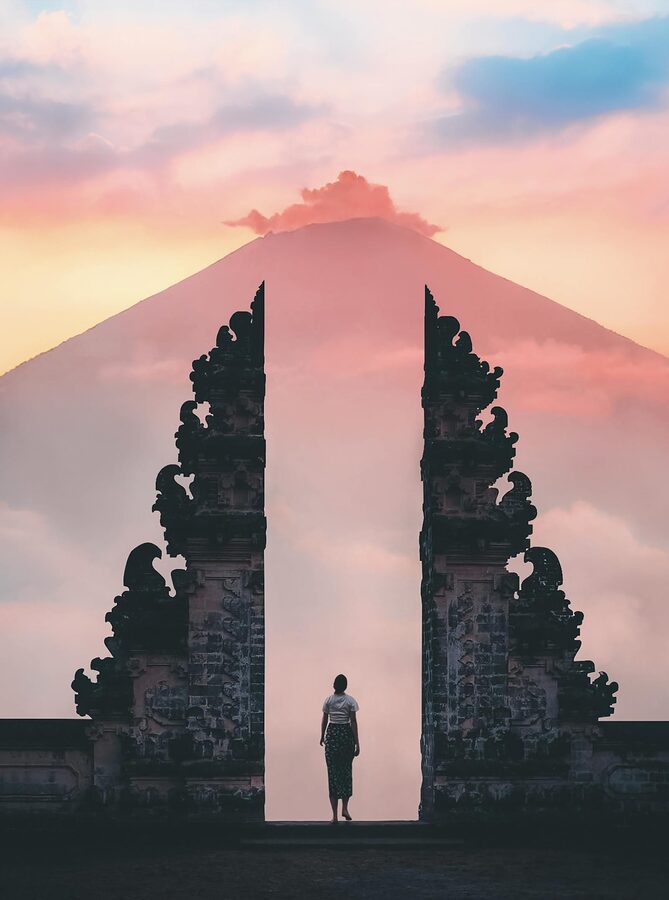
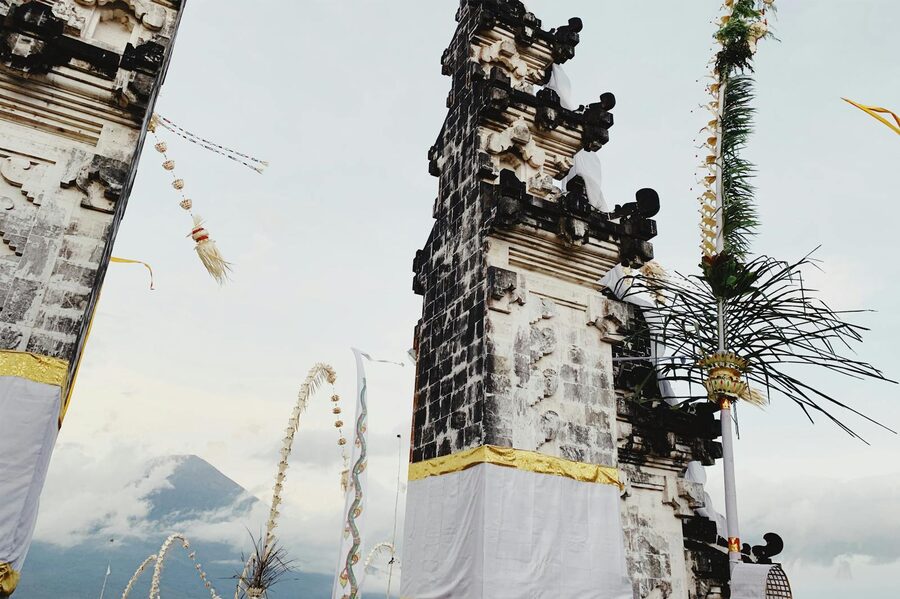
One more thing. Lempuyang is at altitude, around 600 metres, and the clouds come in fast. In the morning you have clear views of Mount Agung behind the gate. By noon the cloud has rolled in and the gate frames grey sky instead of the 3,000-metre volcano. The sunrise photos are better for reasons that have nothing to do with crowds.
What’s Actually on the Tour — Stop by Stop
Pura Lempuyang — The Gates of Heaven
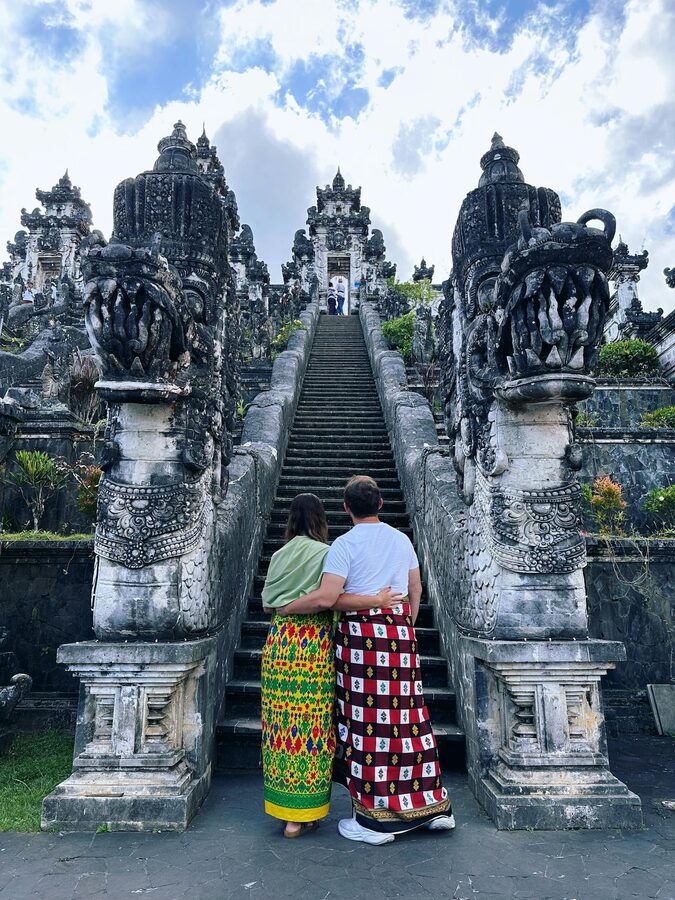
Pura Penataran Agung Lempuyang is not just the gate. The temple is actually a series of seven sanctuaries stretching up Mount Lempuyang, with the famous split gate at the first and lowest level. The seventh is at the summit, about 1,700 stone steps away, and devout Balinese do the full pilgrimage in one morning. Tourists pretty much all just do the bottom one.
Entry to the temple is included in your tour fee. You’ll be given a yellow sash to wear around the waist — this is required for Hindu temples in Bali and the staff will hand one to you at the gate. If you’re wearing shorts they’ll also wrap you in a sarong. Both are free with the entrance.
The actual process at the gate works like this. You join the queue. When you reach the front, you hand your phone to the attendant. He places a small square of plastic or glass on the ground, holds his own phone flat across it to create the reflection effect, points your phone camera at the gate, and takes the shot. Most attendants take two or three tries — one with the reflection trick, one without. Then you step out, the next person steps in, and you move along.
It is not contemplative. It is production-line. But the photo, when it lands, is genuinely striking. Give them 50,000 rupiah as a tip — they are working hard and the temple staff pay is minimal.
Tirta Gangga Water Palace
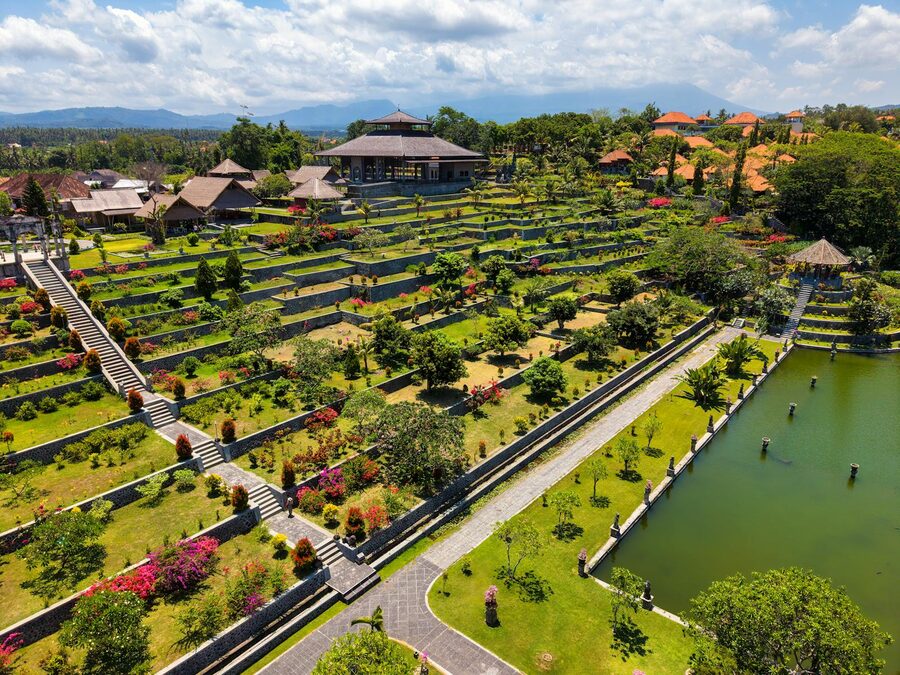
Tirta Gangga means “water from the Ganges.” It was built by the last king of Karangasem in 1948 as a royal bathing complex, destroyed in the 1963 eruption of Mount Agung, and then rebuilt. What you see today is a restored version — ornamental ponds, stepping stones across koi-filled water, fountains, and a bathing pool you can actually swim in for a small extra fee.
The money shot is the stepping-stone path across the main pond. Every visitor’s photo looks the same and that is fine. Budget 60 to 90 minutes. Bring small rupiah notes for the fish food on sale at the entrance — the koi respond enthusiastically and it genuinely improves the photos. Wear shoes you don’t mind getting a little wet on the stepping stones.
Taman Ujung Water Palace
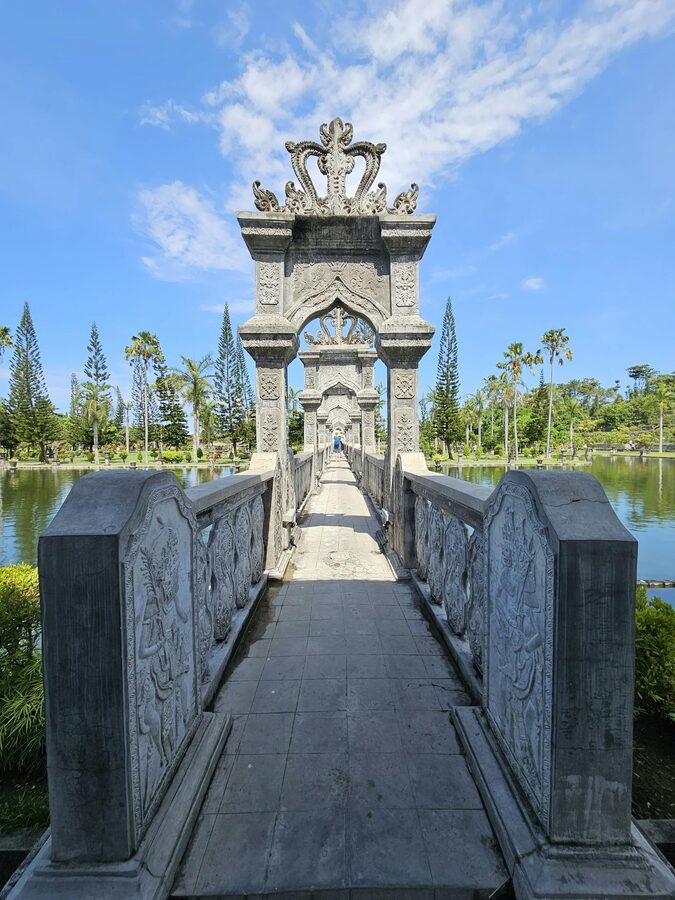
This one is on the longer private tours and I’d push you toward including it if you can. Taman Ujung is the other Karangasem water palace — bigger than Tirta Gangga, with a larger main pond, grand stone bridges, and a ruined palace pavilion on a raised platform at the center. It was also damaged in the 1963 eruption and partly rebuilt; some of the ruined sections are still ruined and feel properly atmospheric.
Crowd levels at Taman Ujung are maybe a quarter of what you get at Tirta Gangga. It sits about 20 minutes south along the coast and most group tours skip it to save time. If you’re doing the private Viator tour above, it’s already included. If you’re on one of the group tours, ask your driver if they can swap it for one of the other stops — some will, most won’t.
Besakih Mother Temple
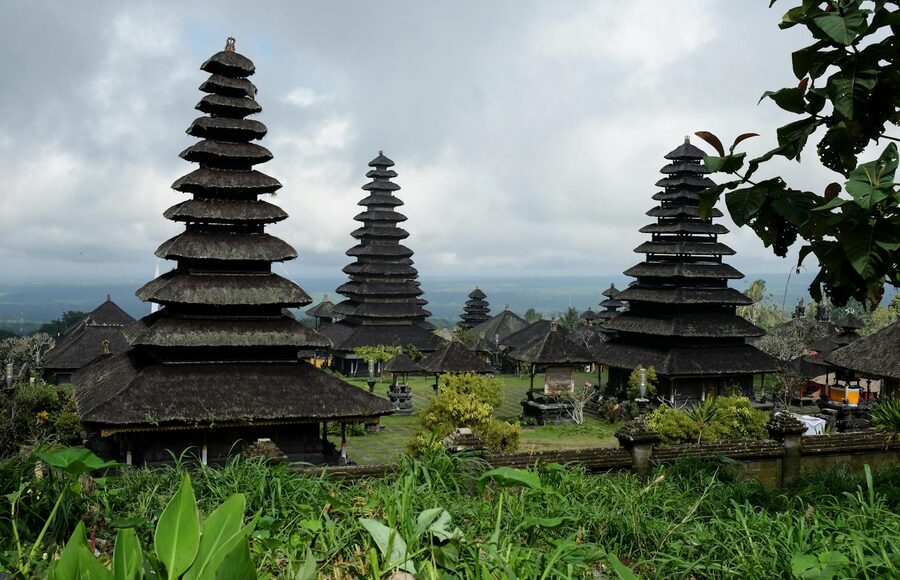
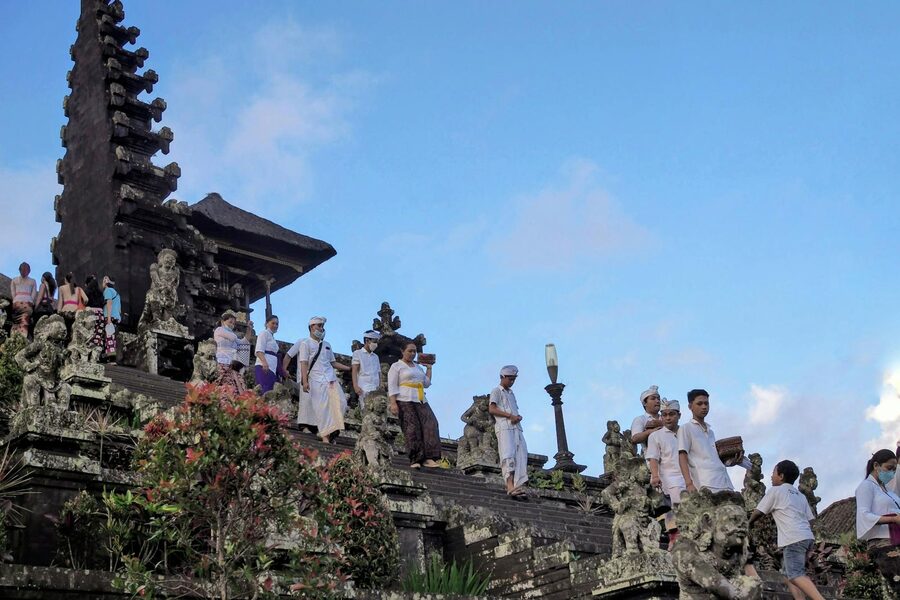
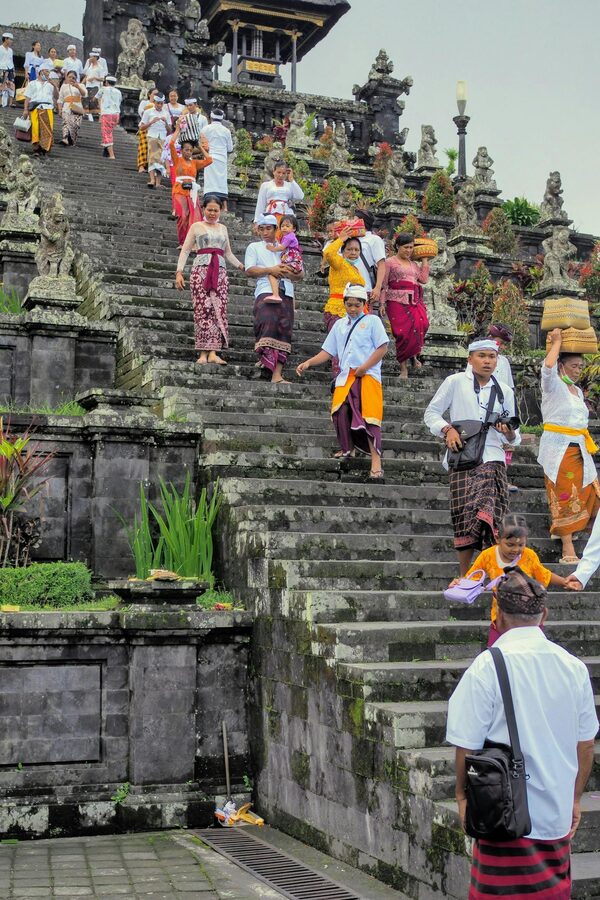
Besakih is the big one culturally. It is the oldest and most sacred temple complex in Bali, a sprawling hillside site with 23 separate temples arranged across six terraces on the southwest slope of Mount Agung. When a major Hindu ceremony happens in Bali, it usually happens here. Priests perform daily rituals, families make pilgrimages, and travellers are — if we’re being honest — secondary to the religious function.
This is what makes Besakih slightly awkward as a tour stop. There is no single photo here the way there is at Lempuyang. The site is too big and too alive to reduce to one frame. You walk the paths, watch the ceremonies from a respectful distance, take in the terraced pagodas, and leave feeling like you’ve seen something important rather than something to photograph.
One important warning. Until about 2019, Besakih had a serious guide-scam problem — men in white uniforms would attach themselves to travellers, claim to be required temple guides, and then demand 500,000 rupiah at the end. That problem has mostly been cleaned up by a new entry system and regulated ticket office, but it can still happen at quieter entrance gates.
Stick with your tour group, do not hire a “guide” who approaches you independently, and if in doubt walk back to your driver.
Entry is now included in the ticket you buy at the visitor centre at the bottom of the complex — around 150,000 rupiah for foreigners, which includes a mandatory shuttle from the car park up to the temple entrance. Your tour driver handles this for you.
The Waterfalls (On the Quick-Access Tour)
The 13.5-hour Lempuyang Quick Access tour adds a waterfall stop, usually Tukad Cepung or Tibumana. Tukad Cepung is the famous “cave waterfall” where sunlight comes through a narrow gap in the rocks above a pool — it’s photogenic between 10am and 2pm when the light is vertical, and it involves wading through ankle-deep water to reach the main chamber. Tibumana is the quieter option, a single tall drop into a swimming pool in the jungle, about an hour from Ubud.
Which one you visit depends on the tour date and crowd conditions. Either way, budget 45 minutes, bring a dry bag for your phone, and wear shoes you don’t mind getting soaked.
What to Wear and What to Bring
For Lempuyang specifically, here is what I wish someone had told me the first time.
- Wear bright clothing for the gate photo. A white, red, or yellow top reads clearly against the grey stone of the gate. Black or dark blue disappears. If you care about the photo, wear the colour.
- Long pants or a long skirt. The temple requires knees covered. You’ll be given a sarong if you’re in shorts, but a flowing long skirt or loose trousers looks much better in the photos than a temple-loaner sarong over gym shorts.
- Walking sandals. There are a lot of stairs, both at Lempuyang and especially at Besakih. Flip-flops will make both of those stops miserable. Closed-toe walking sandals with a back strap are ideal.
- A light rain jacket or umbrella. East Bali catches afternoon rain in a way that Seminyak and Canggu don’t. Even in the dry season you’ll often see a 4pm shower at Besakih or Tirta Gangga. The tour doesn’t stop for rain.
- Cash in small notes. Donations at the temples, fish food at Tirta Gangga, shuttle tips at Lempuyang, bathroom fees at Besakih. Break a 100,000-rupiah note before you leave your hotel.
- Water and a snack. Lunch on a group tour is usually at 1pm, by which point you’ve been going since 5am. A banana from the hotel breakfast buffet in your bag is worth everything.
One thing you should not bring: a drone. Drones are banned at all three temples, strictly enforced, and the fines have been climbing. Leave it at the hotel.
Is the Gates of Heaven Worth It?
I get asked this a lot. The short answer is yes, if you manage your expectations about the queue and the phone-screen reflection. The slightly longer answer depends on what else you’re doing with your day.
If Lempuyang is your one temple day in Bali and you’re combining it with Besakih and the water palaces, it’s absolutely worth the tour. You’ll see three or four genuinely unique sites, get a proper look at East Bali (which feels very different from the south coast), and come home with two or three photos that will make your feed glow.
If you’re already doing Tirta Empul and the Ubud temples on a separate day, and you’re thinking about Lempuyang as a photo-only extra, it’s a harder call. The drive from Seminyak is two hours each way. You are trading a full day of beach time and maybe a Nusa Penida trip for one photo in a queue. For some people that photo is worth it. For others, honestly, it’s not.
My honest advice: book the $35 group tour, go on your first or second day in Bali when your energy is highest, and know going in that the photo is a small part of a bigger East Bali day. You’ll come back happy.
Combining Lempuyang With Other Bali Day Trips
If you’ve got more than a few days in Bali and want to fit the Gates of Heaven into a broader itinerary, these other tours pair especially well:
- How to book an Ubud tour in Bali — this is the other big day-trip from Seminyak and it covers a completely different part of the island. Do one on day two and the other on day four.
- Mount Batur sunrise hike — an early-morning volcano climb that pairs well with a Lempuyang day the day after. The energy curve works out.
- Nusa Penida day trip — the other heavy-Instagram day in Bali. Broken Beach, Kelingking, Angel’s Billabong. Pair with Lempuyang to get the two most-photographed spots in Bali across two days.
- Bali waterfalls tour — if your Lempuyang tour doesn’t include a waterfall, this is the dedicated fix.
- Uluwatu Kecak fire dance — a sunset option for the evening after a Lempuyang day. East Bali in the morning, Uluwatu at dusk.
- Tanah Lot and North Bali tour — another temple-heavy day that covers different geography. Good for a longer Bali trip.
- Bali ATV quad bike adventure — a good contrast to a full day of temples and water palaces if you need to shake off the cultural fatigue.
- Gili Islands snorkeling trip — for when you want a sea day after all the temples.
- Borobudur and Prambanan from Yogyakarta — if you’re continuing to Java, this is the temple day there.
- Mount Bromo sunrise tour — the other great volcano sunrise in Indonesia, also from Java.
A Few Things the Tour Descriptions Don’t Tell You
A few things I learned the hard way that I wish the booking pages had said up front.
First, the attendant at the Lempuyang gate does not speak fluent English. He will give you hand signals to stand, step forward, face the camera. Don’t try to give him detailed posing instructions — just follow along and trust the setup. He’s taken the shot five thousand times.
Second, the “reflection” shot works best when the person in the frame stands still with arms slightly apart and faces the camera, not the gate. Turn around so you’re looking at the attendant and his phone, not at the temple behind you. Every first-time visitor gets this wrong.
Third, your tour fee to Lempuyang almost never includes the 60,000-rupiah shuttle truck at the base. You pay that in cash at the kiosk before you go up. Your driver will tell you, but bring cash.
Fourth, at Besakih, there’s a 30,000-rupiah “sarong rental” that some guides try to collect on top of the ticket. It’s not a real charge. You either bring your own sarong, use the free temple-provided one, or pay it if you don’t mind. The free one works fine.
Fifth, if it rains at Lempuyang, the stone steps become genuinely slippery. The attendant will still take the photo because the queue doesn’t stop for weather. Hold the handrails on the way down, especially if you’re in flip-flops.
The Short Version, If You Skipped to the Bottom
Book the $35 Besakih and Lempuyang tour on GetYourGuide unless you’re travelling as a couple with a budget, in which case book the $100 private East Bali tour on Viator instead. Leave Seminyak by 6am. Wear a bright coloured top and long pants. Bring cash in small notes for the shuttle and temple donations. Skip the drone.
Know that the famous reflection is a phone held under the camera and enjoy the photo anyway. Don’t try to also go out dancing in Seminyak the night of a Lempuyang tour — you will have been awake since 4:30am and the drive back is long.
East Bali is different from the Bali of the Seminyak beach clubs and the Canggu cafes, and that difference is what makes the day worth it even setting aside the photo. The landscape is older, the temples are older, the villages on the drive up still feel like villages. The Gates of Heaven photo is the reason you book the tour. The drive through the rice terraces between Tirta Gangga and Besakih is the reason you remember it.