
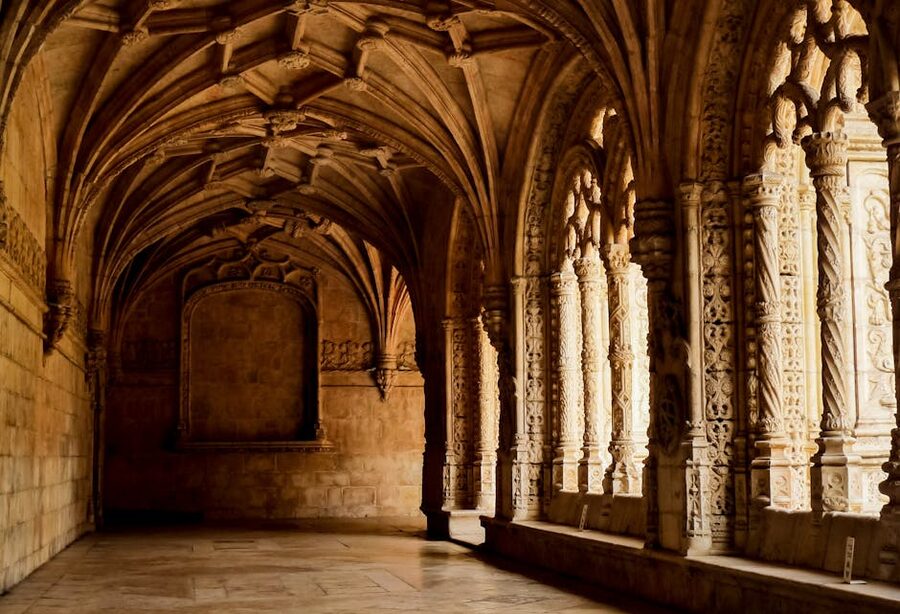
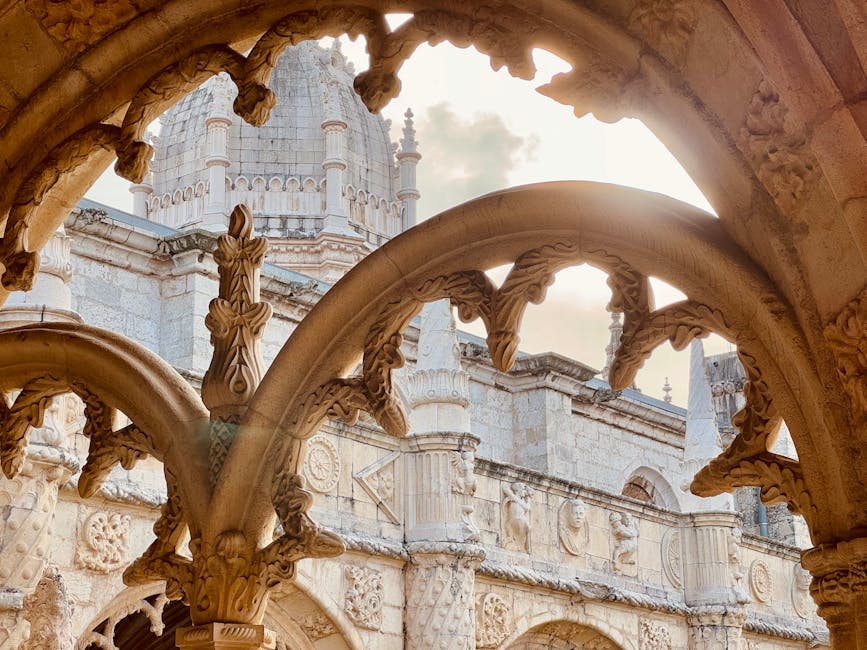
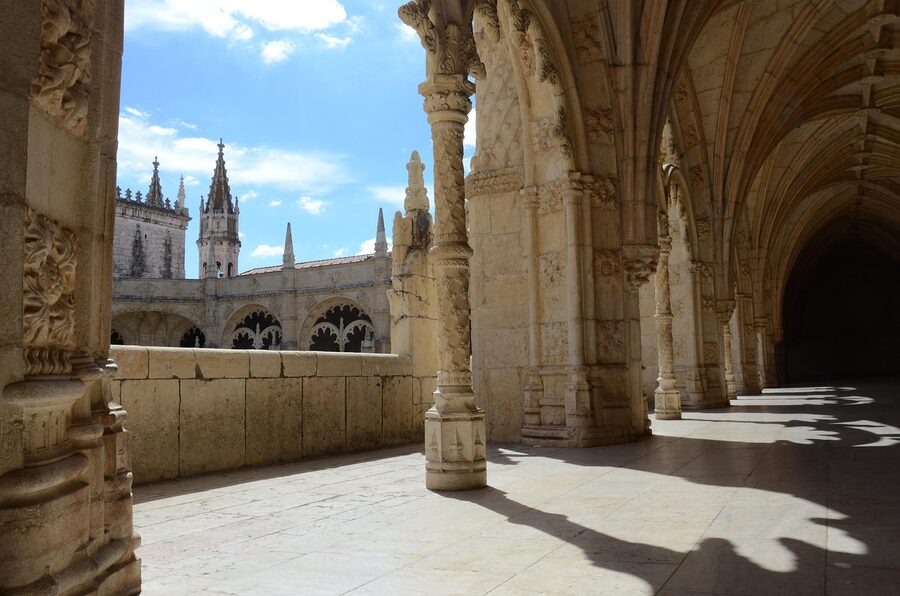
The first time I walked into the Jerónimos cloister it was just before eleven on a Tuesday and the morning sun had reached the upper-level arches. The limestone went the colour of butter. Every column carved with what I thought at first were just decorative twists turned out to be ropes, seashells, sea creatures, knots, the whole iconography of a country whose ships were rounding Africa when this stone was being cut. Then I saw Vasco da Gama’s tomb at the entrance to the church, sun-scarred and Atlantic-explorer-faced in carved stone, and understood why people walk in here and stop talking.
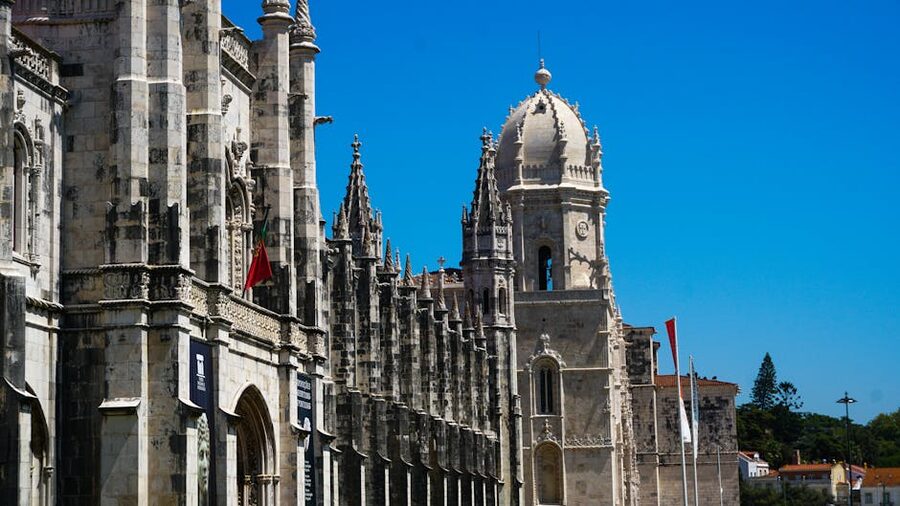
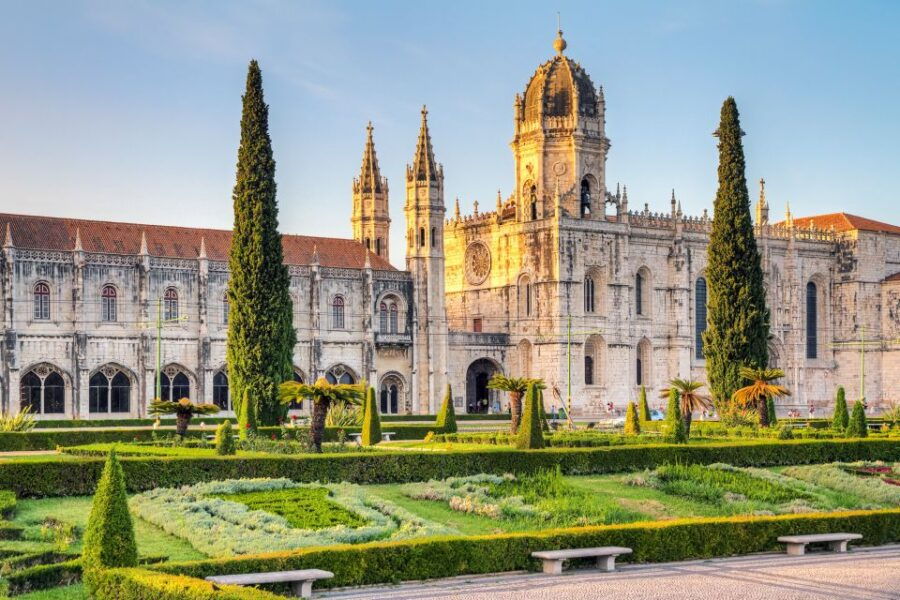
This is the booking guide for Mosteiro dos Jerónimos in Belém, the UNESCO-listed Manueline monastery built between 1502 and 1601 to thank God for Vasco da Gama’s safe return from India. Adult tickets are 18€. The cloister is open Tuesday to Sunday. Below is what to actually book, when to go, and what the free-Sunday rule really means.
In a hurry? My three picks:
- Jerónimos Monastery Entrance Ticket, around $21. The flagship timed-entry ticket. The one to book if you only want the monastery itself, no walking tour.
- Small-Group Belém Walking Tour with Jerónimos Tickets, around $69. Three hours, capped group, the guide does Belém and gets you skipped past the monastery line. The pick if you want context.
- Belém Walking Tour with Monastery Ticket, around $61. Same Belém-walk format at a slightly lower price point. Solid alternative when the small-group sells out.
- What you’re actually buying with a Jerónimos ticket
- The three tickets I’d actually book
- 1. Jerónimos Monastery Entrance Ticket,
- 2. Small-Group Belém Walking Tour with Jerónimos Tickets,
- 3. Belém Walking Tour with Monastery Ticket,
- Solo ticket vs guided walk: how to decide
- Free Sunday hours: who actually qualifies
- When to go: the actual hours, the actual queues
- Vasco da Gama, Camões, and the tomb thing
- The cloister, in slow motion
- Inside the church: the nave, the south portal, the light
- How long to actually plan
- Pastéis de Belém across the road
- Belém Tower and the rest of the strip
- How to get to Belém from central Lisbon
- What guides won’t tell you
- Tickets, refunds, the small print
- Bringing it together
- More from the Portugal cluster, and beyond
What you’re actually buying with a Jerónimos ticket
Here’s the bit nobody tells you up front. The church at Jerónimos, the soaring nave with Vasco da Gama’s tomb at the entrance and Camões opposite, is free to enter. You walk in the side door, you walk past the tombs, you walk out. No ticket required, no booking required, no queue at most hours.
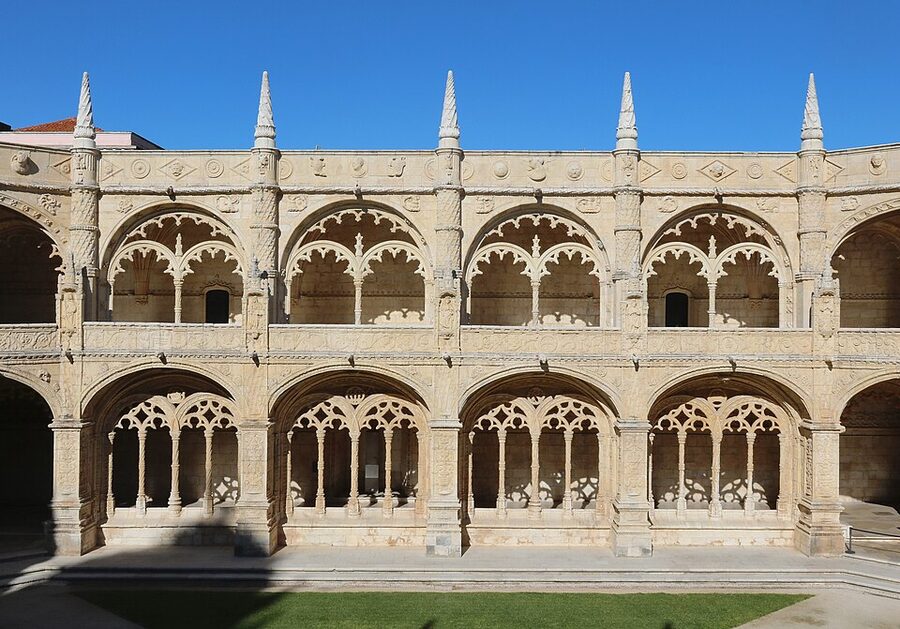
The cloister, the two-storey Manueline masterpiece on the south side of the church, is what your 18€ ticket actually buys. That’s where the rope-and-seashell carvings live. That’s where the upper-level light through the arches happens. That’s where the old refectory and chapter house sit. If you only do the church, you’ve done the brief museum stop. If you do the cloister, you’ve done the actual visit.
The standard adult ticket is the timed-entry online one. Buy it on the official site at museusemonumentos.pt or through a third-party reseller (which is what most tour packages are). If you’d prefer narration without a guide, the e-ticket with audio tour is a third option that bundles the entry with a mobile audio guide. The third-party version usually adds a small fee and gives you a mobile-friendly voucher. The official-site one is cheapest if you’re confident on the date.
The other version worth knowing about is the combined Belém ticket, where Jerónimos comes bundled with Belém Tower across the road. That used to be the obvious move. Belém Tower has been undergoing major works, so check whether it’s actually open before you pay for the combo. If you’re using a Lisbon Card, the monastery is included for free, but the value of the card depends entirely on what else you’re doing that day.
The three tickets I’d actually book
I’ve narrowed this down to one solo-ticket option and two guided options. The flagship entry ticket if you just want in. The small-group Belém walk if you want context and skip-the-line. And a slightly cheaper Belém walking variant for when the first two are gone or the price feels steep. There’s also a separate skip-the-line Belém tour at a higher price point if you want the longer version with the Coach Museum included.
1. Jerónimos Monastery Entrance Ticket, $21
This is the most-booked Jerónimos ticket online and the one I send most readers to. It’s a timed-entry voucher that gets you into the cloister at a specific slot, with no need to queue at the ticket office. Our full review of the entrance ticket covers the redemption process and which slots fill up first. Pick this if you only want the monastery itself and you’re happy to read the placards yourself.
2. Small-Group Belém Walking Tour with Jerónimos Tickets, $69
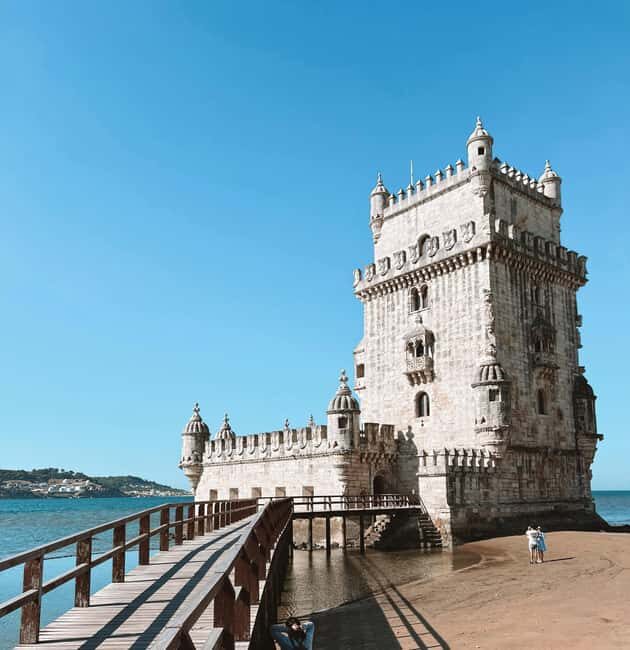
This is the one to book if you want the Manueline carvings explained, not just photographed. Three hours, small group, the guide takes you through the monastery cloister, past the Monument to the Discoveries, around to Belém Tower, and includes a Pastel de Belém stop. Our review breaks down what’s included and how the skip-the-line works. The price-per-hour-of-context ratio is good, and the guides on this one are unusually strong.
3. Belém Walking Tour with Monastery Ticket, $61
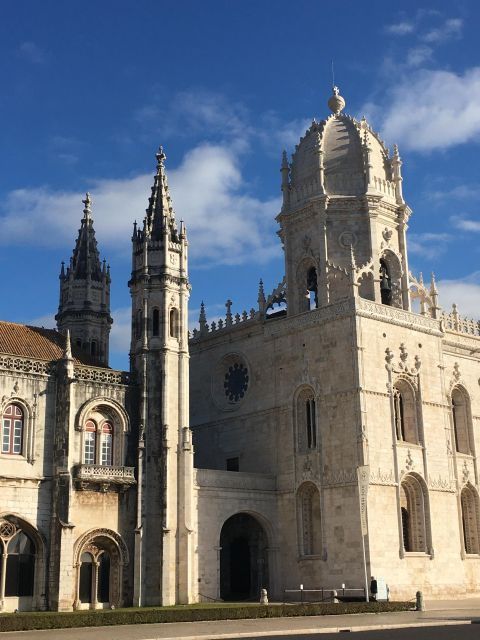
If the small-group version is sold out for your dates or 69 dollars feels steep, this is the alternative. Three hours, the same Belém loop, the same monastery skip-the-line, just a slightly larger group and a touch less hand-holding. Our review covers the operator’s pacing and the Pastéis stop. Solid second-choice pick when you’ve left it late.
Solo ticket vs guided walk: how to decide
Two questions answer this. First, how much do you already know about the Manueline style? If you’ve never heard the words “armillary sphere”, “rope motif” or “Order of Christ cross” applied to architecture, the guided walk earns its money. The carvings are the whole point and they’re meaningless without context. Second, how much do you care about Belém as a neighbourhood? If the answer is mostly the monastery, get the solo ticket. If the answer is the whole Age of Discoveries strip with the tower and the monument and the pastry shop, get the walk.
One more practical filter. Solo tickets are cheaper but require you to read placards and listen to a phone audio guide if you want narration. Guided walks are pricier but include the standing-around time at the carvings, which is when the guide actually earns it. If you’re with kids over twelve, the walk holds their attention better. If you’re with a partner who likes to wander at their own pace, the solo ticket avoids the awkward “are we still with the group” moment.
Free Sunday hours: who actually qualifies
This is the rule that gets misquoted on travel forums constantly. Yes, Jerónimos is free on Sundays and public holidays. The free entry is for residents of Portugal, not for visitors. If you’re a tourist on a short trip, you do not qualify, and the staff will check ID at the entrance.
What you can take advantage of as a visitor: under-12s enter free, and there are reduced rates for over-65s and youth aged 13 to 25. Bring proof of age, a passport works, a child’s birth certificate works. Two adults plus a 9-year-old going to the cloister will pay 36€ rather than the full 54€.
If you’re a Portuguese resident reading this, the official rule is that the free entry applies on Sundays and on public holidays for as long as the monastery is open that day. There’s no specific 10am-to-2pm window in the official hours. Some unofficial guides repeat that timing because the morning is when the queue forms. Get there at opening.
When to go: the actual hours, the actual queues
The official hours, as posted at the entrance and on the museum’s site:
- Cloister: Tuesday to Sunday, 9:30am to 5:30pm. Last entry at 5pm. Ticket office closes at 4:30pm.
- Church: Tuesday to Saturday, 10:30am to 5pm. Sundays and religious holidays, 2pm to 5pm only.
- Closed: Mondays, January 1, Easter Sunday, May 1, June 13 (St Anthony, Lisbon’s feast day), December 25.
Mondays catch a lot of people. If your only day in Lisbon is a Monday, you’re not getting in. Plan around it. The other closure that surprises tourists is June 13, which is a city holiday few outside Lisbon know about; if you’re arriving for the night sardine grills of Santo António, you can’t see the cloister that morning.
Best time to actually visit: Tuesday morning, 9:30am opening. The Tuesday opening is the quietest slot of the week because the city’s been closed Monday and the cruise day-trippers haven’t piled in yet. By 11am the queue at the ticket office can be 40 minutes; by 1pm it’s 60. If you have a timed-entry voucher you skip that line entirely. If you don’t, mornings before 10:30 are your best bet.
Vasco da Gama, Camões, and the tomb thing
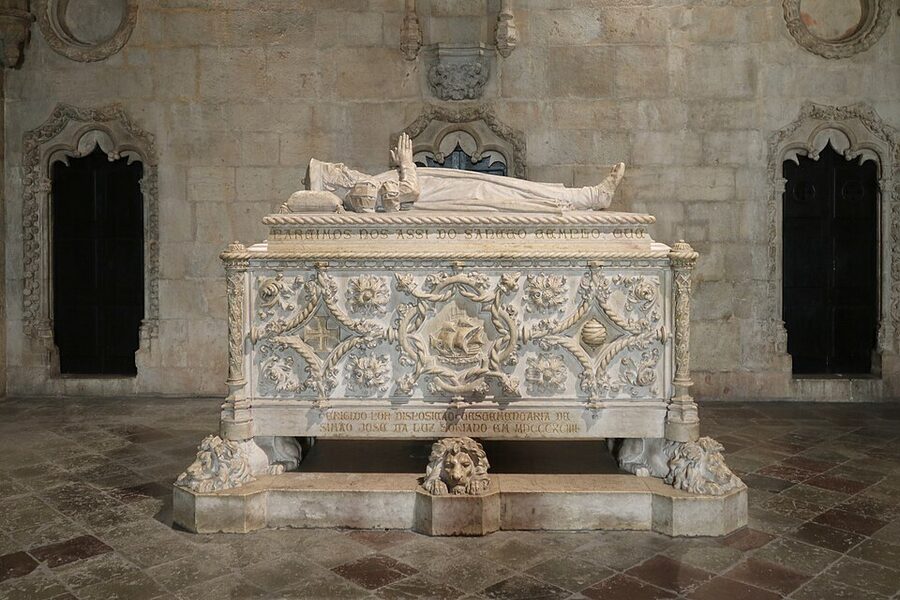
The two tombs at the church entrance are the reason most non-architecture-nerds care about Jerónimos. On the left as you walk in, Vasco da Gama: the navigator who in 1498 became the first European to reach India by sea, opening the spice route that paid for this entire monastery. The tomb is 19th-century neo-Manueline (it was sculpted in 1894 to match the building, not the man’s actual era), but the iconography is straight from the explorer’s life: ships, ropes, the cross of the Order of Christ.
On the right, Luís Vaz de Camões, the poet whose epic Os Lusíadas turned the same voyage into Portugal’s national myth. Camões is the Portuguese Shakespeare. School children memorise lines from the poem the way English-speaking kids memorise Hamlet. His tomb sits opposite Vasco da Gama’s because the country wanted the explorer and the storyteller of the explorer paired.
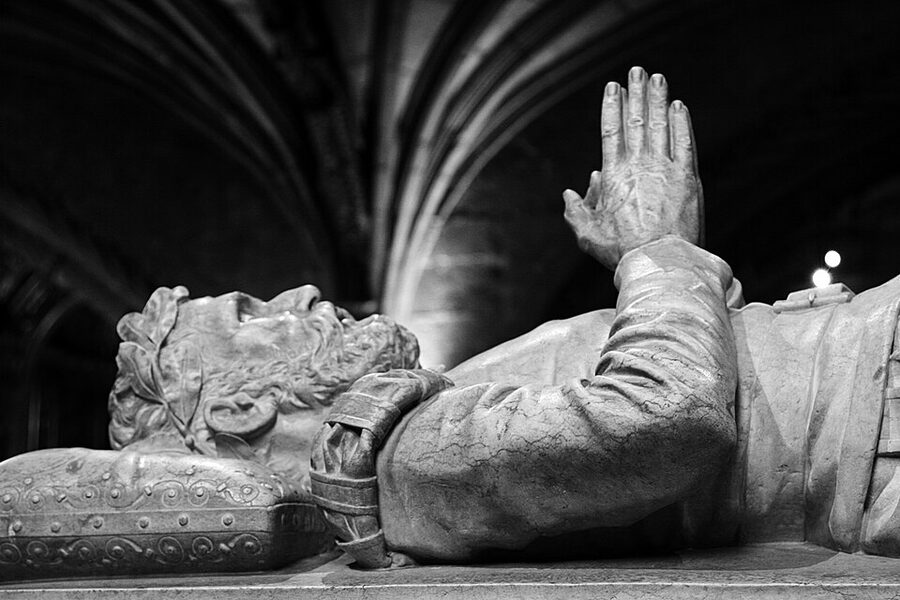
Practical note: both tombs are in the church, which is free. You don’t need a paid ticket to see them. If you only have an hour in Belém and the cloister queue is long, walk straight into the church, see the tombs, look up at the nave, walk out, and use the rest of your time on the tuk-tuk loop or the riverside. End the day with a Fado show in Alfama and you’ve got the Discoveries-and-saudade pairing in a single Lisbon day. The cloister is worth queuing for if you have time. The tombs are worth seeing even if you don’t.
The cloister, in slow motion
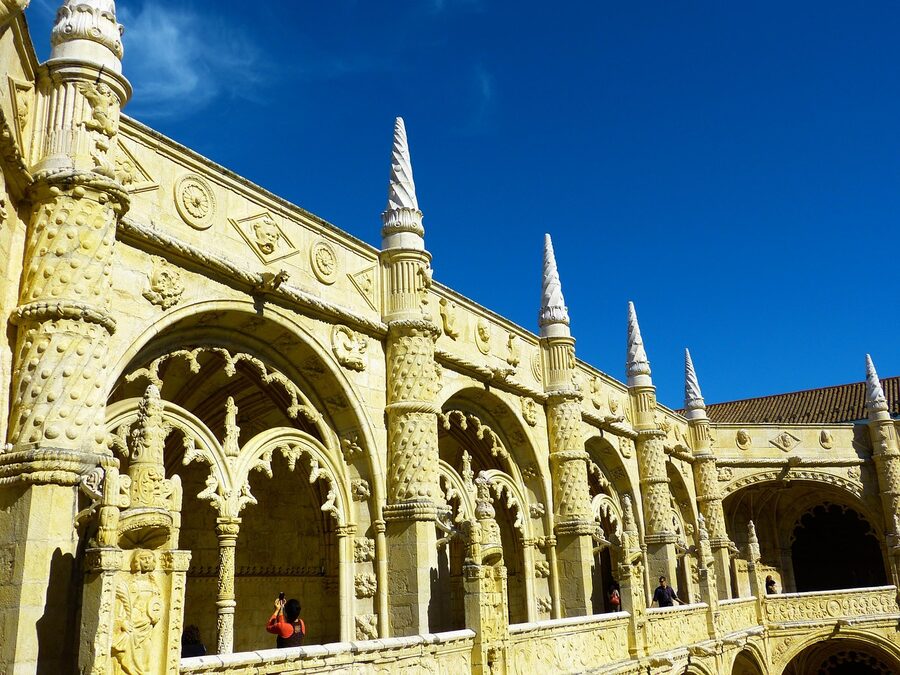
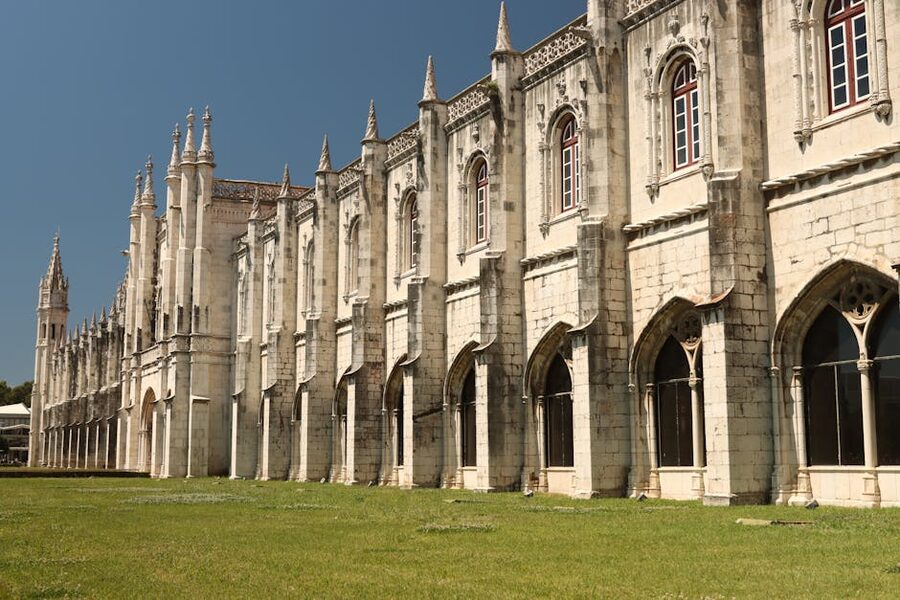
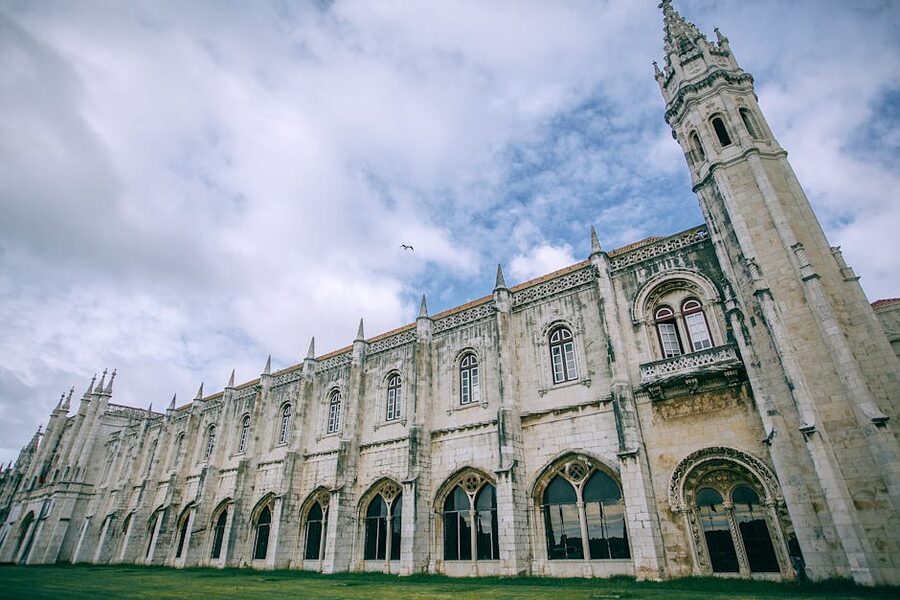
The cloister is two storeys of carved limestone arranged around a square. Diogo de Boytac started it in 1502 in a transitional Late-Gothic style. João de Castilho took over from 1517 and pushed it deeper into the Manueline. They didn’t tear out the older work; they layered new carvings on top of it. The result is one cloister with two visible centuries of taste, side by side, and the contrast is the point. If you’ve already seen the comparable transitional layering at the Mezquita in Córdoba, the Jerónimos cloister will read like its Atlantic-facing cousin.
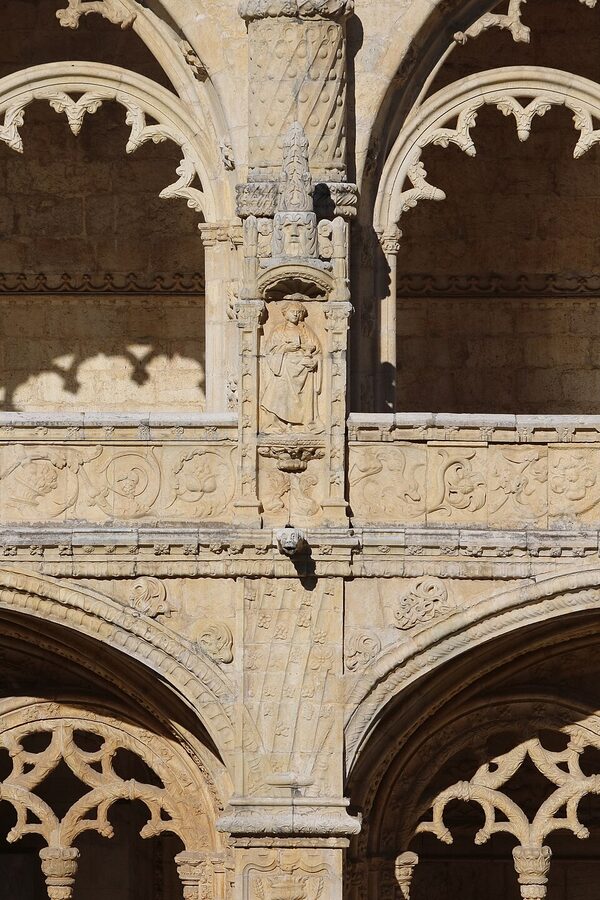
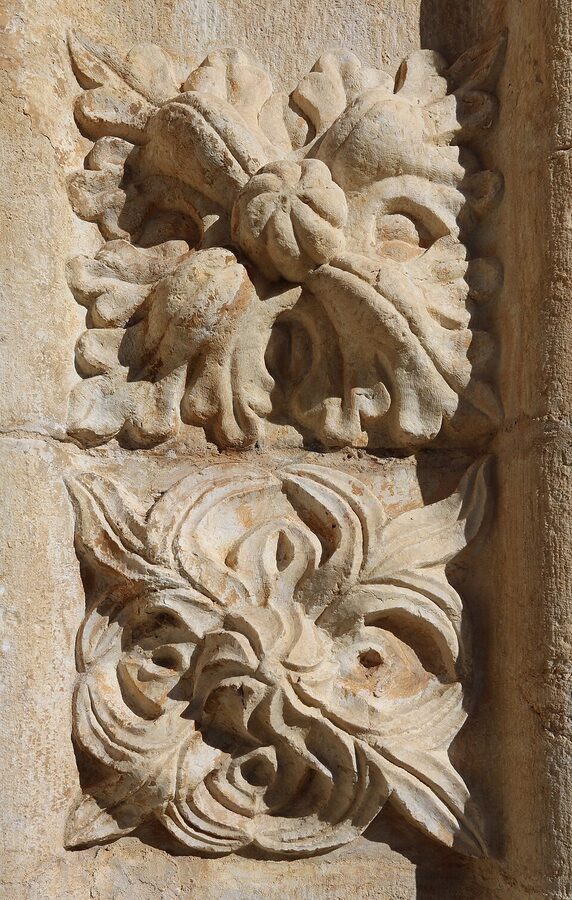
What to look for, in order. The columns: twisted ropes spiral up from the base. These are direct copies of the rope-work on the caravels of the Discovery fleet. Look at the join between two ropes; some have actual carved knots. The capitals: seashells, sea creatures, half-fish, half-foliage hybrids. Spice-route iconography pretending to be classical decoration. The pilasters: armillary spheres (Manuel I’s personal symbol), the cross of the Order of Christ (the church-and-state alliance that funded the voyages), and the occasional armorial shield.
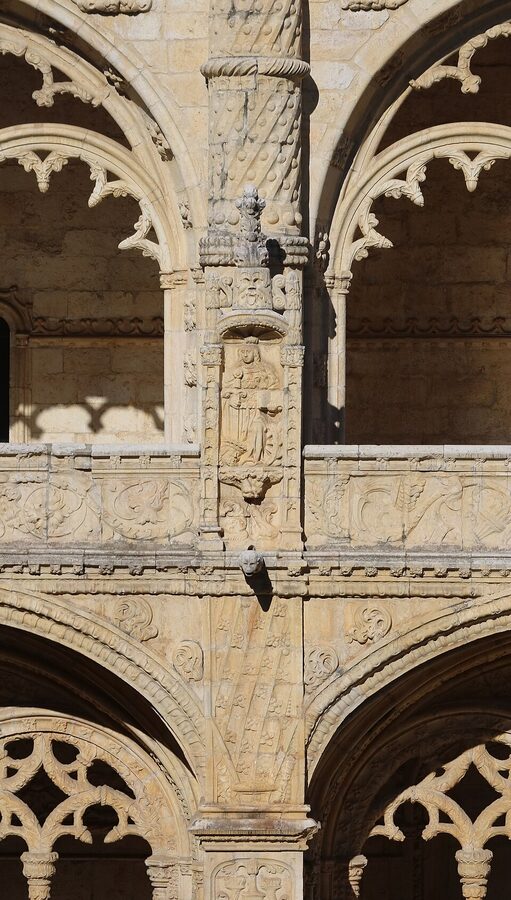
Up the stairs to the second level. This is where the light comes in best between 10:30 and noon. The arches up here are simpler, more Renaissance, less Manueline excess, but the views down into the courtyard are the photo most people remember. Go all the way around. The east side has the old refectory door. The north has the entrance to the chapter house.
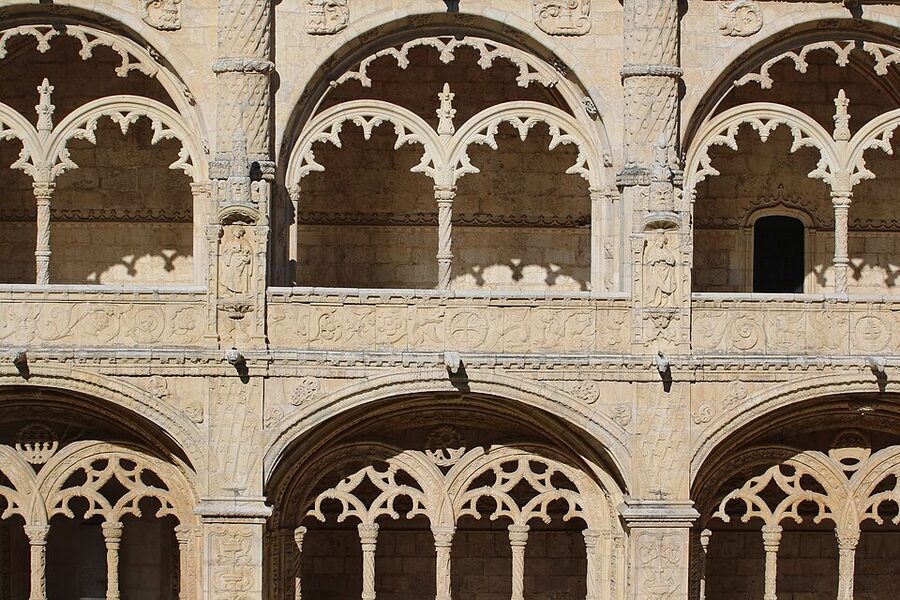
If you’re not on a guided tour, give yourself at least 90 minutes. People rush this in 30 and miss the whole point. The cloister rewards slow looking. Sit on one of the stone benches around the courtyard for ten minutes and let your eye wander up the columns. That’s when the carvings start reading like a story instead of a pattern.
Inside the church: the nave, the south portal, the light
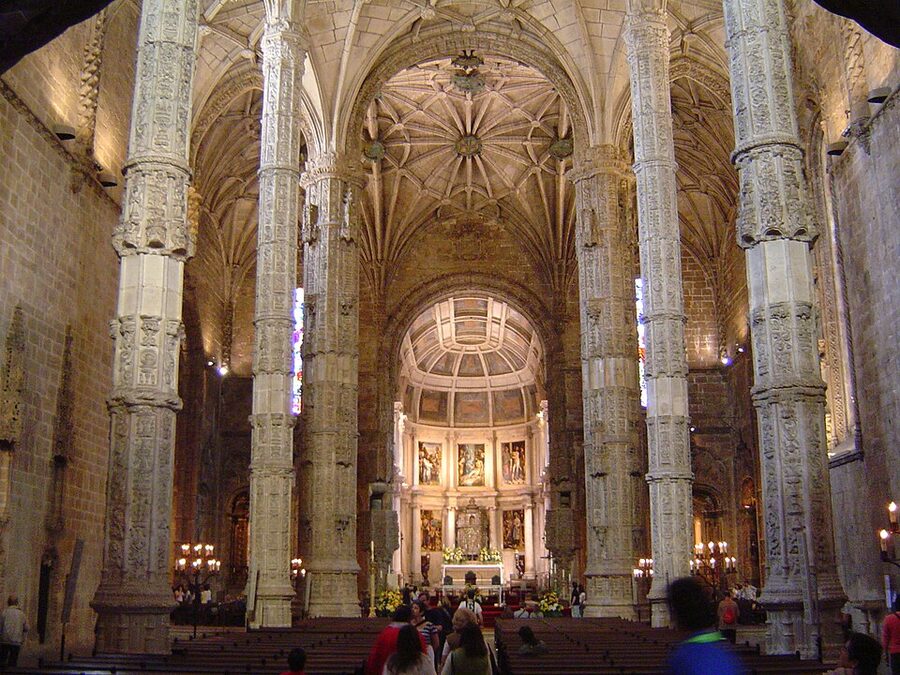
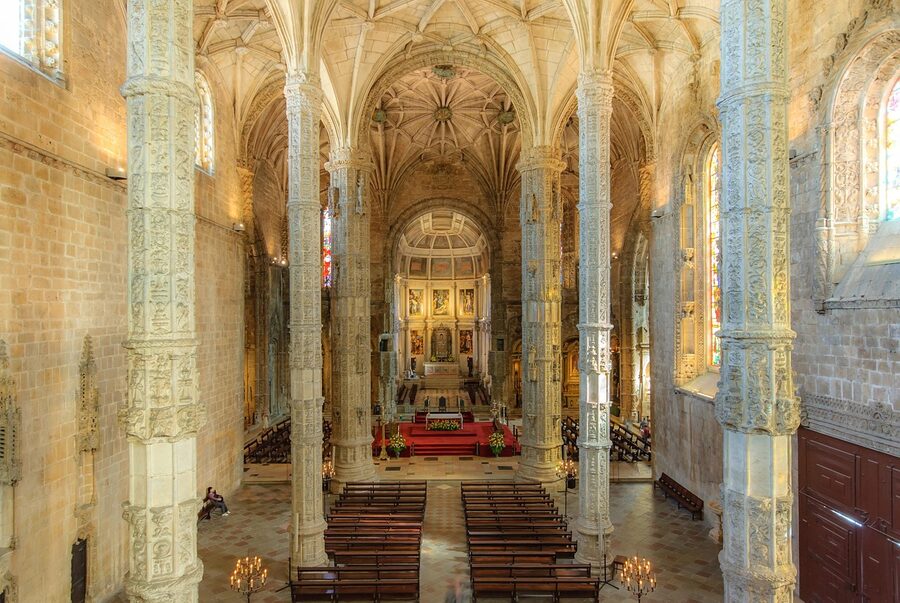
The church next door to the cloister is the other half of the building and the part that doesn’t cost you anything. Walk in via the side door (the south portal is the more spectacular entrance, but it’s usually closed for liturgical reasons; the side door takes you in). The first thing that hits you is scale. The nave is one room, vast, with six columns holding up a single ribbed vault that spans roughly 30 metres. The columns are carved with the same Manueline rope work as the cloister.
The light in here is theatrical in a different way than the cloister. The cloister is sun-and-shadow. The church is filtered through stained glass and tends to feel cool and blue in the mornings, warmer and amber in the late afternoon. If you can be inside between 4 and 5pm in summer, the western windows light the columns from the side and it’s worth the wait. The same warm-late-afternoon trick works at the Royal Palace in Madrid if you’re heading there next.
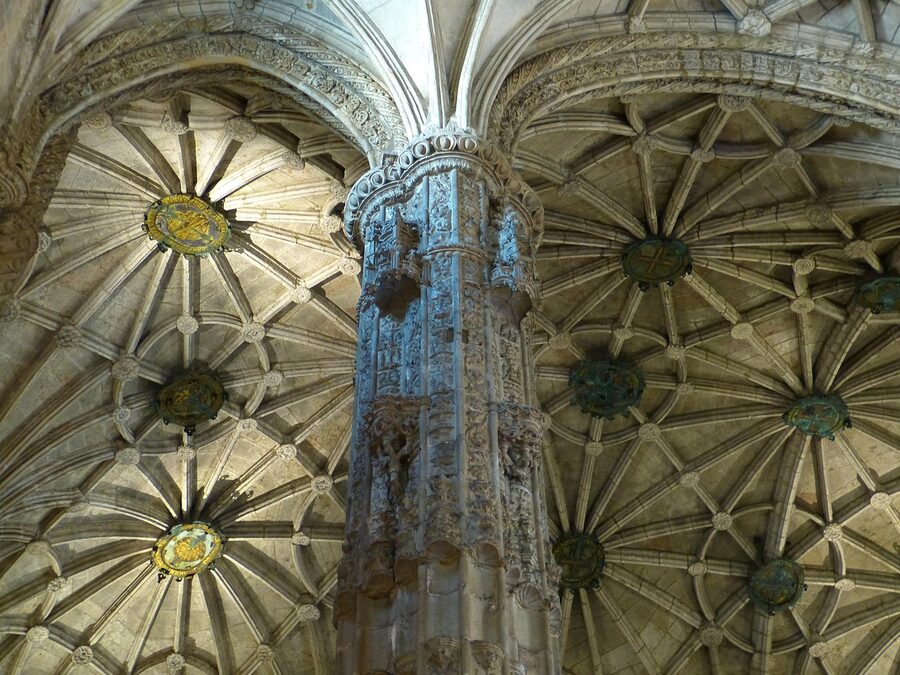
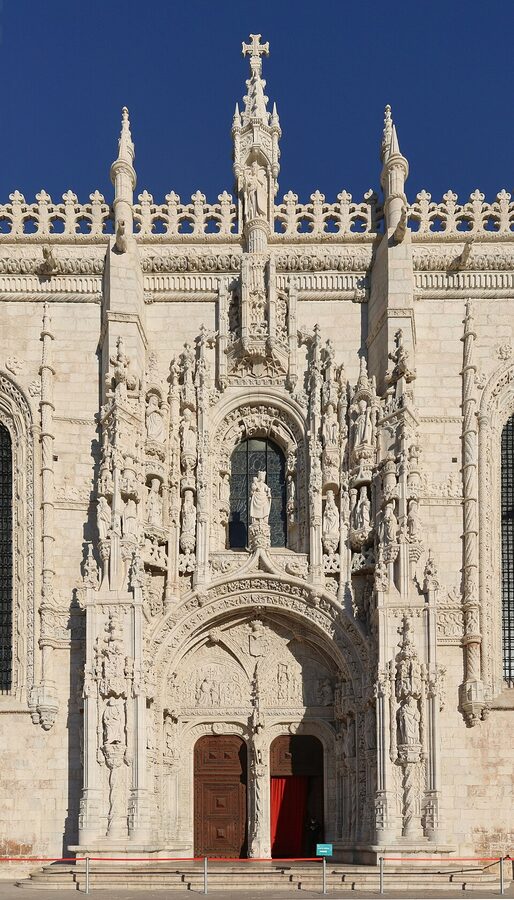
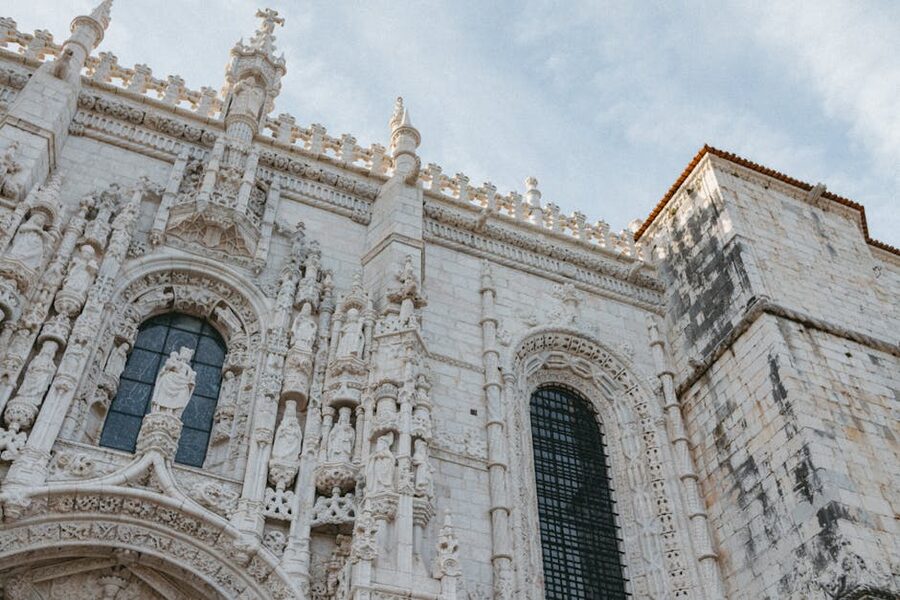
The south portal. Even though you usually can’t enter through it, walk around the outside of the church to see it. It’s a 30-metre-tall pile of carved limestone with the Virgin (Santa Maria de Belém) at the centre, the Archangel Michael at the top, and a riot of saints and shields and small figures in every niche. The carving was directed by João de Castilho and finished around 1517. It’s the most photographed exterior detail of the building for a reason.
How long to actually plan
Bare minimum, you can do the church in 20 minutes and the cloister in 40. That’s the cruise-day-tripper version. I’d plan two hours minimum for the monastery alone, three if you want to read placards or listen to an audio guide.
If you’re combining it with the rest of Belém, plan a half-day. Belém is a 1.5-kilometre strip running along the Tagus from the Monument to the Discoveries to Belém Tower, with the monastery on the inland side roughly in the middle. Walking pace, with stops, the strip takes two to three hours. Add lunch and the Pastéis stop and you’re at five.
The take after a few visits: if you’ve only got one day in Lisbon, skip Belém and stay in the city centre. Belém is a half-day on its own, not a quick add-on. If you’ve got two days, day one in the centre on a guided city walking tour, day two in Belém. If you’ve got three, push Sintra in, with Pena Palace as the standout if you only want the painted-palace photo.
Pastéis de Belém across the road
You can’t write about Jerónimos without writing about Pastéis de Belém, the pastry shop directly across the road that has been baking the original recipe since 1837. The story goes that monks at Jerónimos invented the egg-yolk-custard tart using leftover yolks (the whites went into starching habits and clarifying wine). When the monastery was secularised in the 1830s, the recipe got sold to a sugar-cane refinery next door, which became the bakery. The recipe has stayed in the family since.
The two reasons it’s worth the queue: one, the custard is genuinely better than the supermarket version, with a flakier pastry and a cream that tastes more egg-forward and less starchy. Two, you eat them warm, dusted with cinnamon and powdered sugar at the counter, with a bica (Lisbon espresso) standing up at the bar.
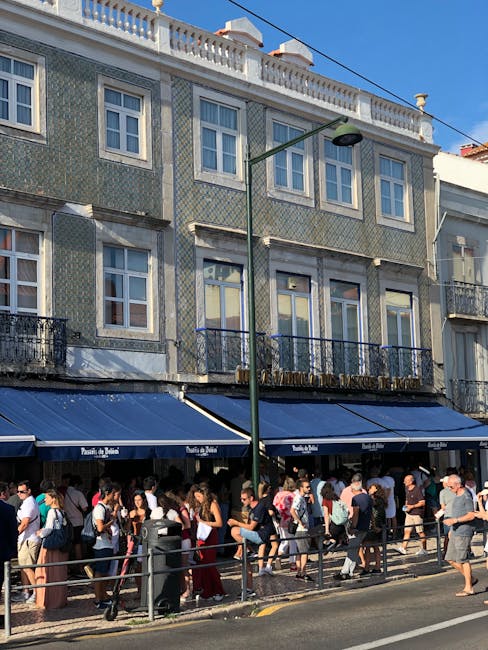
The queue trick. The line you see outside is the takeout line. Walk inside, past the counter, into the back, and there’s a sit-down dining hall that’s almost always immediately available. You can order the same pastéis there with no wait. Most foreign tourists don’t know this and stand in the takeout queue for 30 minutes when they could have been seated in three. The takeout pastries are slightly cheaper per unit, but you save 25 minutes of your life.

How many to order: two each. They’re small. Three is one too many and ruins the next meal. Two is the right number, with a coffee.
Belém Tower and the rest of the strip
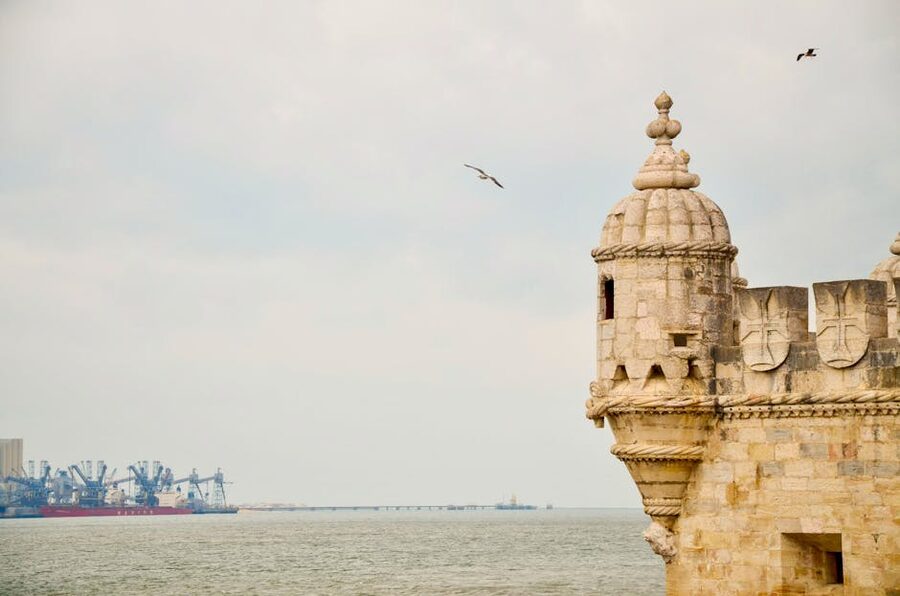
Belém Tower (Torre de Belém) is the other UNESCO-listed Manueline monument in Belém and the one most often photographed alongside Jerónimos. It’s a separate ticket. The combined ticket exists but isn’t always the best deal if Belém Tower is closed for restoration, which it has been on and off for the last few years. Check the official site for current opening status before you book a combo.
If the tower is open, plan an extra hour to climb the narrow spiral staircase to the top. The views are over the river toward the south bank and the Christ statue. If the tower is closed, the exterior view from the riverside is still worth a 10-minute detour from the monastery. The same Iberian-fortress-with-a-river view appears at the Real Alcázar in Seville, with palms rather than the Tagus but the same coastal-empire energy.
Other Belém stops worth knowing about. The Monument to the Discoveries (Padrão dos Descobrimentos) is a 1960 limestone sculpture honouring the navigators, with a viewing platform on top. The Coach Museum (Museu Nacional dos Coches) holds Europe’s best collection of 17th- and 18th-century royal carriages, which is more interesting than it sounds. And the Cultural Centre of Belém hosts contemporary art that contrasts well with the Manueline overload of the monastery.
How to get to Belém from central Lisbon
Belém sits about 6 kilometres west of central Lisbon. Three transit options.
Tram 15E from Praça da Figueira or Praça do Comércio is the slowest but the most scenic, about 30 to 40 minutes depending on traffic, and gives you a riverside ride past the docks and the Monsanto woods. It’s also the most likely to be packed with tourists, so don’t expect a seat.
Bus 728 or 714 from various central stops gets you there in 20 to 30 minutes. The 728 from Cais do Sodré is the most useful. Buses run more frequently than trams and the standard transit ticket covers them.
Train on the Cascais Line from Cais do Sodré to Belém station is the fastest, about 8 minutes, and you walk 5 minutes from the station to the monastery. This is what I do if I’m in a hurry. The train uses the same standard zapping card as the metro and trams.
If you’ve bought a Lisbon Card, all three transit options are included. If you’ve booked a tuk-tuk tour with hotel pickup, the driver does the journey for you and stops at the photo points along the way. A taxi or rideshare costs around 12 to 15 euros from central Lisbon and saves no real time once you factor in walking from the drop-off point.
What guides won’t tell you
A few takeaways after multiple visits.
The cloister is genuinely worth the entrance fee. The church alone, free as it is, can feel a bit thin if you’ve spent five minutes inside and walked out without seeing the cloister. Don’t skip the paid bit. If 18 euros feels like a lot, remember it covers a 90-minute slow walk through one of the world’s better Renaissance-era buildings.
The acoustics inside the church are unusual. If you happen to catch a service or even a single chorister rehearsing, stop and listen. I’ve twice walked in mid-week and found a soloist practising for evening Mass; the sound carries.
Photography rules are loose but not absent. Tripods are not allowed without permission. Flash is supposed to be off. Most staff don’t enforce either rule strictly during normal opening hours but will if you’re being obvious about it. If you want the empty-cloister photo, you have to be there at 9:30am opening, which is also when the soft morning light is best.
Crowds. The single worst time to visit is between 1pm and 3pm on a Saturday in August, when cruise day groups, day-trip coaches from the Algarve, and weekend Lisbon residents all overlap. Even with a timed ticket the cloister gets uncomfortably full. Aim for Tuesday morning, Wednesday morning, or Thursday morning, in that order.
Tickets, refunds, the small print
If you buy through the official site at museusemonumentos.pt, refunds depend on timing: usually a full refund if cancelled 24 hours before your slot, no refund within 24 hours. The site has had some interface friction in the past, so if you have payment trouble, try a different browser before you give up.
If you buy through a third-party reseller (which is what most online ticket pages are), check the cancellation terms before booking. Most allow free cancellation up to 24 hours before. The mobile voucher gets emailed to you and is what you show at the entrance scanner. You don’t need to print anything.
If you’ve bought a Lisbon Card, present the physical card at the ticket office with your ID; staff will issue you a paper entry voucher there. The card holders’ line is sometimes shorter than the regular ticket line, sometimes not.
Bringing it together
The right booking depends on what kind of trip you’re on. If Lisbon is a one-day cruise stop, get the solo entrance ticket and walk yourself through the cloister with the audio guide; pair it with the church and Pastéis and call it a half-day. If you’re staying two or three days and treating Belém as a half-day excursion, take the small-group walking tour because the carvings need narration to come alive. If your dates are tight and the small-group is sold out, the cheaper Belém walking variant is the same idea at a slightly larger group size.
Whatever you book, give the monastery the time it deserves. This building sits at the corner of religion, money, and Empire, and the carvings are a national history class compressed into a single courtyard. Rushing it is the one mistake I’ve watched the most cruise-tour groups make. Don’t be the one with the 30-minute cloister photo.
More from the Portugal cluster, and beyond
If you’re combining Belém with the rest of Lisbon over a few days, two evenings worth booking: a traditional Fado show in Alfama and a guided central-Lisbon walking tour that covers the 1755 earthquake story. Add a day for Sintra if you have time, and a tuk-tuk loop on a tired afternoon. Spain’s Iberian cousins to Jerónimos are worth queuing for too: the Seville Cathedral and the Alhambra in Granada sit in the same Age-of-Discovery story arc and reward the same kind of slow looking.