
I’ve queued at the Louvre twice in my life. The first time I walked up without a ticket on an Easter Monday and stood in the Pyramid courtyard for eighty-seven minutes. The second time I walked past that same line, past security, past the audio-guide counter, and was standing in front of the Mona Lisa twelve minutes after I came through the door. The difference was a $26 ticket booked the night before on my phone.
Here’s how Louvre booking actually works, which ticket type to pick, and which three tours are worth the extra money.

- Short On Time? Three Louvre Tickets Worth Booking
- Why You Need to Book the Louvre Before You Fly
- Which Louvre Ticket to Actually Buy
- The Three Louvre Tickets I’d Actually Book
- 1. Paris: Louvre Museum Timed-Entrance Ticket —
- 2. Paris: Skip-the-Line Louvre Masterpieces Guided Tour —
- 3. Paris: Louvre Timed-Entrance Ticket and Seine Cruise — 0
- When to Visit — The Days and Times That Actually Matter
- How to Get In When Tickets Are Sold Out
- Which Entrance to Use
- What to See First (And What to Skip)
- A Quick History You’ll Want to Know
- Practical Tips Nobody Puts in the Brochure
- How the Louvre Fits With the Rest of Paris
- Where the Louvre Sits in a European Trip
- If You Only Read One Section
- More Paris Tickets Worth Booking Before You Fly
Short On Time? Three Louvre Tickets Worth Booking
- Paris: Louvre Museum Timed-Entrance Ticket — $26. The flagship entry ticket. Pick a 30-minute arrival window and walk straight in. Comes with an audio guide.
- Paris: Skip-the-Line Louvre Masterpieces Guided Tour — $80. Three hours with an art historian who routes you past the paintings you actually want to see. Worth the upgrade if it’s your first visit.
- Paris: Louvre Timed-Entrance Ticket and Seine Cruise — $100. Louvre in the morning, river cruise in the afternoon, two of the four flagship Paris experiences ticked off in one day.
Why You Need to Book the Louvre Before You Fly

The Louvre caps daily entry at 30,000 visitors. It used to be 45,000 before the pandemic, and the new director has held the lower number ever since. That cap is the single most important thing to understand about Louvre booking.
What the cap means in practice: time slots sell out. On a quiet February Tuesday you can book a same-day 2pm slot and walk in. On any Saturday, during any school holiday, during the week either side of Easter, Christmas, or any August afternoon, slots are gone weeks in advance. I’ve watched friends land at CDG on a Friday and spend forty minutes refreshing the official site looking for a Saturday slot that doesn’t exist.
Book at least ten days out for off-peak visits. For peak season (see below) you want three to four weeks minimum. If you’ve left it too late, there are workarounds — I’ll cover those in a minute.
Which Louvre Ticket to Actually Buy

Four ticket types cover almost every visit:
Timed-entrance ticket (~$26). This is the standard adult ticket. You pick a 30-minute window, show up anytime inside it, go through security, scan your QR code, and you’re in. You can stay inside all day — the timed slot only controls when you arrive, not how long you stay. This is what I’d buy 80% of the time.
Priority access with host (~$30-40). A human being meets you at the pyramid, walks you past the main queue, and points you down to the Denon Wing. No tour, just the skip. Useful if you’re travelling with someone who would panic at the Pyramid crowds, but the timed-entrance ticket already skips the line, so this is overkill for most.
Guided tour (~$80-120). Two or three hours with an art historian, usually capped at 6-25 people. The guide plans the route, tells you which paintings matter and why, and — this is the hidden value — gets you through security faster as a group. Book this for your first visit.
Combo ticket (~$100-130). Louvre + Seine cruise, Louvre + Versailles, Louvre + Orsay. Combos work if you’re pairing two things you’d buy separately anyway. They rarely save money, but they save the hassle of booking the second thing and coordinating the times.
The Three Louvre Tickets I’d Actually Book
I’ve been through the listings on GetYourGuide, Tiqets, Headout, and the official ticket.louvre.fr a dozen times over the years. These three are the ones that keep earning their recommendation.

1. Paris: Louvre Museum Timed-Entrance Ticket — $26

The booking most Paris travellers should make before anything else. Our full review covers the 30-minute flex window and the audio guide you get thrown in. Two genuine tips: pick a 9am or 9:30am slot if you care about seeing the Mona Lisa without a scrum, and head straight to the Denon Wing, first floor, Room 711.
2. Paris: Skip-the-Line Louvre Masterpieces Guided Tour — $80
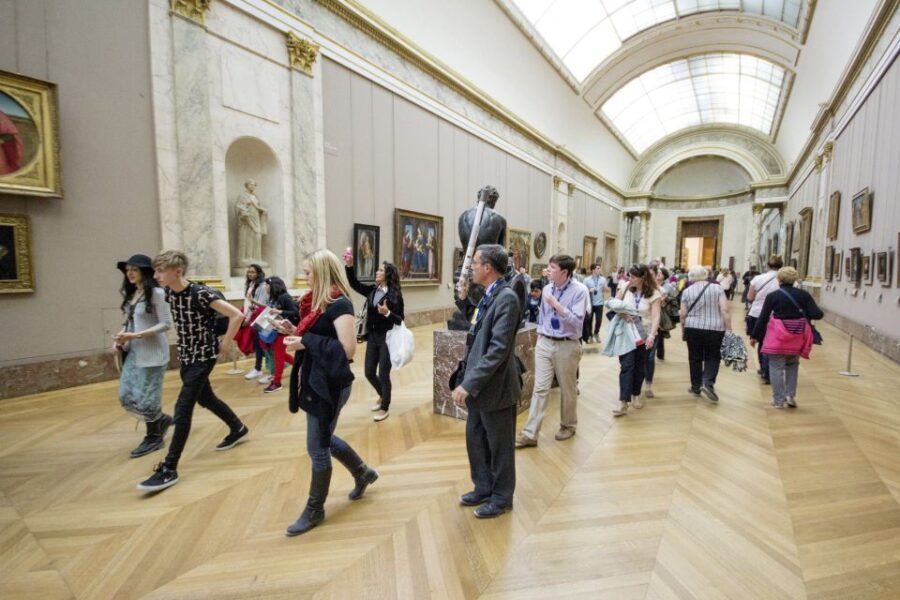
If this is your first Louvre, book this over the basic ticket. Our review gets into the three-hour route — Mona Lisa, Venus de Milo, Winged Victory, Coronation of Napoleon, the Italian Renaissance room, the Egyptian antiquities. The guide is the difference between “saw a lot of paintings” and “understood what I was looking at”.
3. Paris: Louvre Timed-Entrance Ticket and Seine Cruise — $100

The combo I’d pick if I had 48 hours in Paris and wanted to tick the big boxes without micro-planning. Our review walks through the timing — you do the museum in the morning while you’re fresh, then the one-hour Seine cruise at 6pm or 7pm when the light is best. Two bookings, one confirmation email, and the price is roughly what you’d pay for each separately.
When to Visit — The Days and Times That Actually Matter

The Louvre is closed on Tuesdays. Every Tuesday, all year. If you have four days in Paris, don’t waste a morning showing up to a locked pyramid — it happens more than you’d think.
Standard hours are 9am to 6pm, Wednesday to Monday. On Wednesdays and Fridays the museum stays open until 9:45pm, with last admission at 9pm. This is the single best piece of information in the whole article. Book a 6pm or 7pm slot on a Wednesday or Friday and you’ll have the Grande Galerie nearly to yourself. The Mona Lisa still draws a crowd, but the rest of the collection empties out.

The rooms start clearing at 5:30pm on standard days, 9:30pm on late nights. Don’t wander into a wing at closing and expect to browse — the guards are polite but firm, and they herd you out.
Peak season for the Louvre is Christmas week, Easter fortnight, and July through mid-August. On any day during those windows, expect same-day tickets to be sold out and the queue to be 90-minute territory. The shoulder months (October, November, late January through March) are where the museum is bookable and the Mona Lisa room is manageable.
How to Get In When Tickets Are Sold Out

The Louvre website shows a lot of “complet” (sold out) days, particularly in peak season. Here’s the trick most Paris-based guides know and most tourists don’t: the Louvre releases new stock between 9am and 10am Paris time the day before or the morning of. If a date you need is showing sold out today, set an alarm for 9am Paris time tomorrow and refresh.
The releases happen because pre-booked groups fall through, tour operators return unused allocations, or the museum reassesses capacity. Availability is real but fleeting — I’ve seen a Saturday 10am slot appear and disappear inside three minutes.
Second option: book a guided tour instead. Tour operators have their own ticket allocations, separate from the public pool. When the official site says “complet” for a Saturday, GetYourGuide and Viator often still have guided-tour slots for the same day. The tour costs more, but the ticket is included. I’ve used this twice when the official site failed me.
Third option: show up at 4pm. The Louvre still sells same-day tickets at the desk inside. Peak season these may also be unavailable, but on a normal Wednesday or Friday at 4pm the desk is quiet and the queue to get through security is short because most people are leaving. It’s not guaranteed. But I’ve used it once as a backup and it worked.
What to avoid: Third-party “last-minute Louvre” sites selling tickets at 2-3x face value. Some of them are legitimate resellers working with operator inventory, but a non-trivial number are scams or sell tickets that don’t guarantee entry. If the price looks too good compared to GYG, or suspiciously high, close the tab.
Which Entrance to Use

Three entrances in, and most tourists only know about one:
Pyramid (Cour Napoleon). The famous one. Security here is the slowest because it’s also the entrance for anyone without a ticket. Pre-booked ticket holders have a separate priority lane, but on busy days it’s still a 15-minute wait.
Carrousel du Louvre (underground mall). Access through the shopping gallery on Rue de Rivoli or direct from Palais Royal Musee du Louvre metro. Usually the fastest security line if you have a pre-booked ticket. This is the one I default to.

Porte des Lions. The south-side entrance on the Seine, closer to the Pont du Carrousel. Only open when the Denon Wing is open (so not Fridays when it sometimes closes), and only for ticket holders. It’s the best-kept secret of the three — often zero queue. If you booked the Mona Lisa tour, this door drops you one escalator from her.
All three entrances go through the same central lobby under the pyramid. Once you’re in, you’re in.
What to See First (And What to Skip)

The museum has 33,000 artworks on display across 73,000 square metres. You will not see them all. You should not try.
If you have two hours, head for three things: the Mona Lisa (Denon Wing, first floor, Room 711), the Winged Victory of Samothrace on the Daru Staircase (you pass this on the way to the Mona Lisa), and the Venus de Milo (Sully Wing, Room 346). Go in that order — Mona Lisa first before the crowd peaks, then loop back past Winged Victory, then drift to Venus. All three are within a ten-minute walk of each other.

If you have four hours, add the Italian Renaissance Grande Galerie (Denon, first floor — the same corridor the Mona Lisa sits off), the Coronation of Napoleon by Jacques-Louis David (Denon, Room 702, next door to the Mona Lisa), the Liberty Leading the People by Delacroix (Denon, Room 700), and The Wedding Feast at Cana by Veronese — which hangs directly opposite the Mona Lisa and is twenty times her size but fifty times less crowded.


If you have a full day, add the Egyptian Antiquities on the ground and first floors of the Sully Wing (a collection good enough that people fly to Paris specifically for it) and the Apartments of Napoleon III in the Richelieu Wing, which are free to enter and rarely crowded and genuinely one of the most opulent interiors I’ve seen anywhere.


What I’d skip on a first visit: Islamic Art (beautiful but so secondary to the headline collections that it should wait for visit two), Decorative Arts in Richelieu (fine, not urgent), and the temporary exhibitions unless the specific show is why you came.
A Quick History You’ll Want to Know

The Louvre started as a fortress in 1190. Philip II built it on the western edge of medieval Paris to defend against Viking raids coming up the Seine. You can still see the foundations — go down to the Sully Wing, lowest level, and you’ll walk through the medieval moat.
It became a royal palace in the 14th century, then the official Paris residence of the French kings until Louis XIV moved the court to Versailles in 1682. The collection started here — Francois I bought the Mona Lisa from Leonardo da Vinci in 1518, and by the time Napoleon came along there was a serious hoard of royal art in the palace.
The museum opened to the public in 1793, during the Revolution. The old royal collection plus the art Napoleon would go on to “acquire” across Europe turned it into the biggest museum in the world by collection size and floor area, which it still is.

The I.M. Pei glass pyramid went up in 1989. Parisians hated it at first — a Chinese-American architect, modernist glass, stuck in the middle of a Napoleonic courtyard. Now it’s on every postcard. The pyramid isn’t decorative: it’s the functional entrance that channels everyone down into the central lobby where you access all three wings.
Practical Tips Nobody Puts in the Brochure

Arrive fifteen minutes early. Your 30-minute window starts when you scan, but you still have to clear security. On a peak day the priority-lane security wait is 10-12 minutes. If your slot is 10am-10:30am and you show up at 10:25am, you’ll miss the window and have to argue with staff.
Check bag size rules before you pack. Backpacks over 55cm x 35cm x 20cm have to go in the cloakroom, which adds 15-20 minutes to your visit on each end. A standard daypack is fine. A full-size trekking pack is not.
The free floor plan is at the info desk under the pyramid. Grab one before you go up into the collection. The Louvre’s own app has a similar map, but the paper version is faster to refer to mid-walk and doesn’t need your phone battery.
Under-18s go free with a valid ID. EU residents under 26 also go free. The under-18 rule applies to any nationality — bring a passport or ID card. You still need to book a timed-entry slot, but the ticket is free.
The cafe inside is fine for a coffee, not for lunch. The Cafe Mollien has a terrace looking over the Cour Napoleon and does decent espresso. For actual food, walk five minutes to the Palais Royal arcades or across to the Tuileries Gardens for a picnic.
First Saturday of the month, evening (6pm-9:45pm), is free to everyone. The catch: you still need a timed-entry ticket, and they go in about forty seconds. If you want to try, be refreshing the site at 9am Paris time two weeks before the first Saturday.
How the Louvre Fits With the Rest of Paris

Most Paris itineraries pair the Louvre with two or three other things on the same day. Some combinations work and some don’t.
The Louvre pairs well with a Seine River cruise (the boats dock just below the museum at Pont Neuf and Port de Solferino), the Tuileries Gardens (attached to the museum, no ticket), or Musee d’Orsay (a ten-minute walk across the Pont Royal — though two big museums in one day is exhausting).


It pairs poorly with the Eiffel Tower summit. Both are the kind of experience where you should be rested, fed, and not in a hurry, and trying to do both in a day means one of them gets shortchanged. I’d give them separate days.
Versailles takes a full day on its own — the train ride, the palace, the gardens, lunch. Don’t try to bolt a Louvre morning onto a Versailles afternoon. If you must, do the Louvre on a Wednesday or Friday evening after a morning at Versailles.
Where the Louvre Sits in a European Trip

If Paris is one stop on a wider trip, the Louvre is the one Paris attraction most worth defending a half-day for. Notre-Dame is still closed for post-fire scaffolding, Versailles is great but out of town, Sainte-Chapelle is breathtaking but 45 minutes and done. The Louvre is the one where the time investment pays back.
A clean two-day Paris plan: day one, Louvre in the morning (9am slot), Tuileries for lunch, Seine cruise at golden hour. Day two, Versailles in the morning, Paris neighbourhoods (Marais or Montmartre) in the afternoon. Fit the Eiffel on either day, depending on how you feel about crowds.
Three days, add the Montmartre walking tour, the Musee d’Orsay, and if you’re a modern art person the Pompidou. Anything past three days and you can start adding in the Catacombs and Orsay proper.
If You Only Read One Section

Book the timed-entrance ticket ten days out, pick a 9am slot or a 6pm Wednesday/Friday slot, enter at the Carrousel, head for the Denon Wing first. That’s 90% of the Louvre booking problem solved.
The other 10% is whether to upgrade to a guided tour for your first visit. If this is your first time and you want to understand what you’re looking at rather than just see it, book the $80 guided tour. If you’ve been before or you’re a confident museum-goer, the basic ticket is enough.
More Paris Tickets Worth Booking Before You Fly
If the Louvre is sorted, the next three bookings to get out of the way are the Eiffel Tower summit ticket, a Seine River cruise, and a Versailles day trip. All four of these book up in roughly the same way and roughly the same lead time, and doing them all on arrival day is a recipe for a miserable first 48 hours. If you’re continuing on to Asia after Paris, the same “book everything before you fly” discipline applies to the Tokyo samurai museum and anything involving a Mount Fuji day trip. The Louvre is the one I’d get booked first because it’s the hardest to fix last-minute.