
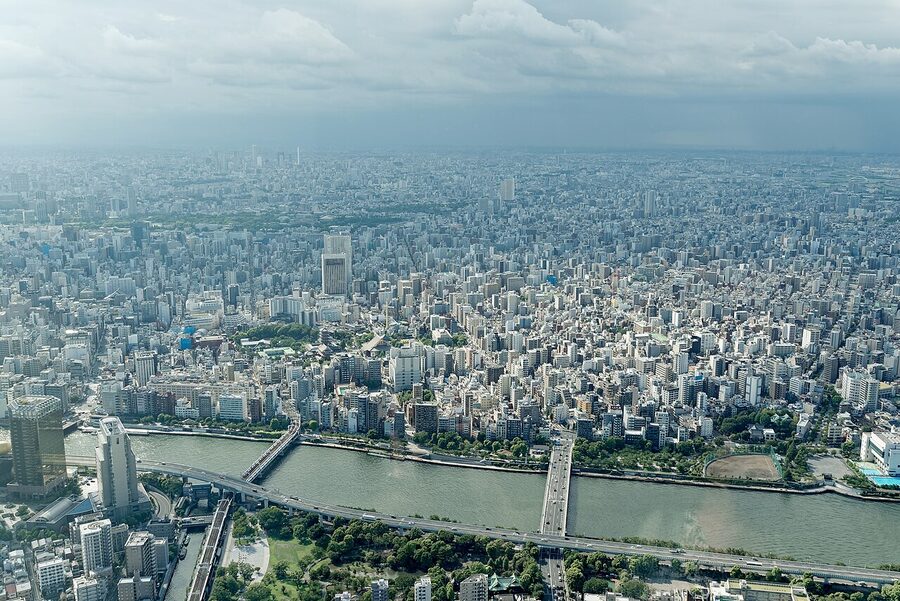
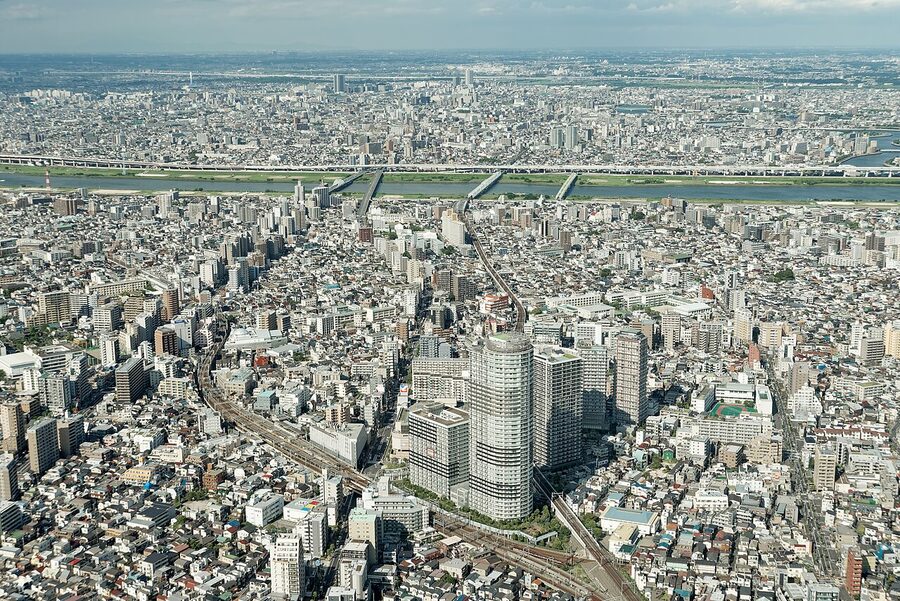
The lift doesn’t feel fast. You step in at ground level, the doors close, a small animated display runs through the four seasons while you ride, and about fifty seconds later the doors open and you’re standing 350 metres above Tokyo. The city you were walking through an hour ago — now a grey-brown carpet stretching to a horizon line that feels improbably far. Rivers, baseball stadiums, the Imperial Palace moat, the shinkansen tracks threading east out of the central wards. If the day is clear, Mt Fuji pokes up above the western suburbs, 80 km away, like a closing punctuation mark.
That’s the Tokyo Skytree. The world’s tallest freestanding tower when it opened in 2012, still one of the ten tallest structures of any kind today, and by a considerable margin Japan’s most-booked paid-entry landmark. Over 11,000 English-language reviews on the main admission ticket alone — that’s not counting the dozens of variant passes, combo tickets, and tours that funnel through it. The sheer volume is an indicator: this is the experience that visitors to Tokyo reliably say was worth their time.
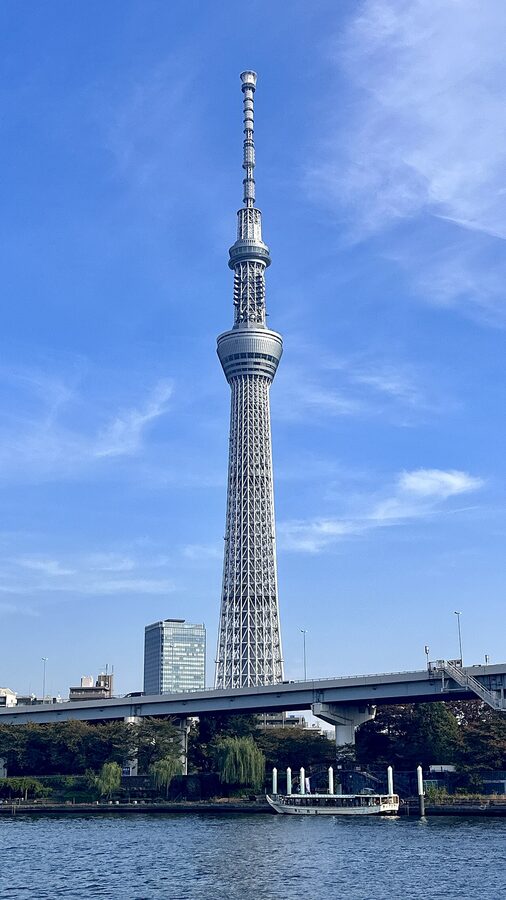
Booking it well is mostly a question of picking the right ticket type. This guide covers the three that matter.
Short on time? Here are my top picks:
Best everyday choice: Tokyo: Skytree Admission Ticket — $13, the flagship e-ticket. Skip the physical queue, enter at your booked time slot, head up to the Tembo Deck at 350m.
Best for the top-top deck: Tokyo Skytree Admission Ticket (Floor 350/450) — $16.42, includes both the Tembo Deck and the upper Tembo Galleria at 450m. Small upgrade fee, significant view upgrade.
Best flexible option: Tokyo Skytree Admission E-Tickets With Options — $14.49, generous cancellation policy and multiple entry-time windows to pick from.
- What the Skytree Is — In One Paragraph
- The 3 Best Tokyo Skytree Tickets
- 1. Tokyo: Skytree Admission Ticket —
- 2. Tokyo Skytree Admission Ticket (Floor 350/450) — .42
- 3. Tokyo Skytree Admission E-Tickets With Options — .49
- Going Up: What the Visit Actually Feels Like
- When to Go — Weather, Time of Day, and Crowd Strategy
- Skytree vs Tokyo Tower — Which Tower, and Why
- The Ground-Level Surround: Solamachi and Sumida
- History, Very Briefly
- Booking Tips
- More Tokyo Experiences
What the Skytree Is — In One Paragraph
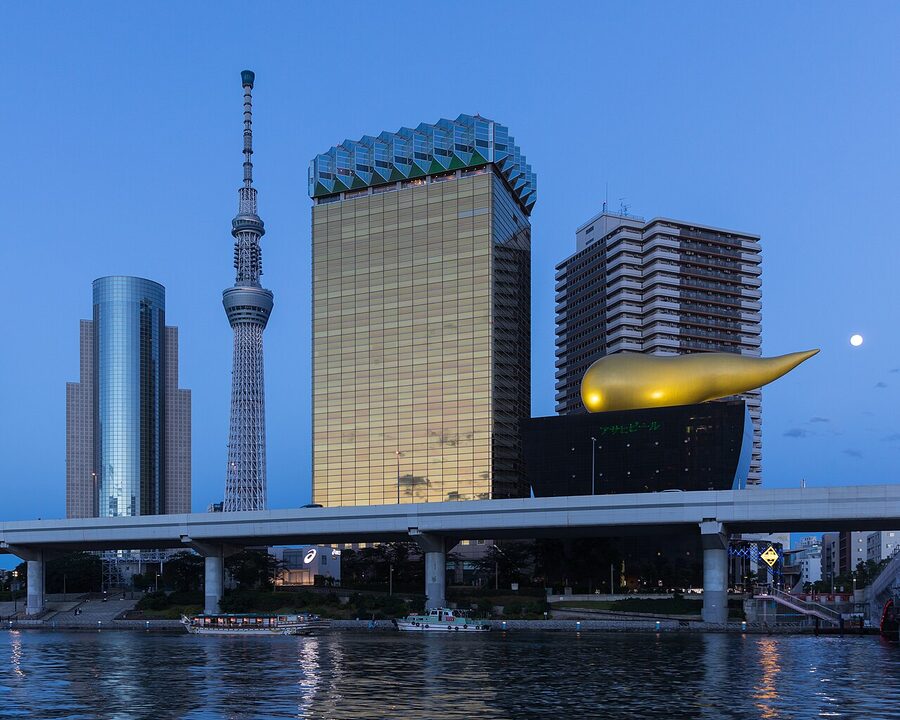
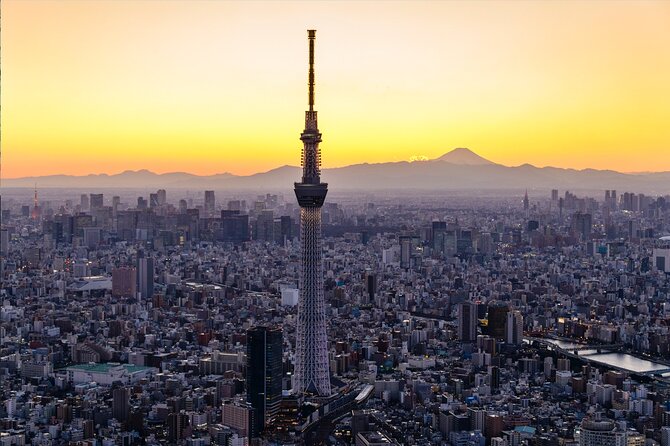
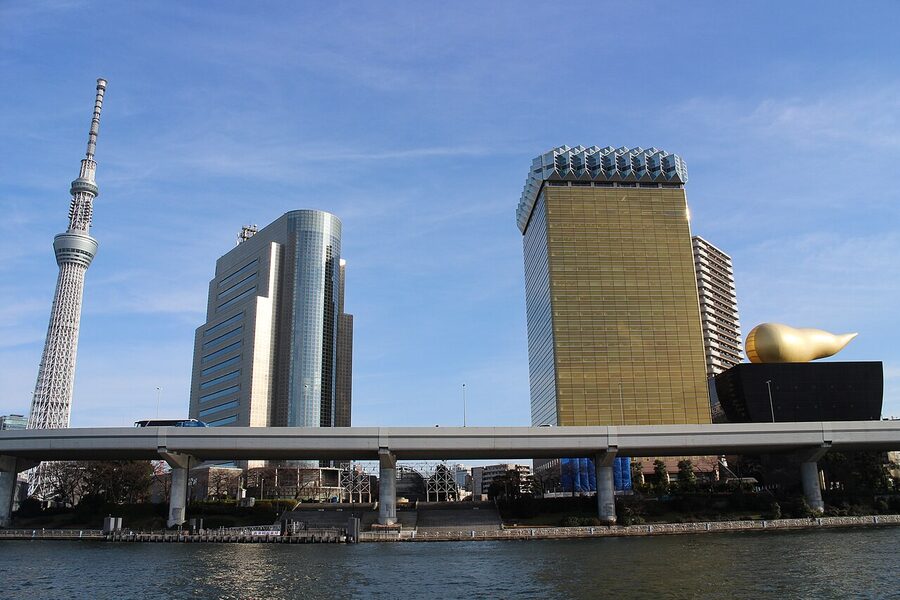
The Skytree is a broadcast tower that happens to also be a visitor attraction. It was built because Tokyo’s older broadcast tower — the orange-and-white Tokyo Tower — was being blocked by the city’s growing skyline, and the networks needed a taller mast to clear the new high-rises. The city took the opportunity to turn the engineering project into a landmark. Construction ran from 2008 to 2012, and the tower sits on the east bank of the Sumida River in a historically working-class neighbourhood that has since been rebranded as a shopping and entertainment district around its base.
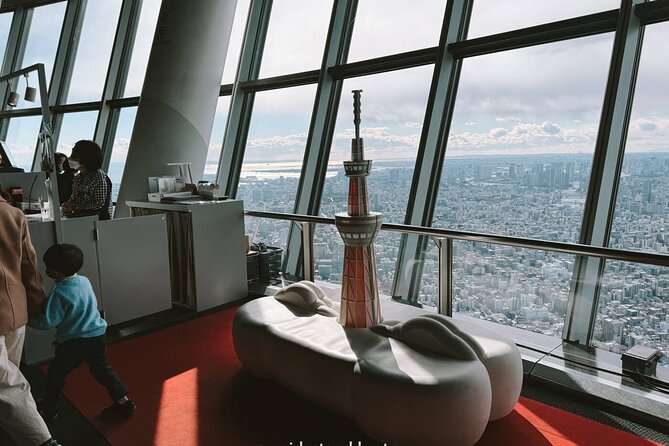
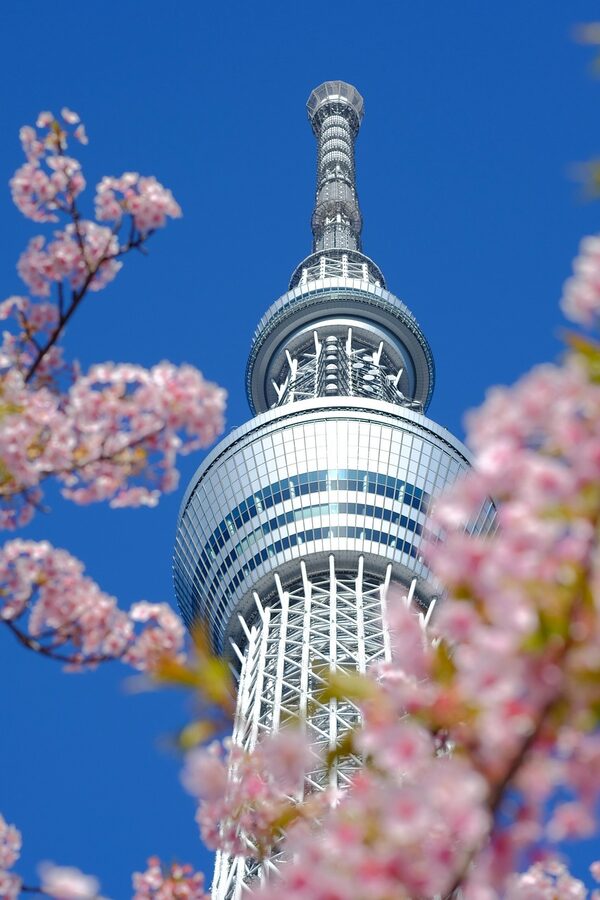
Inside the central concrete column, two sets of observation decks welcome visitors. The lower set is the Tembo Deck — three floors at roughly 340, 345, and 350 metres, with the main viewing windows and the glass floor panels that let you look straight down to the ground. The higher set is the Tembo Galleria at 445, 450 metres. These are reached via an enclosed spiral walkway that climbs the outer wall of the tower — you walk up rather than take a direct lift — which is part of the experience. Between the two, most visitors spend about 90 minutes inside.
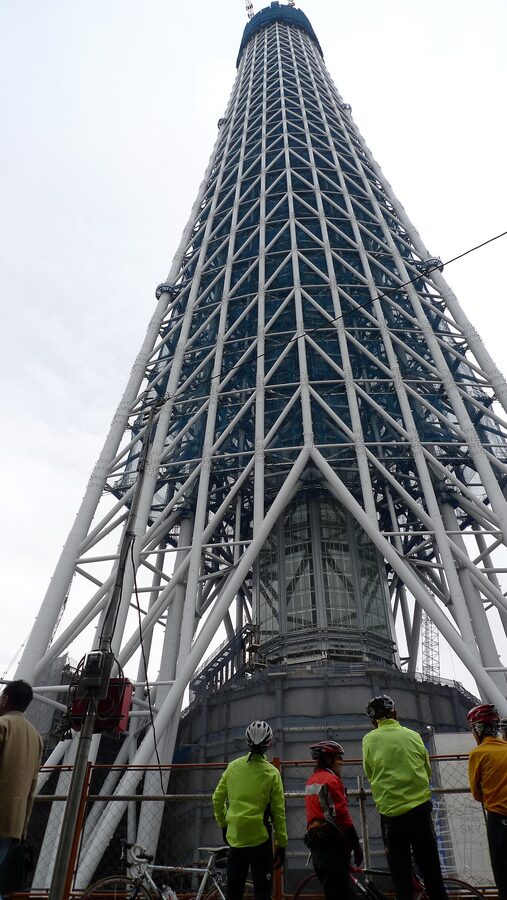
The 3 Best Tokyo Skytree Tickets
1. Tokyo: Skytree Admission Ticket — $13
This is the one to book if you’re not sure what to book. You get entry to the Tembo Deck — the main lower observation complex at 340-350m — with a fixed 30-minute arrival window. You show your phone at the dedicated foreign-visitor queue and skip the ticket-counter line. Entry on any day you pick, no physical voucher. The actual ticket is the most common category of Skytree visit. If there’s one practical reason to upgrade, it’s wanting access to the upper deck — and you can buy that upgrade at the tower itself on the day if you decide the weather warrants it. Our full review covers the entry process and typical timing.
2. Tokyo Skytree Admission Ticket (Floor 350/450) — $16.42
For about $3 more than the base ticket, this version bundles in the upper Tembo Galleria — the 445-450m walkway that most first-time visitors end up wanting to add once they’re inside. The upper level offers a meaningfully different experience: you’re above the altitude of small aircraft traffic, the view is more abstract, and the spiral-walkway approach is fun in its own right. If you’re only going to visit the Skytree once and you’re already investing the trip, the $3 upgrade is almost always worth it. The view on the clearest days really does extend to Mt Fuji, the Japanese Alps, and the Chiba coast simultaneously. Our review covers whether the upper deck is worth it for your specific visit.
3. Tokyo Skytree Admission E-Tickets With Options — $14.49
This format trades the low sticker price of Option 1 for meaningful flexibility — you can modify your time slot, swap to a different date, or upgrade to the upper deck after booking without losing your reservation. The cancellation policy is more forgiving than the $13 GetYourGuide version (usually free up to 24 hours before the visit). Useful if your Tokyo itinerary is still fluid, if you’re booking far in advance, or if you’re weather-watching and want to swap to a clearer day at the last minute. Slightly higher base price; lower total cost if you’d otherwise have cancelled and rebooked. Our review covers when the flexible format wins.
Going Up: What the Visit Actually Feels Like
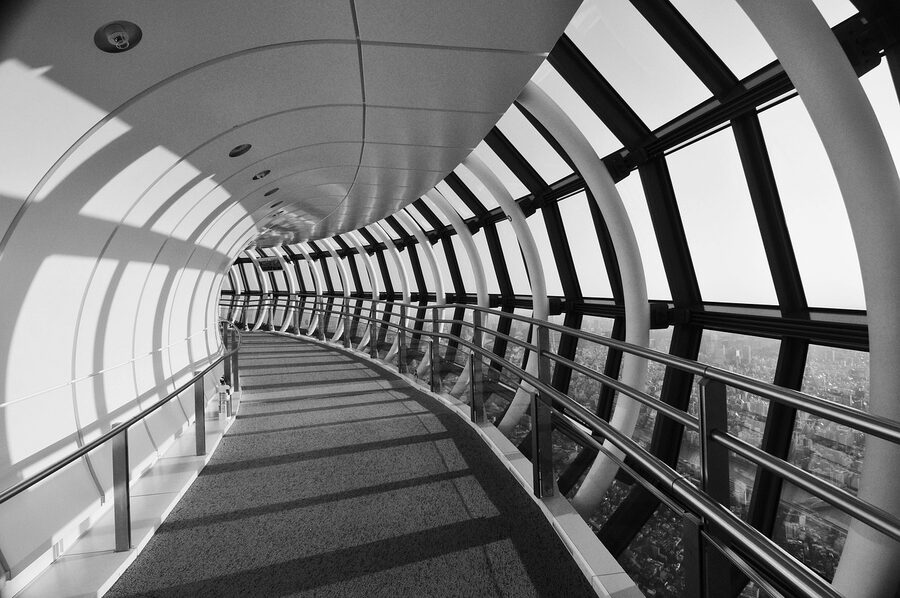
The entry sequence is efficient. You arrive at the base of the tower via Tokyo Skytree Station or Oshiage Station, follow signs to the observatory lifts (the signage is comfortable in English), scan your phone ticket at the turnstile, and ride one of the four main lifts up. The lifts reach the 350-metre deck in about fifty seconds — they’re among the fastest commercial elevators in Japan. Each lift is themed to one of the four seasons, with subtle lighting and animation on the ceiling that references the season’s colours and weather. It’s a small detail that makes the minute-long ride feel more intentional than a simple vertical transport.
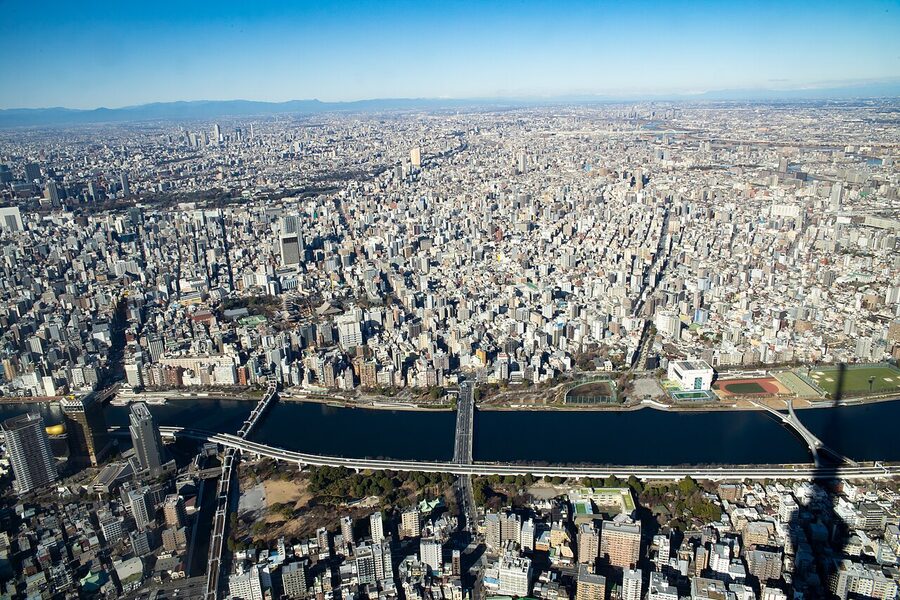
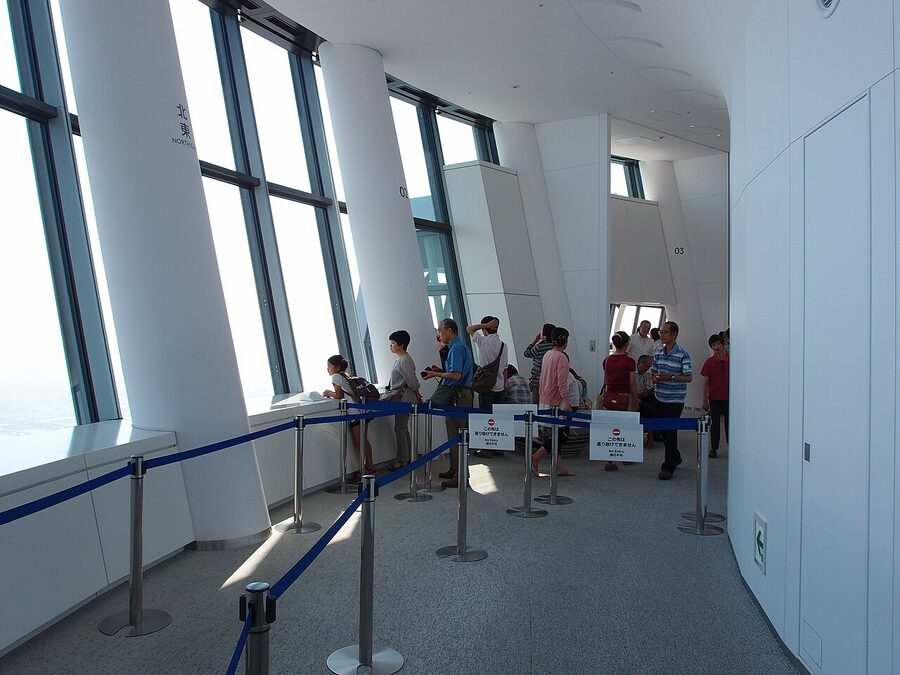
At Floor 350 the doors open onto a curving main observation corridor that wraps the entire tower. Your first instinct is to walk to the windows — which is what everyone does. The first impression is disorientation at scale. Tokyo from 350 metres doesn’t look like a city; it looks like a topographic map that someone has sprayed with detail. Individual skyscrapers you’ve walked past all week are reduced to silver pieces the size of coins. The Sumida River is a thin grey line. Tokyo Bay, to the south-east, extends to the horizon — you can see aircraft lifting off from Haneda if you know where to look.
Two floors down from the main deck — at 340 metres — is the glass-floor section. A panel of reinforced glass lets you stand and look directly at the concrete forecourt 340 metres below your shoes. Several visitors can’t bring themselves to step on it. Most do and laugh nervously. It’s a photograph everyone takes, and it’s genuinely unsettling in a way that looking horizontally out a window isn’t. The engineering of the panel itself is reassuring — it’s rated to hold enormous load — but the perceptual effect of seeing through the ground is something your monkey brain actively resists.
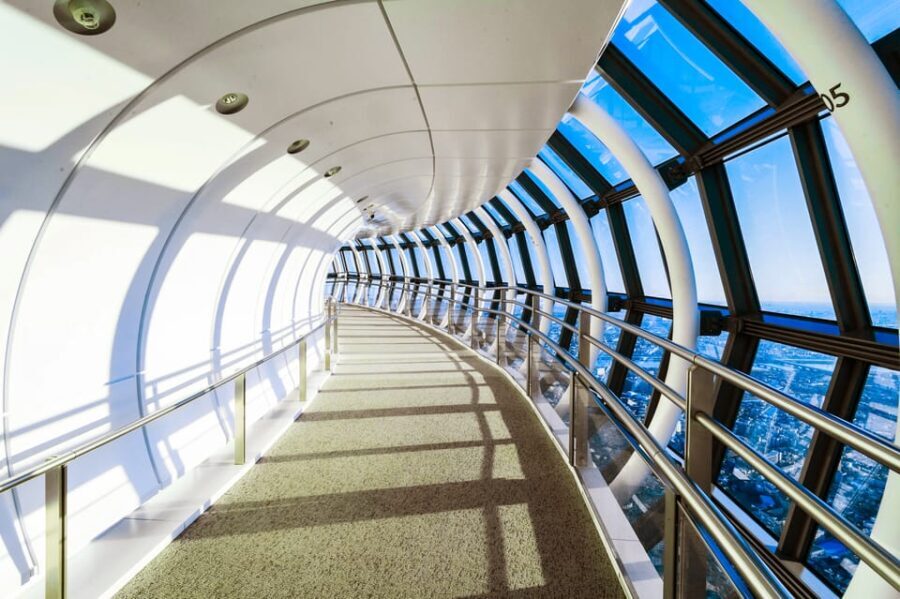
If you’ve bought the combined ticket, you then head to the upper deck. The approach is a spiral walkway that climbs from 445 to 450 metres around the outside wall of the tower. Windows line the outer edge of the ramp, so you’re essentially walking up while the view slowly rises around you. The walkway is long enough that it feels like a short journey rather than a transition — three or four minutes of slowly ascending with the city falling away below — and the arrival at the top platform feels earned in a way the lift ride didn’t.
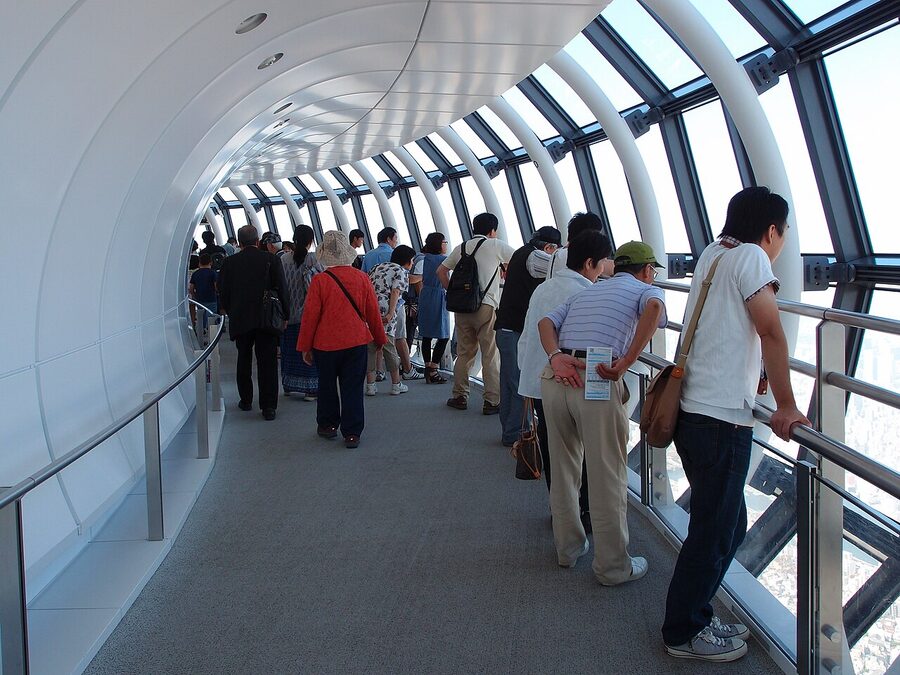
The top platform itself is small and cylindrical — the tower narrows above the lower deck — and in peak visiting hours it can feel crowded. The crowd density depends entirely on the time slot; first-thing-in-the-morning and last-two-hours-of-the-day are dramatically quieter than lunchtime and mid-afternoon.
When to Go — Weather, Time of Day, and Crowd Strategy
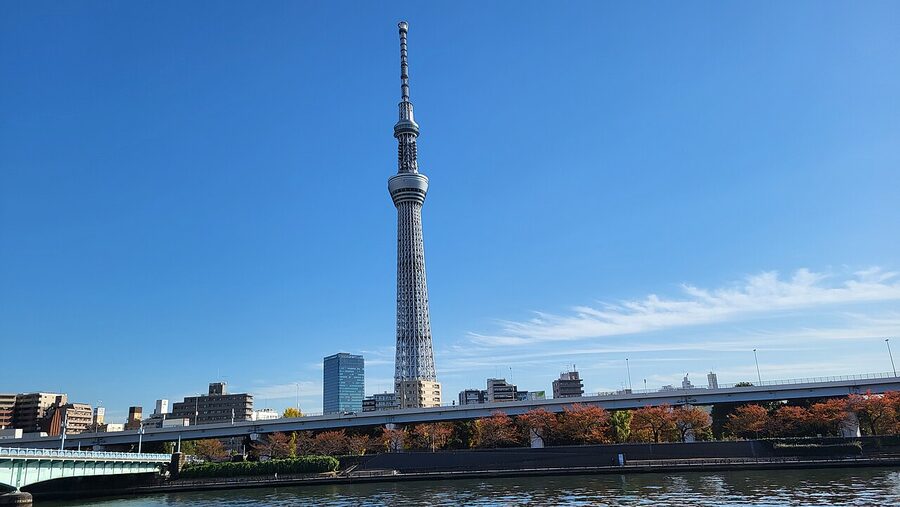
The single biggest variable in a Skytree visit is weather. Tokyo’s air has haze more often than not — a combination of humidity, particulates, and city heat that reduces long-distance visibility below what the observation decks can actually see. Winter (December through February) is when the haze drops and the sight lines get genuinely clean. If Mt Fuji visibility is part of what you want, schedule your visit for a cold, clear morning and go early — the air is at its clearest in the first two hours after sunrise.
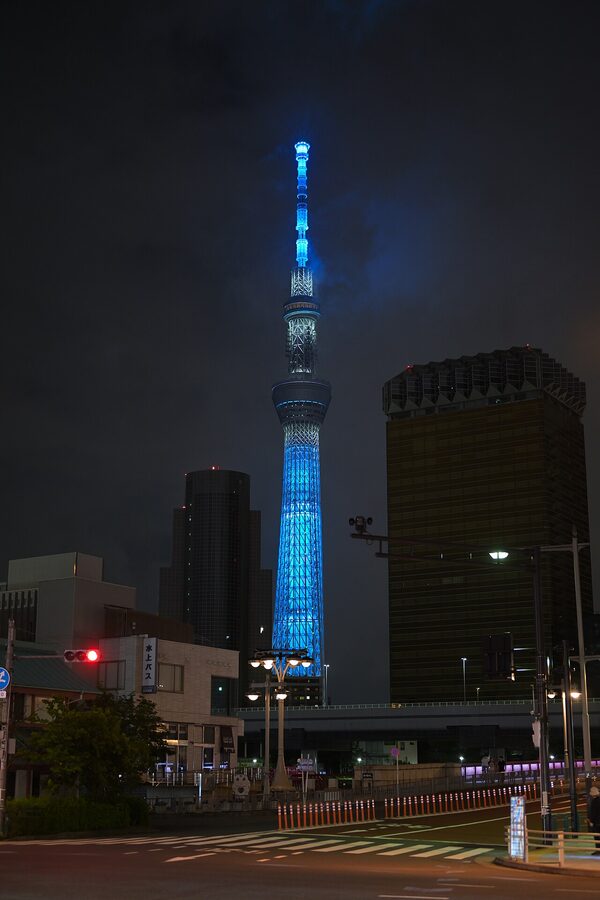
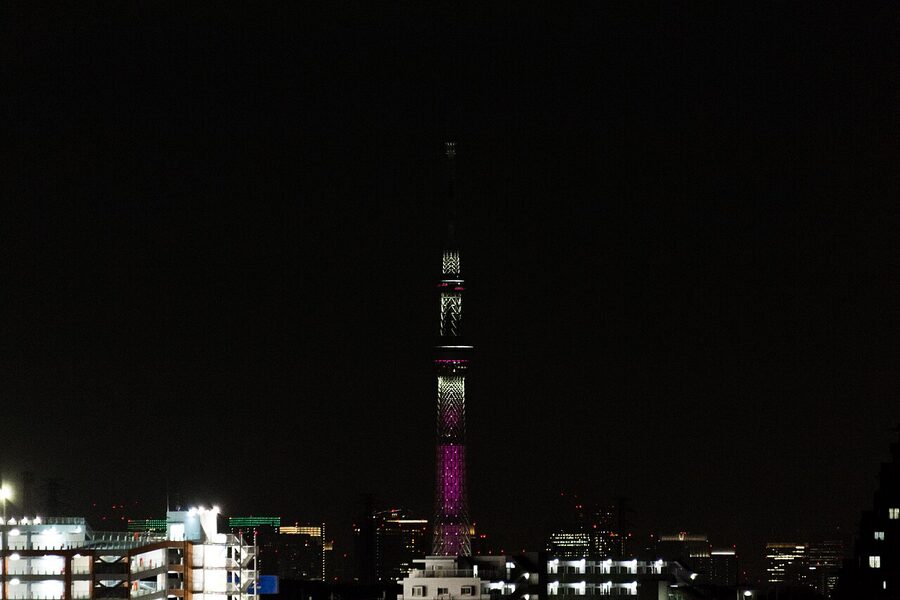
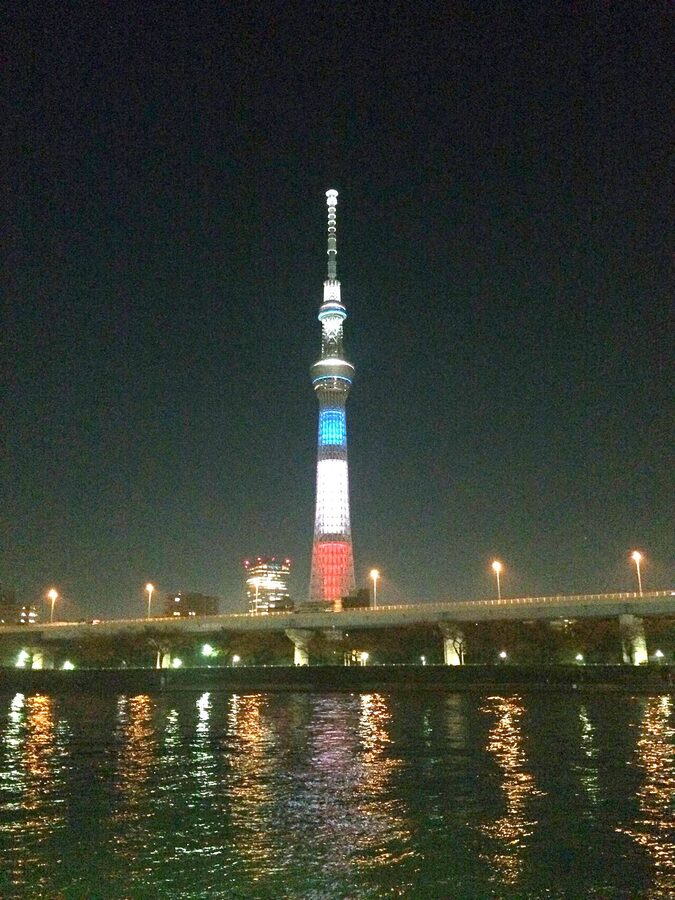
The second variable is time of day. Booking an evening slot gets you the Tokyo-at-night view — the city at full illumination, with the pattern of lit streets running to the horizon. Booking a daytime slot gets you the topographic detail. If you can’t pick both, most visitors prefer the evening: it’s more immediately dramatic, and the engineering-themed lighting of the tower itself is part of the attraction. A “sunset plus night” visit — entering about 90 minutes before sunset and staying until full dark — is the format that photographers specifically go for; the changing light across central Tokyo through the golden hour is one of the tower’s best visual payoffs.
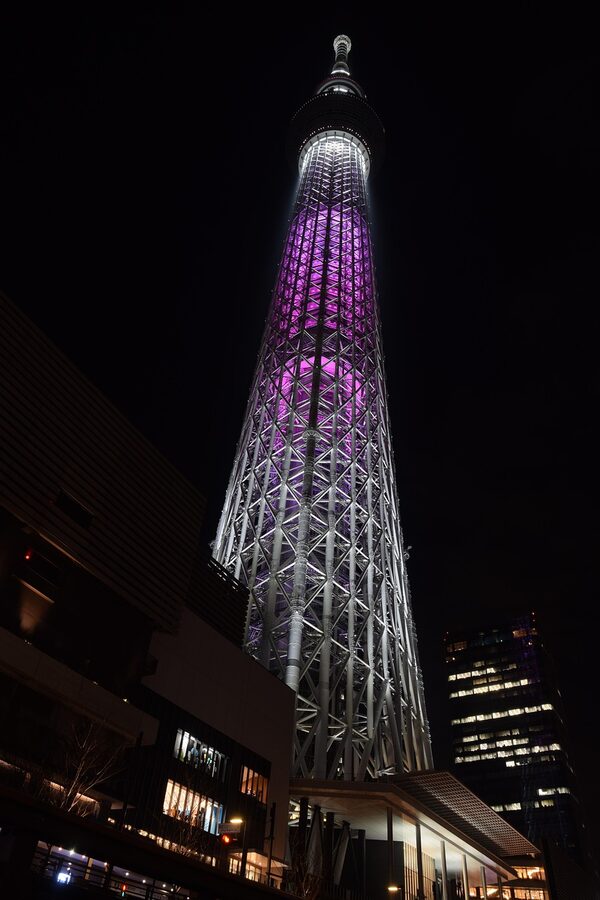
Crowd strategy matters too. The tower operates from 10 am to 9 pm (last entry usually 8 pm), and the busiest slots run from about 12:30 pm to 4:30 pm. Book either the opening window (10:00-11:00 first entry) or the late-evening window (7:00 pm or later). On the opening window you get a near-empty deck and quiet walkways; on the late-evening window you get the illuminated city plus thinner crowds since most visitors have already left. Weekends are roughly 30% busier than weekdays; cherry blossom season (late March to mid-April), Golden Week (late April to early May), and autumn foliage (mid-November) are the three most crowded periods of the year.
Skytree vs Tokyo Tower — Which Tower, and Why
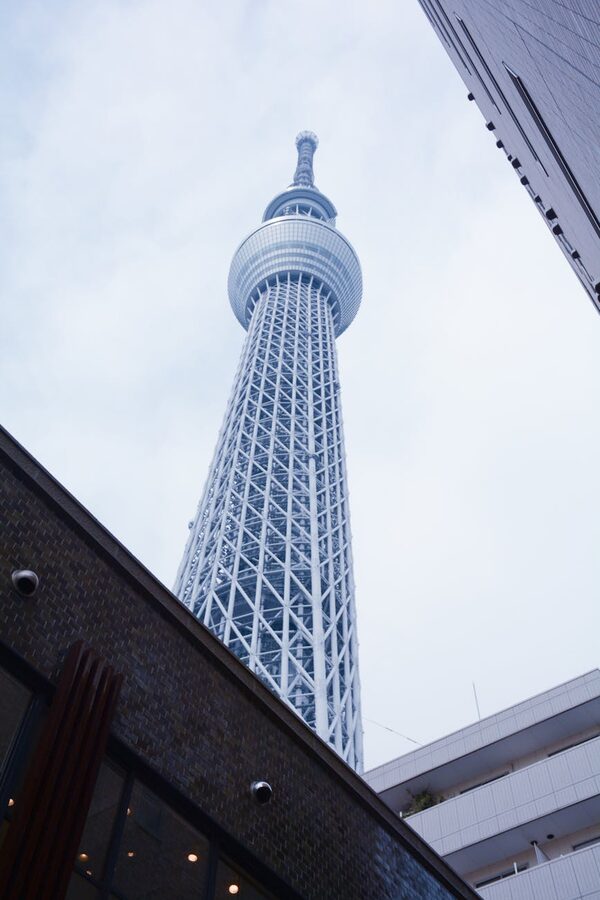
Tokyo has two famous towers, and first-time visitors often wonder which one to prioritise. The Skytree and Tokyo Tower were built for similar reasons — broadcasting — and both now serve as observation platforms and landmarks. The comparison isn’t complicated.
Tokyo Tower is older (1958), shorter (333 metres), red and white, and sits in the Minato business district with views centred on central Tokyo. It’s a nostalgic, photogenic, Eiffel-Tower-inspired structure that Tokyo-born residents associate with the post-war economic boom. The experience is charmingly dated in places — the interior decor leans into the 1960s origins.
The Skytree is newer, taller by almost double, and sits in Sumida on the east side of the river. Its observation experience is more modern — faster lifts, cleaner architectural lines, the Tembo Galleria spiral walkway. The view goes further simply because you’re higher up. If you’re visiting Tokyo for the first time and you only have time for one, the Skytree gives a more complete sense of Tokyo’s scale.
That said, the two aren’t strictly comparable. Tokyo Tower sits in a dense mid-city neighbourhood; the Skytree is on the quieter east side. The surrounding experience is different. Our Tokyo Tower guide covers the nostalgic option if you’re drawn to it; the Skytree guide you’re reading now covers the modern alternative. Many travellers end up doing both over a longer Tokyo visit — Tokyo Tower for one afternoon, Skytree for another evening.
The Ground-Level Surround: Solamachi and Sumida
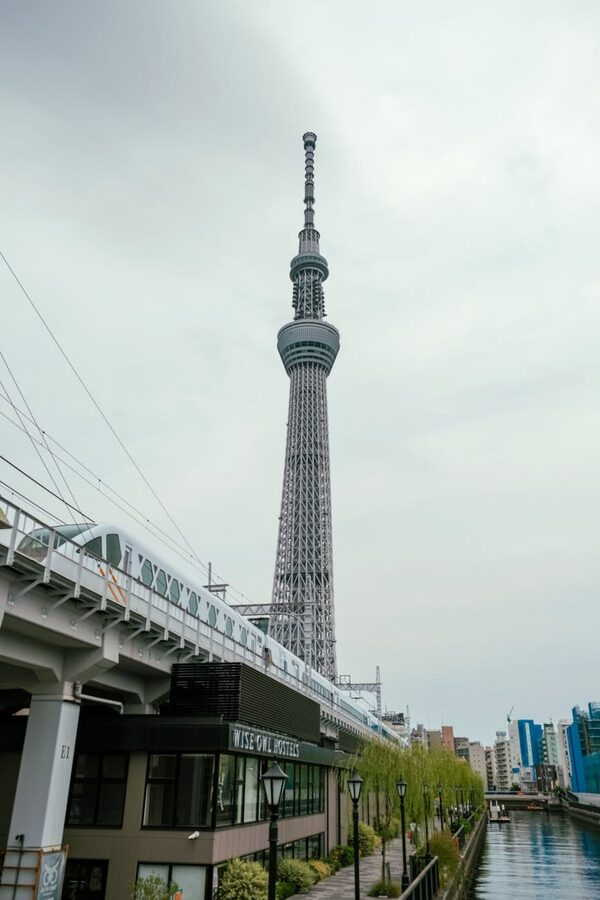
The tower doesn’t stand alone. Its base is wrapped by Tokyo Solamachi, a shopping and dining complex with about 300 tenants spread across three floors. Most visitors walk through Solamachi coming and going from the lifts, and many treat it as a destination in its own right. There are aquariums, a planetarium, and enough restaurants to fill an entire meal before or after the tower visit. If you’re arriving hungry or planning to kill time between a booked time slot and another appointment, Solamachi handles the logistics invisibly.
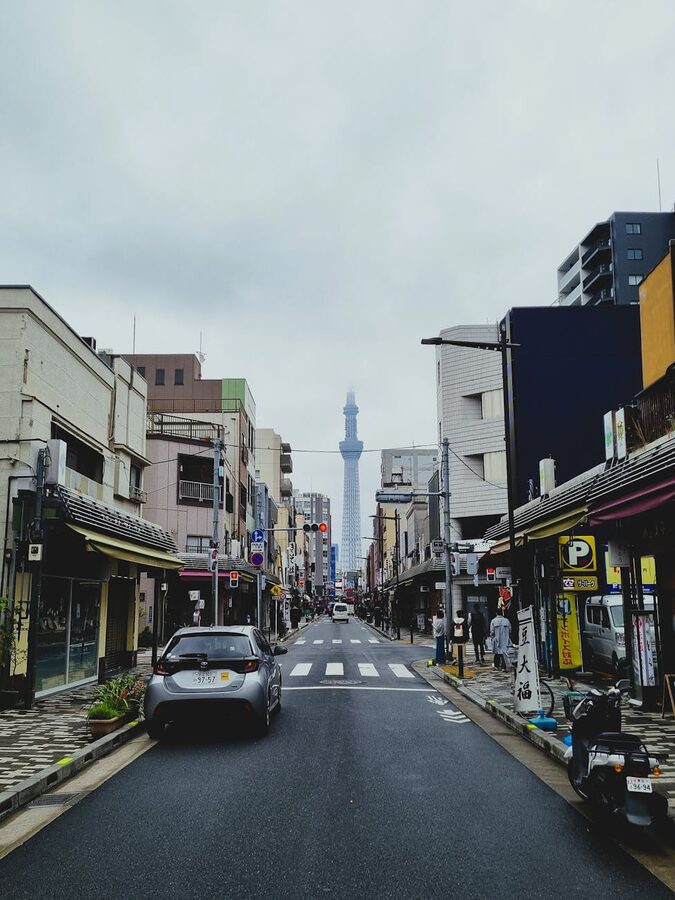
Outside the tower complex, the surrounding Sumida and Oshiage neighbourhoods have been gentrified considerably since the Skytree opened, but retain pockets of the old Shitamachi “low city” character — small izakayas, family-run soba shops, and back-street architecture that predates the tower by decades. A 20-minute walk west brings you to Asakusa, home of Sensoji Temple; a 15-minute walk south brings you to Kinshicho, a local nightlife district. The Skytree is, usefully, a landmark you can navigate by from almost anywhere in eastern Tokyo.
History, Very Briefly
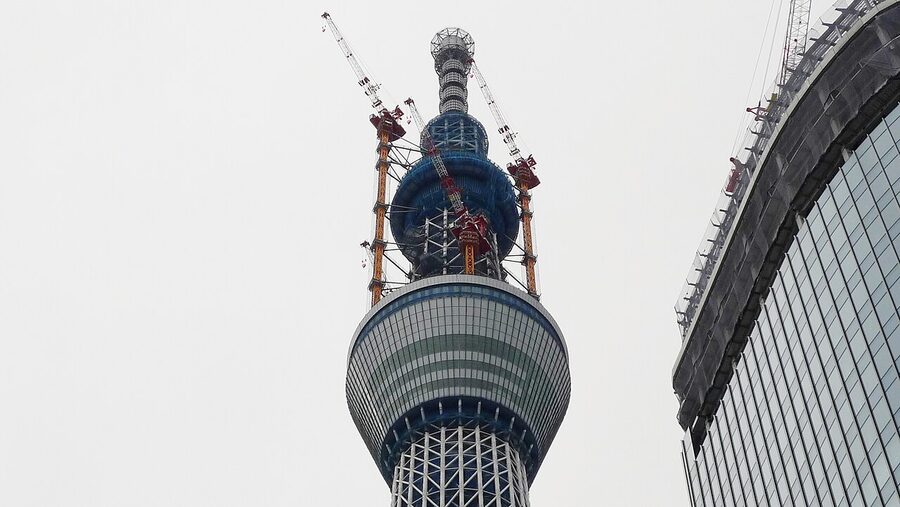
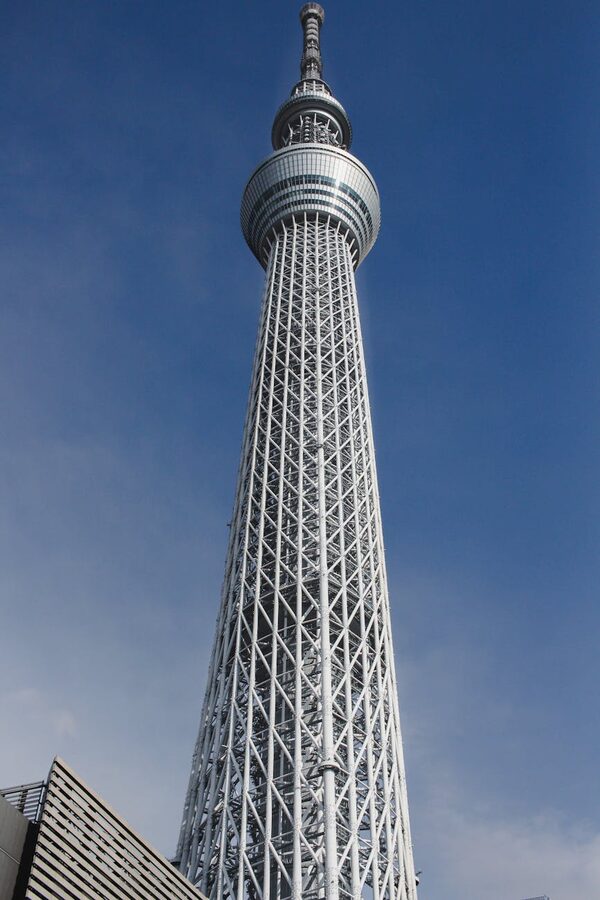
The decision to build was announced in 2005. Tobu Railway — one of Japan’s major private rail operators — partnered with six national broadcasters who needed a new broadcast mast. Construction started in 2008. By the time the tower was nearing its final height in early 2011, the structure became a minor public sensation; Tokyo residents watched it grow from their windows. Then the March 11 earthquake struck — the largest in Japanese recorded history, centred several hundred kilometres to the north. The almost-finished Skytree swayed visibly but suffered no structural damage. The damping system — based on the shinbashira (central pillar) design of traditional Japanese pagodas, some of which have stood through 1,000 years of seismic activity — held exactly as engineers had predicted.
The tower officially opened in May 2012 to crowds that overwhelmed the initial booking system. For months after opening, the observation decks were sold out weeks in advance. The booking system has since stabilised; you can now book a same-day visit with reasonable odds of getting an afternoon slot. But the early demand spoke to how much Tokyo residents had already claimed the tower as part of their city.
Booking Tips
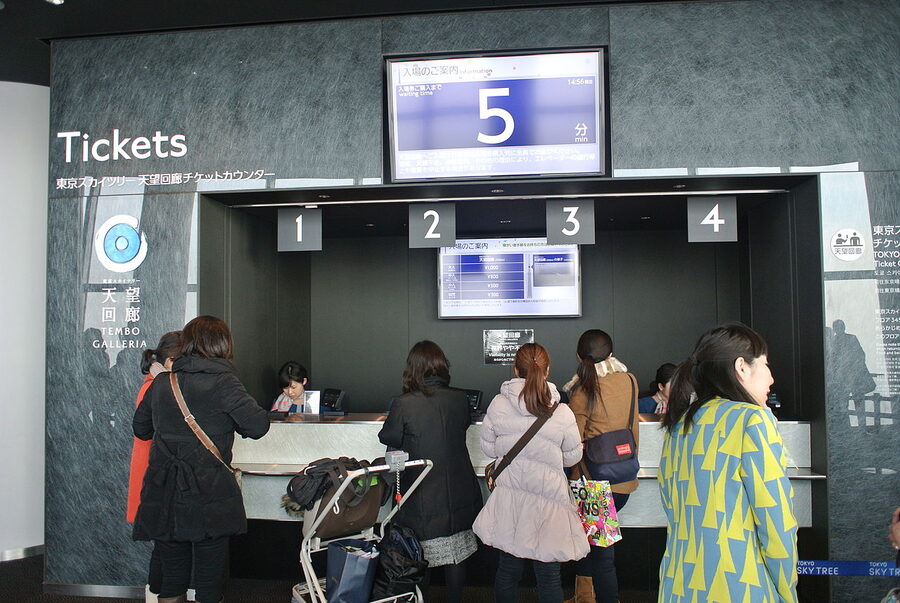
Book at least a day ahead for weekday visits; three to seven days ahead for weekends; two weeks or more for cherry blossom season, Golden Week, or autumn colour peaks. Same-day walk-ups are possible but can involve a long wait at the on-site ticket counter, especially in the afternoon. The online booking always beats the walk-up experience by a comfortable margin.
If you’re booking the flagship $13 ticket, pick your time slot based on weather forecasting. Japan’s tenki.jp site publishes 10-day visibility forecasts that predict cloud cover and haze levels. Use those the day before your visit — a clear forecast is worth scheduling around. If the forecast looks bad for your chosen date, the flexible e-ticket option (Tour 3) lets you swap dates at no penalty; the inflexible option requires rebooking.
On the day, give yourself fifteen minutes between leaving your Tokyo hotel and arriving at the tower base — the Skytree is well-served by rail (Tokyo Skytree Station on the Tobu Skytree Line, Oshiage Station on the Asakusa/Toei subway), and the short walk from either station to the tower is signposted in English. Once you’re at the tower, the fast-track foreign-visitor queue is usually shorter than the main Japanese-language counter, so the actual entry takes around 5-10 minutes.
Inside, budget 90 minutes for the double-deck visit, 45-60 minutes for just the lower deck. You can leave at any time — there’s no time limit once you’re inside — so the main constraint is your own energy.
One last practical note on dress: the upper observation deck can be noticeably colder than street level, especially in winter. The tower’s central shaft isn’t heavily insulated. If you’re visiting in December or January, bring a jacket up with you — you’ll be glad you did, particularly on the upper galleria walkway.
More Tokyo Experiences
A Skytree visit pairs naturally with Asakusa — the historic district across the Sumida River — and our Asakusa Sensoji walking tour guide covers the walking-tour version of that district. Tokyo Yakatabune dinner cruise is the Sumida-river follow-up for evening visits; you’ll actually pass under the Skytree from the water. Our Tokyo Tower guide is the direct alternative-tower comparison. For food after going up, our Tokyo ramen tasting and Yanaka old quarter walking tour cover the food and neighbourhood angles respectively. Tokyo samurai sword & archery class is the traditional-culture counterpart, and Tokyo Shibuya walking tours covers the modern west-side neighbourhood for contrast. If you’re extending into day trips from Tokyo, our Mt Fuji + Hakone day trip guide and Mt Fuji private tours guide cover the classic Fuji options. Kyoto Gion food tour is the must-book for Kyoto, and Nagoya to Takayama and Shirakawa-go day trip fills out the mountain-village-plus-city side of a longer Japan trip. Most travellers visit the Skytree in the evening of their arrival or departure day — the view works particularly well as a bookend experience, either the welcome to Tokyo or the final panorama on the way out.