
The pocket watch in the museum case stopped at 8:15. The wearer, a boy of thirteen, did not. You walk past that case in silence because anything you say out loud feels wrong — and then you continue, because that is the whole point of the memorial.
That pause is what a day trip to Hiroshima is actually about. People book this trip because they want to understand something that cannot be explained in a classroom, and then they cross the water to Miyajima in the afternoon and stand in front of a torii gate that has been photographed a million times and is still, somehow, quietly astonishing. The contrast is not an accident. It is the whole day.
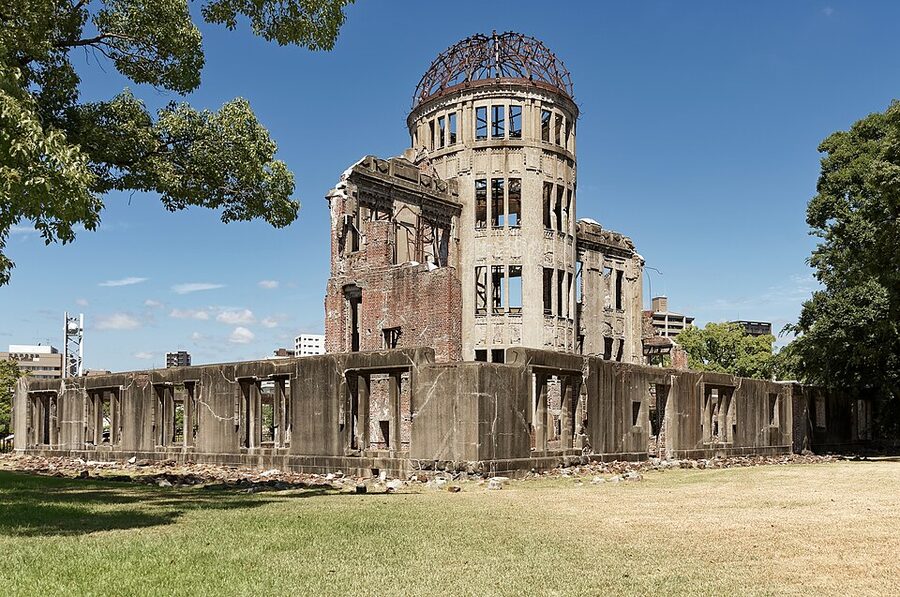
I wrote this because most guides to a Hiroshima and Miyajima day trip get the balance wrong. They front-load the logistics and treat the Peace Park like a tick-box stop between lunch and a ferry. That is backwards. The Peace Memorial is the reason you go. The logistics are there to serve it.
In a Hurry? Three Day Trips Worth Booking
- Hiroshima UNESCO Full-Day Tour — $122. The flagship if you are already in Hiroshima. Peace Park in the morning, Miyajima in the afternoon, thoughtful guides.
- Osaka/Kyoto Shinkansen Day Trip — $277. All transport included. Pick this one if you are day-tripping from Osaka or Kyoto and do not want to plan trains yourself.
- Hiroshima Peace Walking Tour — $94.84. Walking-focused, guide-led. Good choice if you care more about the stories than about ticking off sights.
- In a Hurry? Three Day Trips Worth Booking
- Why you still come, despite the weight
- What this day trip actually covers
- From Hiroshima, Osaka, or Kyoto: how it actually works
- When to visit — the tide matters more than you think
- The Peace Memorial: what to expect when you walk in
- The Children’s Peace Monument and Sadako’s cranes
- Crossing to Miyajima: the ferry and the shift
- Itsukushima Shrine and the torii up close
- Three day-trip tours worth booking
- 1. Hiroshima UNESCO Sites Full-Day Tour — 2
- 2. Osaka/Kyoto Hiroshima Miyajima Bus Tour with Shinkansen — 7
- 3. Hiroshima Peace Walking Tour at World Heritage Sites — .84
- What to eat in Hiroshima — seriously
- The cenotaph and the flame — what they mean
- Hiroshima Castle and the rebuilt city
- Climbing Mt Misen on Miyajima
- What to know about the museum before you go in
- What not to do
- Cost breakdown if you go alone
- Staying overnight vs day-tripping
- Getting to Miyajima from elsewhere in Japan
- Accessibility and travelling with a disability
- One last thing: the hypocentre marker
- Day trips to pair with this one
Why you still come, despite the weight
The first question people ask me about this trip is whether it will wreck their day. The real answer is that the Peace Park sits with you. That is the point. But it is not a grief tunnel. The park is a working city park with joggers and kids and people on lunch breaks, and the memorial buildings are scattered inside it. Between them are lawns and rivers and cherry trees.
You spend an hour or two there. Then you walk to the ferry, and by early afternoon you are watching deer wander around the streets of Miyajima like they own the place. The combination does something that neither half would on its own. If you came only for Miyajima you would miss the thing that makes Japan Japan. If you came only for the Peace Park you would leave drained.
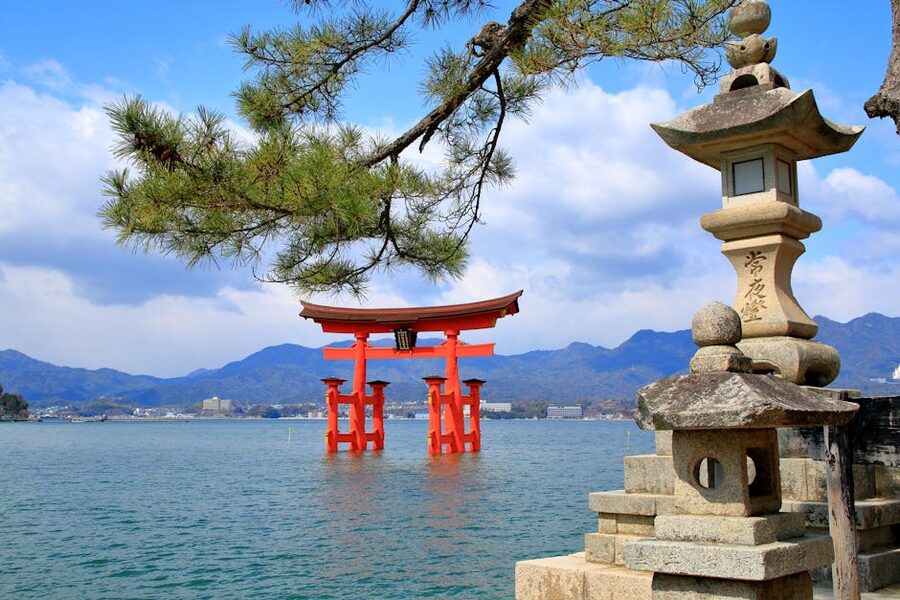
This is why almost every organised tour runs the route in the same order. Park first, island second. Do it the other way round and you arrive at the Peace Memorial Museum tired, with tide-soaked shoes, and the museum deserves more than that.
What this day trip actually covers
A full Hiroshima and Miyajima day trip covers three separate things that most first-time visitors conflate. It helps to keep them straight.
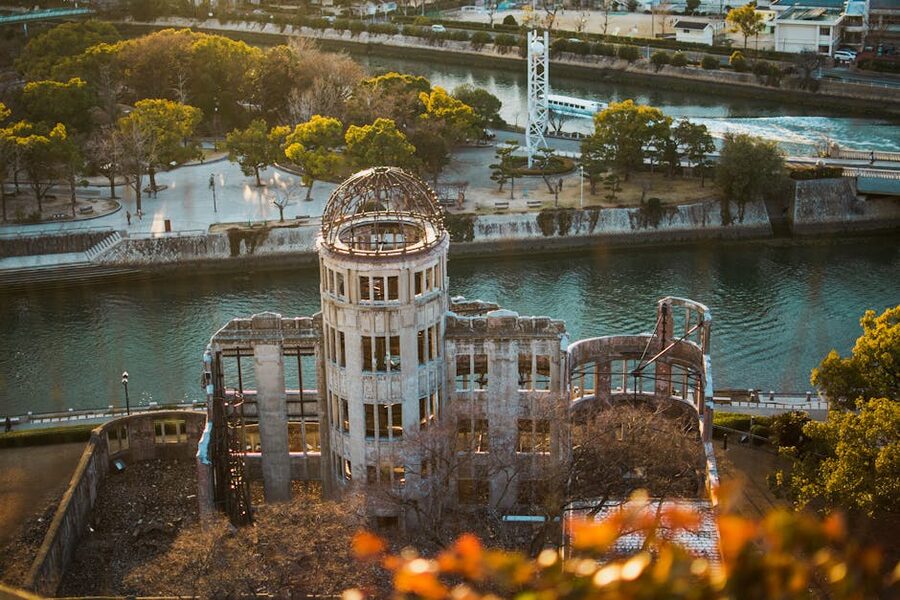
The first is the Hiroshima Peace Memorial Park. This is the long green strip along the Motoyasu River. Inside it you will find the A-Bomb Dome (the skeletal building in every photograph), the Children’s Peace Monument, the Cenotaph arch, the Flame of Peace, and the Peace Memorial Museum. The park itself is free. The museum costs 200 yen. Plan 90 minutes minimum for the museum alone, and do not rush the park — walking between the monuments is how the place works on you.

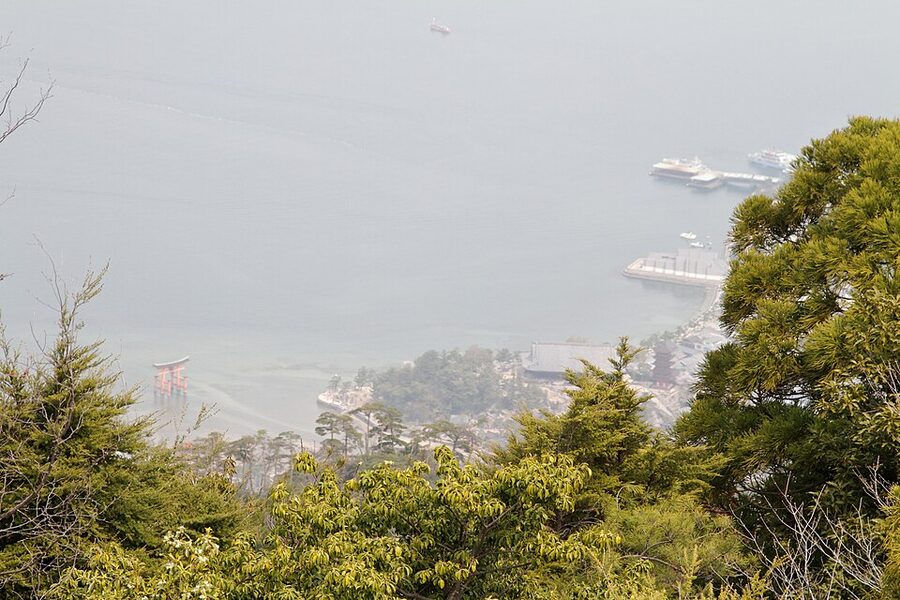
The second is Miyajima itself — technically Itsukushima, a small island in the Seto Inland Sea reached by a 10-minute ferry from Miyajimaguchi. The headline sight is the floating torii gate of Itsukushima Shrine. You have seen the photograph. In person it is bigger than you expect and also smaller than the photograph makes it look, which is a genuinely odd combination. The shrine complex behind the gate is a UNESCO World Heritage Site and, unless you are actively trying to, almost impossible to skip on any day-trip itinerary.
The third is the logistics — trains, trams, ferries, and timing. If you are staying in Hiroshima this is simple. If you are day-tripping from Osaka or Kyoto, it is more complicated than the tour pages let on, and this is the single biggest reason people end up booking an all-in-one package instead of doing it alone.
From Hiroshima, Osaka, or Kyoto: how it actually works
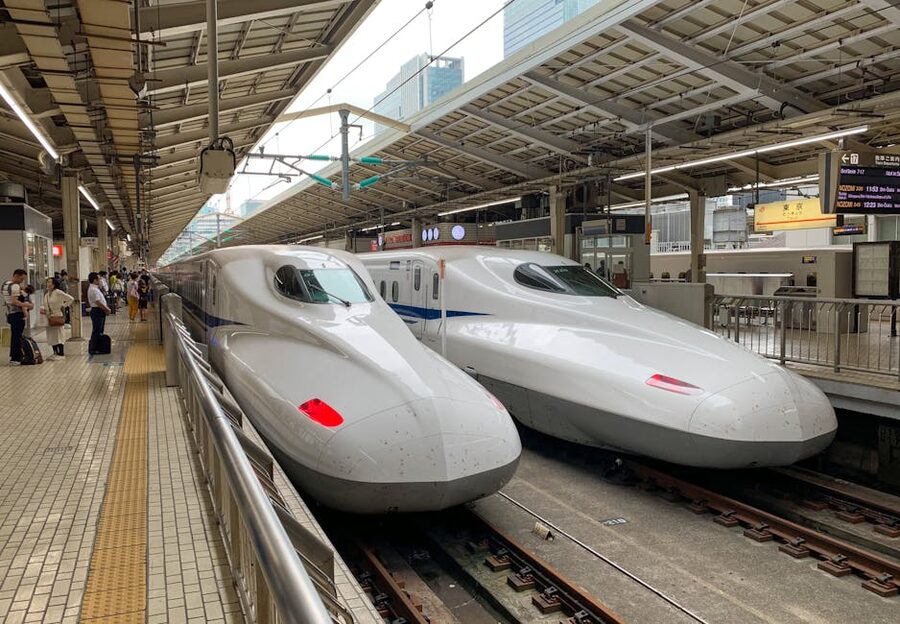
If you are already in Hiroshima, the day is straightforward. Peace Park is a 15-minute tram ride from Hiroshima Station on the Hiroden line (tram 2 or 6, flat fare 220 yen). From the park, take tram 2 all the way down to the port at Hiroden-Miyajimaguchi, or use the JR Sanyo line from Hiroshima Station to Miyajimaguchi Station. Then ferry across. Tours generally handle the tram-and-ferry dance for you and include the ferry ticket in the price.
From Osaka or Kyoto, the only sensible approach is the Shinkansen. Shin-Osaka to Hiroshima runs about 1 hour 25 minutes on a Nozomi, or 1 hour 50 minutes on a Sakura. Kyoto to Hiroshima is similar. A return ticket is not cheap — around 21,000 yen without a JR Pass — but you save three hours each way compared to a highway bus. On the Nozomi, which does not accept regular JR Pass holders, the premium is the price of the day.
The reason many travellers pick the packaged Osaka/Kyoto shinkansen tour over going solo is not the cost. The cost works out roughly the same once you add trains, trams, ferries, Peace Museum entry, and lunch. It is that on a 12-hour day with two transit transfers and a guided park tour in between, someone else holding the tickets is worth something real.
When to visit — the tide matters more than you think
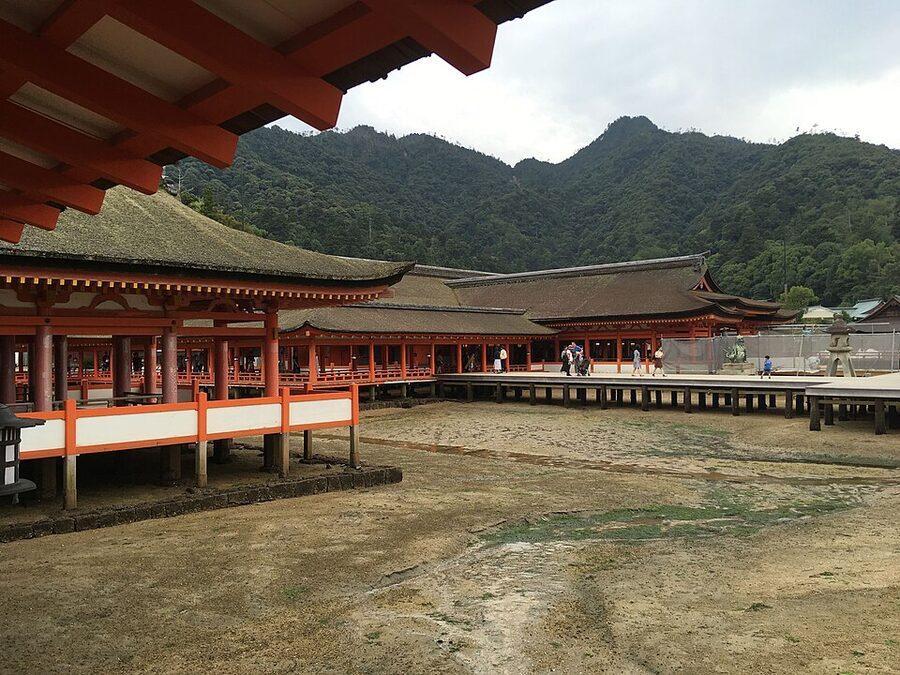
Most guides cover seasons. Few cover tides. Here is the thing: the floating torii only floats at high tide. At low tide it sits on wet sand and you can walk out to it in bare feet. Both are worth seeing. Only one is the picture in your head.
Before you book, check the tide tables for your date — the Japan Meteorological Agency publishes them in English. You want the high-tide window to overlap with your time on the island, ideally around midday. If it does not, you have two choices: accept the low-tide version, or book an earlier or later tour to shift your arrival. Tour companies do not usually advertise this, which is how people end up disappointed with shots that should have been glorious.
By season: April brings cherry blossoms along the Peace Park’s rivers, which is beautiful and crushingly busy. Late May through early July is hydrangea season on Miyajima and noticeably quieter. Autumn leaves at Momijidani Park on Miyajima peak in mid-to-late November and, for my money, are the best time to go if you can choose. Winter is cold but crowd-free and the torii against a grey Seto sky has a starkness the summer shots do not. Summer is hot, humid, and packed with school groups.
The Peace Memorial: what to expect when you walk in
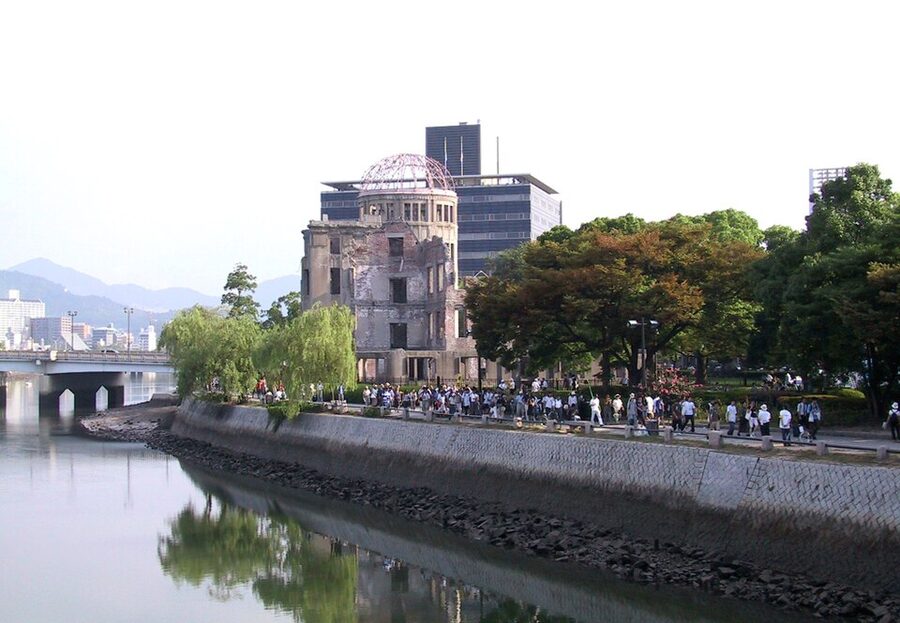
The park works outdoors-in. Start at the A-Bomb Dome on the north bank of the river. Cross the T-shaped bridge. Walk south through the park — past the Children’s Peace Monument, the Cenotaph framing the view back to the Dome, the Flame of Peace — and you end up at the Peace Memorial Museum.
The museum is the heavy part. It is also, I think, why this trip exists. The main exhibit was redesigned in 2019 and the curators chose a specific approach: personal objects, arranged with dignity, minimal commentary. A lunchbox. A tricycle. A school uniform. The watch I mentioned at the top. The displays do not explain themselves; they trust you to understand.
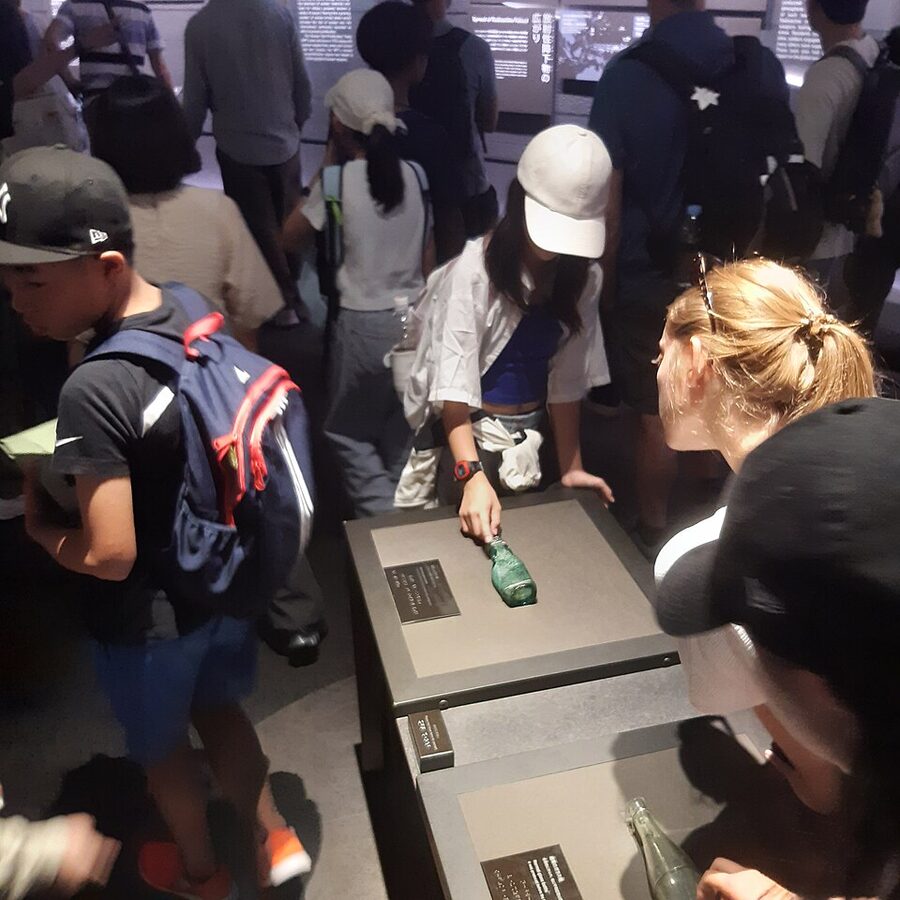
A few practical things people wish they had known. The museum is not pushchair-friendly in the way most museums are — the exhibits are quiet and the hallways narrow, and a loud toddler will feel exposed. Many families leave young children with a partner in the park. The museum’s own guidance suggests ages 10+ for the main hall. Trust that.
Cameras are permitted but almost nobody uses them inside. You will see other visitors crying; people are gentle with each other. Leave about 90 minutes. Allow an extra 20 if you want to read every panel — and you might, once you start.
The Children’s Peace Monument and Sadako’s cranes
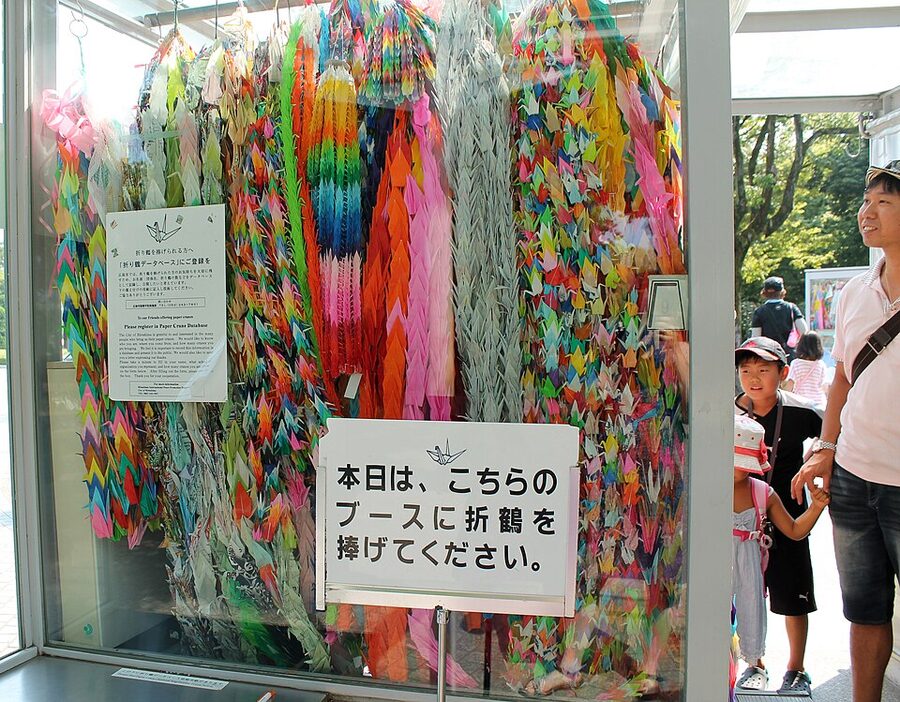
Halfway through the park, between the Dome and the museum, stands the Children’s Peace Monument. It was built in 1958 in memory of Sadako Sasaki, who was two when the bomb fell and twelve when she died of leukaemia. She folded paper cranes in the hospital because Japanese tradition holds that folding a thousand cranes grants a wish. She folded more than that.
Schoolchildren still send cranes to the monument. Glass cases around it are stuffed with them, bright and slightly faded in the sun, millions of birds. It is one of the few parts of the park that feels entirely about children — the others carry everyone’s grief at once.
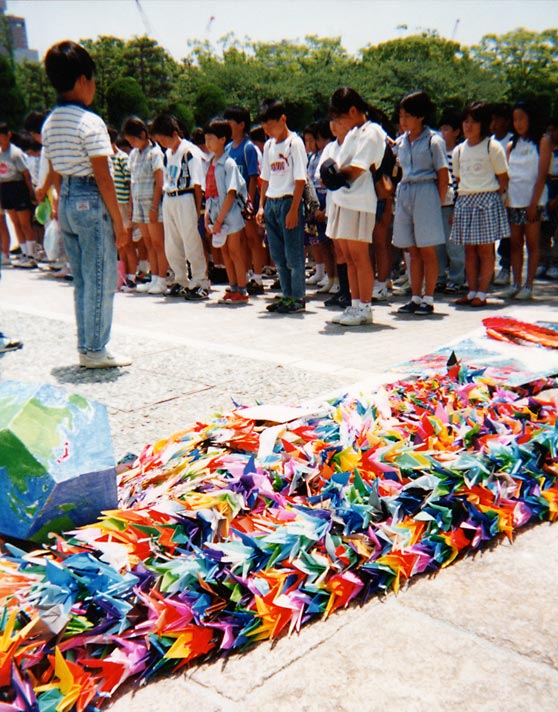
If you are travelling with kids old enough to understand, the monument is a better starting point than the museum. It is outdoors, specific, and hopeful in a way the museum cannot quite be.
Crossing to Miyajima: the ferry and the shift
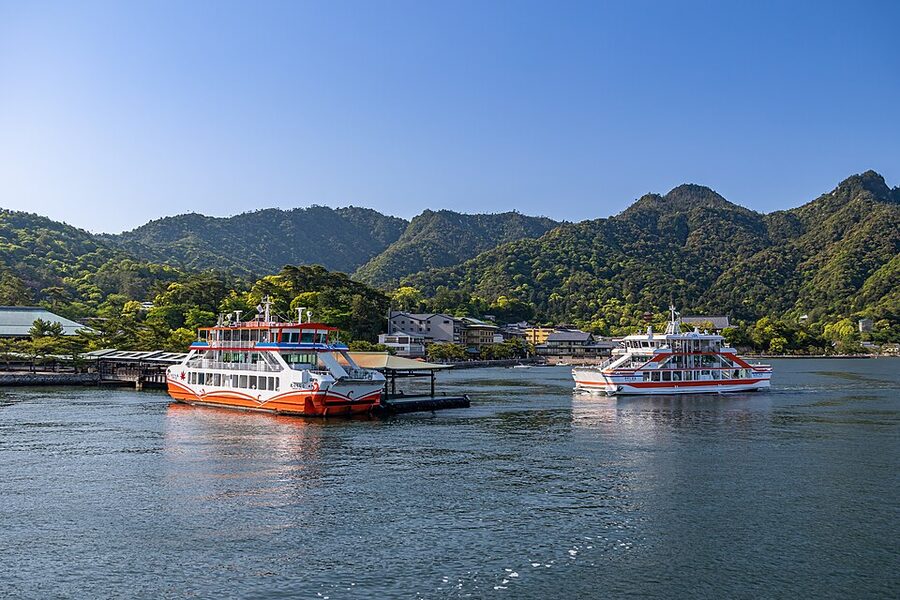
The ferry crossing is short. Ten minutes, maybe twelve if the wind is up. The JR ferry tilts slightly closer to the torii on its approach if you want the best shot — it is a marketed thing, not a secret. Get to the right side of the boat.
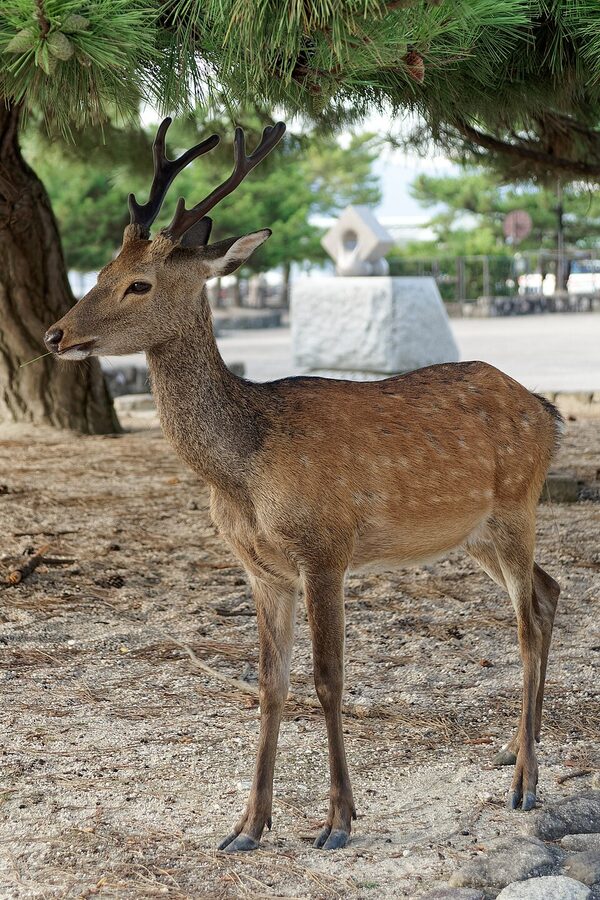
But the real experience of the crossing is not the gate. It is the change in the day. You have come from a park built on silence. You are arriving on an island where the first thing you see is a deer eating someone’s ferry ticket. The temperature drops as the water opens up around you. The weight lifts. That is the trip.
Itsukushima Shrine and the torii up close
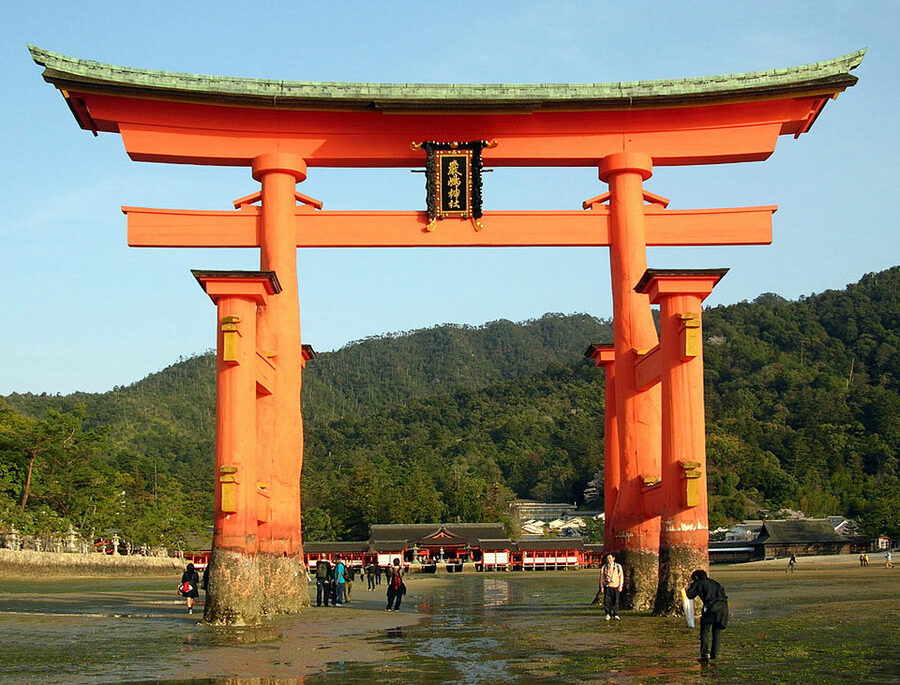
From the ferry pier it is a 10-minute walk along the waterfront to the shrine. You pass the souvenir streets, the oyster grills, the momiji manju shops (more on those shortly). The torii appears long before you reach it. It has a way of seeming larger the closer you get.
The shrine entry is 300 yen and worth every yen. The complex is built on stilts over the water so that when the tide comes in, you are walking on corridors suspended above the sea. This was intentional — Miyajima was considered so sacred that commoners were not allowed to set foot on its soil. The shrine floated them above it.
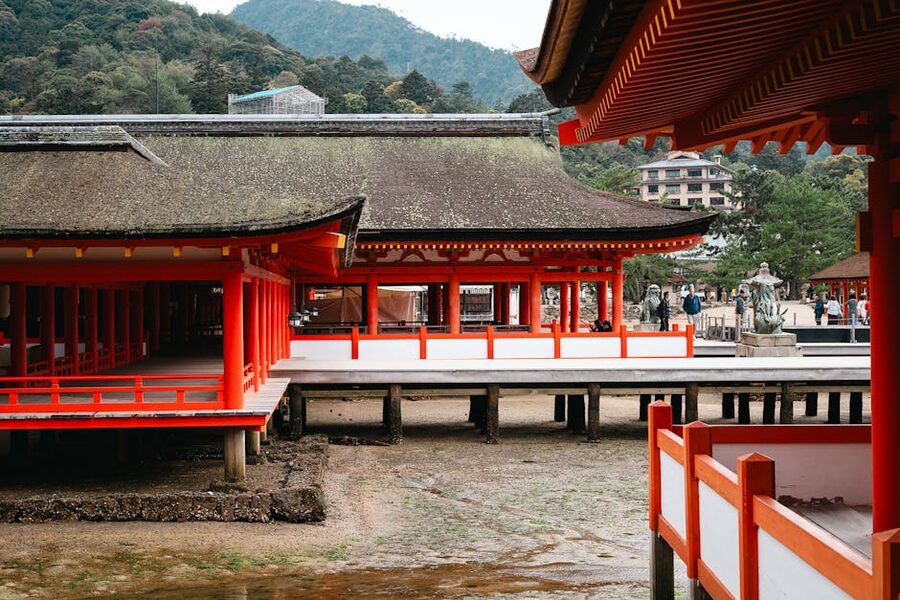
The main hall is small. Most visitors spend 20 minutes inside. That is enough to walk the corridors, stand at the stage that faces the gate, and watch for the shrine’s famous resident, a koi carp that has lived in the pond by the Noh theatre for longer than anyone can remember.
Three day-trip tours worth booking
I have tested the three day-trip formats that cover this route: Hiroshima-based, Osaka/Kyoto-based, and walking-focused. Each has a specific reader in mind. Below is the short version on why you would pick each one.
1. Hiroshima UNESCO Sites Full-Day Tour — $122
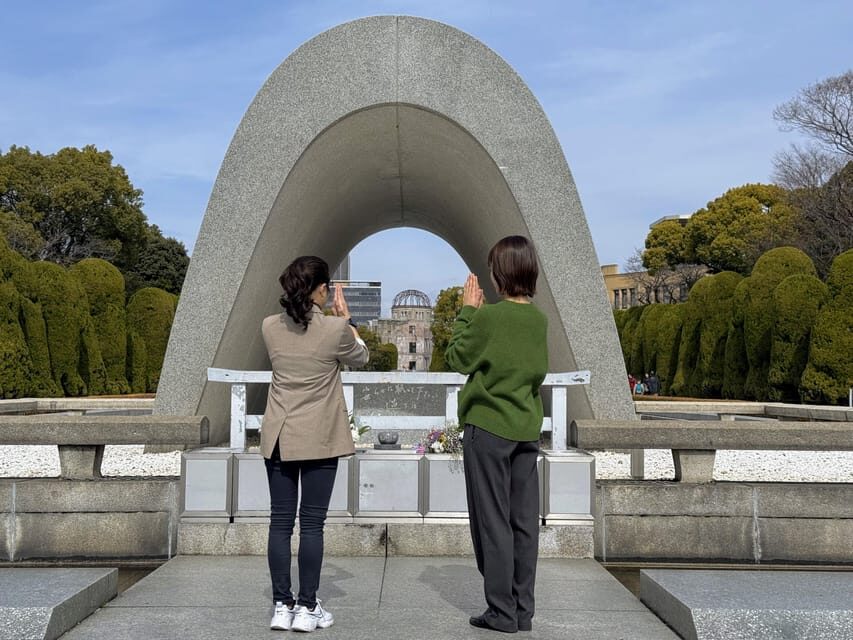
This is the flagship. Eight hours, English guides, and a pace that gives the Peace Park the time it deserves before crossing to Miyajima for lunch and the torii. Our full review breaks down what is and is not included — ferry yes, shrine entry yes, lunch usually no. Reviewers consistently single out guides Marin and Momiji by name, which is rare.
2. Osaka/Kyoto Hiroshima Miyajima Bus Tour with Shinkansen — $277
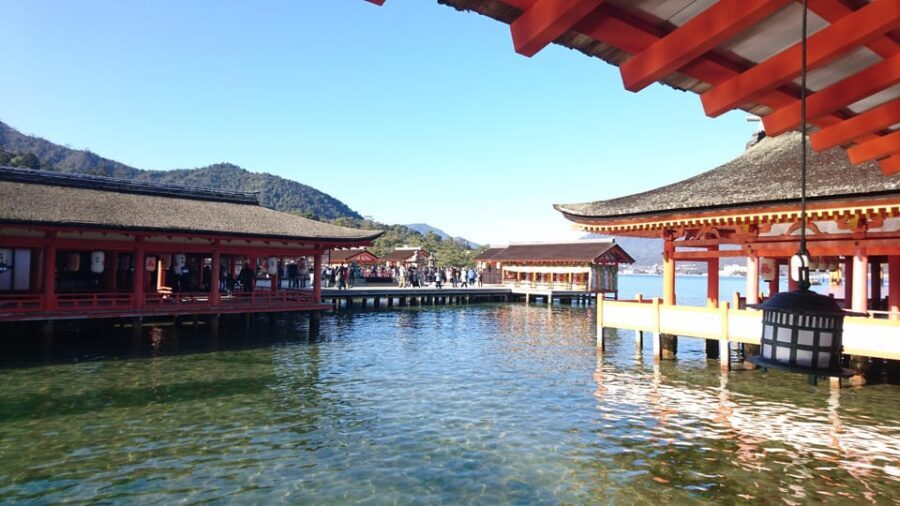
This is the one to book if you are not staying in Hiroshima overnight. It is a 12-hour day — brutal but efficient — and the packaging solves the single hardest part of this trip, which is not the tour itself but the train logistics at either end. Reviewers call it out as a highlight of their entire Japan itinerary. Our review walks through what is and is not included, and why the price makes sense once you add up the DIY equivalent.
3. Hiroshima Peace Walking Tour at World Heritage Sites — $94.84
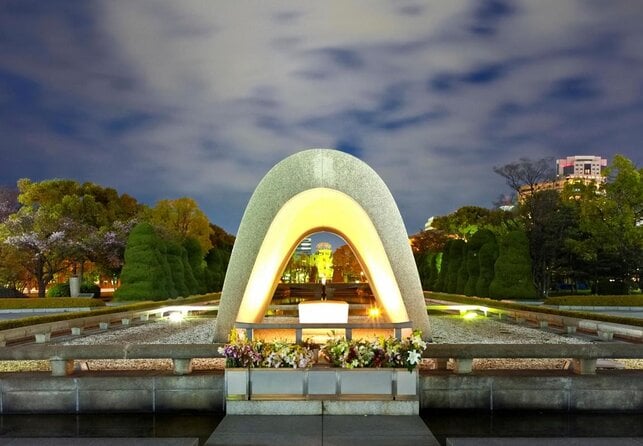
If you want the Peace Park to be the heart of the day and the shrine to be the postscript, this is the format. Small-group walking pace, experienced guide, and the flexibility to let questions change the route. Our review covers the main caveat — the museum entry is tight on busy weekends, so if the day happens to fall on a school holiday, consider a weekday instead.
What to eat in Hiroshima — seriously
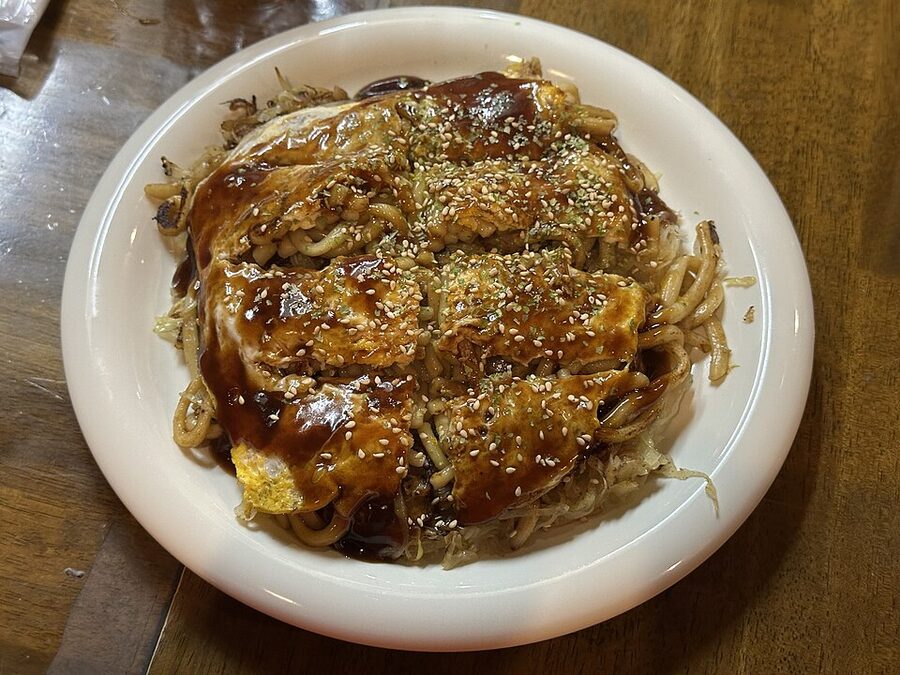
The Hiroshima version of okonomiyaki is its own thing — not the Osaka version, not a variant, a completely different dish. It is layered rather than mixed, with yakisoba noodles built into the stack. If your tour stops for lunch in Hiroshima, push for okonomiyaki. Packaged tours sometimes default to a bento box because it is easier to manage on a schedule; worth asking in advance whether an okonomiyaki stop is on the menu. A plate runs about 1,000–1,400 yen at one of the places inside Okonomimura, a four-floor building with nothing but okonomiyaki griddles on every level.
On Miyajima, the local dish is anago meshi — grilled sea eel over rice. It is richer and more savoury than unagi and the island does it better than anywhere else in Japan. There is a legendary shop called Ueno just outside Miyajimaguchi Station; budget 2,500 yen and an extra 40 minutes in your day if you want to try it.
The other Miyajima thing to know about is momiji manju — maple-leaf-shaped cakes with various fillings, traditionally red bean. Every souvenir shop on the island sells them. The best are the freshly grilled ones you can buy from stalls on the main street; factory-wrapped ones travel home fine but do not compare.
The cenotaph and the flame — what they mean
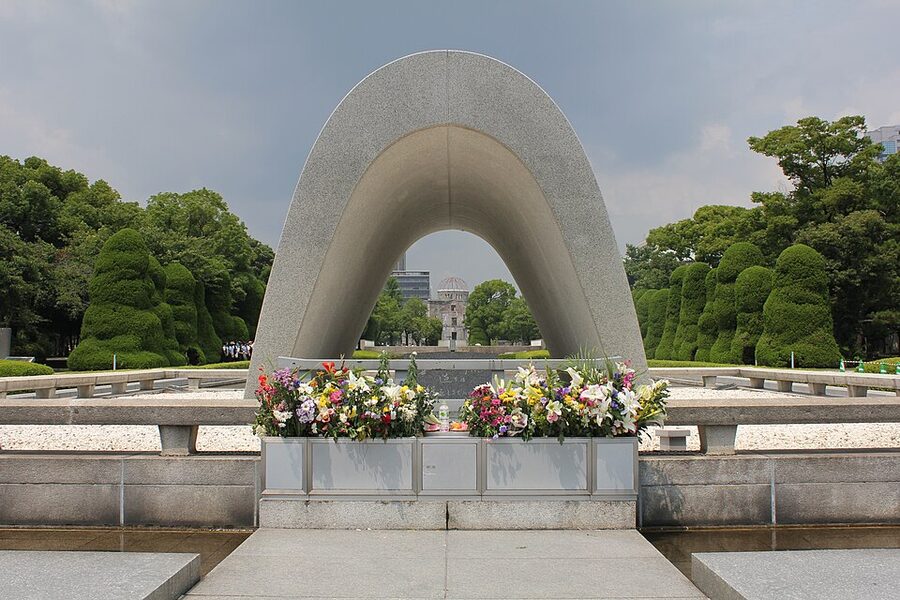
Between the museum and the Children’s Peace Monument, the Cenotaph is easy to walk past. It is a simple concrete arch over a stone chest containing a list of every confirmed victim of the bombing. The list is added to every year — people who were exposed that day and whose deaths are still being attributed to it decades later. As of 2024 it contains over 340,000 names.
The arch frames the Flame of Peace, which has burned since 1964 and will only be extinguished when the last nuclear weapon on earth is dismantled. Behind the flame, the Dome sits on the other side of the river. The whole line-up is deliberate. If you stand at the arch and look north, you see the flame in the foreground, the Dome in the middle distance, and the sky beyond. Tour guides pause here for a reason.
Hiroshima Castle and the rebuilt city
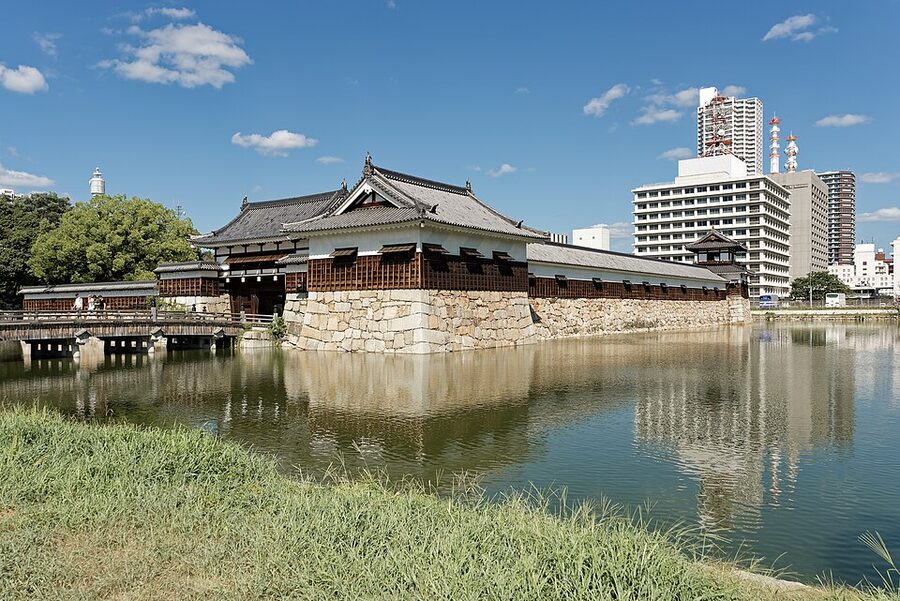
Most day trips skip Hiroshima Castle. They shouldn’t. A 10-minute walk from the Peace Park, the castle grounds are free and the reconstructed keep (370 yen) houses a small museum about Hiroshima’s feudal history. It is a useful corrective — the city did not begin on 6 August 1945, and the displays make that clear in a way the Peace Park does not try to.
If your tour does not include it and you have a little flex, slip in 45 minutes. Even the grounds alone are worth it. The castle is ringed by a wide moat full of koi, and in April the cherry trees along the walls are among the best in the city.
Climbing Mt Misen on Miyajima
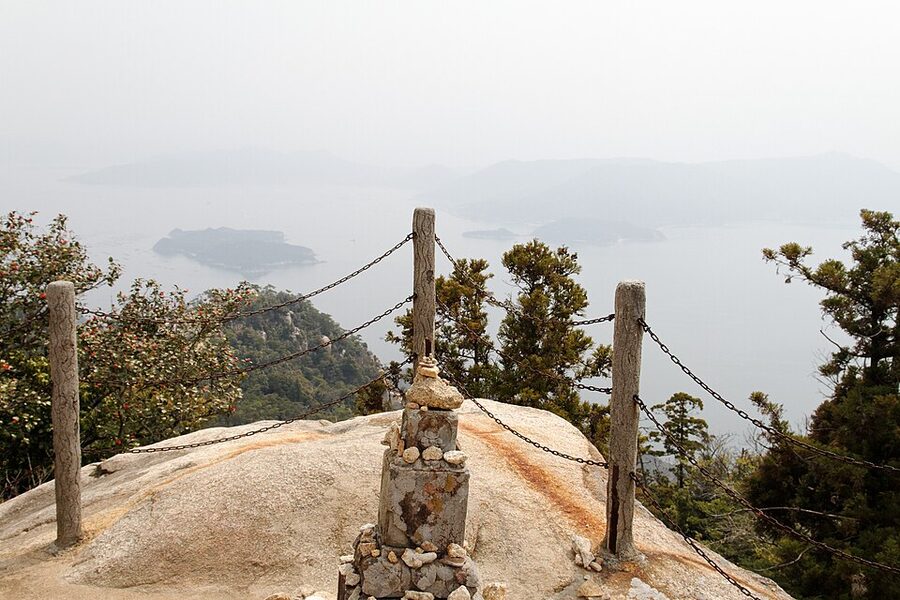
Day tours almost never include Mt Misen because of the time. That is fair — adding 90 minutes for the ropeway and 45 for the summit walk does not fit a 12-hour day with shinkansen transits. But if you are doing Miyajima solo and have the afternoon free, skip the shopping streets and take the ropeway instead. The view across the Seto Inland Sea, with its hundreds of small islands, is the thing you come to Japan for.
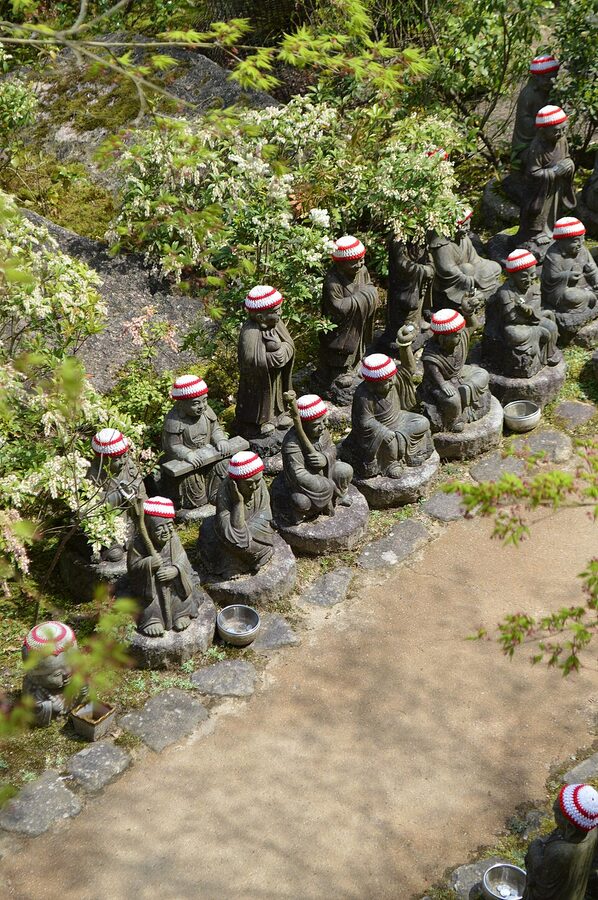
On the way down, walk rather than ride. A path drops you through cedar forest to Daisho-in, an 800-year-old Shingon Buddhist temple complex with spinning sutra cylinders, a cave of 88 Buddhas, and rows of carved Rakan statues with individually expressive faces. Most travellers never see it.
What to know about the museum before you go in
A few practical things about the Peace Memorial Museum that nobody tells you. Entry is 200 yen, cash or card. The main exhibit is on the second floor; the ground floor is a lobby with luggage lockers you will be glad to use. English audio guides are 400 yen and they are worth it — the translations on the panels are sparse, and the audio guide fills in a lot of what you would otherwise miss.
The museum does not allow re-entry on the same ticket, so do the whole thing in one visit. There is a small bookshop at the exit that stocks survivor testimonies translated into English; the paperback of Keiji Nakazawa’s I Saw It is the one I recommend if you only read one. It is the basis for Barefoot Gen and it is 800 yen.
Lines can stretch in summer school-trip season, when Japanese schools bring classes on the morning bus. If your tour gives you a choice, push for an 11am or later entry; the tour groups have cleared by then.
What not to do
A few specific warnings. The Peace Park is not a photo op. Selfies in front of the Dome are technically allowed and widely done; I am not going to tell anyone how to mourn. But the most common regret I hear from visitors is that they filmed or photographed their way through and felt they missed the experience. Put the camera in a bag for the museum.
On Miyajima, do not feed the deer. They will eat almost anything you offer, including paper, which is bad for them. The ferry will sell you a sealed can of deer food that is actually deer food; only buy that one if you want to feed them at all. Signs on the island ask visitors not to, and it is not ceremonial — the deer have genuine health problems from garbage and paper ingestion.
And do not try to sprint the day. This trip does not reward efficiency. Sixteen hours of rail is not worth it for three hours on the ground. If you are coming from Osaka or Kyoto and you cannot commit to at least six hours between the park and the island, consider staying overnight in Hiroshima instead. The city is a good place to sleep.
Cost breakdown if you go alone
For anyone considering going solo from Osaka or Kyoto, here is the maths in full. Round-trip shinkansen: around 21,000 yen (Nozomi, no JR Pass). Tram in Hiroshima: 440 yen. JR ferry return: 360 yen. Peace Museum entry: 200 yen. Shrine entry: 300 yen. Lunch at an okonomiyaki stall: 1,200 yen. Coffee and a snack: 800 yen. Total before any souvenirs: around 24,300 yen, or roughly $160 USD.
The $277 package from Osaka/Kyoto is more expensive — call it a $110 premium — but that buys you an English-speaking guide, a small group, no train or ferry logistics, and an itinerary that does not collapse if a shinkansen runs late. For a one-off day trip into someone else’s country, that is usually worth it. If you are an experienced solo traveller in Japan and speak some Japanese, doing it alone is fine. If this is your first month in the country, the package is a better buy.
Staying overnight vs day-tripping
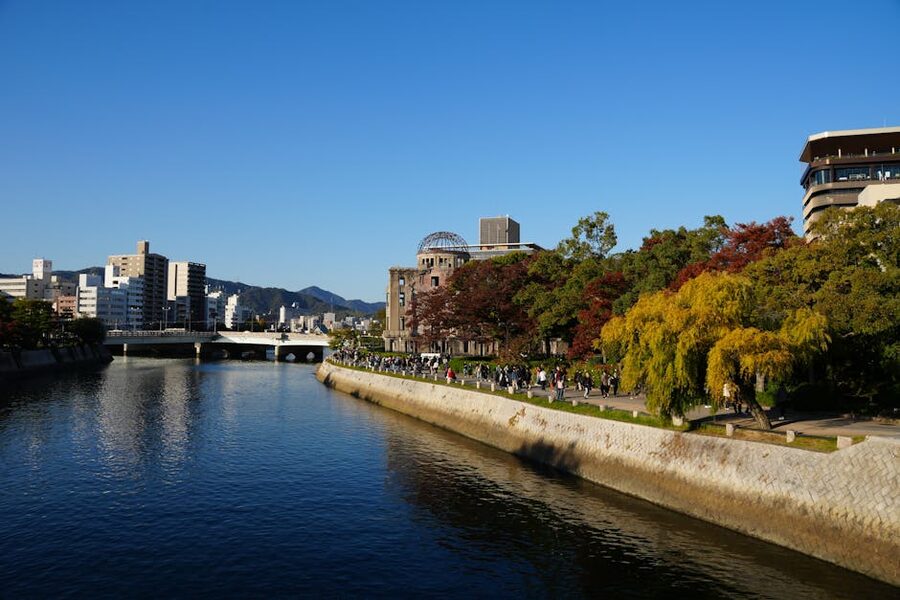
A day trip from Osaka or Kyoto is possible and common. An overnight in Hiroshima is better. You arrive in the afternoon, walk the park at dusk — it is illuminated subtly at night and the Dome at sunset is a quieter, less crowded photograph — and tackle the museum first thing the next morning before the tour buses arrive. Miyajima gets the whole afternoon. Dinner at a local okonomiyaki spot closes the day.
For hotels, the area around Hiroshima Station is convenient but bland. The Peace Park neighbourhood (Naka-ku) is prettier and puts you walking distance from the memorial and the Honkawa riverside. Mid-range hotels run 10,000–14,000 yen a night. Stay two nights if you can and consider a half-day in nearby Iwakuni for the Kintaikyo bridge on day two.
Getting to Miyajima from elsewhere in Japan
The short version: Hiroshima is the hub. From Tokyo, a one-way Nozomi shinkansen is about 4 hours and 19,000 yen. From Fukuoka (Hakata), it is 1 hour 10 minutes and 9,000 yen. From Kyoto, 1 hour 45 minutes and 11,000 yen. All routes run the Sanyo Shinkansen line, so a JR Pass covers everything except the Nozomi service (use Sakura or Hikari instead if you hold a Pass).
Once you are in Hiroshima, Miyajimaguchi is 25 minutes on the JR Sanyo Line (410 yen) and then 10 minutes on the ferry. Alternatively, a direct fast ferry runs from Peace Memorial Park pier to Miyajima, which is gorgeous and lets you skip the tram-plus-train-plus-ferry chain altogether. It costs 2,200 yen one way and takes 45 minutes. Worth it if you are doing the park in the morning and want the simplest possible afternoon.
Accessibility and travelling with a disability
The Peace Memorial Park is flat and paved, with ramps throughout. The museum has lifts to both upper floors and accessible toilets on each level. Wheelchair rentals are available free of charge at the main information centre near the east entrance — ask for one on arrival, they are first-come first-served and well-maintained.
Miyajima is trickier. The ferry is step-free and the waterfront is paved, but the shrine has raised thresholds on most doorways and the Mt Misen ropeway is accessible only with assistance. Daisho-in is essentially inaccessible by wheelchair. A few small hotels on the island have ground-floor rooms; ask specifically when booking.
If you are travelling with a mobility aid, the Hiroshima-based UNESCO full-day tour is the easiest of the three picks — the guides are experienced with accessibility requests and they will skip Mt Misen without fuss.
One last thing: the hypocentre marker
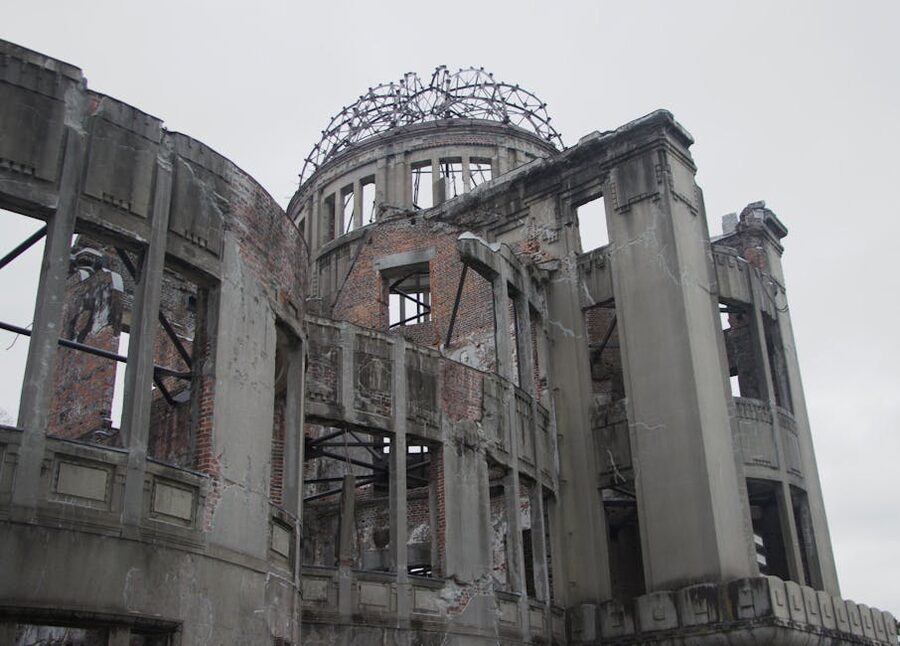
About 160 metres southeast of the Dome, on a quiet residential street, there is a small brown plaque on the wall of a medical clinic. It marks the exact spot in the air, 600 metres up, where the bomb detonated. Most tours do not stop here. Some guides will walk you over if you ask. It is worth the five minutes — seeing the plaque outside a working clinic, surrounded by ordinary city life, reframes the whole park. This is where it happened, and people live here now.
The plaque is small, easily missed, and without much context if you arrive cold. It is the kind of detail that turns a visitor into someone who understood. Ask your guide.
Day trips to pair with this one
If Hiroshima and Miyajima are anchoring a few days in western Japan, the other day trips worth building around them are Himeji (for the castle) on the way back to Kyoto, and Kurashiki (for the old canal district) on the way to Okayama. For longer stays in Kyoto itself, the Kyoto UNESCO bus tour covers the major temples in a single long day. The tea ceremony workshops and Gion geisha walking tours are good for shorter windows when the shinkansen day trips are too much. In Osaka, Osaka Castle and the Shinsekai food tour make a good pairing after a Hiroshima day. If you are routing through central Japan, the Nagoya to Takayama and Shirakawa-go day trip is the equivalent mountain-and-village version of what Hiroshima does with history and sea. And in Tokyo, the Skytree admission guide is the fastest way to queue-skip the city’s biggest viewing-deck pinch point.
The point of building your Japan itinerary this way — one heavy day, one beautiful one, one practical one — is that you arrive home with a country in your head rather than a photo album. Hiroshima and Miyajima are the single best one-day version of that. You will be different afterwards. That is the trip.