
Between April 1975 and January 1979, the Khmer Rouge regime killed an estimated 1.7 to 2.2 million Cambodians — roughly a quarter of the country’s population — through execution, starvation, forced labour, and disease.
Two sites in and around Phnom Penh preserve the physical evidence of those 44 months: Choeung Ek, the best known of the “killing fields” where prisoners were taken to be executed, and Tuol Sleng (security prison S-21), the former school in central Phnom Penh that the regime converted into its main interrogation and torture centre.
Visiting both in a single morning is the most common way travellers to Cambodia confront this history, and it is one of the hardest, most important things you can do on a trip to Southeast Asia.
This guide walks through how a Killing Fields and S-21 tour actually works, which two operators consistently receive the best reviews from travellers, what to expect emotionally and practically, and — most importantly — how to visit in a way that honours the people who died here and the survivors who built these memorials. There is no “fun” language in what follows. This is dark tourism in its truest sense, and it deserves care.
- Why these two places, and why together
- The tours worth booking
- 1. The Killing Field and Toul Sleng Genocide Museum (S21) Tour — Viator
- 2. Killing Field and Toul Sleng Genocide Museum Tour — Viator (smaller operator)
- Which tour should you pick?
- A brief history, in the plainest terms
- What Tuol Sleng (S-21) is actually like to visit
- What Choeung Ek is actually like to visit
- How to behave at these sites
- Emotional preparation
- Practical logistics
- Where to stay in Phnom Penh before your tour
- When to visit — time of day and year
- What to bring
- Entrance fees and audio guides
- Can you visit independently without a tour?
- What to do after your tour
- How the Killing Fields tour fits into a Cambodia itinerary
- Common questions travellers ask about the Killing Fields and S-21
- Is it safe to visit Phnom Penh?
- How long does the full Killing Fields and S-21 tour take?
- Is photography allowed?
- Are there English-language audio guides?
- Can I meet a Khmer Rouge survivor?
- Do I need to book in advance?
- Can I take the tour in combination with the Royal Palace?
- Is there anywhere to eat near the tour?
- What about the Khmer Rouge Tribunal — can I visit?
- Should I tell my travel companions about the visit beforehand?
- A final word on why this matters
Why these two places, and why together
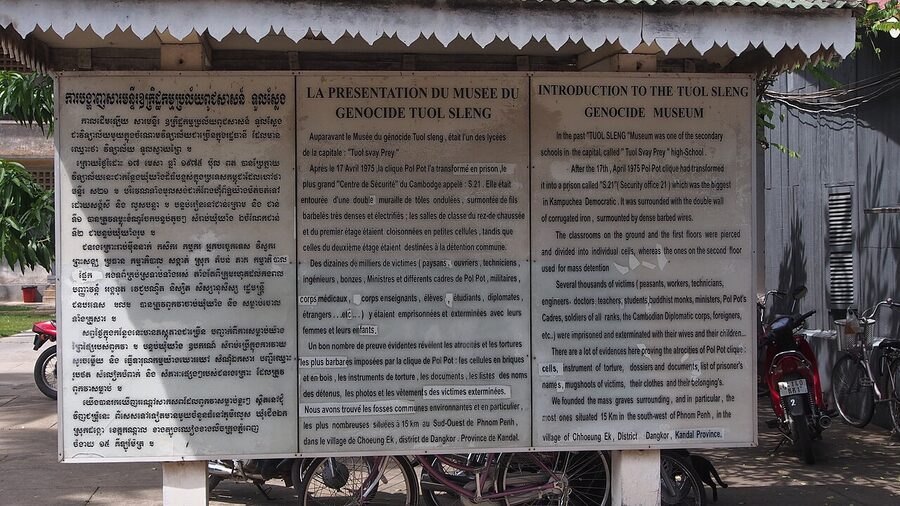
Tuol Sleng and Choeung Ek are connected by a single terrible logistics chain. The Khmer Rouge used Tuol Sleng — a four-building former high school in central Phnom Penh, renamed Security Prison 21 or S-21 — as the main interrogation centre for prisoners accused of being enemies of the state.
Between 1975 and 1979, at least 14,000 people passed through S-21, and by current estimates only twelve survived. The rest were tortured into signing confessions, then trucked 15 kilometres south to Choeung Ek, a former orchard and Chinese burial ground, where they were executed and buried in mass graves.
After the Vietnamese invasion that ended the regime in January 1979, Cambodian investigators exhumed 8,895 bodies from 86 of the 129 mass graves at Choeung Ek. The other 43 graves were left undisturbed.
Because the prison and the field are two ends of the same process, visiting them in sequence — S-21 first, then Choeung Ek, in the order prisoners themselves would have travelled — is the structure most guided tours follow. Doing only one and not the other leaves you with half the story.
S-21 on its own is a catalogue of paperwork and photographs; Choeung Ek on its own is a quiet field without the context of where the people buried there came from. Together, they are the moral spine of modern Cambodian history, and you understand the country differently after seeing them.
The tours worth booking
I reviewed tour data pulled from tens of thousands of traveller reviews across Viator, GetYourGuide, and Klook to identify which Killing Fields and S-21 tours consistently earn high marks for guide quality, logistics, and — most importantly for this subject — handling the material with care. Two stood out. They are closely related in structure but differ in price and platform, and either will give you a respectful, well-organised experience.
1. The Killing Field and Toul Sleng Genocide Museum (S21) Tour — Viator
This is the most reviewed Killing Fields and S-21 tour on any platform, and at close to 2,000 reviews at a perfect five-star average it is extremely difficult to find a negative comment. The tour runs as a half-day with morning and afternoon departures from central Phnom Penh hotels.
You are picked up by a small air-conditioned vehicle — usually a Toyota Hiace or an SUV depending on group size — and driven about 15 kilometres south to Choeung Ek first, then back into the city to Tuol Sleng, taking a total of roughly four hours door to door.
What travellers mention most: The guides. travellers name individual Khmer guides repeatedly and describe how they balance historical information with personal family stories — many of the guides are themselves children or grandchildren of survivors, and they speak about the regime with the weight of lived memory rather than as an academic exercise.
Several travellers say their guide paused the tour to give them space to sit quietly when the emotional load became too heavy, a quiet kindness that speaks well of the operator’s training.
What to know: Entrance fees are included (Choeung Ek costs $6 including the audio guide, Tuol Sleng costs $5 including an audio guide in English, French, Khmer, Japanese, Spanish, or German). Bottled water is included. The tour runs every day of the year.
Photography is permitted at both sites but with restrictions at Tuol Sleng — you cannot photograph the torture rooms or the exhibition of victim portraits on the second floor. Your guide will explain exactly where you can and cannot take pictures.
2. Killing Field and Toul Sleng Genocide Museum Tour — Viator (smaller operator)
Nearly identical in structure to the first tour, this is the same half-day Choeung Ek plus Tuol Sleng circuit run by a separate local operator with a smaller fleet. Reviews are also at a five-star average, and the 610-review base is still robust enough that you can trust the consistency.
The advantage of this tour is the smaller groups — the operator caps at six to eight people per vehicle rather than the ten to twelve the larger tour runs — which means more time with the guide at each stop and less waiting for people to regroup.
What travellers mention most: The pacing. With fewer people in the group the guide can linger at the exhibits that matter most, answer individual questions, and let the group move at the speed of the slowest reader through the documentation rooms at S-21.
Several travellers note that their guide specifically offered to separate the group briefly at Tuol Sleng so that anyone who needed to step outside and take a break could do so without feeling like they were holding others up — a detail that matters enormously given the nature of the material.
What to know: Same inclusions as the larger tour (entrance fees, water, hotel pickup). This operator runs slightly later start times on some days — around 8:30 or 9:00 rather than the standard 8:00 — which is easier if you are arriving in Phnom Penh the night before on a late flight and want an hour or two of extra sleep. Confirm the start time when you book.
Which tour should you pick?
Both tours cover the same two sites with knowledgeable guides, at essentially the same price. The decision comes down to group size and timing.
- Pick the 1,977-review tour if you want the most proven track record and the widest range of departure times to fit your schedule. It is the default choice for solo travellers and couples who have no strong preference.
- Pick the 610-review tour if you are travelling in a small group, if you are an introverted traveller who finds crowds emotionally exhausting, or if you want the slower pacing that smaller group sizes allow. It is also slightly cheaper by a fraction.
- Either way: book at least two days in advance during peak season (November to February and the week around Chinese New Year), and use the messaging function at booking to let the operator know if you have any specific needs — mobility, language, or emotional — so the guide can prepare.
A brief history, in the plainest terms
The Khmer Rouge were a communist movement led by Pol Pot, originally Saloth Sar, a Paris-educated ideologue who blended a particular reading of Maoist agrarian communism with ethnic nationalism.
After the Cambodian Civil War and the withdrawal of American support from the Lon Nol government, the Khmer Rouge captured Phnom Penh on 17 April 1975 and immediately began forcibly evacuating the entire population of the city — men, women, children, hospital patients — into the countryside.
Their goal was a self-sufficient agrarian society built from “Year Zero,” with urban life, religion, private property, family structures, education, and foreign influence all destroyed.
The regime’s policies combined to produce death on a scale that is genuinely difficult to process. Forced agricultural labour with inadequate food killed hundreds of thousands from starvation and exhaustion.
A paranoid purging of perceived enemies — intellectuals, Buddhist monks, ethnic Vietnamese and Chinese Cambodians, Muslims, anyone who had worked for the previous government, anyone who wore glasses, anyone who spoke a foreign language — killed hundreds of thousands more.
Prisoners were sent to S-21 and other security centres to be tortured into confessions that named other “enemies,” and those confessions were used to justify the next round of arrests. It was a closed loop that fed on itself.
The regime was finally ended by a Vietnamese military invasion that began in late 1978 and took Phnom Penh on 7 January 1979, a date Cambodia now marks as Victory Over Genocide Day. Pol Pot fled to the Thai border and lived, largely untroubled, until his death from heart failure in 1998.
The Khmer Rouge Tribunal — officially the Extraordinary Chambers in the Courts of Cambodia — was established in 2006 to try the surviving senior leadership; its last conviction came in 2018. Of the five senior leaders indicted, three were convicted, one died before trial, and one was declared unfit to stand trial.
It is one of the lowest conviction counts of any major genocide tribunal in history, and it is a source of ongoing grief for survivors.
What Tuol Sleng (S-21) is actually like to visit
The museum sits in a quiet residential neighbourhood in central Phnom Penh, about ten minutes from the Royal Palace. From the street it still looks like a school — four three-storey classroom blocks around a grass courtyard, a basketball pole still standing on one edge, bougainvillea climbing the outer walls. Before the Khmer Rouge renamed it S-21 in 1975, it was Chao Ponhea Yat High School.
That fact — that this was a place where teenagers studied mathematics and French until a regime decided to convert it into a torture centre — is what most visitors say stays with them longest.
You enter through the main gate, past a small ticket office where you can pick up an audio guide. The audio guide is essential. It is voiced by Cambodian survivors and their descendants, and it walks you through the buildings in a specific order with pauses at key exhibits. Each building tells a different part of the story.
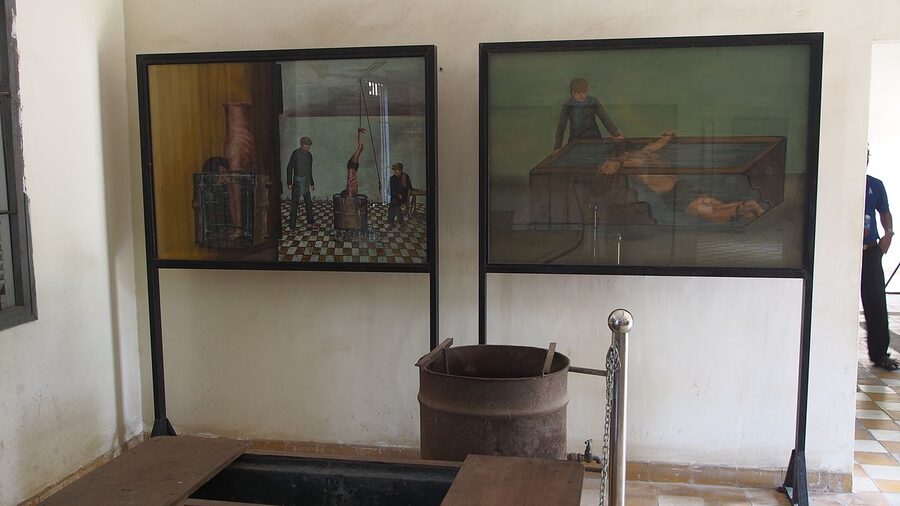
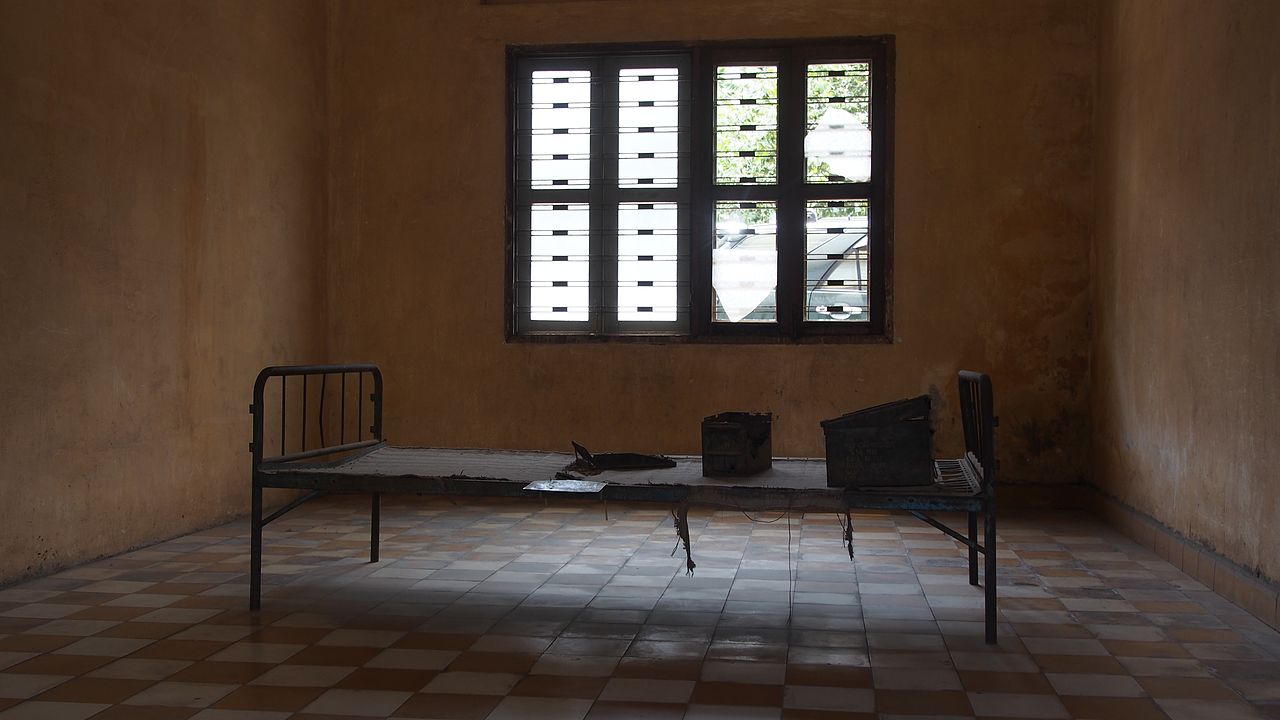
Building A still has several of the original interrogation rooms preserved as they were found in 1979, with iron bed frames, shackles, and in some rooms the photographs the liberating Vietnamese forces took of the bodies they discovered. These are confronting rooms and they are labelled clearly so you can choose whether to enter.
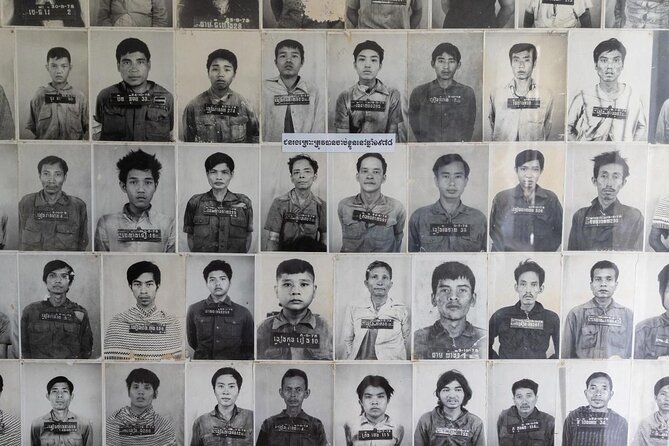
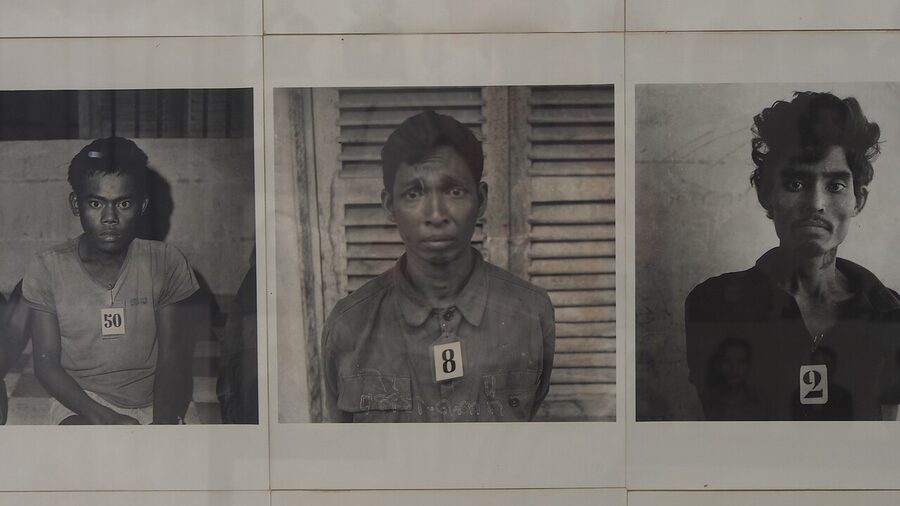
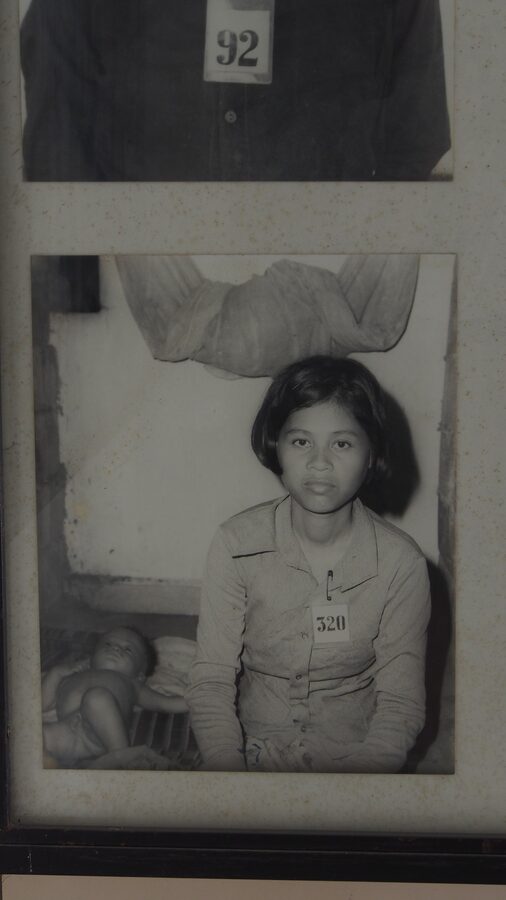
Building B houses the documentation archive. S-21’s leadership was obsessive about records: every prisoner was photographed on arrival, given a number, interrogated, and the confession — no matter how fabricated — was filed. Thousands of these mugshots now line the walls of Building B, floor to ceiling. The photographs are not displayed as trophies.
They are displayed so that each victim is a person with a face, not a statistic. Walking through these rooms in silence, reading the few names that survivors and researchers have since managed to identify, is the heart of the Tuol Sleng experience.
Building C shows the conversion of classrooms into individual cells — walls of crude brick built just wide enough for a single prisoner, the dividers still in place. Building D contains survivor testimony, including a short film with interviews from Chum Mey and Bou Meng, two of the handful of people who survived S-21.
Both men are frequently present at the museum itself during the day, selling copies of their memoirs at small tables near the exit. If they are there when you visit, buying a signed copy directly from them is one of the most meaningful things you can do on the visit. Both are in their nineties as of the mid-2020s and their daily presence at the museum will not last forever.
You will spend roughly 90 minutes at Tuol Sleng. Some visitors stay longer, sitting under the frangipani trees in the courtyard between buildings to process what they have seen. The guides understand this and will give you the time you need.
What Choeung Ek is actually like to visit
The killing field sits at the end of a dusty road through the southern outskirts of Phnom Penh — past markets, a small bridge over a canal, rice fields in the wet season, dry earth in the dry. Fifteen kilometres from the city centre but it feels much further.
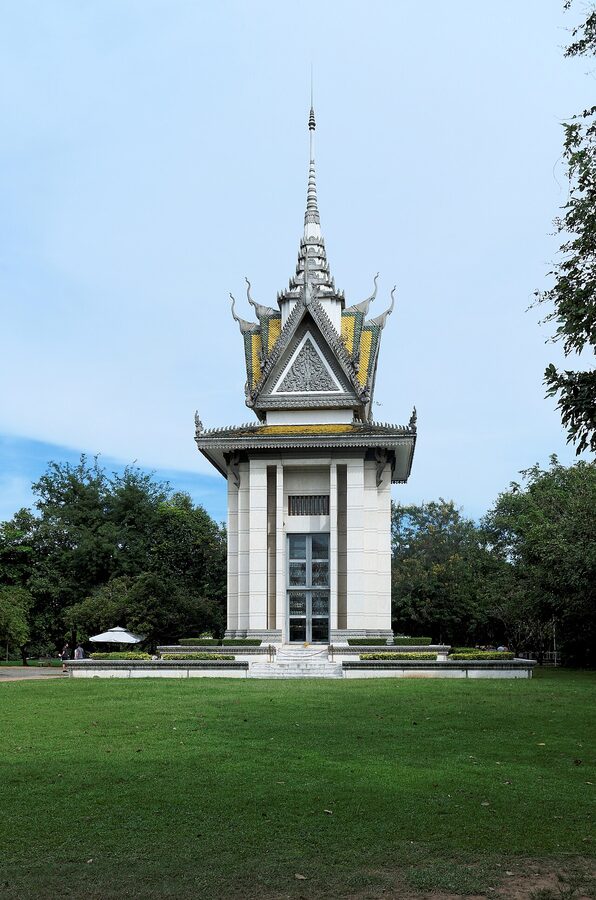
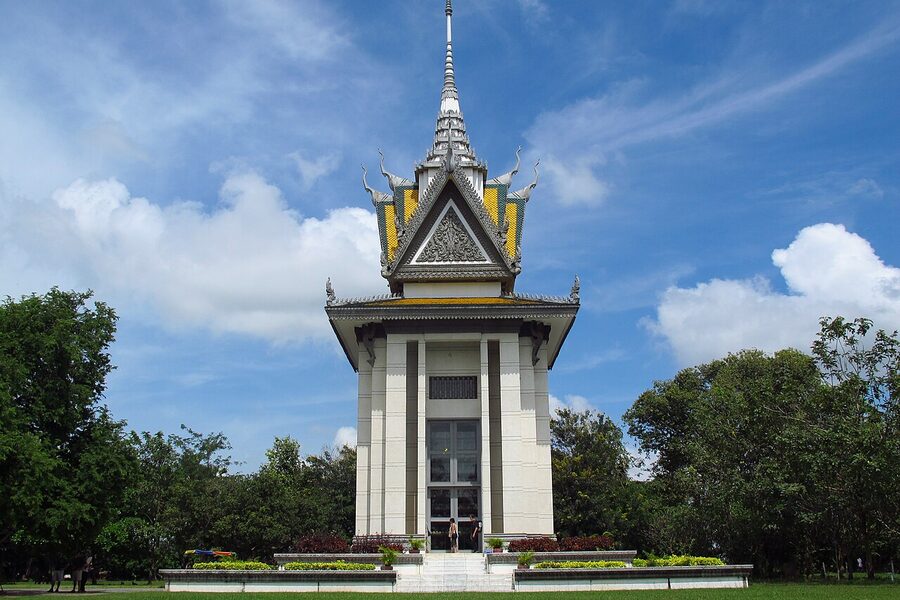
The Cambodian government opened the site as a memorial in 1988 and built the central stupa — a traditional Buddhist tower — to hold the remains exhumed from the mass graves.
Today the site is managed by JC Royal, a Cambodian-Japanese joint venture, which is controversial locally because the operators are a commercial entity rather than a state memorial body, but the site itself is well maintained and the audio guide is excellent.
You enter through the visitor centre and collect the audio guide at the ticket counter. The guide is narrated by Him Huy, a former Khmer Rouge soldier who worked at Choeung Ek and who later became a witness at the Khmer Rouge Tribunal. His voice walks you around the grounds at your own pace, stopping at numbered posts.
This format is powerful in a way that group guiding cannot be — you control when to move, you sit with the silence between tracks, and you hear Cambodian voices directly.
The grounds themselves are quiet and green. You walk past the sites of the former prisoner detention shed, the chemical store where DDT was kept to cover the smell of the mass graves, and then the graves themselves — now shallow depressions in the earth marked with small signs. Some are empty.
Some still contain bones and fragments of clothing that surface naturally when rain erodes the soil — which is why visitors are asked not to walk on the raised paths between the graves rather than directly across the ground. Small wooden offering boxes hold the fragments that visitors have picked up from the paths, so that the staff can re-inter them.
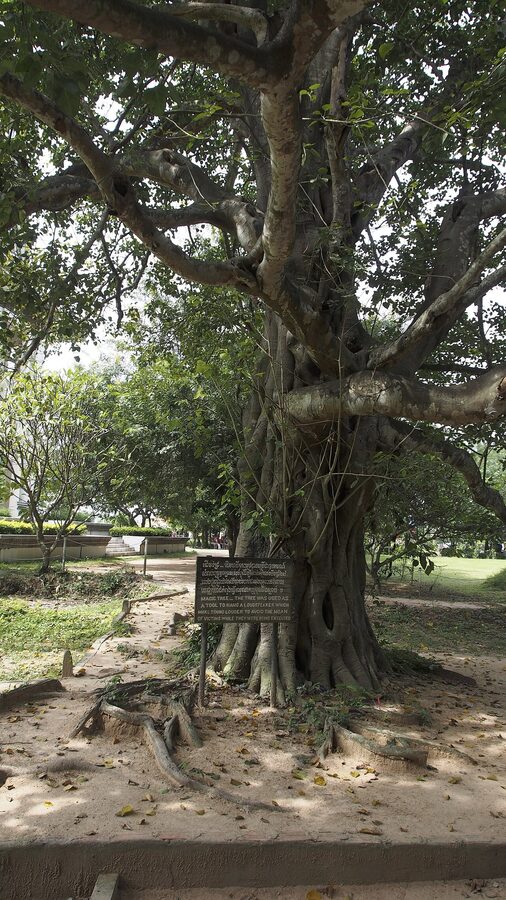
Near the centre of the site stands the “Killing Tree,” a large tree that was used to murder infants. There is a plaque. There are bracelets tied to the branches by visitors — small, personal gestures of mourning that Cambodian authorities permit as long as they are removed periodically and stored. You stand in front of this tree and you are expected to be silent. Most people cry. That is the appropriate response.
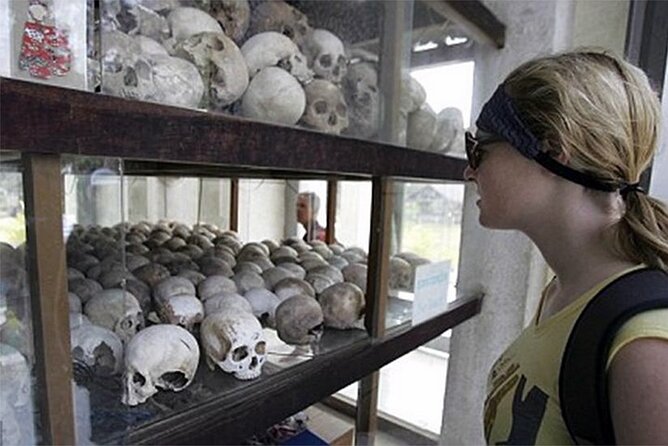
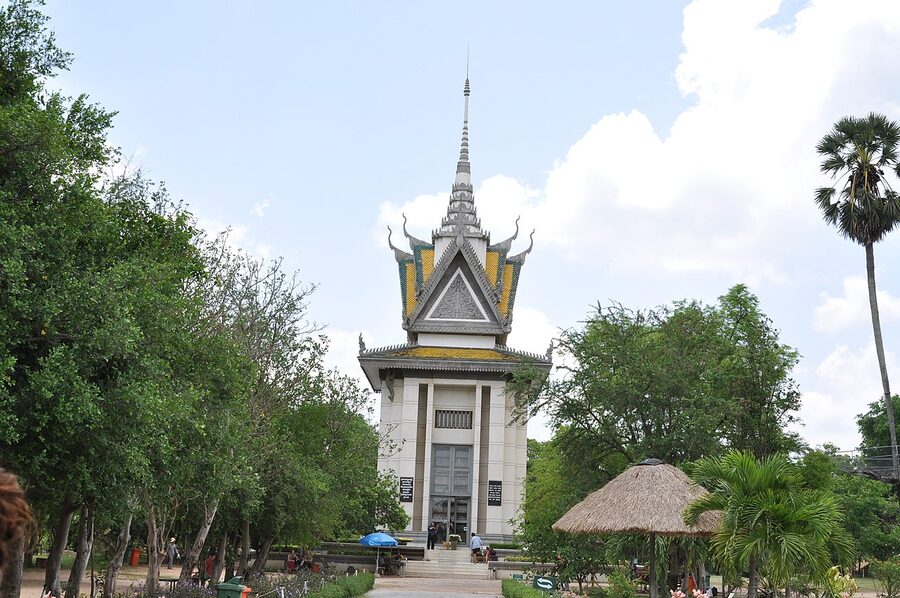
The final stop on the audio guide is the memorial stupa itself, a 62-metre tower of clear glass and gold-leafed wood that holds more than 5,000 skulls and bone fragments organised by age and sex, stacked on seventeen levels. You walk around the stupa, not into it. You take off your shoes and hat before approaching. Monks visit regularly to pray.
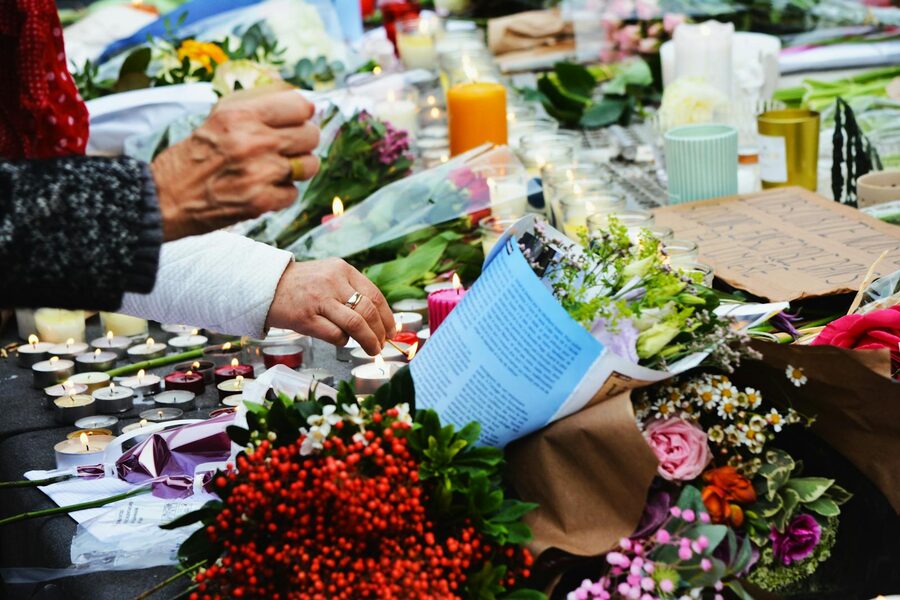
Visitors who wish to make offerings of incense or flowers can do so at the base. You will spend roughly 90 minutes to two hours at Choeung Ek depending on your pace and how much time you sit with the stupa.
How to behave at these sites
This section is the most important part of this article, and it is worth reading twice.
These are not museums in the ordinary sense. They are memorial sites — functional graveyards where Cambodians come to grieve their murdered relatives. Many of the cleaning staff, guides, and neighbours have personal connections to the people buried or photographed here. The standard rules of respectful behaviour at any grave apply, and then some.
- Dress modestly. Shoulders and knees covered at both sites. No tank tops, no short shorts, no flip-flops with loud printed graphics. This is not a temple dress code — it is a funeral dress code. Err on the side of restrained.
- Keep your voice low. Whispered conversation only. The audio guides are designed for solo listening. If you are in a small group, walk separately and regroup afterwards.
- No selfies. No smiling photographs. This should go without saying but sadly does not. Do not photograph yourself in front of the stupa, the graves, the killing tree, or the photographs of victims. Do not ask a friend to take your picture at the Tuol Sleng torture rooms. If you want to document your visit, photograph the landscape and the architecture — not yourself. The audio guide at Choeung Ek explicitly asks visitors not to take smiling photographs, and this request should be honoured everywhere on both sites.
- Do not touch bones or fragments. If you see something on the path at Choeung Ek, tell a staff member. Do not pick it up. Do not photograph it as a trophy.
- Turn your phone to silent. Not vibrate — silent. The buzz of an incoming call at either site is jarring to other visitors.
- Let the audio guide finish each track. Do not skip ahead. The pacing is deliberate and the silences between tracks are part of the experience. Resist the urge to check your messages during a quiet moment — that quiet moment is the point.
- Tip generously. Your guide is doing emotionally exhausting work every single day. Five to ten dollars per person at the end of the tour is appropriate; more if the guide has been particularly thoughtful. This is not optional — tour commissions in Cambodia are thin and tips are how guides actually earn a living wage.
- If you are travelling with children under 12, consider carefully. Many parents who have done this visit regret bringing young children. The material is graphic and age-appropriate discussion is genuinely hard. Teenagers who have studied the period at school can benefit from the visit; younger children often cannot, and their presence can also make the experience harder for other visitors who are trying to process the material in silence.
Emotional preparation
Travellers who visit Tuol Sleng and Choeung Ek without preparation frequently describe being hit harder than they expected. This is worth taking seriously. Reading a short history of the period before you go is the single best preparation. Philip Short’s Pol Pot: The History of a Nightmare is the most accessible comprehensive account.
David Chandler’s Voices from S-21 is the definitive scholarly work on Tuol Sleng itself and will prepare you especially well for what you see in Building B. Loung Ung’s memoir First They Killed My Father, which Angelina Jolie later adapted into a Netflix film, is a survivor’s child account that gives you the human scale of what happened.
If you do not have time to read a book before your trip, the free audio guides at both sites include a short historical introduction at the first stop. Listen carefully. Do not skip it to get to the physical exhibits faster — the context is what makes the physical exhibits meaningful.
Consider going in the morning rather than the afternoon. Both sites are cooler, quieter, and less crowded early. The emotional weight of what you have seen will also give you the rest of the day to process before sleep, rather than sending you straight into a restless night. Many travellers report that the night after visiting Tuol Sleng and Choeung Ek is difficult, and that is normal.
Talk to your travel companions. If you are alone, write your thoughts down. There is no correct way to feel; there is only the need to let yourself feel it.
If you know you struggle with depictions of violence, graphic historical photographs, or confined spaces, talk to your guide before you enter each building at Tuol Sleng so they can direct you to the rooms you can manage and help you skip the ones you cannot. There is no shame in stepping outside. Several of the guides at these sites keep chairs under the shade trees in the courtyard precisely so visitors who need to sit out a section can do so in peace.
Practical logistics
Where to stay in Phnom Penh before your tour
Most Killing Fields tours start with a hotel pickup in central Phnom Penh, typically within a triangle bounded by the Royal Palace, the Central Market, and Boeung Keng Kang (BKK1 district). If you stay in this area your pickup is automatic and punctual. Stay further out in neighbourhoods like Tuol Kork or Chroy Changvar and you may need to travel to a central pickup point — confirm this when you book.
For a first-time visitor I would recommend staying one or two nights in BKK1, the expat and embassy district where most good cafes, restaurants, and mid-range hotels are concentrated. It is quieter than the riverside, walkable during the day, and centrally placed for both the tour pickup and the rest of your sightseeing. The Royal Palace area is more atmospheric and closer to the river sunset scene, but traffic around the palace can slow morning pickups.
When to visit — time of day and year
Both sites open at 08:00 and close at 17:30 year-round. Tours typically begin at 08:00 to 09:00 with Choeung Ek first, then return to the city for Tuol Sleng around 11:00. Avoid the hour between 12:00 and 13:00 at either site — the midday sun at Choeung Ek is brutal (there is little shade on the grounds themselves), and Tuol Sleng’s school buildings do not have air conditioning, only slowly turning ceiling fans.
November through February is dry, cool, and the most comfortable time to visit — expect morning temperatures around 25°C (77°F). March through May is the hot season and midday temperatures can hit 38°C (100°F) at Choeung Ek, which makes the outdoor sections of the tour physically draining on top of the emotional weight.
June through October is the wet season: mornings are usually clear, with afternoon thunderstorms, and the Choeung Ek grounds can be muddy — closed-toe shoes are essential.
What to bring
- Modest clothing — shoulders and knees covered. A light long-sleeve shirt or scarf also helps with sun exposure at Choeung Ek.
- Closed-toe shoes with grip. The paths at Choeung Ek are uneven earth, and in the wet season they are slippery.
- Water bottle. Most tours include one but carrying extra is wise — it is hot and you will want to stay hydrated through the two-hour Choeung Ek audio walk.
- Sunhat and sunscreen. Especially for Choeung Ek.
- A handkerchief or tissues. You will probably need them. There is no shame.
- Small US dollars in cash for tipping the guide, buying the audio guide if it is not included, or purchasing a book from Chum Mey or Bou Meng if they are at Tuol Sleng that day. Cambodia uses dollars alongside riel for tourist transactions.
- Quiet phone. Put it on silent before you enter either site and leave it that way.
Entrance fees and audio guides
Independent visitors (without a tour) pay $6 for Choeung Ek entrance including the audio guide, and $5 for Tuol Sleng entrance plus $3 for the audio guide. Children under 12 are free at both sites. Organised tours from Viator, GetYourGuide, and Klook include these fees in the ticket price — check your booking confirmation to be sure, but on both tours listed above they are bundled in.
The audio guides are genuinely excellent and I would not visit either site without one, even on a guided group tour where you have a live Cambodian guide as well. The audio guides add a different kind of narration — personal, testimonial, often in the voices of actual survivors — that supplements what your human guide tells you. On the tours above your guide will hand you an audio device at each site and let you walk through at your own pace before regrouping.
Can you visit independently without a tour?
Yes, and some travellers prefer it. Tuk-tuks and PassApp (Cambodia’s Grab equivalent) drivers in Phnom Penh will happily take you to both sites and wait — expect to pay around $15 to $20 for a half-day with a tuk-tuk or slightly more for an air-conditioned car, plus the entrance fees.
This works well if you want complete control over your pacing and you have already read enough about the period that you do not need a live guide. The audio guides at both sites are good enough to carry you through.
However, the organised tours are only marginally more expensive — sometimes the same price or less once you include entrance fees — and you get the benefit of a Cambodian guide who can answer questions the audio guide cannot, plus the logistical simplicity of not negotiating with drivers in the heat. For most first-time visitors the tour is the better choice. Save the independent option for a second visit if you return to Phnom Penh.
What to do after your tour
This is a tour that needs decompression afterwards. I would strongly recommend not packing anything else into the afternoon. Eat a proper lunch somewhere quiet — Cuisine Wat Damnak, Malis, or any of the cafes in BKK1 are good choices. Drink water. Sit in the shade. Write in a journal. Do not try to follow Tuol Sleng and Choeung Ek with a palace tour or a temple visit on the same day; the tonal whiplash is jarring and you will not appreciate either.
If you feel you need to do something rather than sit still, the National Museum of Cambodia on the riverside is a reasonable next step. If you are heading back to Siem Reap the next day, a gentle evening show at the Phare Cambodian Circus is a particularly good counterweight to the Killing Fields visit — it is Cambodia’s younger generation reclaiming its own cultural story on stage.
It holds the Angkor-period sculpture that the Khmer Rouge tried and failed to destroy, and it reminds you that Cambodian culture is thousands of years older than the Khmer Rouge and has survived them. That shift in perspective — from 1975 to the glorious Angkor period of the 12th century — is good for the soul.
If you have another day in Phnom Penh after the tour, the Royal Palace and the Silver Pagoda are worth several hours in the morning, and a sunset boat cruise on the Mekong and Tonle Sap rivers where they meet at the city waterfront is a gentle end to the trip. Phnom Penh is a city that deserves to be seen as more than the place where the killing fields are.
It has street food stalls, bookshops, riverside cafes, colonial-era French architecture, and a young Cambodian generation that is visibly, stubbornly rebuilding.
How the Killing Fields tour fits into a Cambodia itinerary
Most first-time visitors to Cambodia fly into Siem Reap for the Angkor temples — usually opening their trip with a classic Angkor Wat sunrise experience and maybe a gentle morning out at the Kampong Phluk floating village — and add Phnom Penh as a two- or three-day side trip by bus or short flight.
The Killing Fields and S-21 tour is almost universally the centrepiece of the Phnom Penh portion of that itinerary. It works best in the morning of your second day in the city, after you have had an evening to settle in and orient yourself.
The contrast between Angkor and Phnom Penh is a large part of what makes a Cambodia trip so powerful. In Siem Reap you see the peak of Khmer civilisation at its most confident — temples built by kings who thought their empire would last forever, like the ones you walk through on a proper Angkor Wat sunrise tour.
In Phnom Penh you see what happens when that same society is destroyed by its own rulers. Seeing both sides of the story in one trip is the difference between “I went to Cambodia” and “I understood Cambodia.”
If you are building out a full itinerary, most Siem Reap travellers combine the temples with a sunrise Angkor Wat tour, a Kampong Phluk floating village trip on the Tonle Sap, a Khmer cooking class, and an evening at the Phare Cambodian Circus before moving on to Phnom Penh for the Killing Fields tour. If you have a full week, adding a day trip out to Kulen Mountain and the 1000 Lingas rounds out the Siem Reap side beautifully.
Common questions travellers ask about the Killing Fields and S-21
Is it safe to visit Phnom Penh?
Yes. Phnom Penh is a generally safe city for travellers with ordinary precautions. Petty theft — particularly phone and bag snatching from passing motorbikes — is the main street-level concern. Keep your phone out of your hand when walking, carry bags away from the traffic side of the pavement, and do not walk alone in unfamiliar streets late at night.
Both Tuol Sleng and Choeung Ek are in perfectly safe neighbourhoods during daylight hours and the tours do not involve any walking through sketchy areas.
How long does the full Killing Fields and S-21 tour take?
Plan for four to five hours door to door. About 30 minutes of that is driving (15 minutes each way to Choeung Ek from central Phnom Penh), 90 minutes to two hours at Choeung Ek, 90 minutes at Tuol Sleng, plus the time between sites for pickup and regrouping. Some tours add a short stop at a coffee shop or a Buddhist temple to break up the emotional load; others go directly. Either is fine.
Is photography allowed?
Yes at both sites, with restrictions. You may not photograph the prisoner portraits on the second floor of Building B at Tuol Sleng (out of respect for the victims), and you may not photograph any of the preserved torture rooms in Building A at Tuol Sleng. At Choeung Ek photography is permitted throughout the grounds but is discouraged inside the stupa itself and around the killing tree.
Personal selfies are explicitly discouraged at both sites. When in doubt, ask your guide, and err on the side of putting the phone away.
Are there English-language audio guides?
Yes. The audio guide at Tuol Sleng is available in English, French, Khmer, Japanese, Spanish, German, Italian, Chinese, and Korean. The audio guide at Choeung Ek is available in more than a dozen languages including all the above plus Vietnamese, Thai, and Russian. The English narration is clear and paced for non-native speakers.
Can I meet a Khmer Rouge survivor?
Two survivors of Tuol Sleng — Chum Mey and Bou Meng — are often present at the museum itself during opening hours, seated at small tables inside the main gate. They sell signed copies of their memoirs (around $10) and will speak briefly with visitors. Both are in their nineties.
If they are there when you visit, buying a book directly from them is a way to support survivors financially and to take home a first-hand account of the period that you can continue reading after you leave Cambodia. Do not press them for extended conversation; their presence at the museum is already a gift of their time.
Do I need to book in advance?
In peak season (November to February) yes — book at least two days ahead. Small-group tours fill up. In shoulder and low season you can often book the day before, though same-day booking is still risky because morning departures fill up first and afternoon slots are hotter and more crowded.
Can I take the tour in combination with the Royal Palace?
Some operators offer combined tours that do the Royal Palace and National Museum in the morning followed by Tuol Sleng and Choeung Ek in the afternoon. I would not recommend this combination. The emotional tonal shift from the gilded throne hall to the killing field in the same day is jarring, and you will not do justice to either site. Split them across two days if at all possible.
Is there anywhere to eat near the tour?
At Choeung Ek there is a small cafe at the visitor centre selling basic Khmer food (fried rice, noodle soup, bottled drinks) but most visitors find they have little appetite on-site.
At Tuol Sleng the surrounding neighbourhood has several quiet cafes within a few minutes’ walk where you can sit after your visit — The Common Tiger and Farm to Table are both within walking distance. Take a proper meal break once you are back in central Phnom Penh after the tour is complete, not between sites.
What about the Khmer Rouge Tribunal — can I visit?
The Extraordinary Chambers in the Courts of Cambodia (ECCC) — the tribunal that tried the surviving Khmer Rouge leadership — is located at Chaom Chau, about 17 kilometres southwest of Phnom Penh. It is open to visitors on public hearing days, though as the trials have now concluded (the last verdict came in 2022), the site mostly functions as an archive and educational centre.
A visit is best arranged in advance through the ECCC’s public affairs office. Most travellers find Tuol Sleng and Choeung Ek sufficient for understanding the period, and the tribunal is primarily of interest to those with a specific interest in international criminal law.
Should I tell my travel companions about the visit beforehand?
Yes, and in detail. Not everyone wants to do this kind of visit, and making sure your travel partners know what they are signing up for is basic courtesy. Someone who has lost a family member recently, someone who struggles with depictions of violence, or someone who is dealing with their own grief may genuinely not be ready for a day at Tuol Sleng and Choeung Ek.
That is entirely valid and does not need to be justified. Give them the option to skip the tour and meet up afterwards — a low-key half day in a Khmer cooking class (if you are still in Siem Reap) or a slow lunch at a riverside cafe in Phnom Penh is a reasonable alternative.
A final word on why this matters
There is a question that many travellers ask themselves in the weeks leading up to a Cambodia trip: should I go? Is this “dark tourism” — the visiting of sites of historical atrocity — morally acceptable, or is it voyeurism? The honest answer is that it depends entirely on how you go. Going to photograph yourself smiling in front of a mass grave for Instagram is voyeurism and it dishonours the dead.
Going to learn, to bear witness, to understand, and to leave a meaningful tip for your Cambodian guide — that is something the survivors themselves asked for.
Chum Mey and Bou Meng have both said, in interviews and in their books, that they chose to return to the building where they were tortured in order to tell visitors what happened there. They did not do this easily. They did it because they believe that if the world forgets, it can happen again.
The single most important thing you can do as a traveller at Tuol Sleng and Choeung Ek is to remember, and to tell other people what you learned when you go home. Reading the history, donating to the museums’ upkeep, talking to people who ask about your trip — these are small acts and they matter.
The Cambodian tourism board does not market the Killing Fields. They do not need to. Travellers come because they understand, intuitively, that visiting this history is part of what it means to understand a country that has been shaped by it.
And Cambodian guides will tell you, if you ask, that the travellers who come are a kind of ongoing reassurance — that the world has not forgotten, that the people who died here are still named out loud to strangers every day. That is the reason to go. And that is the reason to go respectfully.