
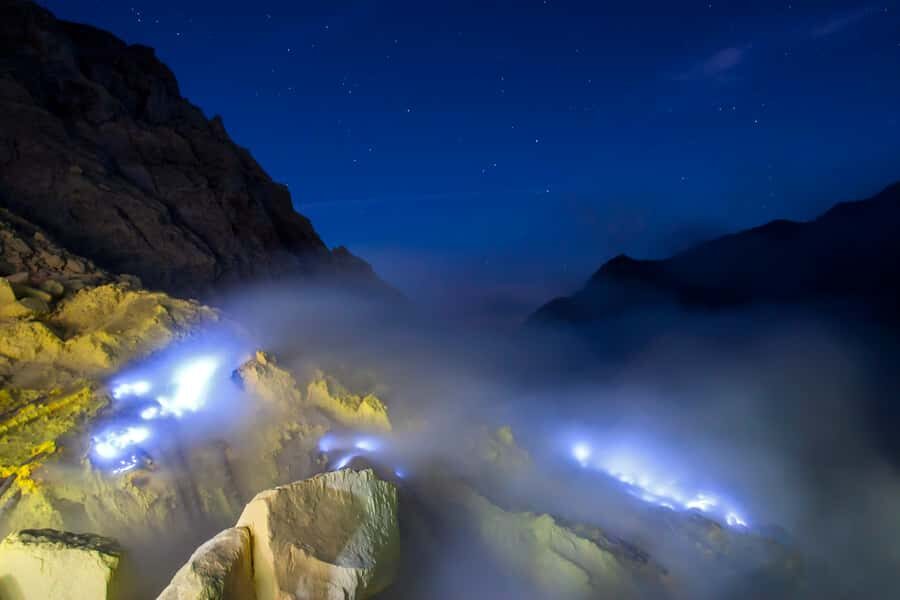
Picture this: it’s 2am on a ridge in East Java, your headlamp carving a small yellow circle out of the dark, and directly below you — pouring from cracks in the rock like spilled liquid — are flames the color of a gas stove on full. Not orange. Electric, almost-purple blue. They hiss, they flicker, they go dark, they return. Nobody told you they would actually sound like something.
The sulfur mask on your face smells like a public pool that has given up, and your guide is already motioning you down into the crater because sunrise is coming and once the sky starts to lighten the fire disappears like a trick.
That’s the Ijen blue fire. It is one of only a handful of places on earth where you can see ignited sulfuric gas at this scale, and the window is brutal: you have to be on the crater rim between roughly midnight and 4:30am, which is why every tour on the mountain leaves in the small hours and why most travellers arrive at the trailhead already half-dead from the drive.
This guide covers how to book an Ijen volcano tour that actually delivers the blue flames, which departure point makes sense for your itinerary, what the hike is really like, and the three tours we’d recommend based on review volume and what travellers are actually saying about them.
- The quick version: what Ijen actually is and why the timing is so strict
- Which departure point is right for you?
- The three Ijen tours we’d book
- Tour 1: Banyuwangi or Bali Ijen Volcano Trip with Professional Guide
- Tour 2: Surabaya or Malang 3-Day Tumpak Sewu, Bromo and Ijen
- Tour 3: From Bali — 24-Hour Kawah Ijen Blue Flames with Dinner and Room
- What the hike actually feels like
- What to wear and pack (actually, not the generic list)
- Who should skip it
- The crater lake at sunrise (the part nobody talks about)
- Combining Ijen with the rest of East Java and Bali
- When to go: the season actually matters
- Gas masks: the part worth getting right
- How to get to the trailhead if you’re doing it independently
- The sulfur miners — a note of respect
- Photography: realistic expectations
- Food, sleep, and recovery
- Frequently asked questions about booking an Ijen tour
- Is the blue fire guaranteed?
- How old do kids need to be?
- Do I need travel insurance that covers volcano hiking?
- Can I do Ijen without descending into the crater?
- What’s the difference between Ijen from Bali vs Ijen from Banyuwangi?
- Is it safe?
- Will I actually make it up? I’m not that fit.
- What if the tour is cancelled?
- Final booking advice
The quick version: what Ijen actually is and why the timing is so strict
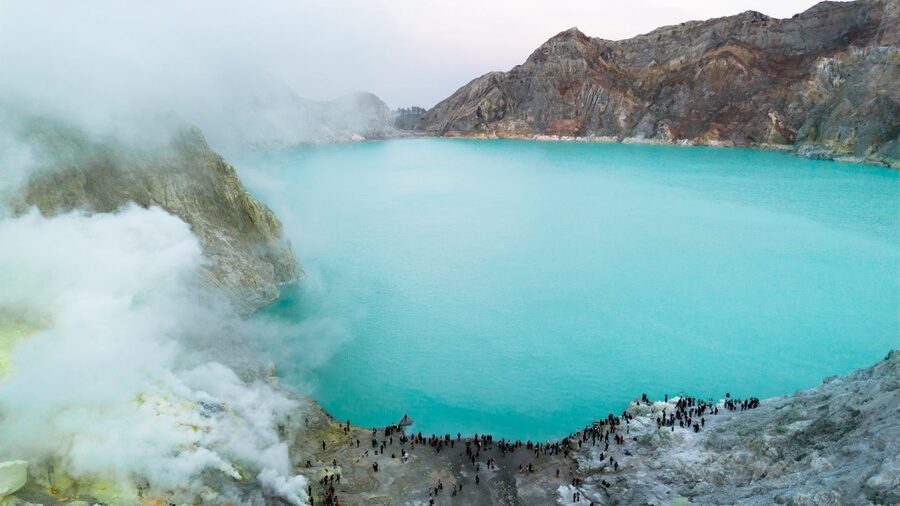
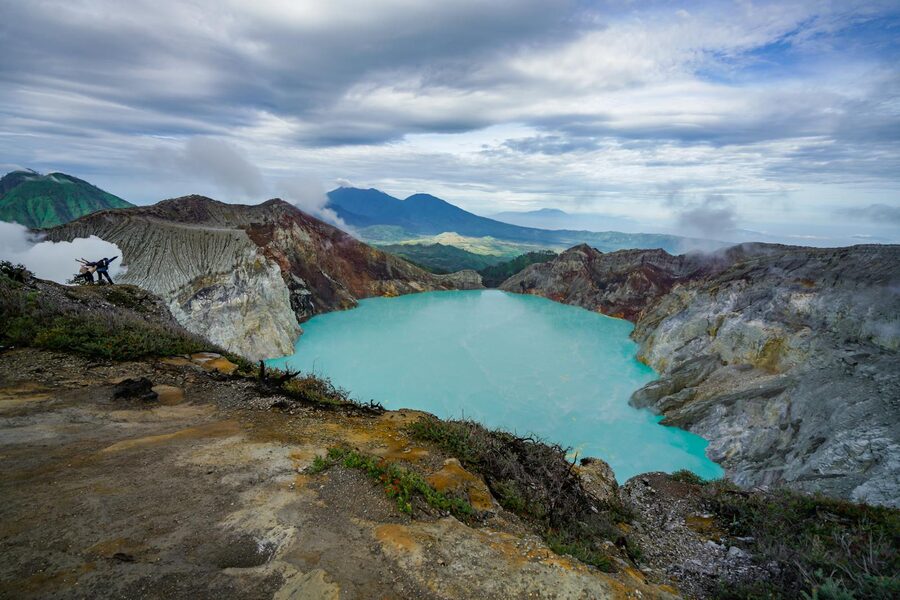
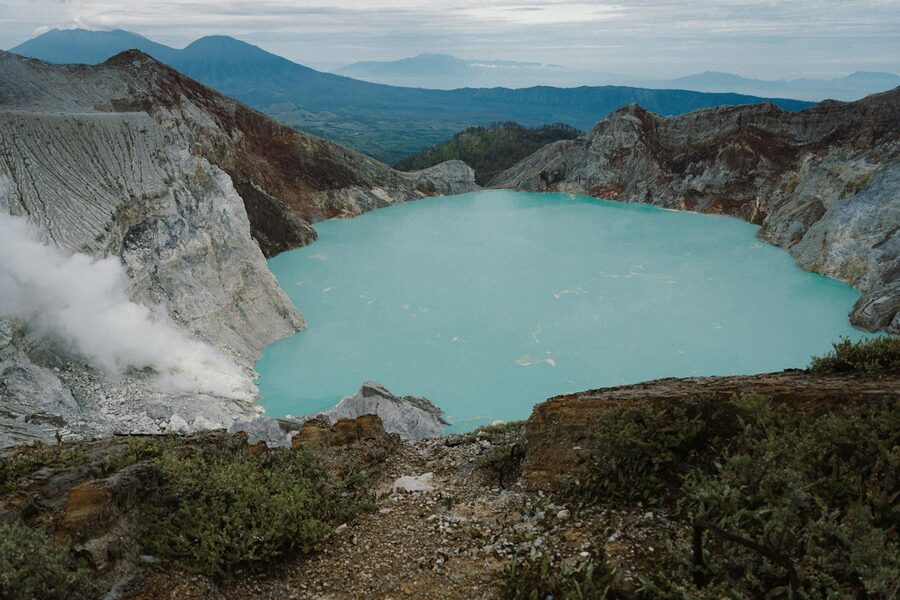
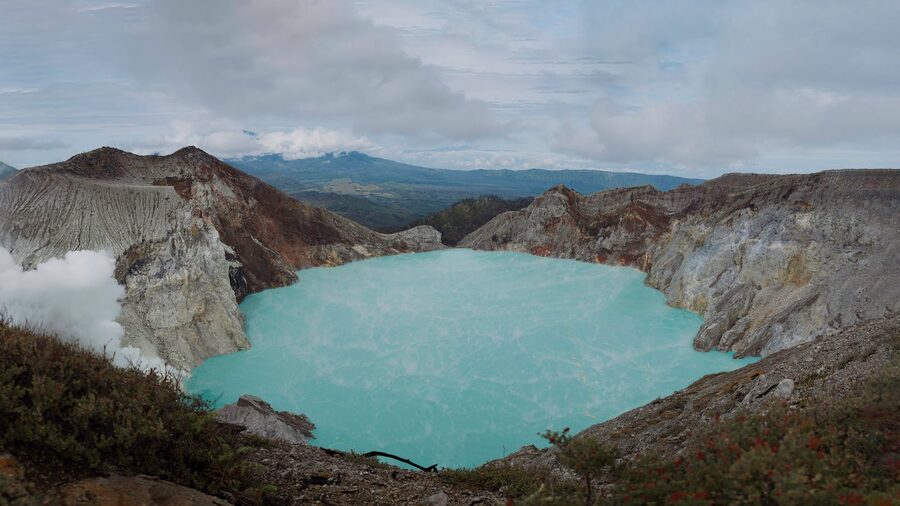
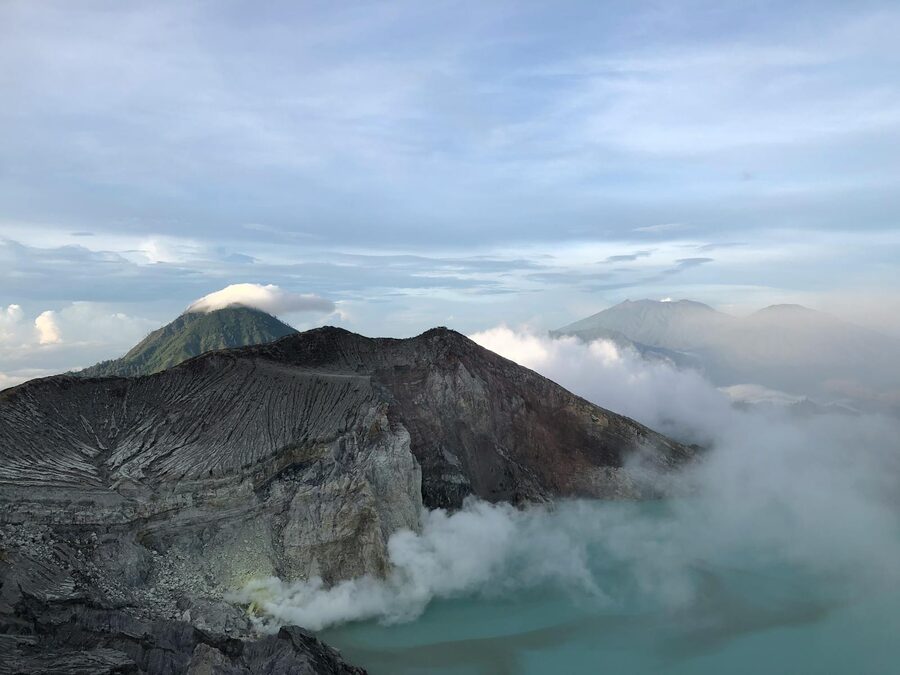
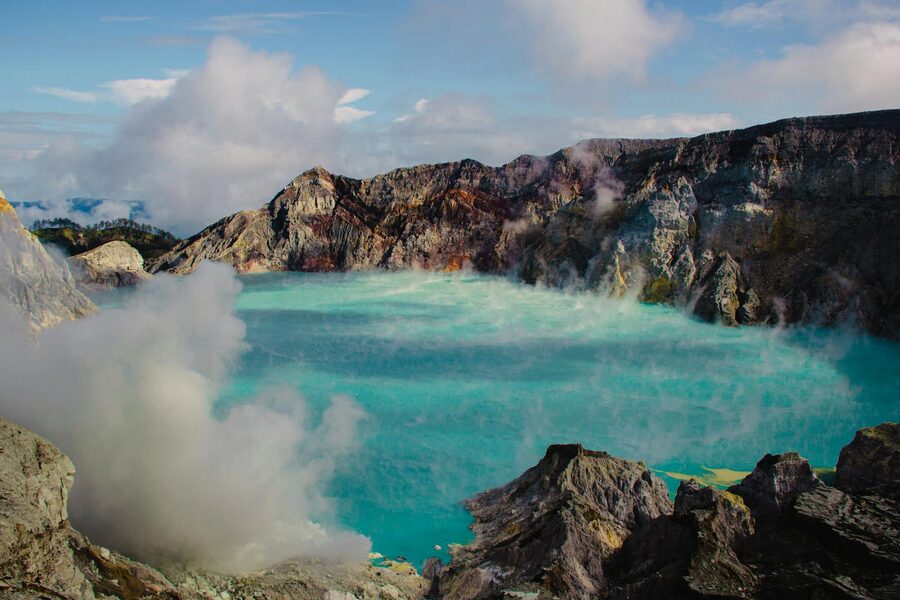
Kawah Ijen is an active stratovolcano on the eastern tip of Java, about an hour’s drive from the port town of Banyuwangi and a ferry-ride away from Bali. The crater holds a milky turquoise lake that is the largest acidic body of water on the planet (pH somewhere around 0.5 — more acidic than battery acid, not a swimming situation). That lake alone would be worth the trip.
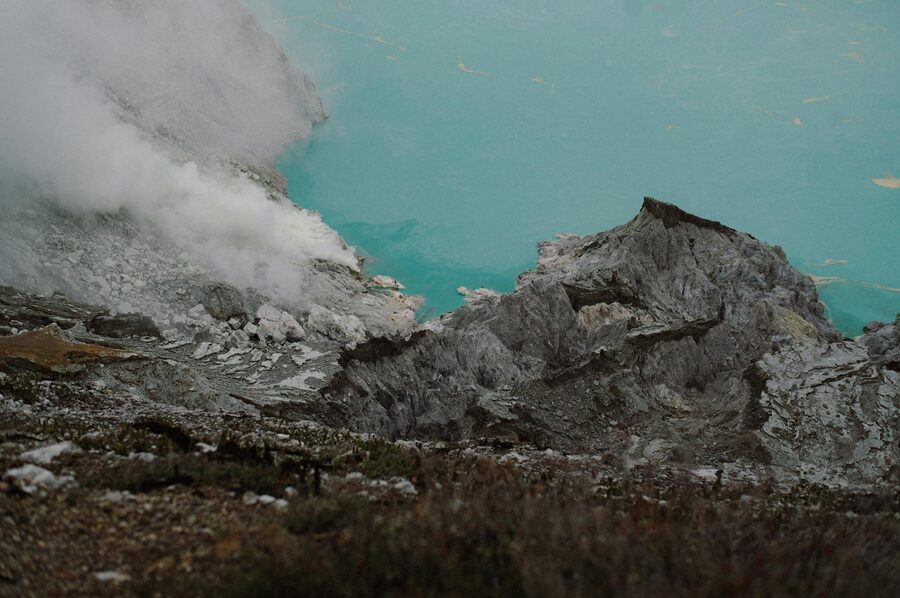
What makes Ijen famous, though, is the solfatara at its edge: vents that release sulfuric gas under pressure, hot enough that when the gas meets oxygen, it combusts. In daylight you see yellow smoke and deposits. At night, in total darkness, you see blue flames up to five meters high.
The timing is strict because the fire is only visible in real darkness. Once there is any hint of dawn in the sky, the flames wash out and vanish. That’s why tours start at midnight from nearby Banyuwangi, 10pm or earlier from Bali (there’s a ferry involved), and around 1am from the homestays closest to the trailhead.
You hike up to the rim, descend partway into the crater on a steep miners’ path to get close to the vents, then climb back up and wait for sunrise over the lake. By 6am you’re walking back down, and by 9am you’re somewhere having breakfast wondering whether any of it was real.
Which departure point is right for you?
There are basically three places you can start an Ijen tour from, and the right one depends entirely on where you already are in Indonesia.
From Banyuwangi (East Java). This is the closest departure point and by far the cheapest.
You’ll pay around $12 to $15 per person for a shared group tour that picks you up from your Banyuwangi guesthouse or hotel around midnight, drives about an hour up to Paltuding (the trailhead), hikes you to the rim, shows you the fire, gets you to the crater lake for sunrise, and has you back in town before breakfast.
The catch: you need to actually get to Banyuwangi first, which usually means a train from Surabaya (about seven hours) or a ferry from Bali.
From Bali (Kuta, Ubud, Lovina, Amed). This is the most popular option because most travellers are already in Bali. Tours from Bali are longer — typically 18 to 24 hours door to door — because they include a ferry crossing from Gilimanuk to Ketapang.
Pickup is usually late afternoon or early evening, you ferry across after dark, and the driver gets you to the trailhead in time for the 1am start. Expect $95 to $130 per person depending on whether accommodation is included in the package.
From Surabaya, Malang, or Yogyakarta. These are almost always multi-day packages that combine Ijen with Mount Bromo, and sometimes Tumpak Sewu waterfall. Think of these as an East Java volcano circuit rather than a single tour. You’ll pay $175 to $285 depending on length and whether the trip ends in Bali (a lot of travellers use these as a one-way transfer, which is smart).
These are the tours that made us realize Bromo and Ijen are basically one itinerary for most people — if you’re reading this and you haven’t already decided, look at our Mount Bromo sunrise tour guide and mentally stitch the two together.
The three Ijen tours we’d book
We pulled every Ijen tour on the major booking platforms, sorted by review count, and read through what travellers were actually saying. Three rose to the top — one dirt-cheap local option from Banyuwangi that has become the default for backpackers, one multi-day combo that pairs Ijen with Bromo and Tumpak Sewu, and one from Bali for travellers who don’t want to overnight in Java and just want the blue fire as a day trip out of their beach holiday.
Tour 1: Banyuwangi or Bali Ijen Volcano Trip with Professional Guide
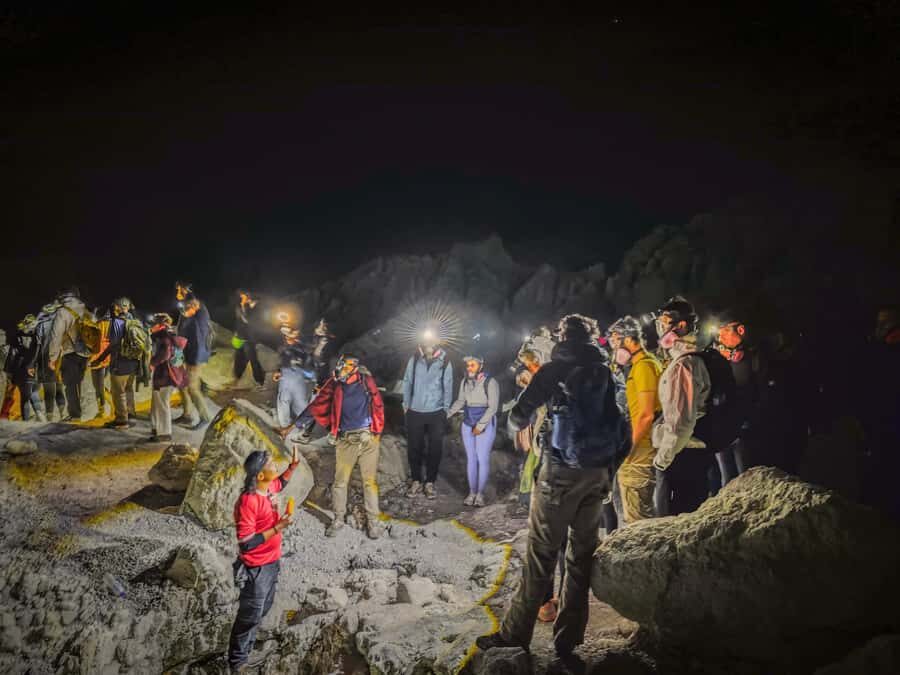
This is the tour that has basically become the Banyuwangi default. The $13 price point is only possible because they’re running shared jeeps with a local guide — you’re not getting a private experience, and you’re definitely not getting silence on the mountain. You’re getting the fire, the crater, the sunrise, and a gas mask, and that’s really the whole assignment.
The flexible duration is because the same operator runs it both as a 6-hour local pickup and as an 18–20 hour Bali round trip with the ferry included, so when you book you’ll choose your pickup city and the length adjusts automatically.
What travellers love: the guides actually take people down into the crater (some budget operators just stop at the rim), gas masks are proper ones not the cheap paper kind, and the pickup is reliable.
Watch out for: if you book it from Bali, the van picks up multiple hotels before heading to the ferry, so departure time is a suggestion. Pack snacks. The “optional” extra to climb down to the vents is mostly safety theater — assume you’ll do it.
Tour 2: Surabaya or Malang 3-Day Tumpak Sewu, Bromo and Ijen
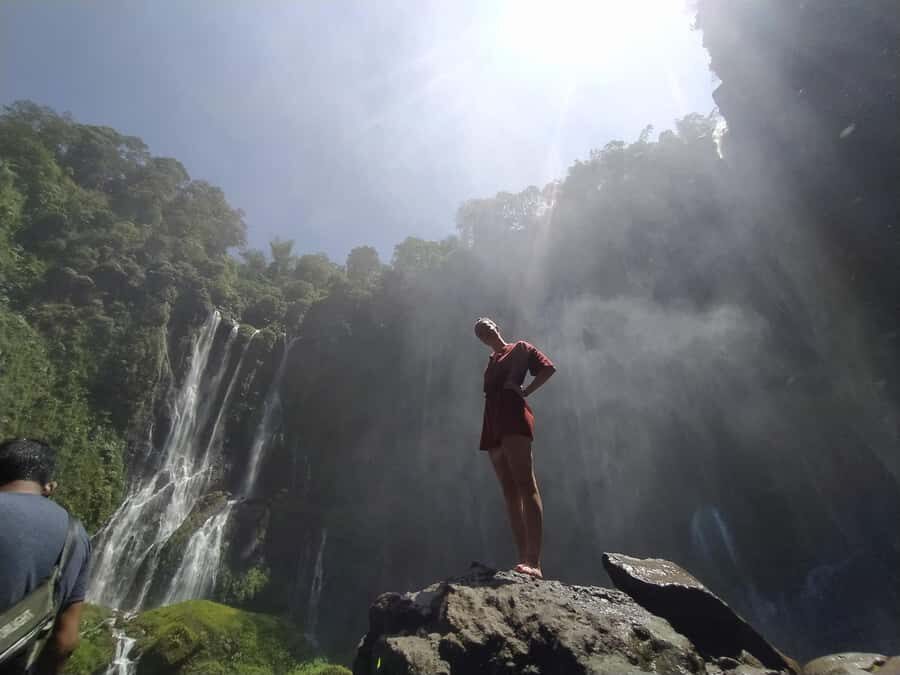
If you’re flying into Surabaya or Malang and plan to end in Bali anyway, this is the trip to book. It stitches Tumpak Sewu (the tiered waterfall that took over Instagram a few years ago), Mount Bromo sunrise, and Ijen blue fire into a single three-day run, with accommodation and transfers baked in.
Day one is Tumpak Sewu, day two is Bromo at sunrise followed by a long drive east, day three is the midnight Ijen hike and then the Bali ferry. It is not a relaxing itinerary. You will sleep maybe eleven hours across three nights. You will also see four of the most famous landscapes in Java for the price of one reasonably nice Bali hotel, and the one-way drop in Bali means you don’t backtrack.
What travellers love: the logistics are handled — no scrambling for ferries, no hunting taxis at midnight, no figuring out where Tumpak Sewu actually is (spoiler: the viewpoint is in a different village from the waterfall base). Drivers speak decent English and the itinerary flexes for fitness level.
Watch out for: this is physically demanding. Day two and day three are stacked overnight hikes back to back. If you’ve never done a sunrise volcano hike before, start with Bromo or Mount Batur in Bali before committing to this one.
Tour 3: From Bali — 24-Hour Kawah Ijen Blue Flames with Dinner and Room
This one solves the single biggest problem with doing Ijen as a Bali day trip: the fact that without it, you would be awake for 30 hours straight. You get picked up in Bali in the afternoon, cross the ferry, and then arrive at a homestay near Banyuwangi where dinner is served and — crucially — you get an actual private room to sleep in for a few hours before the midnight wakeup call.
Then you do the full hike, watch sunrise at the crater, and get driven and ferried back to Bali, arriving mid-afternoon the following day. It’s not glamorous but the sleep changes the entire experience.
What travellers love: the mid-trip rest room is the make-or-break detail. Reviews repeatedly mention that this was the only way they made it up the mountain without falling over. Dinner is simple Indonesian food, nothing fancy, but generous portions.
Watch out for: the “private room” is genuinely basic — think homestay with a bed, fan, cold shower. If you’re expecting a hotel you’ll be disappointed. If you’re expecting a place to actually lie down for four hours, it delivers.
What the hike actually feels like
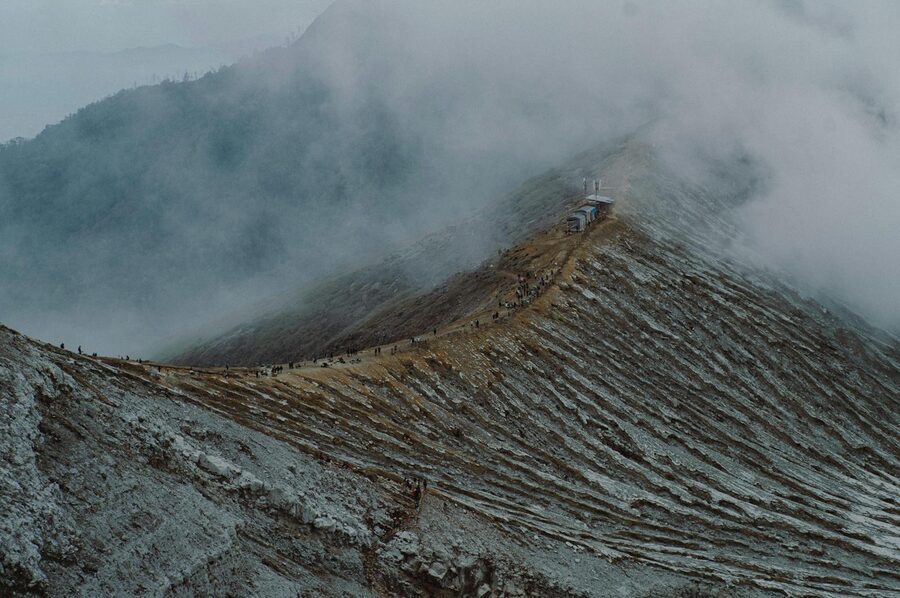
The trail starts at Paltuding post, elevation around 1,850m. From there it’s roughly three kilometers to the crater rim, climbing about 500 vertical meters. On paper that’s short. In practice, at 1:30am, with a group that’s moving at the speed of its slowest member, it takes most people between 75 and 120 minutes to reach the top.
The first kilometer is the steepest — a wide gravel road that feels like walking up a ski slope. After that it flattens slightly into a more conventional hiking path. You’ll pass sulfur miners coming down with their baskets the entire way, even in the dark, even at 2am. Step aside for them.
They are faster than you and they are carrying between 70 and 90 kilograms of sulfur blocks on a wooden shoulder yoke.
At the rim, the temperature drops sharply and the smell intensifies. Put your mask on and keep it on. From the rim you can see faint blue flickers below but to actually see the flames properly you have to descend a narrow, rocky miners’ path about 300 meters down into the crater itself.
This is optional on paper and required in practice — nobody books the Ijen blue fire tour and then refuses to go see the blue fire. The descent is steep and slippery with loose sulfur gravel, but it’s short. When the wind shifts the wrong way the smoke can be overwhelming, and your guide will tell you to retreat until it clears. Listen to them.
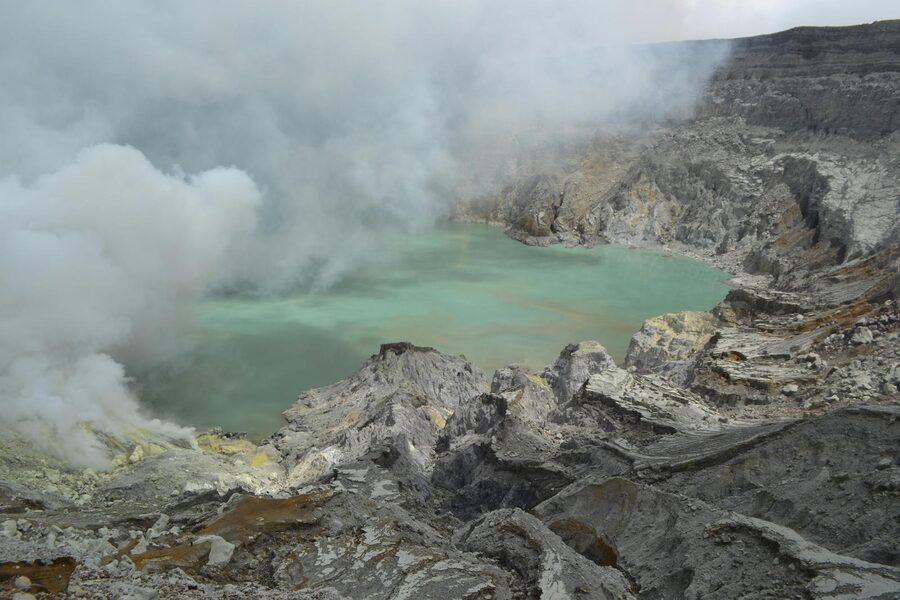
You’ll spend about 20–30 minutes down near the vents if the wind cooperates. Then back up to the rim, and this is the magic hour most people don’t expect: as the sky lightens, the lake emerges.
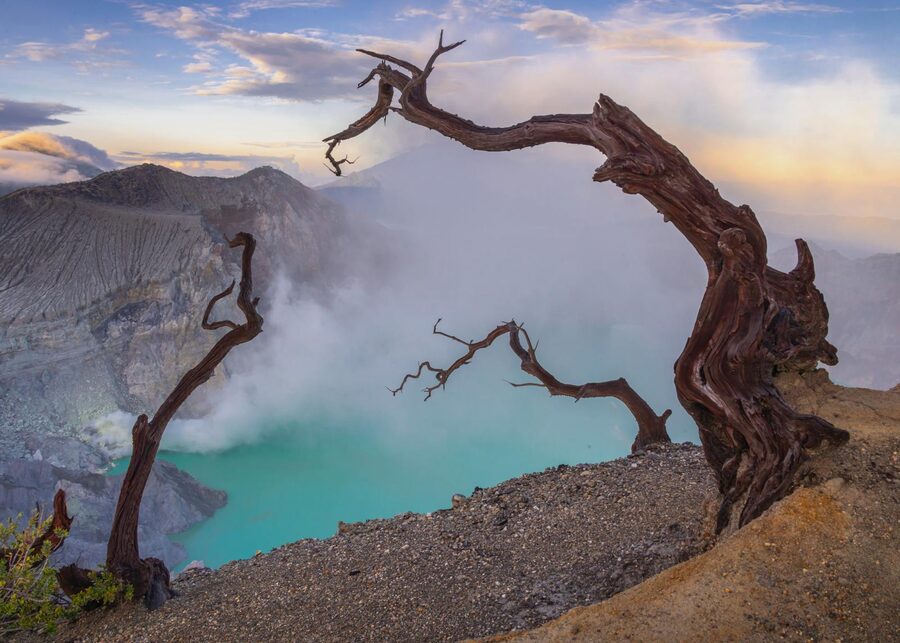
That impossible turquoise color comes from the dissolved minerals — sulfuric acid, hydrogen chloride, and various metals — and in certain lights it looks almost fake, like a swimming pool dropped into a crater.
The rim circuit continues around the lake for anyone with the legs for it, but most groups stop at the first viewpoint and take photos until the sunlight is strong enough to make the descent easy.
What to wear and pack (actually, not the generic list)
Forget what you read about Indonesia being hot. On the Ijen rim at 4am in July, it is cold. Wind chill takes it down to something around 5°C on a bad night. A proper fleece or light down jacket is the difference between enjoying the sunrise and leaving the second the fire fades. Your tour will provide a gas mask (ask to check the filter — if it looks old, ask for another one), a headlamp (bring your own as backup), and in some cases a walking stick.
What we’d add to your day pack: a buff or bandana to wear over the mask seal against your face (some masks don’t seal well on smaller faces and the buff helps), a liter of water, a small bag of carbs like nuts or a bar for the 3am energy dip, a proper lightweight beanie, thin gloves, sunglasses for after sunrise, and phone protection — the sulfur smoke is genuinely corrosive and if you hold your phone out for long exposures down in the crater, expect minor etching on the screen glass over time.
Hiking shoes not trainers. The gravel eats soft soles.
And one more thing that nobody warns you about: the smell sticks. Your clothes will smell like struck matches for two or three washes. Don’t wear anything you care about. We met one traveler on the ferry back to Bali who had packed a dedicated “Ijen outfit” in a separate dry bag just to contain the smell from the rest of her luggage. Excessive? Maybe. We respected it.
Who should skip it
Ijen is not for everyone and it’s worth saying that clearly. If you have asthma, chronic respiratory issues, or heart conditions, the combination of altitude, exertion, and sulfur exposure is genuinely risky — no tour can fully protect you from a bad wind shift. Most reputable operators will ask about medical conditions before booking and we’d encourage you to be honest.
Children under roughly 10 will struggle with the hike in the dark. Older travellers do fine physically if the tour is patient with pace, but the midnight start is brutal regardless of age.
If you’re nervous about the sulfur, there is an alternative: skip the crater descent and watch the blue flames from the rim only. You see them clearly but from farther away, and you avoid the worst of the gas. Some tours explicitly offer this option; others expect everyone to go down. Ask before you book if this matters to you.
The crater lake at sunrise (the part nobody talks about)
Most Ijen marketing focuses on the blue fire, and that’s fair — it’s the unique thing. But honestly? The moment that stays with most travellers we’ve spoken to is the sunrise over the lake.
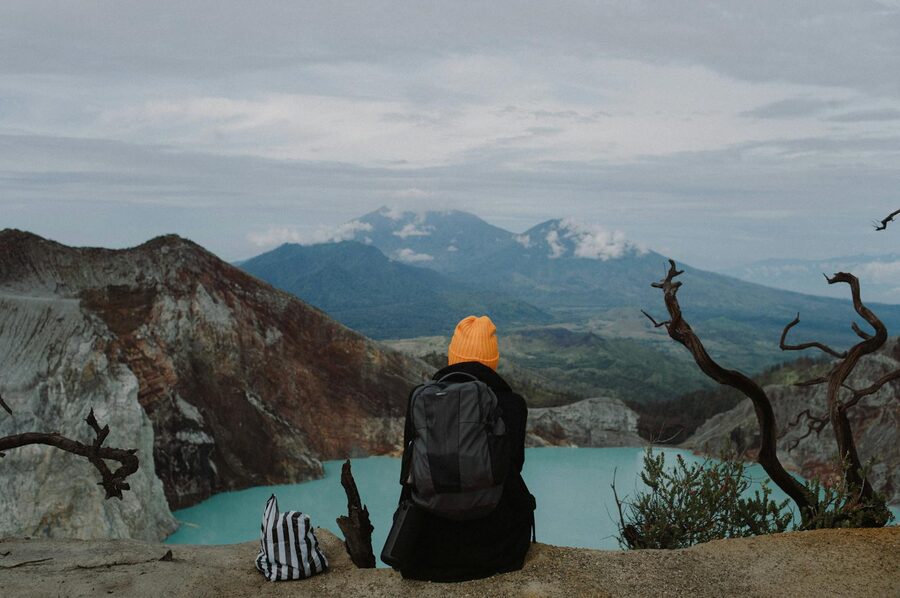
You’ve been awake for hours, you’ve seen something you only previously saw in nature documentaries, and then you turn around and the crater opens up as the sky goes from black to navy to a kind of bruised purple, and the lake sits there like a chunk of turquoise dropped into a grey bowl. People tend to go quiet. You hear the wind, the occasional clatter of a miner’s load, and that’s it.
A lot of guides try to rush you back down at this point because it’s easier on their logistics. If you have any say, ask to stay another 15 minutes at the rim. It’s the moment you came for even if you didn’t know it when you booked.
Combining Ijen with the rest of East Java and Bali
Almost nobody does Ijen as a standalone trip. It makes far more sense to combine it with other East Java and Bali highlights, and the logistics practically force you into it. Here are the three combinations we’ve seen work:
The East Java volcano circuit. Surabaya → Tumpak Sewu → Bromo → Ijen → Bali. Three to four days. This is the classic and it’s what most multi-day tours package. You’re on the road a lot but you see everything. The 3-day Tumpak Sewu/Bromo/Ijen tour covers this exact route.
The Bali-to-Bali quick strike. Leave Bali afternoon, do Ijen overnight, return to Bali by afternoon next day. 24 hours total. You sacrifice some sleep and you don’t see Bromo, but you get the blue fire without reorganizing your entire Indonesia trip. The 24-hour Bali package with dinner and room is the right tool for this.
The slow version. Fly to Banyuwangi, spend two nights there, do Ijen as a local half-day tour, then ferry to Bali rested. This is the most expensive way measured in days, the cheapest measured in money, and the easiest on your body. If you have the time, consider it.
And once you’re back in Bali there’s plenty to slot in. We’d start with a day around Ubud — maybe the Bali waterfalls tour or a cooking class in Ubud, both of which are deliberately low-effort and easy on a body that just climbed a volcano. The Uluwatu Kecak fire dance and Jimbaran dinner is another gentle option for the evening after an Ijen trip. Save the active stuff — Nusa Penida day trips or Bali ATV rides — for after you’ve had a real sleep.
When to go: the season actually matters
Ijen is open year-round but the experience changes a lot by season. The dry months — roughly April to October — are the sensible window. Visibility is better, the trail is less slippery, and the gas disperses more reliably. July and August are peak for both weather and crowds; expect more people on the rim and a longer line to descend into the crater. May, June, and September are the sweet spot: clear skies, fewer crowds.
Wet season (November to March) is doable but risky. The trail turns to mud in places, the clouds can close in around the crater and block the view of both the fire and the sunrise, and tours sometimes get cancelled due to gas levels or official closures. If the Indonesian volcanology agency raises Ijen’s alert level, the crater closes — no exceptions — and you’ll only see the rim. Check recent conditions on the day before your tour, not weeks in advance.
The volcano has closed for extended periods several times in the past decade when gas levels spiked. Don’t build a trip entirely around Ijen without a backup plan. If it’s closed and you’re already in Banyuwangi, the Borobudur and Prambanan temple tour is a long train ride away and a reasonable pivot.
Gas masks: the part worth getting right
Your mask is the most important piece of gear on this hike and it varies wildly by operator. Cheap tours sometimes hand out paper dust masks, which are useless against sulfur gas. Slightly better tours supply simple half-face rubber masks with disposable filters. The good operators use proper twin-cartridge respirators with carbon filters that genuinely neutralize SO₂.
When you book, ask specifically what kind of mask is provided and check it at pickup. If the filter cartridges look crusty or are expired, ask for a replacement. If your operator refuses or doesn’t carry spares, that tells you something. The three tours we’ve featured here all include proper respirators based on traveler reviews, which is a big part of why they made the shortlist.
If you’re pregnant, have any lung condition, or are unusually sensitive to smells, bring your own N95 to layer under the mask. It’s not a cure but it helps.
One more note: don’t take the mask off to take a photo while you’re down near the vents. It takes seconds of exposure to cause a coughing fit you can’t stop, and the wind shifts unpredictably. Either get used to shooting with the mask on or wait until you’re back at the rim.
How to get to the trailhead if you’re doing it independently
Some travellers skip the tour and arrange their own transport. We don’t generally recommend this for first-timers — the 2am wakeup, the midnight drive, the gas mask sourcing, and the guide requirement (you legally need one to descend into the crater) add up to more hassle than savings. But if you’re determined:
Stay in Banyuwangi town or closer to Licin village. From Banyuwangi, hire a private driver for roughly 500,000–700,000 rupiah round trip to Paltuding post. Leave by 1am. At Paltuding you’ll pay the park entrance fee (currently around 100,000 IDR on weekdays, 150,000 weekends) and can hire a local guide for another 150,000–200,000. Gas masks can be rented at the post for about 50,000.
Total independent cost lands around $60–$75 per person for a couple sharing a driver, which is notably more than the $13 group tour and much less comfortable.
The reason the group tours are so cheap is that they’re filling vans to capacity. Unless you really value privacy on the drive, the economics don’t favor independent travel here.
The sulfur miners — a note of respect
You will share the trail with sulfur miners the entire way. They work for one of two companies based in Banyuwangi and they are paid roughly by the weight of sulfur they carry out. A full basket weighs 70–90 kg and they make one or two trips per day. Wages work out to somewhere around $12–$15 a trip, which is why you’ll see them everywhere and why they are faster than you. Most of them wear only a bandana for respiratory protection.
Some of them sell small hand-carved sulfur figurines at the rim — turtles, little Buddhas, the occasional Spider-Man. Buying one is a reasonable way to tip directly, far better than trying to give cash to someone who’s trying to get down the mountain. A small figurine is usually 50,000–100,000 IDR. We’d budget for this if the interaction feels right at the time.
What we’d ask you not to do: don’t take close-up photos of them hauling their loads without asking. It’s a working environment, not a photo op. A nod, a hello, a question about their trip — all fine. Shoving a lens in their face is not. The same way you’d want someone to treat a construction worker on your street.
Photography: realistic expectations
The blue fire is notoriously hard to photograph well. Your phone will capture something — a glow, vague blue shapes — but the dynamic range of the scene (pitch black rocks, intense small flames, your own headlamp bouncing around) confuses most smartphone cameras.
If you care about photos, bring a real camera with manual controls, a small tripod, and practice beforehand with long exposures of a candle in a dark room. You’ll want settings somewhere around ISO 1600–3200, aperture as wide as your lens allows, shutter at 2–8 seconds depending on how much flame movement you want to capture. Turn off in-body stabilization when the camera is tripod-mounted.
The sunrise at the rim is much easier to shoot — it’s just a sunrise, which phones are good at. The crater lake in the hour after sunrise is arguably the most photogenic moment of the entire trip and does not require any special gear.
Don’t let photography ruin the experience. A lot of travellers we’ve talked to regret spending the blue-fire window fiddling with settings instead of actually watching the flames. Give yourself ten minutes minimum of no-camera time standing there, letting your eyes adjust, watching the thing that almost nobody on earth has seen.
Food, sleep, and recovery
You will not eat properly until the morning after. Most tours provide a snack box (crackers, a banana, some fried tofu) but this is fuel, not a meal. Plan to have a real breakfast in Banyuwangi or back on the ferry to Bali. There is a warung at Paltuding post that opens early and serves instant noodles and coffee; it is not good food but at 6am after a midnight hike, it is miraculous food.
Sleep is the other recovery priority. Most travellers nap on the drive back and then sleep a full afternoon once they’re home. Plan nothing active for the day after Ijen. Book a spa, a beach afternoon, a long meal. If you try to squeeze another activity in the same day you will regret it.
Frequently asked questions about booking an Ijen tour
Is the blue fire guaranteed?
No. It’s a natural phenomenon and depends on wind direction, gas activity, and whether the volcano is on alert status. Most nights it’s visible. On windy or cloudy nights you may see less, and if the wind blows smoke directly over the vents you won’t see anything at all. Reputable tours don’t promise the fire — they promise the attempt. If it’s a bust, you’ll still see the crater lake at sunrise.
How old do kids need to be?
Most operators set the minimum around 10 years old, and we’d push that higher in practice. The midnight start, the long hike in the dark, the sulfur gas, and the steep descent into the crater are not kid-friendly. Teenagers who are experienced hikers do fine.
Do I need travel insurance that covers volcano hiking?
Yes, and check your policy. Some standard policies exclude “hazardous activities” which can include hiking to an active volcano crater. A traveler-focused policy with adventure sports coverage is worth it for the trip.
Can I do Ijen without descending into the crater?
Yes. You can stay on the rim and watch the flames from above. You see them clearly but the experience is less dramatic. Tell your guide at the start that you don’t want to descend. The hike to the rim is still worth it for the sunrise over the lake.
What’s the difference between Ijen from Bali vs Ijen from Banyuwangi?
Distance, price, and sleep. From Banyuwangi you save about 15 hours of travel time and about $100 in tour costs but you have to get to Banyuwangi first. From Bali you get the convenience of picking up from your Bali hotel but you’re in a vehicle for most of the trip.
Is it safe?
Ijen is an active volcano. The Indonesian authorities monitor gas levels and close the crater when they’re dangerous. Within that framework, an organized tour with a proper gas mask and an experienced guide is a reasonable-risk activity. The risks are real — gas exposure, slipping on the descent, exhaustion — but they’re managed. We’d compare it to glacier hiking: serious but routine if you follow the rules.
Will I actually make it up? I’m not that fit.
Probably yes. The distance is short. The issue is pace and sleep deprivation, not fitness. Go slow, rest often, drink water, and you’ll be fine. If you can walk up a flight of stairs without stopping, you can hike to the rim — it’ll just take you a bit longer than the fit people in your group.
What if the tour is cancelled?
If the volcano closes due to gas activity, tours are refunded or rescheduled — confirm this policy when booking. GetYourGuide and Viator both have cancellation protection on most Ijen tours; the local operators directly usually don’t, which is another argument for booking through a platform.
Final booking advice
If you’re in Banyuwangi already, book the $13 group tour. It’s the best deal in Indonesian adventure travel and there’s no reason to pay more unless you specifically want a private guide. If you’re in Bali and just want the fire without changing your itinerary, book the 24-hour Bali package with the rest room — the sleep is non-negotiable.
If you’re coming from Surabaya or Malang and want to see Bromo and Tumpak Sewu in the same trip, book the 3-day circuit and plan to end in Bali so the drive isn’t wasted.
Book at least 48 hours in advance, especially in high season. The best tours fill up and walk-in rates in Banyuwangi are usually slightly higher than online. Pack layers. Bring your own headlamp as a backup. Don’t skip sleep the day before if you can help it — a short afternoon nap makes a shocking difference to how you feel at 3am on a volcano rim.
And when you’re down in the crater, in the dark, with the flames in front of you and the sulfur pouring out of the rocks and your own breath fogging the inside of your mask — put the camera down for a minute. Just watch. It’s one of the strangest things on this planet and you only get the one go at it.
For more Indonesia inspiration and similar adventure guides, check our Mount Bromo sunrise tour companion piece (the two volcanoes pair perfectly), our guide to the Mount Batur sunrise hike in Bali for a gentler volcano warmup, and our round-up of the best Bali waterfalls for your recovery day afterward.