
Hue served as Vietnam’s imperial capital for 143 years. From 1802 until 1945, thirteen Nguyen Dynasty emperors ruled the country from a walled fortress so large that it took decades to build — and it still takes a full day to explore properly.
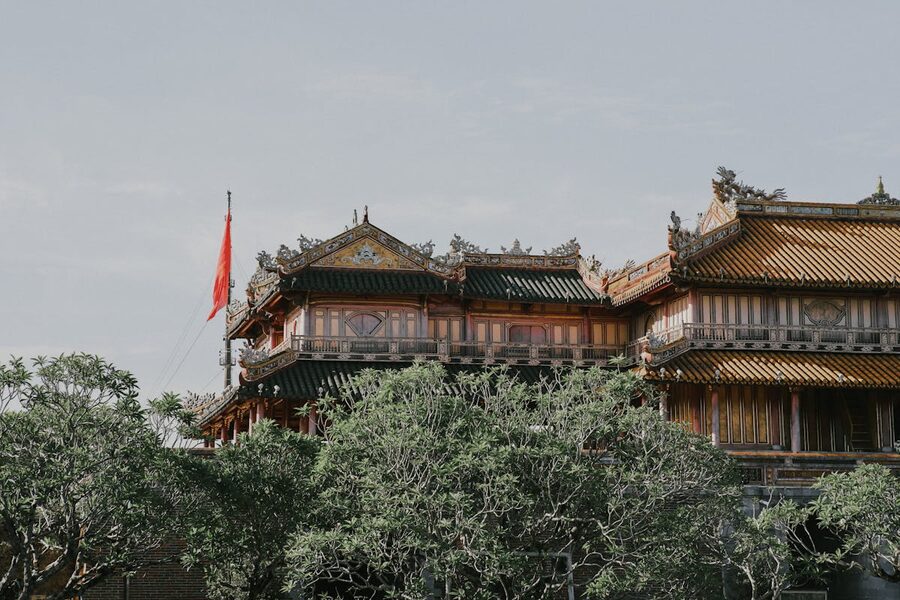
The Imperial City (or Dai Noi, as locals call it) sits on the northern bank of the Perfume River, surrounded by walls that stretch two kilometers on each side and a moat that still holds water. Of the 160 original structures that once stood inside, only about 10 survived the wars of the 20th century. The rest have been slowly rebuilt and restored since UNESCO listed the site in 1993.
I spent a full day here and still missed sections. Here is what I learned about booking the right tour — and whether you even need one.
Short on time? Here are my top 3 picks:
Best overall: Hue Full-Day or Half-Day City Tour — $19. Covers the Imperial City plus royal tombs, Thien Mu Pagoda, and lunch. Most complete option.
Best budget: Hue City Tour from Hoi An/Da Nang — $11. Pickup from Hoi An or Da Nang included. Hard to beat that price for a full day.
Best for depth: Hue Walking Tour to Imperial Citadel — $12. Highest-rated of the three. Walking format means more time at each stop.
- How Tickets Work at the Imperial City
- Self-Guided vs Guided Tour — Which One?
- The Best Hue City Tours to Book
- 1. Hue Full-Day or Half-Day City Tour —
- 2. Hue City Tour from Hoi An/Da Nang with Lunch —
- 3. Hue Walking Tour to Imperial Citadel and Forbidden City —
- When to Visit the Imperial City
- How to Get to the Imperial City
- Tips That Will Actually Save You Time
- What You Will Actually See Inside
- What Most Tours Include Beyond the Imperial City
- Getting Between Hue and Other Vietnam Destinations
- More Vietnam Guides
How Tickets Work at the Imperial City
The official ticket price is 200,000 VND (around $8 USD). You buy tickets at the window right outside the Meridian Gate — there is no advance booking system and no reserved time slots. Just show up, pay cash or card, and walk in.
The ticket covers entry to the entire Imperial City complex including the Forbidden Purple City, the Thai Hoa Palace (Throne Hall), the royal theater, and the gardens. It does not cover the royal tombs outside the Citadel walls — those are separate tickets.
Opening hours:
- Summer (roughly April to October): 6:30 AM to 5:30 PM
- Winter (November to March): 7:00 AM to 5:00 PM
There is no audio guide available at the ticket office, which is one reason many people opt for a guided tour instead. The signage inside the complex is limited — a few plaques here and there, but nothing that really explains the history or significance of what you are looking at. Without context, you are basically walking through pretty buildings wondering what they were used for.
A combo ticket covering the Imperial City plus three royal tombs (Khai Dinh, Minh Mang, and Tu Duc) costs 530,000 VND and saves you a bit compared to buying each separately.
Self-Guided vs Guided Tour — Which One?
This is the question everyone asks, and my honest answer: get a guide. Here is why.
The Imperial City is enormous. The outer Citadel walls alone run 10 kilometers in total circumference. Inside, you have the Imperial Enclosure with palaces, temples, gardens, and the Forbidden Purple City — the emperor’s private quarters that were once off-limits to everyone except the royal family and their eunuch servants.
Walking around without a guide, you will see the buildings and gardens, but you will not know that the Thai Hoa Palace was where the emperor held court and that officials had to prostrate themselves in specific positions based on their rank. You will not know that the Forbidden Purple City was almost entirely destroyed during the 1968 Tet Offensive — what you are looking at is largely reconstruction.
A cooking class in Hoi An doesn’t need much context. But a 19th-century imperial palace complex? That is where a guide earns their fee.
If you are set on going solo, at least read up before you go. But for $11-19 per person, a guided tour with transportation is honestly hard to argue against.
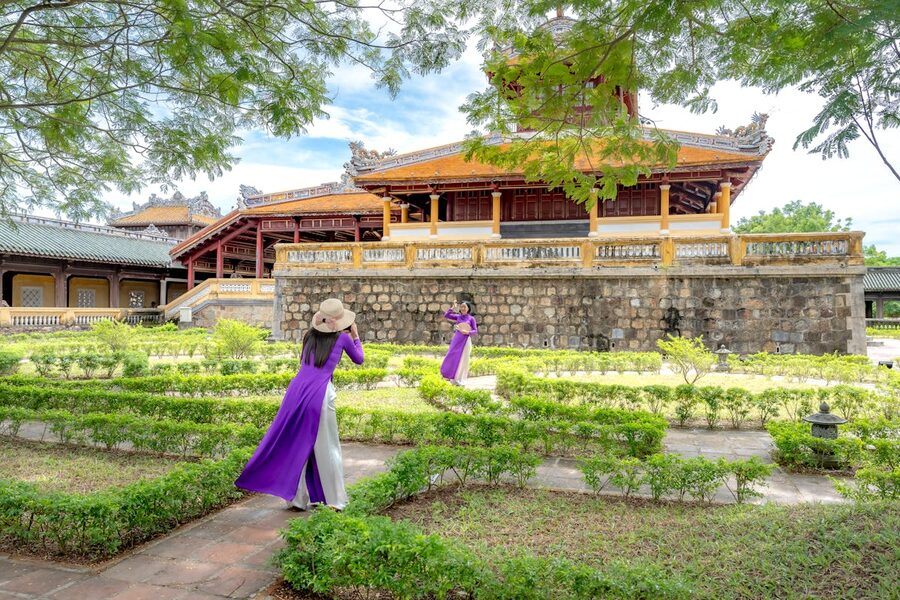
The Best Hue City Tours to Book
I went through all the major tour options for Hue and narrowed it down to three. Each one takes a different approach — full-day with everything included, a budget option from Hoi An, and a focused walking tour for people who want to go deep on the Imperial City itself.
1. Hue Full-Day or Half-Day City Tour — $19

This is the one I would recommend to most people visiting Hue. With over 1,100 reviews and a 4.7-star rating, it is the most booked Hue city tour for good reason. At $19 you get a guide, transport, entrance fees, and the flexibility to choose between a half-day (Imperial City focused) or full-day itinerary that adds the royal tombs and Thien Mu Pagoda.
The full-day version runs 4 to 8 hours depending on group pace. Lunch is included at a local restaurant — not a tourist trap buffet, which I appreciated. The guides know their stuff and most speak solid English. If you only have one day in Hue, this is the tour to book.
2. Hue City Tour from Hoi An/Da Nang with Lunch — $11

At $11 per person including hotel pickup from Hoi An or Da Nang, this is almost too cheap. The drive from Hoi An to Hue takes about 2.5 hours each way along the coast (passing through the Hai Van Pass on some routes), so it is a long day — 8 to 11 hours total. But the itinerary covers the Imperial City, Thien Mu Pagoda, and lunch.
With 4.8 stars from nearly 1,100 reviews, this is the highest-rated group day tour on the list. The trade-off is time. If you are spending a night in Hue anyway, go with option 1 or 3. But if you are short on time and based in central Vietnam, this handles both transport and sightseeing in one shot. That is rare for eleven dollars.
3. Hue Walking Tour to Imperial Citadel and Forbidden City — $12
This is the tour for people who want depth over breadth. Instead of rushing through the Imperial City, royal tombs, and pagodas in one frantic day, this walking tour focuses specifically on the Citadel and Forbidden Purple City with a local guide who really knows the history.
$12 for a walking tour with a knowledgeable local guide — and it holds the highest rating of the three at 4.9 stars from 937 reviews. The base tour runs about 2.5 hours, but some options extend to a full day if you want to add the royal tombs or nearby attractions. If you are staying in Hue and want to visit the tombs separately on another day, this is the smartest pick.
When to Visit the Imperial City
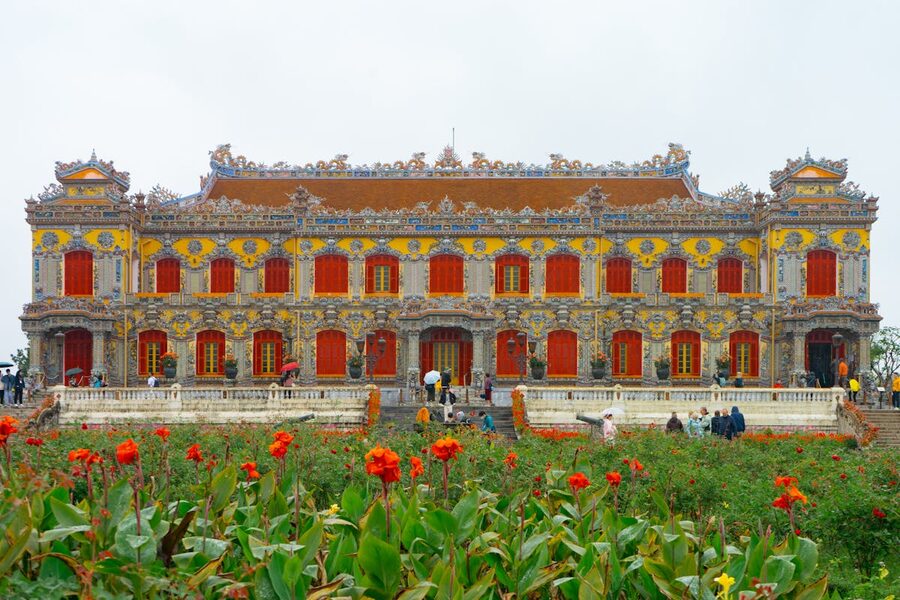
Best time of year: February through April. The weather is warm but not scorching, rain is less likely than in autumn, and the gardens are in bloom. Hue gets hammered by typhoons and heavy rain from September through November — I would avoid that window entirely.
Best time of day: Early morning, right at opening. By 10 AM the tour groups start flooding in and the heat builds. Late afternoon (after 3 PM) is another good window — the light is better for photos and the crowds start thinning. If your schedule allows it, visit in the afternoon and stay until closing for the golden hour light on the pavilions.
How long to spend: Minimum two hours for a quick hit of the main highlights. Three to four hours if you want to explore properly without rushing. A full day if you are combining the Imperial City with the royal tombs (which are outside the Citadel walls, scattered along the Perfume River).
The Imperial City also hosts a biannual Hue Festival (usually in even-numbered years, around April or June) with traditional music, royal court reenactments, and illuminated events. Worth timing your trip around if it lines up.
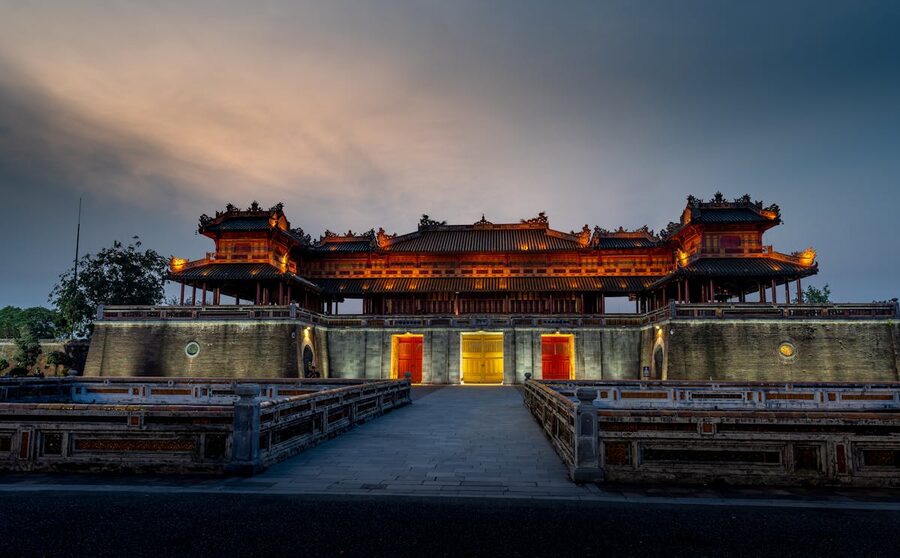
How to Get to the Imperial City
The Imperial City is on 23 Thang 8 Street on the northern bank of the Perfume River in central Hue. Getting there depends on where you are coming from.
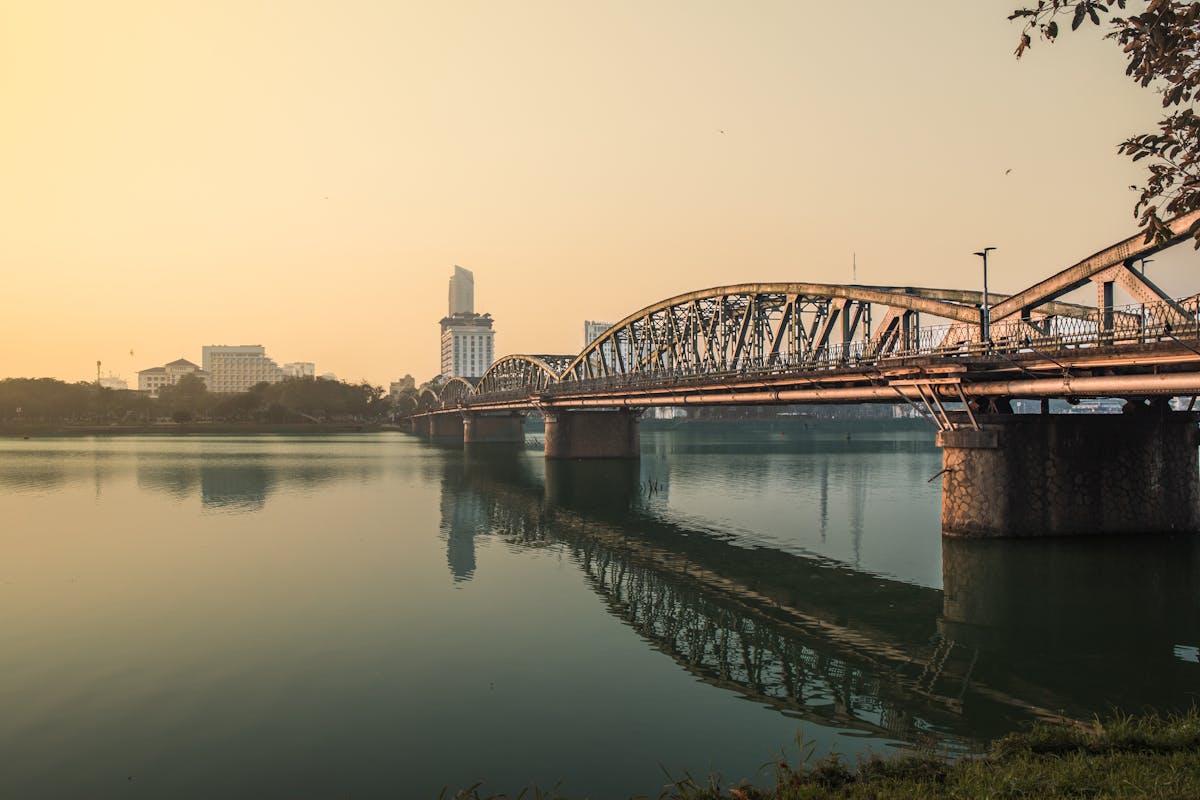
If you are already in Hue: Most hotels are within 2-3 kilometers. Grab a Grab (the Southeast Asian Uber) for 15,000-30,000 VND, or walk if your hotel is south of the river — it is a pleasant 15-20 minute stroll across Truong Tien Bridge.
If you are coming from Hoi An or Da Nang: The drive is about 2-2.5 hours. You can take a private car, join a group tour (the $11 option above handles this), or catch a bus. The train is also an option — the Hue railway station is about 2 km from the Imperial City.
If you are coming from Hanoi or Ho Chi Minh City: Fly into Phu Bai International Airport (HUI), about 15 km south of the city center. A taxi from the airport to the Imperial City area costs around 200,000-250,000 VND. The train from Hanoi is also an option if you want to see the coast — it takes roughly 13 hours.
Tips That Will Actually Save You Time
Wear comfortable shoes. The complex is massive and you will be walking on stone, gravel, and uneven paths for hours. Flip-flops will not cut it.
Bring water and sunscreen. There is very little shade inside the complex, especially in the large courtyards. The heat between 11 AM and 2 PM can be brutal, particularly from May through September. A few vendors sell water and snacks near the Meridian Gate, but not much once you are deeper inside.
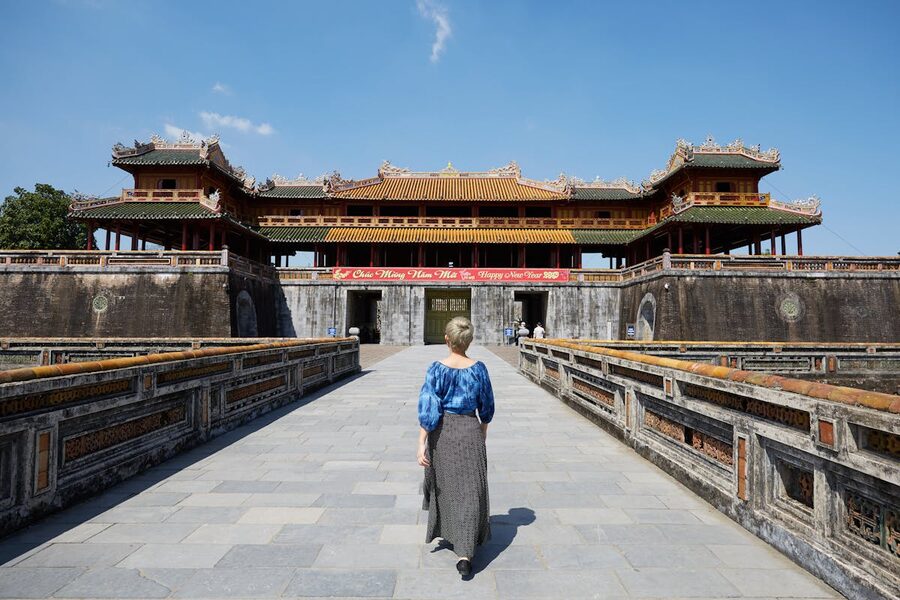
Start at the Meridian Gate and work inward. The natural flow is: Meridian Gate, then Thai Hoa Palace (Throne Hall), then the inner courts, then the Forbidden Purple City, then exit through one of the side gates. Do not try to see every single building — pick the highlights and give them proper time.
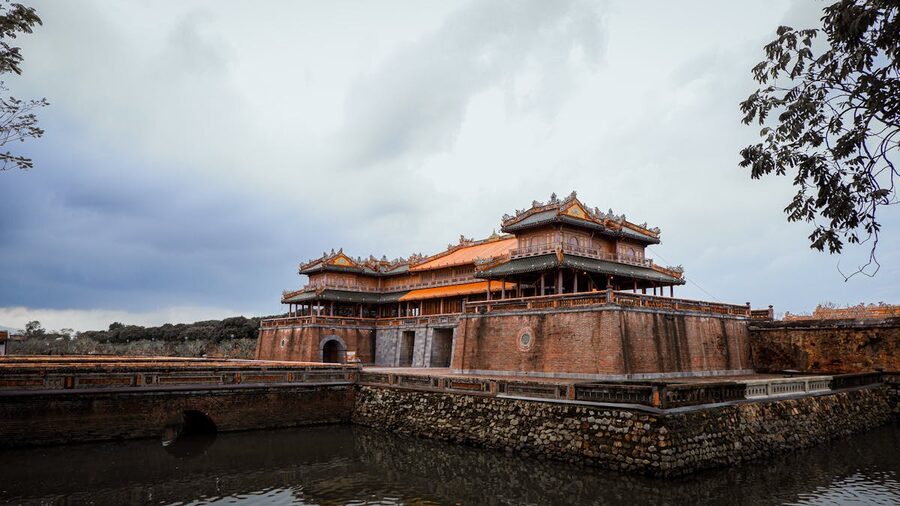
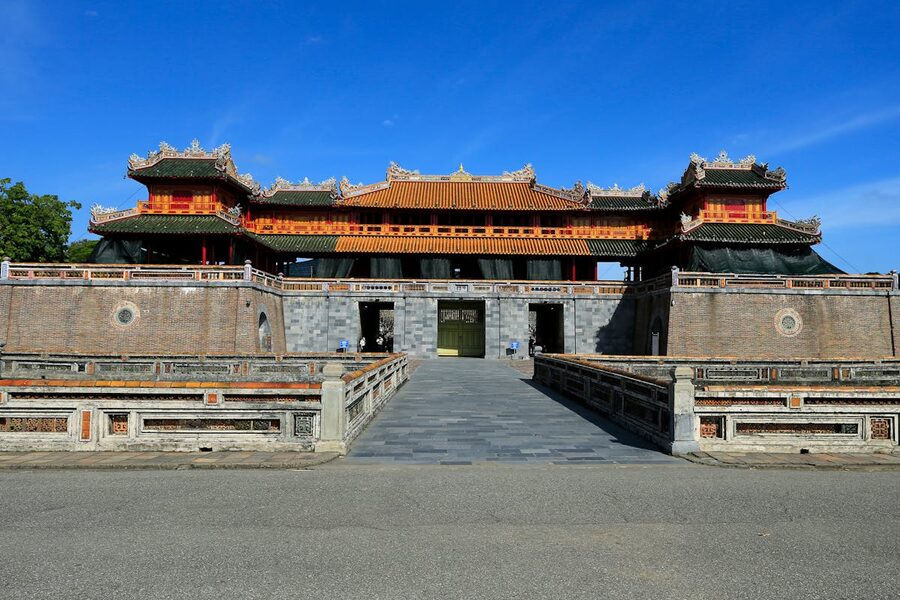
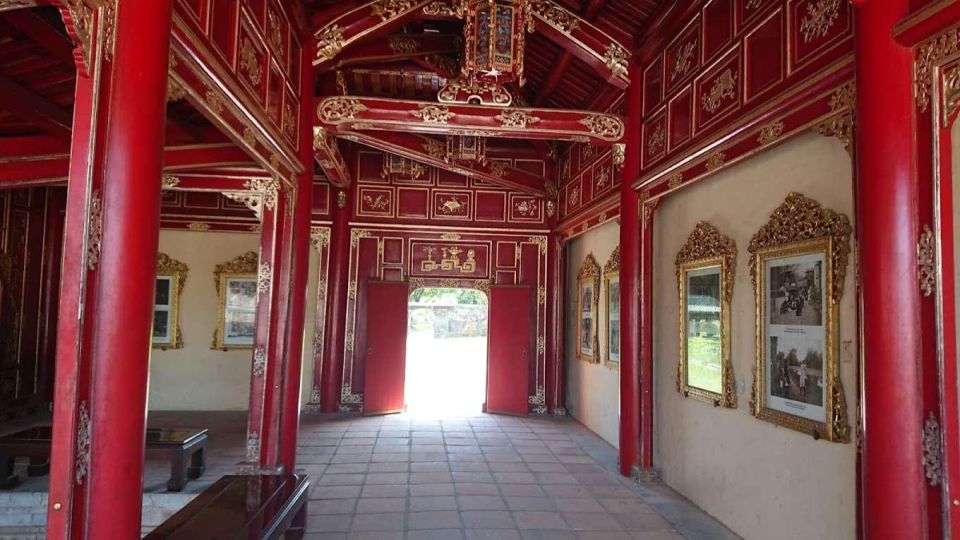
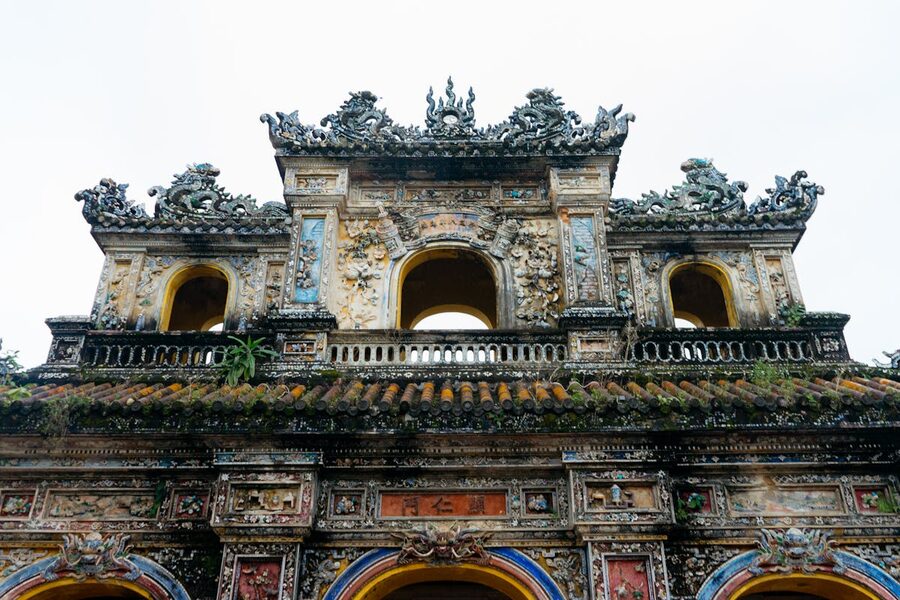
Don’t skip the pavilion above the Meridian Gate. Most visitors walk right past it. Climb the stairs to the Five Phoenix Pavilion for the best aerial view of the complex and the Flag Tower. There are also historical photographs inside showing the Imperial City before and during the wars.
Combine with the royal tombs if you have a full day. The tombs of Khai Dinh, Minh Mang, and Tu Duc are all within 20-30 minutes by car or motorbike from the Imperial City. Each one is different in style and worth visiting — Khai Dinh for its wild Art Deco mosaics, Minh Mang for the scenic lake setting, and Tu Duc for the peaceful garden atmosphere.
Hire a motorbike if you want to do tombs independently. Renting a semi-automatic scooter in Hue costs about 120,000-150,000 VND per day. The roads to the tombs are easy to navigate, and you will save a lot compared to taxi-hopping.
What You Will Actually See Inside
The Imperial City was modeled after Beijing’s Forbidden City, but with a Vietnamese twist. Emperor Gia Long started construction in 1803 and it took decades to complete, with each subsequent emperor adding their own buildings and gardens.
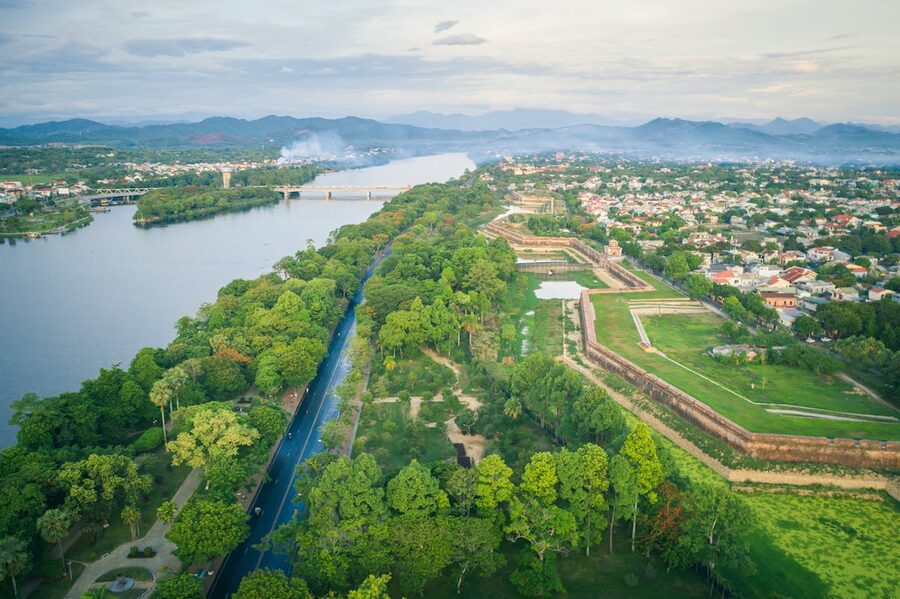
The complex has three layers, each one more restricted than the last.
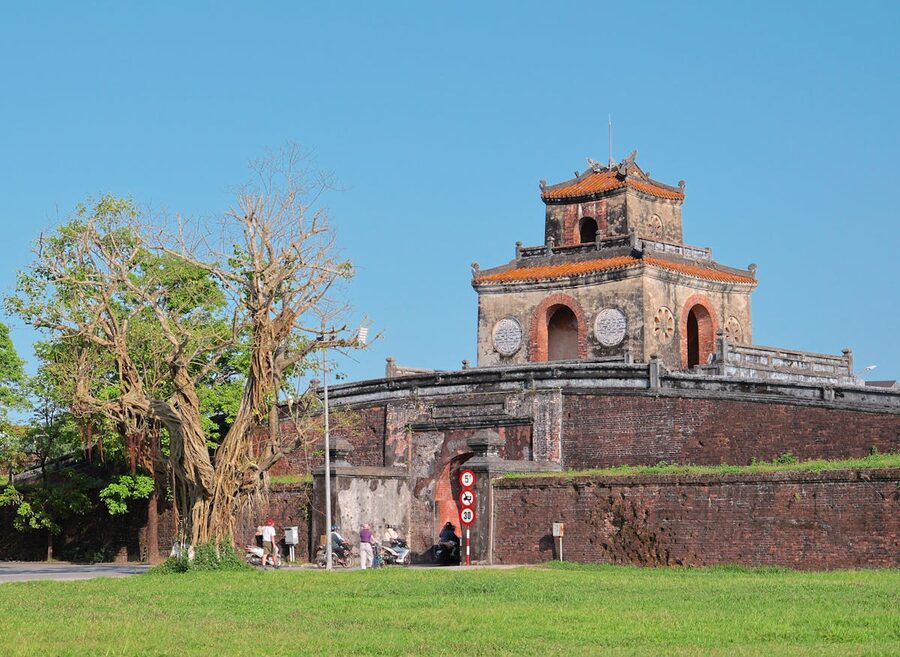
The Citadel (Kinh Thanh) is the outermost layer — a massive fortress with walls over 6 meters thick, 10 gates, and a moat that still surrounds the whole thing. Regular people lived and worked in this zone. Today it is a neighborhood with houses, shops, and even a military base on part of the grounds.
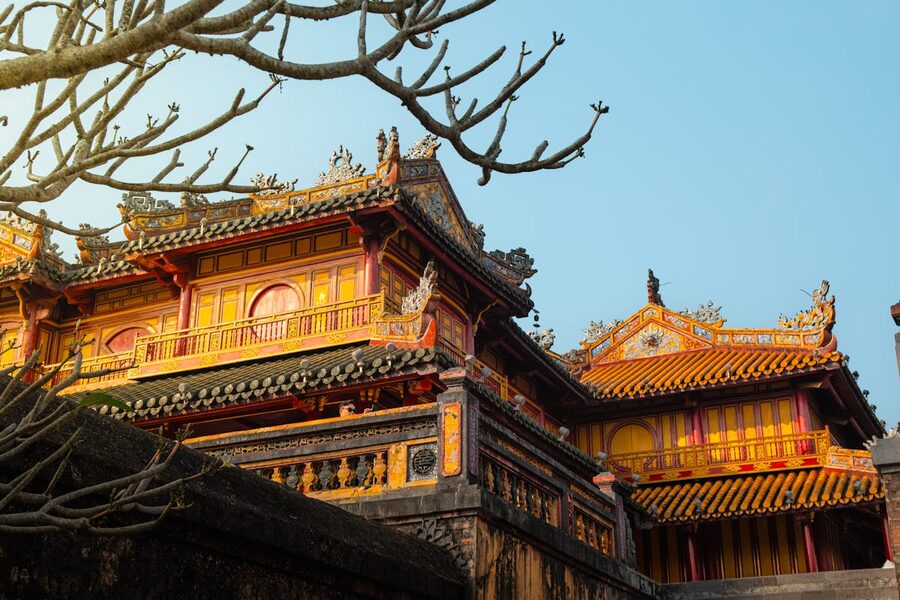
The Imperial Enclosure (Hoang Thanh) is the middle layer, and this is what your ticket gets you into. The Meridian Gate, Thai Hoa Palace, the royal temples, gardens, and administrative buildings are all here. This is where the emperor held court, received foreign delegations, and managed the country.
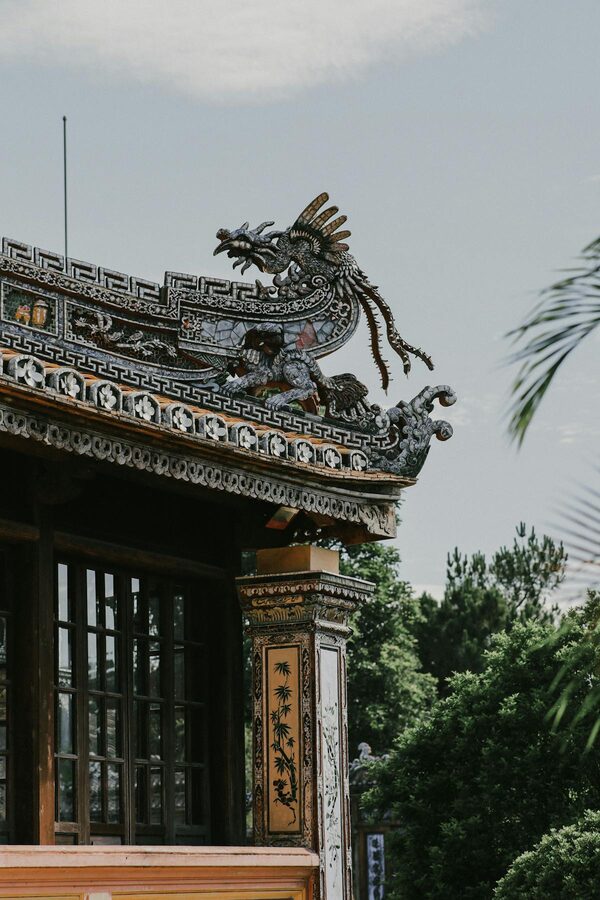
The Forbidden Purple City (Tu Cam Thanh) is the innermost layer — the emperor’s private residence. Only the emperor, his family, and eunuch servants were allowed here. Anyone else who entered was executed. During the Tet Offensive in 1968, the Forbidden Purple City was almost completely destroyed. What you see today is mostly empty foundations and a few reconstructed buildings, but the scale of it still comes through.
The standout buildings to look for:
Thai Hoa Palace (Hall of Supreme Harmony): The largest and most important building. This is where coronations happened, where the emperor sat on his throne, and where officials gathered for ceremonies. The interior has 80 ironwood columns, each one lacquered and gilded with dragon motifs. They have been standing since 1805.
The Royal Theater (Duyet Thi Duong): One of the oldest court theaters in Vietnam. They still hold performances of traditional Nha Nhac music here — UNESCO actually listed Hue royal court music as an intangible cultural heritage separately from the Imperial City itself.
The Nine Dynastic Urns: Massive bronze cauldrons sitting in front of the Hien Lam Pavilion, each one weighing between 1,500 and 2,600 kg. Cast in 1835, each urn represents one Nguyen emperor and is decorated with imagery of Vietnamese landscapes, animals, and natural phenomena. They are considered among the finest bronze castings in Vietnamese history.
What Most Tours Include Beyond the Imperial City
Full-day tours don’t just cover the Imperial City. Most include stops at several other key sites around Hue, and honestly, these extras are part of what makes a guided tour worth it — you would spend half your day arranging transport between them on your own.
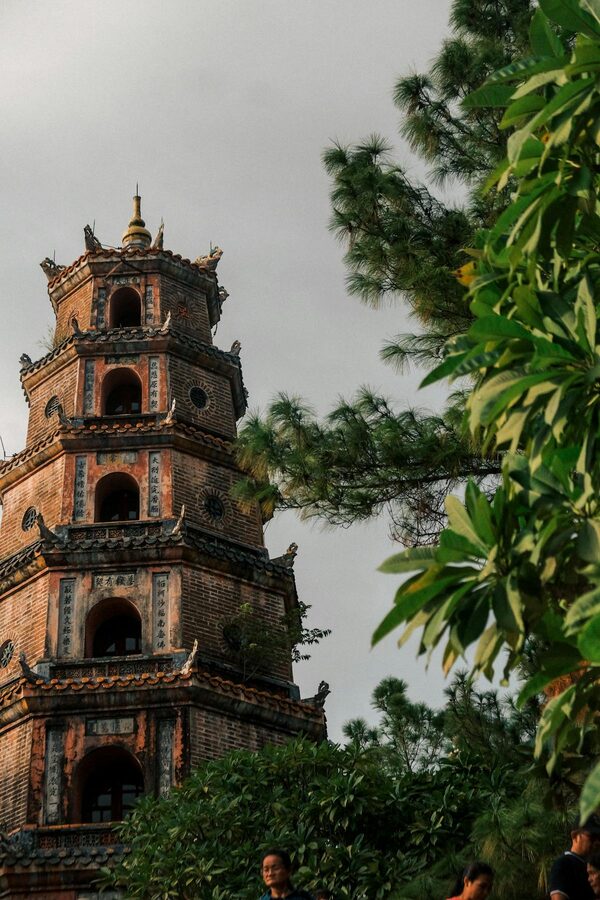
Thien Mu Pagoda: The seven-story pagoda on the bank of the Perfume River is Hue’s most recognizable landmark. It was built in 1601, making it older than the Imperial City. Most tours reach it by dragon boat along the river, which is genuinely one of the highlights. Inside the temple grounds you will find the car that belonged to the monk Thich Quang Duc, who famously self-immolated in Saigon in 1963 in protest against the persecution of Buddhists.
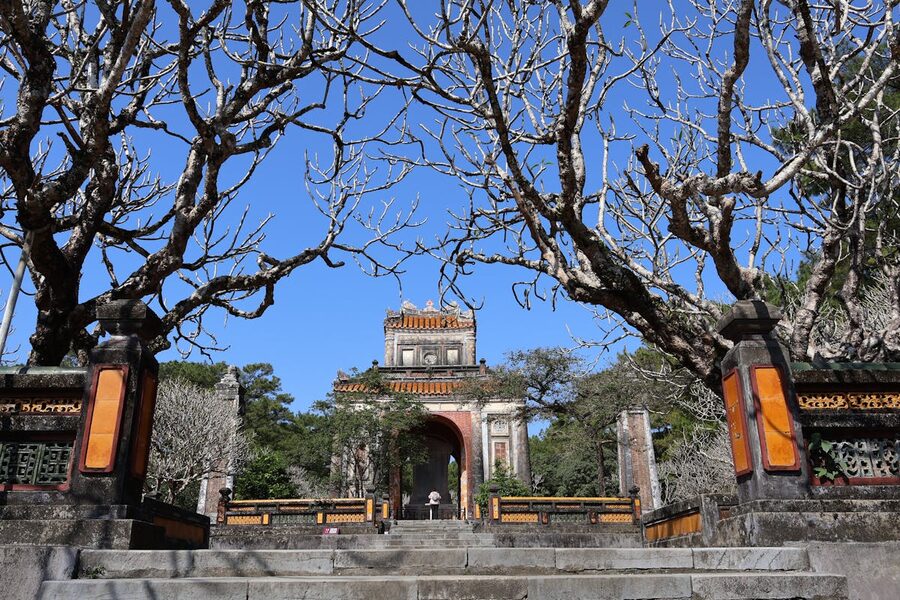
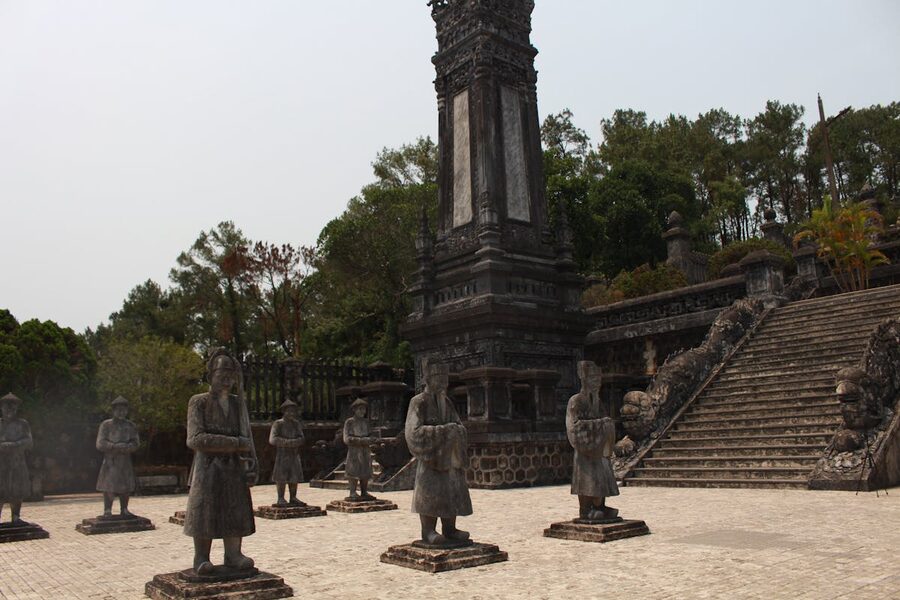
The Royal Tombs: Each Nguyen emperor built their own elaborate tomb complex while still alive, treating it as a combination palace, temple, and final resting place. The three most visited are Khai Dinh (the most ornate, with glass and porcelain mosaics), Minh Mang (the most scenic, surrounding a crescent-shaped lake), and Tu Duc (the most peaceful, set in pine forests and gardens).
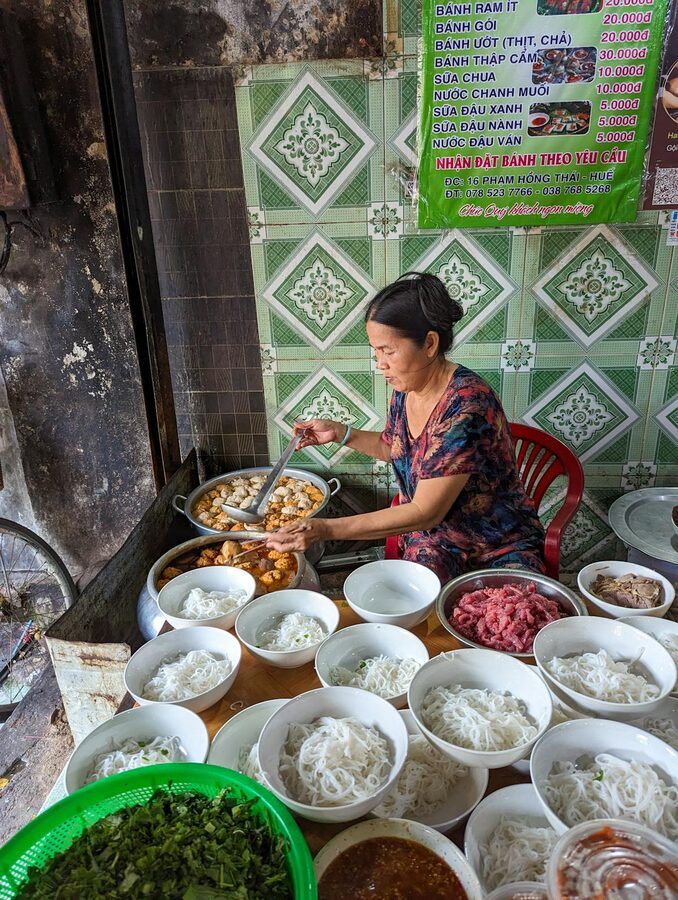
Dong Ba Market: Some tours include a stop at Hue’s main market. It is the usual organized chaos of a Vietnamese market, but it is a good place to try bun bo Hue (the city’s signature spicy beef noodle soup) and pick up local specialties like me xung (sesame peanut candy).
Getting Between Hue and Other Vietnam Destinations
Hue sits roughly in the middle of Vietnam’s coast, making it a natural stop between Hanoi in the north and Ho Chi Minh City in the south. Most travellers combine it with Hoi An and Da Nang, which are only 2-3 hours south.
Hue to/from Hoi An: About 120 km. Private car transfer takes 2-2.5 hours. The $11 tour mentioned above handles this if you want sightseeing included. You can also catch a local bus for about 100,000 VND.
Hue to/from Hanoi: The Reunification Express train takes about 13 hours and is a classic Vietnam experience. Flights take about 1 hour and cost from $30-50 one way if booked in advance. If you are planning other things in Hanoi, consider the water puppet show or a Ninh Binh day trip while you are up north.
Hue to/from Ho Chi Minh City: Flights are the practical option at about 1.5 hours. The train takes a full day. Once in HCMC, the Cu Chi Tunnels and Mekong Delta tours are the big day trip options.
More Vietnam Guides
If you are building a Vietnam itinerary, Hue pairs naturally with the central coast. The Marble Mountains and Lady Buddha in Da Nang are an easy day trip or stopover on the way between Hue and Hoi An, and Hoi An’s basket boat rides are one of those things you cannot really do anywhere else. The Hoi An cooking classes are a good wet-weather option too. For the north, Ha Long Bay cruises are still the headline act, and the Hanoi jeep and motorbike food tours are worth looking into if you want to eat your way through the capital. Down south, don’t skip the Ho Chi Minh City street food tours — the motorbike versions are genuinely thrilling.
