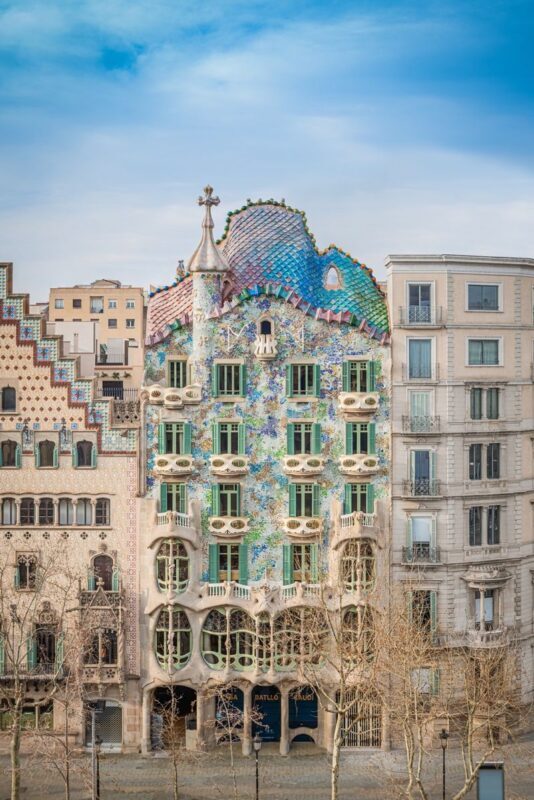
Casa Batlló turns a city residence into a sculptural world of curved walls, bone-like balconies and a roof that suggests a dragon’s back. I love two things here: the house shows Gaudí designing for everyday life, not just grand spectacle, and the changing blue tiles in the central courtyard make his practical use of natural light easy to grasp.
The main caution is crowding. Timed entry helps control numbers, but it does not guarantee a quiet visit, and the route can feel slow when people pause for photos. I’d book an early slot if you want more breathing room, while keeping expectations realistic during busy months.
- What to know before you go
- A home built like a work of art
- Entry, timing and the flow of the visit
- The family rooms and the Noble Floor
- The courtyard, where color does a job
- Gaudí Dome and Cube: the digital additions
- The Dragon’s Rooftop and Barcelona views
- Choosing a ticket and judging the value
- Practical details for a smoother visit
- Should you book Casa Batlló?
- FAQ
- How long should I allow for a visit?
- What languages are available for the audio guide?
- Do I need to book a time slot?
- What is included with the Gold ticket?
- Does the Platinum ticket include priority admission?
- Are children admitted free?
- How do I get to Casa Batlló?
- Can I bring luggage or take photographs inside?
- The Best Of Barcelona!
- More Tickets in Barcelona
- More Tours in Barcelona
- More Tour Reviews in Barcelona
- Not for you? Here's more nearby things to do in Barcelona we have reviewed
What to know before you go
- The rooftop is part of the story: Look for the tiled forms and chimneys that give the roof its dragon-back nickname.
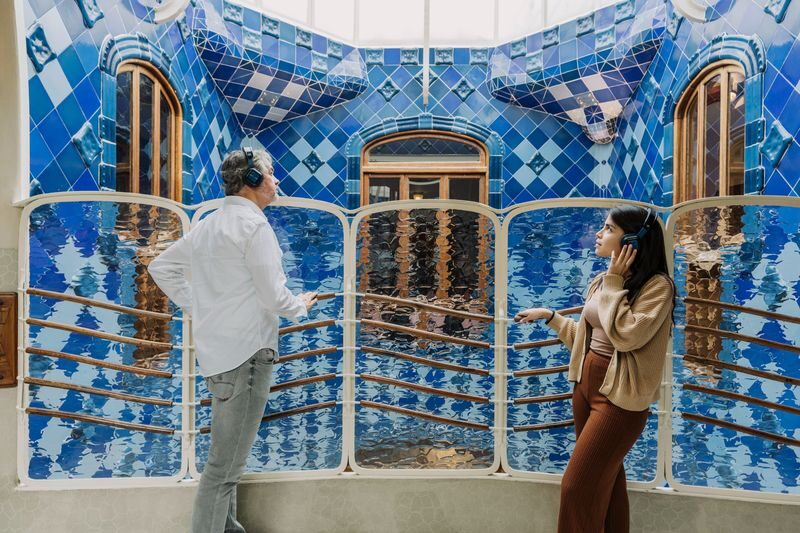
- The courtyard is clever, not just pretty: Its changing tile shades help spread daylight through the house.
- The audio guide sets your pace: Commentary is available in 15 languages, so you can pause at details instead of following a live group.
- Ticket tiers add different access: Gold and Platinum include an augmented-reality tablet and special rooms; Platinum also lists priority admission.
- Early entry can help, but not guarantee solitude: Even early slots may have queues or tour groups.
- Plan for about an hour to 90 minutes: That leaves time to hear the commentary, look closely and reach the rooftop without rushing.
👉 See our pick of the Best Guided Tours In Montserrat
A home built like a work of art
Casa Batlló sits at Passeig de Gràcia 43, among Barcelona’s best-known Modernist buildings. Antoni Gaudí renovated the residence for the Batlló family, shaping its rooms and surfaces around flowing forms rather than rigid lines. The result is playful, but it is also a real home with a practical plan.
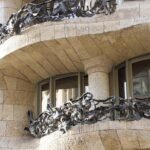
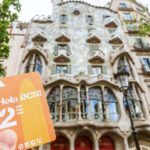
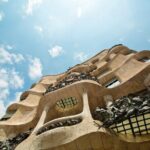
From the street, the façade gives you an early hint of what is inside. Its color, curved surfaces and skeletal-looking balconies bring natural forms to mind. If you have already seen Gaudí’s Sagrada Família, Casa Batlló offers a useful contrast: here, his imagination works at the scale of a private residence rather than a basilica.
I recommend taking a moment outside before scanning your ticket. The exterior is easy to treat as a quick photo stop, but its forms make more sense when you see how their curves continue through the interior. The house is compact enough that small details matter, and they are easy to miss if you hurry inside.
You can also read our reviews of more tours and experiences in Barcelona



Entry, timing and the flow of the visit
Your entry is tied to the date and time on your voucher. Show the mobile voucher at the venue and arrive at your assigned slot. The ticket information says capacity is limited to 300 people inside, but a timed ticket is not a promise of immediate admission: queues can form, especially in peak season from July to September.
I would aim to arrive a little before your slot, then check which line is for your ticket type. Entry lines can be confusing, and the crowd may take longer than expected to move through the checkpoint. Keep your QR code ready, and if you booked more than one ticket, make sure you can access the relevant codes before you reach the entrance.
The route takes roughly 60 to 90 minutes. You can explore at your own pace with the audio guide, though the one-way flow and popular photo stops may shape how quickly you move. If you want time to listen and study the rooms, don’t schedule another attraction immediately afterward.
The venue’s hours are listed as daily, generally from 8:30 or 9:00 in the morning until 10:00 at night, with last entry listed at 9:00 p.m. Opening hours and closure dates can change, so check the current details for your visit date. Early-entry tickets and evening visits are separate options, not simply a matter of arriving whenever you like.
The family rooms and the Noble Floor
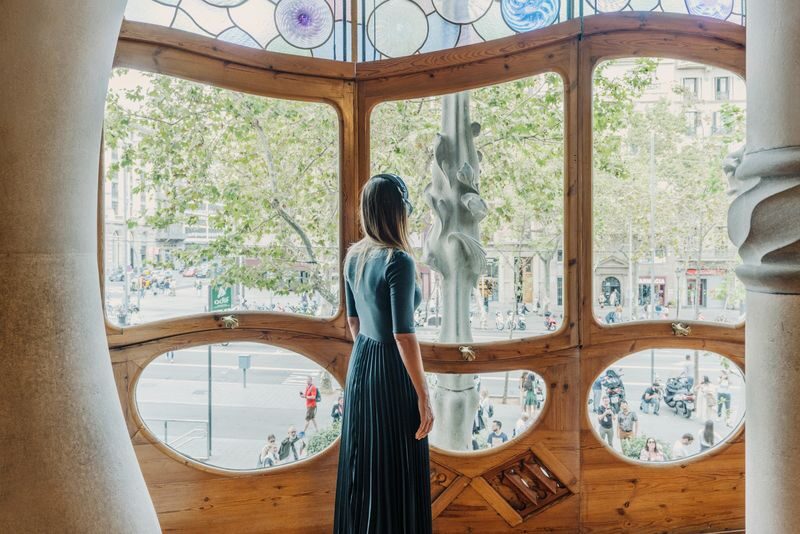
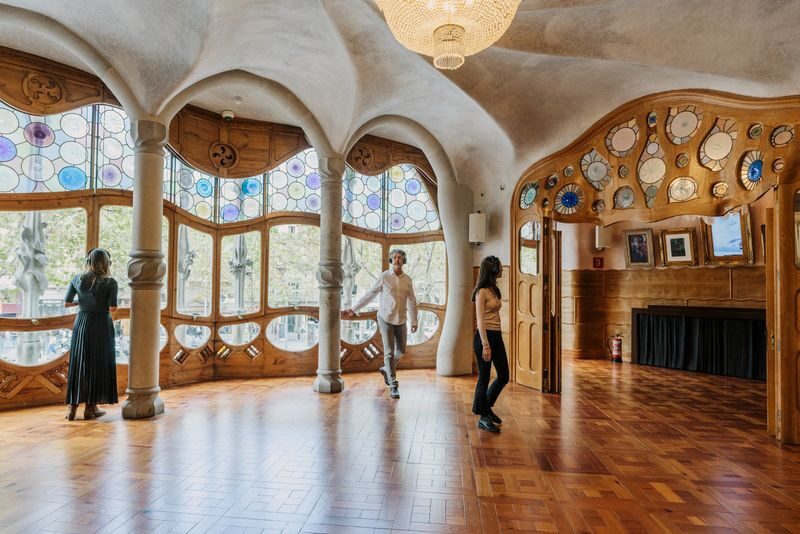
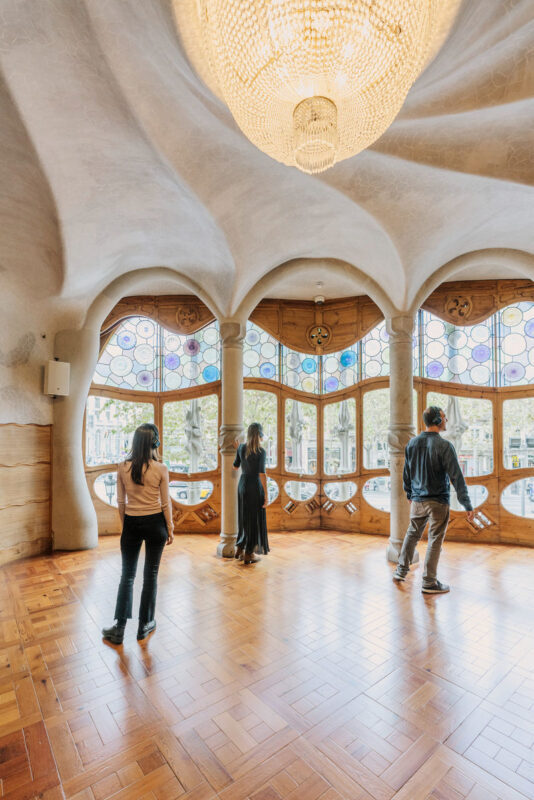
Inside, the route brings you through spaces associated with the Batlló family, including the Noble Floor, where the family lived. This is where Casa Batlló becomes more than a striking façade. You can see Gaudí’s ideas applied to rooms meant for daily use, with unusual shapes and carefully considered details rather than a standard sequence of square chambers.
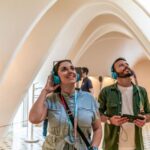
The audio guide helps connect those details to the house’s design and history. It is available in 15 languages: Chinese, English, Spanish, Russian, Portuguese, Japanese, German, Korean, French, Cantonese, Italian, Polish, Romanian, Dutch and Catalan. Since there is no live guide included with the standard admission, the commentary is your main source of context as you move through the rooms.
Look out for the mushroom-shaped fireplace, one of the more memorable features in the home. It gives a familiar household object an unexpected form, while still feeling made for sitting around. That mix of imagination and function is a good way to read the house: Gaudí is not decorating a blank box, but reshaping the experience of living in one.
Ticket access varies, so check exactly what your chosen tier covers. The Silver option lists additional rooms, while Gold and Platinum include special room access. The Gold and Platinum descriptions also include the private residence areas and an augmented-reality tablet. Do not assume that every ticket opens every room simply because the general visit description names them.
The courtyard, where color does a job
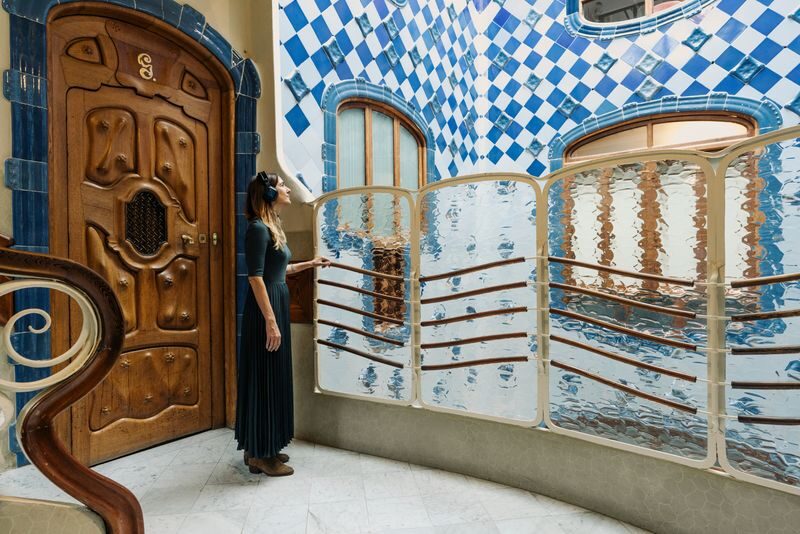
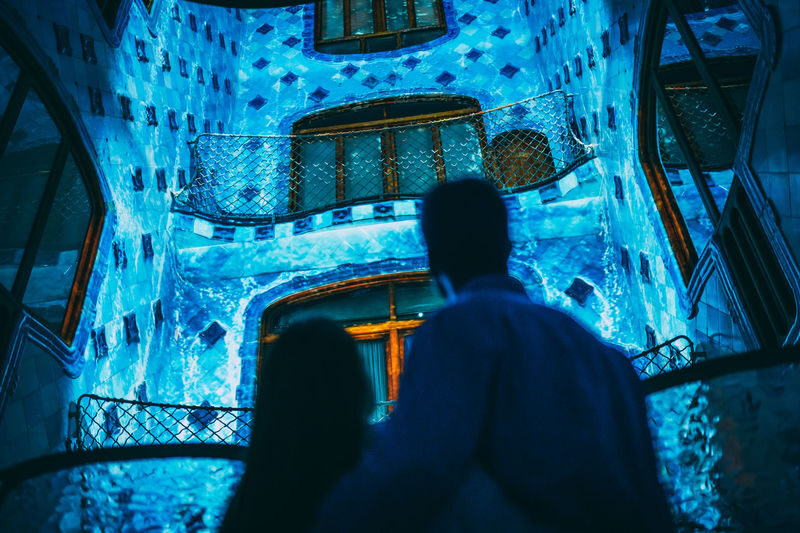
The central courtyard is one of the best places to slow down. Its tiles shift in shade from one level to another, helping distribute natural light through the building. The effect is beautiful, but the design also solves a practical problem: bringing light into interior spaces.
This is the sort of detail that makes the audio guide useful. Without a little explanation, you may simply register a striking wall of blue tiles. With context, you can see the courtyard as part of Gaudí’s thinking about how a home works. I’d pause here rather than treating it as a corridor between more famous rooms.
The light changes as you look upward, and the curved surfaces give the courtyard a softness that contrasts with the straight street outside. It can also be a busy spot, so you may need patience if you want an unobstructed view or photograph. The building’s appeal is in its details, but so are the bottlenecks.
Gaudí Dome and Cube: the digital additions
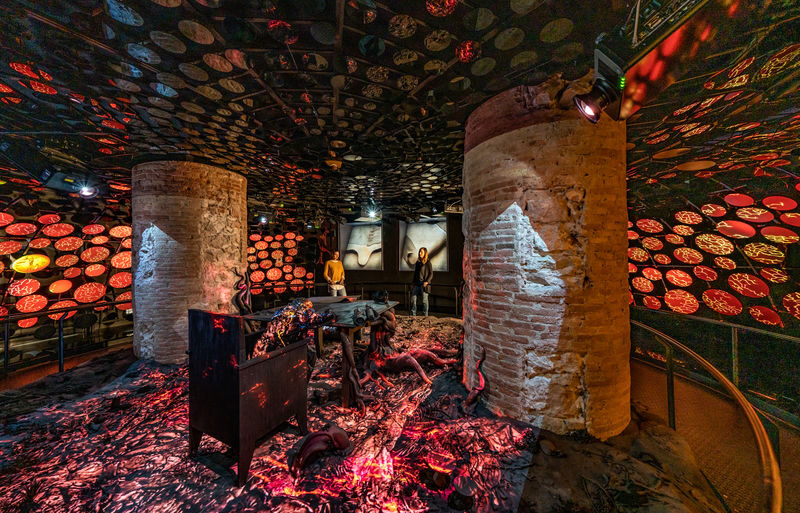
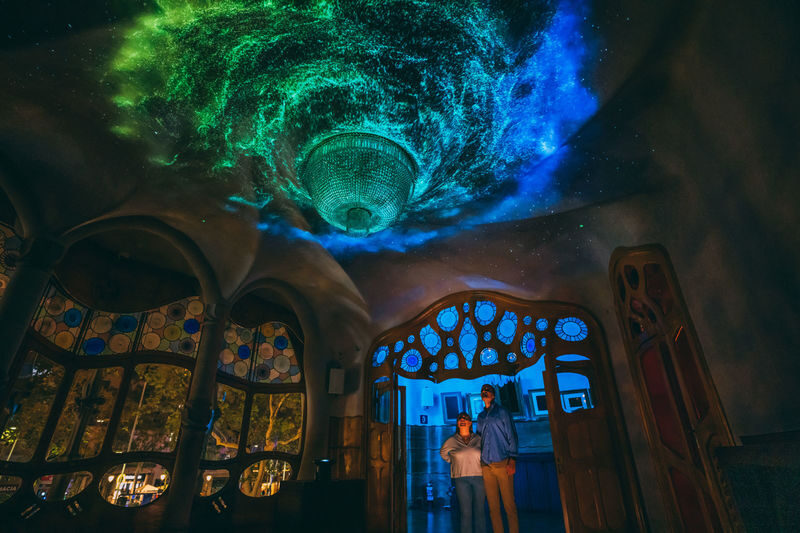
Some ticket options include the Gaudí Dome, described as a room of light projections that presents early inspirations, and the Gaudí Cube, a 360-degree light-and-sound experience. The Cube is a modern exhibit rather than part of the historic house, so think of it as an interpretive finale, not an original room.
Gold and Platinum also list an augmented-reality tablet. It lets you view reconstructions of how certain spaces looked in Gaudí’s time, including the Batlló family’s living areas. That can be helpful if you want to picture the home in use rather than as a preserved architectural interior. The trade-off is practical: holding a tablet while listening, moving through rooms and taking photos can feel cumbersome.
These digital elements are not essential to appreciating the building. If you mainly want to see Gaudí’s architecture, a lower tier may suit you. If you enjoy visual explanations and want access to more rooms, the Gold ticket is the more complete option described here. Check the exact inclusions on your chosen package before paying.
You can also read our reviews of more guided tours in Barcelona


The Dragon’s Rooftop and Barcelona views
The rooftop is the visit’s natural high point. Its chimneys and tiled surfaces are often read as a dragon’s back, with shapes that reward a closer look. From here, you also get views over Barcelona, though the roof itself is the main attraction rather than a sweeping panorama.
Take time to look across the chimneys instead of aiming straight for a photo and heading back down. Their sculptural forms bring the outside façade’s organic shapes into sharper focus. The roof can be crowded, so a little patience may be needed to enjoy the view or photograph the details without people in the frame.
Ticket tiers matter here too. The Blue option includes the Gaudí Cube, while the higher tiers list additional rooms and features; access details can vary by package. Confirm that rooftop entry is included in the specific ticket you select. Evening options add special lighting, and Magical Nights tickets pair a visit with a rooftop concert and a drink.
Choosing a ticket and judging the value
The advertised starting price is $18.49, while the listed Blue ticket starts at $32.49, Silver at $38.09, Gold at $43.65 and Platinum at $54.85. Prices depend on the option and date, so compare the final price and inclusions rather than relying on the lowest starting figure. The higher price buys more than a label: Gold adds the tablet, Gaudí Dome and special room access, while Platinum adds priority admission.
For a straightforward visit, Blue may be enough if you mainly want the house and the Cube. Silver adds rooms, and Gold makes sense if you want the extra visual context and expanded access. Platinum costs more for priority admission, but priority does not necessarily mean a private visit or an empty building. If quiet matters most, consider the earliest available entry and avoid peak dates where possible.
There are also evening options with special lighting, a glass of cava or a Kir Royal, depending on the ticket. Magical Nights packages include a rooftop concert, with Gold offering front-row seating. These are better suited to someone who wants the visit to be an evening outing, not just a quick architectural stop.
The price can feel high for a visit that lasts about an hour, especially if crowds restrict how long you can linger in a room. I think the value is strongest for people who care about architecture, interiors or Gaudí’s use of light and form. If you are mainly looking for a broad historical tour, note that the standard experience is self-guided and focused on the house itself.
Practical details for a smoother visit
Casa Batlló is on Passeig de Gràcia in the Eixample district. You can reach Passeig de Gràcia station on metro lines L3 or L4, or by RENFE R2 Nord and R2 Sud trains. Barcelona Bus Turístic also stops at Casa Batlló – Fundació Antoni Tàpies.
Large bags and luggage are not allowed inside, and outside food and drinks are prohibited. Children aged 0 to 12 are listed as free, but infants and children must still be included in the passenger count; children under 12 must be accompanied by an adult. Students should bring a student card if using a student ticket.
Photography is allowed according to the venue information, but flash is not permitted. Photography fees are not included, so check on site if you are interested in any paid photo service. Audio commentary is available in several languages, and Braille information can be provided for participants who need it. The route includes stairs, which may be difficult if you have knee or mobility concerns; contact the venue before booking if you need specific access information.
Tickets are valid only for the selected date and, where applicable, time. The booking terms supplied for this activity say cancellations and refunds are not available, so choose your slot carefully. The venue permits animals only with prior approval from staff.
Should you book Casa Batlló?
I’d book Casa Batlló if you enjoy design and want to see Gaudí’s ideas in a home-sized setting. The courtyard, Noble Floor and rooftop make a satisfying visit, and the audio guide helps explain why the house is more than an eccentric façade. Choose an early time if you want the best chance of moving at your own pace, but don’t expect the building to be empty.
If your budget is tight, compare the Blue and Silver options with Gold before buying. Pay extra for Gold if the tablet, Dome and special room access matter to you; consider Platinum only if priority admission is worth the added cost. For a broader architectural experience, Casa Batlló pairs well with other Gaudí sites, but it is not a substitute for them. Book it for the house itself, and give its details time to work on you.
Barcelona: Casa Batlló Ticket & Audio Guide Option
“Buying tickets and passing through checkpoints on Klook is very convenient, and they have relevant activities no matter which country you visit. I…”
FAQ
How long should I allow for a visit?
Allow 60 to 90 minutes. That gives you time to use the audio guide, visit the rooms included with your ticket and go up to the rooftop.
What languages are available for the audio guide?
The audio guide is listed in 15 languages: Chinese, English, Spanish, Russian, Portuguese, Japanese, German, Korean, French, Cantonese, Italian, Polish, Romanian, Dutch and Catalan.
Do I need to book a time slot?
Yes. The ticket is valid only on the date and time shown, where a time is specified. Arrive for your assigned slot, and check current availability before you go.
What is included with the Gold ticket?
The Gold ticket description includes an audio guide, augmented-reality tablet, Gaudí Dome and special room access. Check the selected package details at booking to confirm its current inclusions.
Does the Platinum ticket include priority admission?
Yes. The Platinum option lists priority admission along with an audio guide, augmented-reality tablet, Gaudí Dome and special room access.
Are children admitted free?
Children aged 0 to 12 are listed as free, but they must be included in the passenger headcount. Children under 12 must be accompanied by an adult.
How do I get to Casa Batlló?
The address is Passeig de Gràcia 43. Take metro line L3 or L4 to Passeig de Gràcia, use RENFE line R2 Nord or R2 Sud, or take the Barcelona Bus Turístic to the Casa Batlló – Fundació Antoni Tàpies stop.
Can I bring luggage or take photographs inside?
Large bags and luggage are not allowed. Photography is allowed, but flash is prohibited; any photography fees are not included.