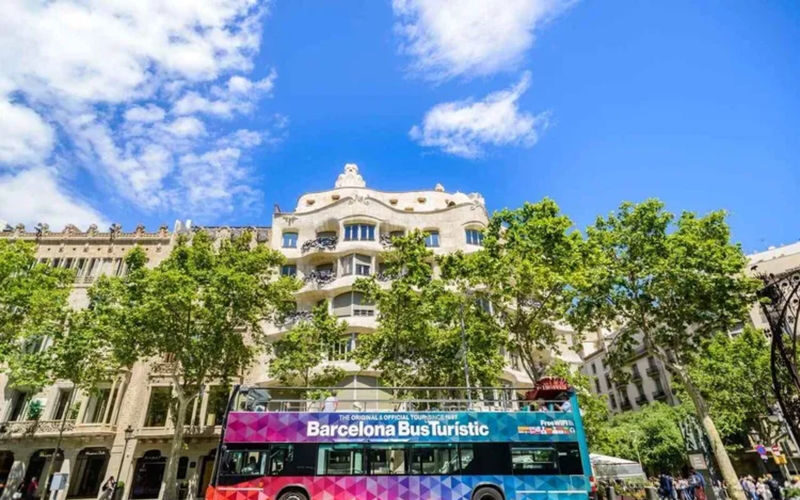
Barcelona’s two bus routes offer a simple way to connect far-flung sights, from Gaudí’s houses on Passeig de Gràcia to the Olympic sites on Montjuïc and the beaches along the coast. Ride a full loop to get your bearings, or hop off at landmarks that deserve more than a passing glance.
I like two things in particular: the red and blue routes cover different parts of the city, and the open top gives you a fine view of Barcelona’s street life and architecture. The multilingual audio guide and frequent buses also make the system easy to use without much advance planning.
One consideration: each route takes about two hours for a full loop, and traffic can slow the ride. The audio commentary may also be mistimed, so treat it as an introduction rather than a perfectly synchronized guide.
- Two routes, two different itineraries: The red route takes in Montjuïc, the waterfront, and central sights; the blue route heads toward Park Güell, Tibidabo, and the city’s northern districts.
- Full loops take about 120 minutes: Riding both routes without getting off takes roughly four hours, before adding time for stops.
- Best views come from the upper deck: Open-top seating is ideal for photos, though sun, rain, and heat can make it less comfortable.
- A useful first-day orientation: The routes connect major sights and let you decide which places merit a longer visit.
- Admission is not included: The pass gets you to attractions, but you’ll need separate tickets to enter them.
- Plan around the timetable: Buses run from 9 a.m. to 7 p.m., with service every 5 to 20 minutes depending on the season.
- Two routes for seeing Barcelona’s many sides
- Red route: from Passeig de Gràcia to Montjuïc and the sea
- Blue route: Gaudí, Park Güell, and the northern districts
- What the audio guide and open deck add
- What the ticket costs, and when it earns its keep
- Small planning details that can save time
- Who should book this bus tour?
- FAQ
- How long does a full route take?
- What are the ticket options?
- Where can I start the tour?
- What time do the buses run?
- How often do buses arrive?
- Which attractions are near the routes?
- Is attraction admission included?
- What languages are available for the audio guide?
- Is the bus wheelchair-accessible?
- Can I cancel for a refund?
- The Best Of Barcelona!
- More Tours in Barcelona
- More Tour Reviews in Barcelona
- Not for you? Here's more nearby things to do in Barcelona we have reviewed
Two routes for seeing Barcelona’s many sides
 1 / 7
 2 / 7
 3 / 7
 4 / 7
 5 / 7
 6 / 7
 7 / 7
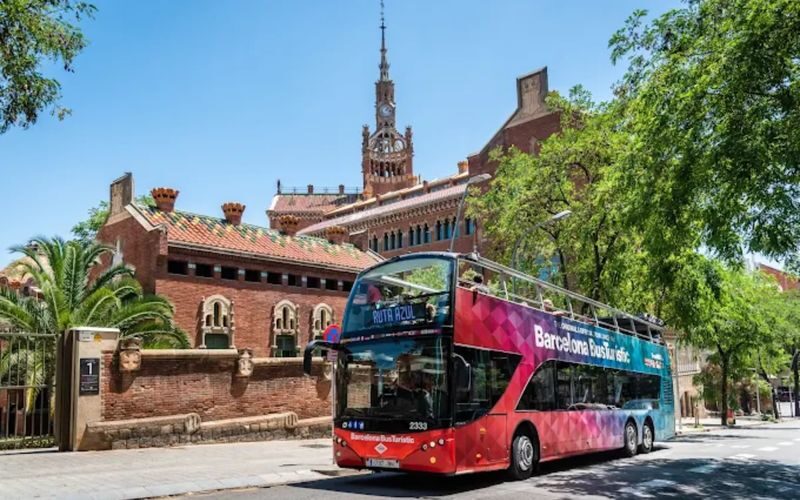
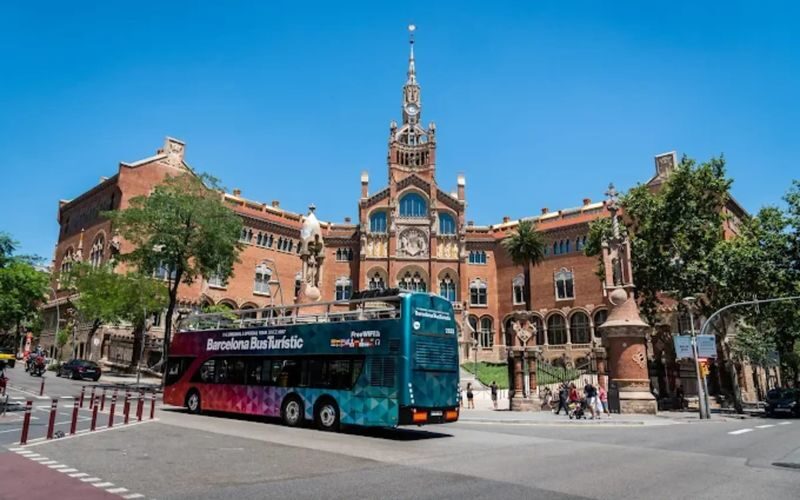
The red and blue routes make this more than a ride around the city center. Both begin at Plaça de Catalunya, and you can board at any designated stop. The red route loops through central Barcelona, Montjuïc, and the waterfront, while the blue route concentrates on Gaudí sites and districts farther north.
Each full loop is listed at about 120 minutes. If you ride both routes end to end, budget around four hours, though traffic and seasonal waits can stretch the day. The buses run every 5 to 20 minutes, depending on the season, so you can get off for a visit and catch a later bus. That flexibility is the main point: you’re not tied to a fixed group schedule.
The routes share some stops, including Casa Batlló and Plaça de Catalunya, making a transfer possible. The system is one-way, though, so check the route map before hopping off. A stop that looks close on the map may not put you right at an attraction entrance, and the bus won’t take you back in the opposite direction.
👉 See our pick of the Best Guided Tours In Montserrat
Red route: from Passeig de Gràcia to Montjuïc and the sea
The red route is a strong choice if you want a broad first look at Barcelona. It leaves Plaça de Catalunya and passes Casa Batlló and the Fundació Antoni Tàpies before heading toward CaixaForum and the Mies van der Rohe Pavilion. These early stops put you near some of the city’s best-known architecture, though the bus ride itself is an overview, not an architectural tour on foot.
The route then climbs toward Montjuïc, where stops include Poble Espanyol, the Museu Nacional d’Art de Catalunya, the Olympic Ring, and the Fundació Joan Miró. This stretch helps you understand how much of Barcelona’s character sits beyond the old center. You can get off to explore, but allow time for the hill and the distance between sites. The route also passes the Montjuïc cable car area, Miramar, and Jardins Costa i Llobera.
On the way back toward the center, the bus passes the World Trade Center, Colom, La Rambla, and the Museu d’Història de Catalunya. It then follows the coast past Port Olímpic and several beaches, including Bogatell and Nova Mar Bella, before reaching the Forum, Diagonal Mar, Poblenou, and Torre Glòries. The route finishes its circuit through the city, with stops near Sagrada Família and Arc de Triomf.
This is the route I’d choose first if I wanted variety: grand buildings, a hilltop cultural district, waterfront views, and a glimpse of newer Barcelona. But don’t mistake passing a sight for visiting it. A quick view from the upper deck is useful for orientation, not a substitute for getting off and spending time.
You can also read our reviews of more tours and experiences in Barcelona.



Blue route: Gaudí, Park Güell, and the northern districts
The blue route starts along the same central stretch, passing Casa Batlló, the Fundació Antoni Tàpies, and Passeig de Gràcia. It then reaches La Pedrera, another of Antoni Gaudí’s signature buildings, before continuing toward the Sant Pau Recinte Modernista. These stops make the route especially appealing if Barcelona’s architecture is high on your list.
Farther north, the route serves Park Güell, then continues toward Tramvia Blau, Tibidabo, Sarrià, and the Monestir de Pedralbes. It also passes the Palau Reial, the Güell Pavilions, and the area around Futbol Club Barcelona, before returning through Diagonal, Les Corts, Francesc Macià, Eixample, and Sant Antoni.
Keep expectations sensible at Park Güell. The bus stops near the site, but not at every part of the park, and the approach may involve a walk. The same principle applies across the route: check exactly where the stop is and how much walking your chosen attraction requires. A route map is worth keeping handy, especially if you’re trying to make a timed entrance.
The blue route offers a useful contrast to the red one, but it may feel less varied if you’re mainly after waterfront scenery and central landmarks. If you have just one day, choose stops based on your priorities instead of trying to see everything from the bus.
What the audio guide and open deck add
The audio guide is available in 16 languages: English, Spanish, French, German, Italian, Dutch, Hebrew, Japanese, Chinese, Portuguese, Russian, Swedish, Arabic, Turkish, Catalan, and Norwegian. It gives you context as the bus moves between districts, and headphones are provided. The quality and timing may vary, so keep your eyes on the city rather than relying on each stop announcement to line up exactly with the view.
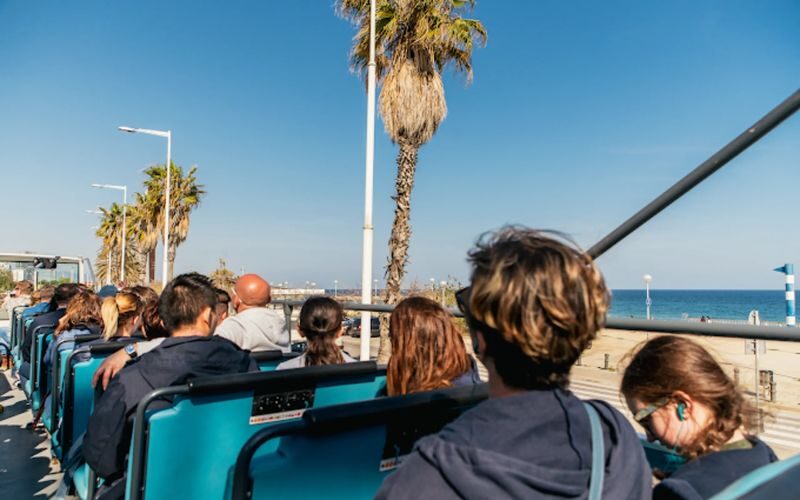
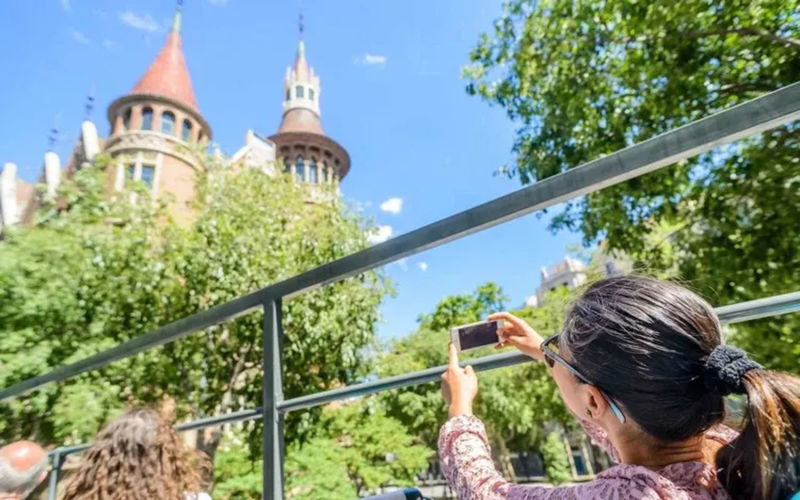
The upper deck is the main draw for many people. It gives you a clear angle on façades, boulevards, and the coastline, and it’s a handy spot for photos. But Barcelona’s sun can be fierce, and hot weather can make the ride uncomfortable. One practical compromise is to sit in the shade when you can. The lower deck is air-conditioned, according to the tour information, and can be a better choice in hot or rainy weather.
Onboard Wi-Fi is included, though the connection may be only adequate for basic use. Download or save the route map before you set out, rather than depending on onboard internet to find the next stop. Clear bus-stop signs help, but finding the precise boarding point can take some attention in busy areas.
What the ticket costs, and when it earns its keep
Prices start at $40.65, with a choice of 24-hour and 48-hour tickets. The value depends less on how many stops you can cram in than on how much you’ll use the bus to move between distant areas. For a first visit, a pass can save energy and simplify travel between places such as Montjuïc, Park Güell, and the waterfront. If you plan to stay mostly in the central districts, walking and local transit may suit you better.
The pass includes the bus, audio guide, Wi-Fi, and more than €250 in advertised discounts for attractions, sights, and shopping. Those discounts may be useful if they match places you already plan to visit, but don’t count the full advertised amount as a saving unless you’ll actually use the offers. Attraction admission is not included, so budget separately for places where you want to go inside.
A 24-hour pass suits a focused day of sightseeing. The 48-hour option gives you more room to split the routes and spend longer at stops, rather than turning the bus into a race. Start early: the routes run from 9 a.m. to 7 p.m., and the last bus leaves Plaça de Catalunya at 7 p.m. The service operates year-round, except on December 25, January 1, and January 6.
Small planning details that can save time
You can start or end at any designated stop, not just Plaça de Catalunya. Present your mobile voucher when boarding. At some stops, staff may be on hand to help explain the map and ticket, but don’t count on finding an attendant at every location.
Stop locations can be less obvious than the attraction they serve. Check the map before leaving one bus, and note the name of the stop where you want to get back on. The red and blue routes use distinct colors, but take a moment to confirm the bus and route before boarding, particularly at shared stops.
The service is wheelchair-accessible, and most buses have wheelchair spaces. The stated maximum wheelchair dimensions are 70 cm wide, 120 cm long, and 135 cm high. If your chair is larger or you’re unsure it will fit, contact the operator before setting out.
Children aged 0 to 3 ride free, while children aged 13 and older pay the adult rate. The tour information does not specify a separate fare rule for children aged 4 to 12, so check the ticket details before booking for that age group.

Who should book this bus tour?
I’d consider this pass if it’s your first time in Barcelona, you want a quick overview, or you’d rather save your legs between widely spaced sights. It’s also handy if you enjoy open-air city views and want the freedom to change plans as you go. The 48-hour ticket is the more relaxed choice if you intend to visit several attractions along the way.
I’d skip it if you prefer detailed, stop-by-stop commentary, need to travel after 7 p.m., or plan to explore only the central neighborhoods. Traffic can make the ride slow, and the audio guide may not always match the view. Book it for flexible transport and a broad city introduction, not as a substitute for walking tours or attraction tickets.
Barcelona: Hop-On Hop-Off Bus
“🧒🏼I got my "actual" ticket and map from the person / staff assigned at the Casa Batlló stop. wasn't able to get her name but she's very attentive,…”
FAQ
How long does a full route take?
Each route takes about 120 minutes for a full loop. Riding both routes without getting off takes roughly four hours, though traffic can affect the timing.
What are the ticket options?
You can choose a 24-hour or 48-hour ticket.
Where can I start the tour?
You can board at Plaça de Catalunya or at any designated City Sightseeing or Barcelona Bus Turístic stop.
What time do the buses run?
Both routes operate from 9 a.m. to 7 p.m. The last bus leaves Plaça de Catalunya at 7 p.m.
How often do buses arrive?
Frequency is listed as every 5 to 20 minutes, depending on the season.
Which attractions are near the routes?
Stops include Sagrada Família, Park Güell, Casa Batlló, La Pedrera, Montjuïc, the Olympic Ring, and several beaches.
Is attraction admission included?
No. The pass covers the bus tour, but attraction admission and personal expenses are not included.
What languages are available for the audio guide?
The audio guide is available in 16 languages: English, Spanish, French, German, Italian, Dutch, Hebrew, Japanese, Chinese, Portuguese, Russian, Swedish, Arabic, Turkish, Catalan, and Norwegian.
Is the bus wheelchair-accessible?
The activity is wheelchair-accessible, and most buses have wheelchair spaces for chairs up to 70 cm wide, 120 cm long, and 135 cm high. Contact the operator if your chair is larger or you’re unsure about fit.
Can I cancel for a refund?
You can receive a full refund if you cancel at least 24 hours before the activity date, using the destination’s local time.