Rome’s three-route bus links major sights such as the Colosseum, Vatican City, Trevi Fountain, and Borghese Gallery with a food-focused route and one aimed at less-visited corners. It can help you get your bearings without plotting every trip yourself. I like the choice of routes and the multilingual audio guide; the main catch is that some routes run much less often than the classic Green route.
I also like that you can board at any stop and ride with free Wi-Fi, a city map, and a multilingual assistant on board. But the bus is not a cure for all Roman walking: wind, crowds at boarding, and gaps between buses can make a short city-center trip faster on foot or by metro.
- Key points before you ride
- Three routes, three different Rome days
- What the open-top ride gives you
- Audio commentary and help on board
- Starting at Termini and finding your bus
- Is the pass good value for your Rome plan?
- Who will appreciate this bus most?
- Should you book the Rome hop-on hop-off bus?
- FAQ
- Where does the Green route start?
- Can I board at a stop other than Terminal 1A?
- How many routes does the ticket include?
- How often do the buses run?
- What languages are available for the audio guide?
- Are entrance fees included?
- Is the bus accessible for wheelchairs and strollers?
- Can I bring children or pets?
- Can I bring luggage onboard?
- Can I cancel for a refund?
- The Best Of Rome!
- More Tours in Rome
- More Tour Reviews in Rome
- Not for you? Here's more nearby things to do in Rome we have reviewed
Key points before you ride
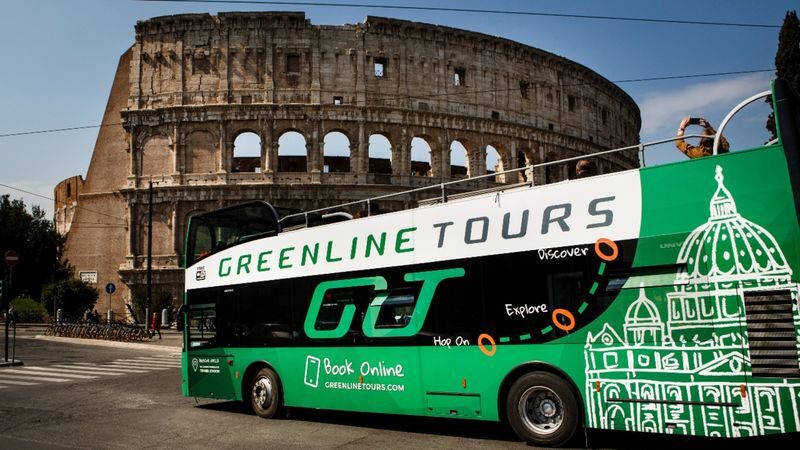
- Three routes offer three different angles on Rome: Green for classic landmarks, Orange for food-focused areas and the Pyramid, and Blue for museums and less-visited sights.
- The Green route is the practical backbone: the summer frequency is listed as about every 15 to 20 minutes, while the other routes may have longer waits.
- You get 15 stops and flexible boarding: join at any stop, though the easiest starting point is Piazza dei Cinquecento at Termini.
- The audio guide works in 16 languages: commentary is accessed through a digital guide on your phone, and a single-use earphone is included.
- This is transport and orientation, not admission: entrance fees, food, drinks, and shopping are extra.
- Check route timing before you plan around Blue or Orange: published departure times are limited at some boarding points, and a missed bus may mean a long wait.

👉 See our pick of the 25 Best Guided Tours In Rome
Three routes, three different Rome days
The Green route is the natural starting point for most first-time visitors. It is described as the classic route, with access to headline sights including the Colosseum, Vatican City, Trevi Fountain, and Borghese Gallery. The appeal is simple: you can sit back, get a sense of how Rome’s major areas fit together, then choose where to spend your walking time.
The bus does not replace a visit inside a monument. Your ticket covers riding, not entry, so you will need separate admission for places that charge it. Think of the route as a way to connect sights and see the city between them, rather than a guided visit to every landmark.
The Orange route is pitched toward Rome’s culinary side and heads through the southern part of the city, including the area around the Pyramid. That makes it a change of scene from the familiar center. It may suit you if you want to see a less expected stretch of Rome, but do not treat it as a frequent shuttle: the Orange service is described as much less frequent than Green.
The Blue route is the museum-focused and off-the-usual-track option. It adds access to places such as the Borghese Gallery and other less-visited areas. It can broaden your trip, but its less frequent service calls for planning. Use the bus’s real-time map if available to check its progress, and leave room in your schedule in case the next departure is not soon.
The tour describes 15 stops across its routes. Since the exact stop-by-stop sequence is not provided here, check the current map before choosing a stop as your base for a timed museum visit or meal. The named sights are useful orientation points, not a promise that every bus stops right at every entrance.
You can also read our reviews of more tours and experiences in Rome.



What the open-top ride gives you
Rome’s rooftops, broad avenues, monuments, and shifting neighborhoods are part of the experience, not just the view from the bus. An open top gives you a high vantage point and a chance to notice how the city changes as you move between its famous center and less familiar districts. For a first day, that bird’s-eye view can help you decide where you want to return on foot.
There is a practical trade-off. The upper deck has both covered and uncovered seating, and you may not control which section you get. The uncovered seats give you the clearest view, but they can be cold and windy, especially in winter or on a blustery day. Bring a layer even when the forecast looks mild. If the weather turns, a covered seat is less dramatic but more comfortable.
Crowds can also affect the ride. Boarding involves presenting a mobile voucher, and checking QR codes can slow the line when many people are waiting. Arrive with the voucher ready on your phone, and do not assume the bus will feel like a private sightseeing carriage. This is shared city transport with a view.
Audio commentary and help on board
The digital audio guide is available in 16 languages: English, Spanish, Arabic, Hindi, Russian, Portuguese, Japanese, German, Korean, French, Italian, Polish, Dutch, Mandarin, Greek, and Hebrew. You download it to your phone, and a single-use earphone is included. That makes it easier to follow the route in your preferred language, though you will need your phone and should be ready to use the guide as directed.
Free Wi-Fi is listed onboard, along with a multilingual assistant and a city map. Those details matter most when you are trying to find the right stop or understand a route change. Staff are described as friendly, but the bus timetable and live progress are still worth checking yourself, especially for Blue and Orange.
I would not use the commentary as a substitute for a museum guide or a detailed walking tour. Its value is in giving you context while you move, so you can look up from the screen and take in the streets. The audio is a welcome extra, not the main reason to buy the pass.
Starting at Termini and finding your bus
The main Green-route starting point is Piazza dei Cinquecento, Terminal 1A, beside Termini Station. The address is 00185 Rome. From the metro, take Line A, B, or B1 to Termini, exit at Via Amedeo VIII, and walk about one minute. You can also join at any stop, so this is a convenient base rather than a compulsory starting point.
Other listed boarding points include Piazza dell’Indipendenza, Terminal 1C, for Green, and Via Giovanni Amendola 85, Terminal 1B, for Blue and Orange. The listed departures from Piazza dell’Indipendenza are 09:25, 10:30, 11:10, 12:15, 12:55, and 14:00. Via Giovanni Amendola 85 has listed departures at 11:50, 14:35, and 17:05. Those limited times make it especially important to check the schedule before heading there.
At Terminal 1A, Green-route departures are listed from 09:00 to 18:30. The daily ticket is described as available from 09:00 to 18:00, so confirm the current operating details before planning to board near closing time. Opening hours and closure dates can change.
Summer frequency is given as roughly every 15 to 20 minutes, with another note saying every 20 minutes. Treat that as a guide, not a guarantee for every route or season. The Blue and Orange routes are specifically described as less frequent, and a missed departure can cost you a sizeable chunk of sightseeing time. Check the live map and timetable rather than relying on the Green route’s rhythm.
Is the pass good value for your Rome plan?
Prices start at $32.15, but the final cost depends on the ticket option you choose. Options include a daily ticket and 24-hour, 48-hour, and 72-hour passes. A longer ticket makes most sense if you will use the buses on more than one day and want time to explore several routes without rushing.
For a single day, the value depends on how you travel. If you plan to cover several far-apart sights and appreciate an overview from the upper deck, the pass can save you from organizing each connection. If your day is mostly in the historic center, where you want to stop often and wander streets between landmarks, walking or the metro may be quicker and cheaper. The bus’s own appeal is the route and view, not necessarily speed.
Remember that admission fees are not included. Food, drinks, souvenirs, and other personal expenses are also on you. The bus can get you near the places you want to see, but it does not bundle the cost of the Colosseum, museums, or other paid attractions into the ticket.
The best value case is a 48- or 72-hour pass for someone who will use the Green route as a regular connector and fit in Orange or Blue when their schedules suit. The weakest case is buying a one-day ticket with a packed list of timed visits, then expecting the less frequent routes to run like a metro. Give yourself flexible time, and the pass has a better chance of earning its fare.



Who will appreciate this bus most?
I would consider this bus if it is your first Rome visit and you want a broad overview before choosing where to spend more time. It can also suit you if you prefer to limit long walks, want the option to rest between sights, or enjoy seeing a city from an open-top deck. Families may find the flexible boarding useful, though young children must be accompanied by a paying adult.
It is less appealing if you are focused on the city center and comfortable walking or using the metro. A bus queue and QR check can eat into a short visit, and cold weather can make the top deck less pleasant than it sounds. If you are counting on the Blue or Orange route to arrive at a precise time, build in a backup plan.
The bus is stroller- and wheelchair-accessible, and small or medium-sized pets are allowed if leashed and muzzled. Luggage is not allowed onboard, so this is not a transfer service for arriving with bags. Children aged 0 to 5 ride free but must still be included in the passenger headcount; children aged 0 to 12 need a paying adult, and ages 13 and up pay the adult rate.
Should you book the Rome hop-on hop-off bus?
Book it if you value an easy city overview, like the open-top perspective, and have enough time to work around the route schedules. The Green route is the safest bet for regular sightseeing; treat Orange and Blue as useful extras that require more attention to timing.
Skip it, or keep your expectations modest, if your plan is a fast circuit of central Rome with several timed entries. The bus cannot promise quick point-to-point travel, and its ticket does not include admission. For a relaxed first look at the city, it can be a practical companion. For a tight schedule, Rome’s streets and metro may serve you better.
Rome hop-on hop-off bus by Greenline (Valid for 3 routes)
“I was able to efficiently tour the city of Rome. It would be helpful if there were a few more buses.”
FAQ
Where does the Green route start?
The listed Green-route starting point is Piazza dei Cinquecento, Terminal 1A, at Termini Station in Rome.
Can I board at a stop other than Terminal 1A?
Yes. You can join the hop-on hop-off bus from any stop. Other listed boarding points include Piazza dell’Indipendenza for Green and Via Giovanni Amendola 85 for Blue and Orange.
How many routes does the ticket include?
The ticket includes the Green, Orange, and Blue routes. Green covers classic landmarks, Orange focuses on food-related areas and the south, and Blue serves museums and less-visited sights.
How often do the buses run?
The summer frequency is listed as about every 15 to 20 minutes, with another note giving every 20 minutes. The Blue and Orange routes may run much less often than Green, so check the timetable and live progress.
What languages are available for the audio guide?
The digital audio commentary is available in English, Spanish, Arabic, Hindi, Russian, Portuguese, Japanese, German, Korean, French, Italian, Polish, Dutch, Mandarin, Greek, and Hebrew.
Are entrance fees included?
No. Entrance fees are not included. Food, drinks, souvenir shopping, and other personal expenses are also excluded.
Is the bus accessible for wheelchairs and strollers?
Yes. The activity is described as wheelchair-accessible and stroller-accessible.
Can I bring children or pets?
Children aged 0 to 5 ride free but must be included in the passenger headcount. Children aged 0 to 12 must be with a paying adult, and children aged 13 or older pay the adult rate. Small and medium-sized pets are allowed if they wear a leash and muzzle.
Can I bring luggage onboard?
No. Luggage is not permitted onboard.
Can I cancel for a refund?
Yes. Free cancellation is available if you cancel at least 24 hours before the activity date, using the destination’s local time.