Rome’s old center makes most sense on foot, where an ancient column, a grand Baroque church and a fountain crowded with wish-makers can sit within a short walk of one another. This roughly two-hour guided route links those layers, from Trajan’s Column to Piazza Navona, with a guide to explain what you are seeing.
I like two things in particular: the route pairs famous stops such as the Trevi Fountain and Pantheon with less expected details, including the frescoed courtyard at Galleria Sciarra; and the guides often add practical advice, from where to eat to how to use Rome’s public drinking fountains.
The trade-off is that this is a brisk overview, not an in-depth visit to each monument. Crowds can slow the walk, and the tour is not wheelchair-accessible, so comfortable walking shoes matter.
- Start beneath the pines at Piazza d’Aracoeli: Meet your guide near Via di S. Venanzio 8 and look for the yellow Carpe Diem Tours sign.
- See Rome’s layers in one compact route: Piazza Venezia and Trajan’s Forum lead toward Trevi, the Pantheon and Piazza Navona.
- Look beyond the grand monuments: Galleria Sciarra’s Art Nouveau courtyard and the painted ceiling at Sant’Ignazio add quieter stops.
- Expect stories and useful local pointers: Guides such as Sharon, Dan, Sila and Domenica have shared history, restaurant suggestions and tips for finding Rome’s nasoni, or public fountains.
- Plan for about two hours on foot: The advertised options are 10:00 and 17:30, with the end point at Piazza Navona.
- Check the final price before booking: The listed starting prices vary, and personal expenses and gratuities are not included.
- A compact walk through Rome’s historic center
- From Piazza d’Aracoeli to Trajan’s Column
- Trevi Fountain: spectacle, stories and crowds
- Galleria Sciarra and Sant’Ignazio’s painted sky
- The Pantheon: engineering on a human scale
- Finishing at Piazza Navona
- What the pace, group and price mean for you
- Should you book this Rome walking tour?
- FAQ
- How long does the walking tour take?
- Where does the tour begin and end?
- What departure times can I choose?
- What is included in the price?
- Is the tour wheelchair-accessible?
- Can children join the tour?
- The Best Of Rome!
- More Walking Tours in Rome
- More Tours in Rome
- More Tour Reviews in Rome
- Not for you? Here's more nearby things to do in Rome we have reviewed
A compact walk through Rome’s historic center
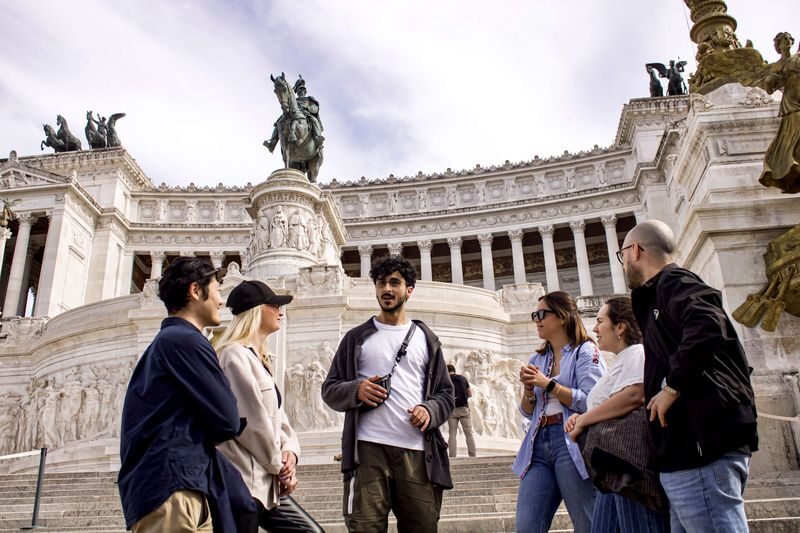
This small-group walking tour is built for a first look at central Rome. It starts at Piazza d’Aracoeli, passes through Piazza Venezia and Trajan’s Forum, then threads through streets to the Trevi Fountain, Galleria Sciarra, Sant’Ignazio di Loyola, the Pantheon and Piazza Navona.
That sequence is useful because the city’s history can otherwise feel like a jumble of emperors, popes, artists and modern traffic. A guide gives you a thread to follow, pointing out how the streets, monuments and churches relate to one another. You get the broad story while moving between places, rather than spending the whole morning in one building.
The advertised route gives roughly 15 minutes to each stop, with the walk between them bringing the total to about two hours. Treat those stop times as a guide, not a promise: crowds, weather and the pace of the group can affect the schedule.
👉 See our pick of the 25 Best Guided Tours In Rome
From Piazza d’Aracoeli to Trajan’s Column
The meeting point is Piazza d’Aracoeli, near Via di S. Venanzio 8. The instruction is to meet under the pine trees in the center of the park and look for a yellow Carpe Diem Tours flag or sign. Arriving 10 minutes early is sensible, especially in a city where a small square can have several possible entrances and meeting spots.
The walk begins with a short introduction to Rome, then heads toward Piazza Venezia. This busy junction brings together ancient and modern views of the city. The Altar of the Fatherland, with its broad white stone frontage, is hard to miss. Your guide uses it to set the scene, connecting Rome’s more recent history with the older remains nearby.
At Trajan’s Forum, the focus shifts to imperial Rome. Trajan’s Column is carved with a long, detailed relief celebrating Roman military victories. It is worth taking a moment to look closely: from a distance it can seem like a single decorated shaft, but the carved scenes tell a sequence of events. A guide can help you read what might otherwise register as impressive stonework without much context.
These opening stops are especially helpful if you are new to Rome. They give you a quick sense of how much history shares the same small area, and they help you orient yourself before the route moves into the narrower streets.
You can also read our reviews of more walking tours in Rome


Trevi Fountain: spectacle, stories and crowds
The route continues through central lanes to the Trevi Fountain, one of Rome’s most famous sights. The fountain’s scale and sculpted figures make it a natural pause, but it is also one of the busiest points on the walk. Expect other people around the edge and allow yourself a little patience if you want a clear look or a photo.
The guide explains the fountain’s symbolism and stories, and you can toss a coin for luck. This is a short stop rather than a long, quiet encounter with the monument, so it helps to focus on the explanation and take in the details while the group is gathered.
One useful part of the tour is the context around the landmark. You hear about its place in the city’s popular imagination as well as its visual design. Some guides also point out small features along the nearby streets, such as images of the Madonna on buildings. Those details give you something to notice later when you explore on your own.
A practical caution: the Trevi area can be crowded, and one visitor described seeing shell-game operators nearby. Keep your belongings close and do not let street distractions pull you away from your group. The walk’s purpose is to see and understand the area, not to stop for a street performance or buy something on impulse.
Galleria Sciarra and Sant’Ignazio’s painted sky
After the fountain, the route includes Galleria Sciarra, a 19th-century courtyard decorated with colorful Art Nouveau frescoes and detailed paintings. It offers a change of pace from the grand monuments: a more enclosed space, with ornament overhead and around the walls. This is one of the tour’s more unusual stops, and a good reason to look beyond the standard Rome checklist.
Next comes the Church of Sant’Ignazio di Loyola. The church is known for its Baroque decoration and striking frescoes. The tour introduces its architecture and interior, giving you a chance to notice how painted surfaces and perspective can make a church feel far larger and more elaborate than its footprint suggests.
These stops also make the walk feel less like a march from one famous landmark to another. The big names draw you in, but smaller architectural details can be the things you remember afterward. Guides have been known to share images of how buildings looked in the past, along with little observations you might not notice by yourself.
The Pantheon: engineering on a human scale
The Pantheon is the route’s major ancient interior landmark, and its dome remains a striking example of Roman engineering nearly 2,000 years after it was built. The tour gives you a short introduction to the building’s history, architecture and lasting influence. Even if you have seen pictures, standing beneath the dome helps make its scale easier to grasp.
The visit is scheduled as a 15-minute stop, so this is not a long, detailed architectural session. It is better viewed as an introduction that helps you know what to look for if you return later. The tour information does not specify admission arrangements, so check the booking details if entering the Pantheon is important to you.
I find this kind of guided explanation particularly useful at the Pantheon. The building is famous enough that it is easy to take a quick look, snap a picture and move on. A guide can direct your attention to the design and history, giving the short visit more meaning.
Finishing at Piazza Navona
The walk ends in Piazza Navona, a grand square known for its fountains and elegant architecture. It makes a fitting last stop: lively, spacious and full of details to explore after the group has dispersed. Your guide can also suggest nearby restaurants, bars and rooftop terraces, which is handy if you are still deciding where to spend the afternoon or evening.
The stated end times are 12:00 for the 10:00 departure and 19:30 for the 17:30 departure, although the schedule can change with traffic and weather. The tour begins at Piazza d’Aracoeli and ends at Piazza Navona, so plan your next stop from there rather than assuming you will return to the starting point.
Several guides have been praised for clear explanations, an easy pace and a friendly manner. Sharon, Dan, Sila and Domenica are among the names associated with past tours, but your guide will depend on the date. Some guides have also shared restaurant recommendations and tips for using Rome’s nasoni, the city’s public drinking fountains. Those small pointers can be useful long after the formal walk ends.
You can also read our reviews of more guided tours in Rome


What the pace, group and price mean for you
The tour is a join-in small-group experience led in English. A small group can make it easier to hear the guide and ask a question than a large coach group, though it is still a shared walk and the pace must suit everyone. In busy areas, stay close enough to hear explanations and keep in mind that the group may need to move on after a short stop.
The listed headline price is from $32.20, while the join-in package information also gives a starting price of US$28. Prices can change, so check the total for your chosen date before booking. At that level, the value comes from having a guide connect several central sights in a short time, plus the chance to pick up local pointers. It is not a substitute for extended visits inside major sites, and personal expenses and tips are extra.
This walk suits you best if you have limited time, want help making sense of the historic center, or prefer a guided orientation before exploring independently. It can also work well early in a Rome visit: after the tour, you will have a better idea of which places deserve a longer return visit.
If you already know the center well or prefer to spend an hour at each monument, the short stops may feel too compressed. Families should note that children aged 0 to 4 can join free, while those aged 0 to 17 must be accompanied by a paying adult. The route is not wheelchair-accessible, and sturdy walking shoes are recommended.
Should you book this Rome walking tour?
Book it if you want a useful first pass through Rome’s central sights, with more context than you would get by walking between them alone. The mix of headline monuments and stops such as Galleria Sciarra gives the route welcome variety, and the local tips can help you make better use of the rest of your stay.
Skip it if you want a slow, specialist tour or a long visit inside every monument. The route is designed to cover ground in about two hours, and its strongest value is as an engaging introduction. For a first-time visit, that balance of famous landmarks, street-level details and practical advice is a sound way to start.
Rome City Highlights Guided Walking Tour
“We enjoyed the evening taking in the sights & sounds in this walking tour. Our guide Joseph was knowledgeable, speaks well and even cracked jokes….”
FAQ
How long does the walking tour take?
The tour takes about two hours. The schedule may change depending on traffic and weather.
Where does the tour begin and end?
It begins at Piazza d’Aracoeli, near Via di S. Venanzio 8, and ends at Piazza Navona.
What departure times can I choose?
The listed departure times are 10:00 and 17:30. Choose the time selected when you book.
What is included in the price?
The join-in tour includes an English-speaking guide, a guided walk through Rome’s highlights and a small-group experience. Personal expenses and tips are not included.
Is the tour wheelchair-accessible?
No. The activity is listed as not wheelchair-accessible.
Can children join the tour?
Children aged 0 to 4 can join for free. Children aged 0 to 17 must be accompanied by a paying adult.