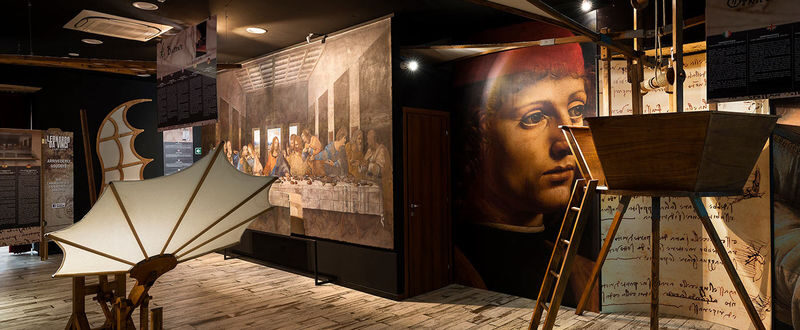
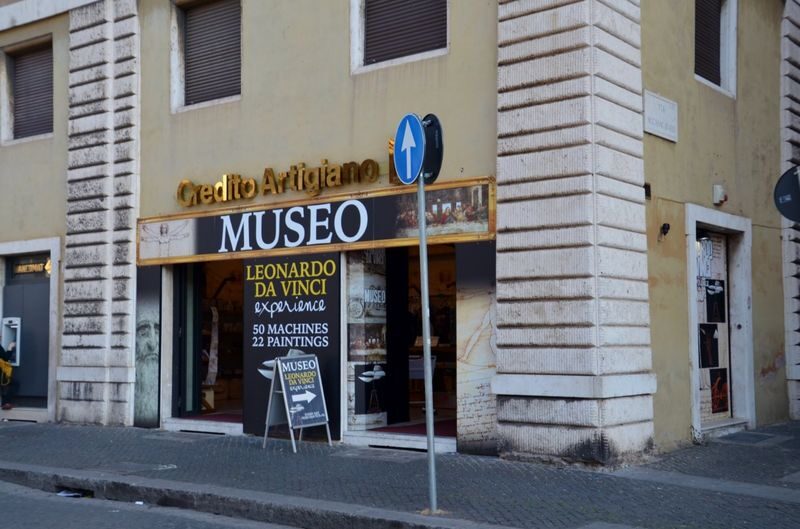
Leonardo’s ideas are easier to grasp when you can turn a crank, test a mechanism or stand beside a model of his armored tank. This compact museum on Via della Conciliazione brings together 50 inventions, paintings and visual displays in five rooms, with plenty to inspect at your own pace.
I like two things in particular: the machines make da Vinci’s sketches feel practical rather than remote, and the audio commentary gives context to works such as The Last Supper and The Lady with an Ermine. The main caveat is size: this is a small exhibition, not a grand art museum, and its ticket price may be higher than the walk-up price.
At a glance
- Try da Vinci’s designs: Many of the 50 reconstructed inventions are interactive, including models of lifting equipment, bicycles and flying machines.
- Walk through five themed rooms: Displays cover flight, military devices, optics and music, mechanical principles, and paintings.
- See familiar works in reproduction: The gallery includes around 20 paintings, among them versions of The Virgin of the Rocks and The Last Supper.
- Go at your own pace: There is no tour guide; a digital audio guide is included in several languages.
- Allow about an hour: You can spend longer if you want to test the machines and listen closely to the commentary.
- Check the price and practical details: The advertised price starts at $19.75, while some visitors have found a lower price at the museum.
👉 See our pick of the 25 Best Guided Tours In Rome
- At a glance
- A compact museum built around working ideas
- Room I: flying machines, the Mona Lisa and the Last Supper
- Room II: military machines from the codices
- Room III: light, perspective and music
- Room IV: springs, chains and the bicycle
- Room V: paintings and the case for copies
- Audio guide, pacing and the value of a self-guided visit
- Price, location and practical planning
- Who will get the most from this visit?
- Should you book it?
- FAQ
- How long should I allow for the museum?
- What does the ticket include?
- What languages are available for the audio commentary?
- Is the museum suitable for children?
- Is the museum wheelchair-accessible?
- Can I leave and come back in?
- The Best Of Rome!
- More Tickets in Rome
- More Tours in Rome
- More Tour Reviews in Rome
- Not for you? Here's more nearby things to do in Rome we have reviewed
A compact museum built around working ideas
 1 / 5
 2 / 5
 3 / 5
 4 / 5
 5 / 5
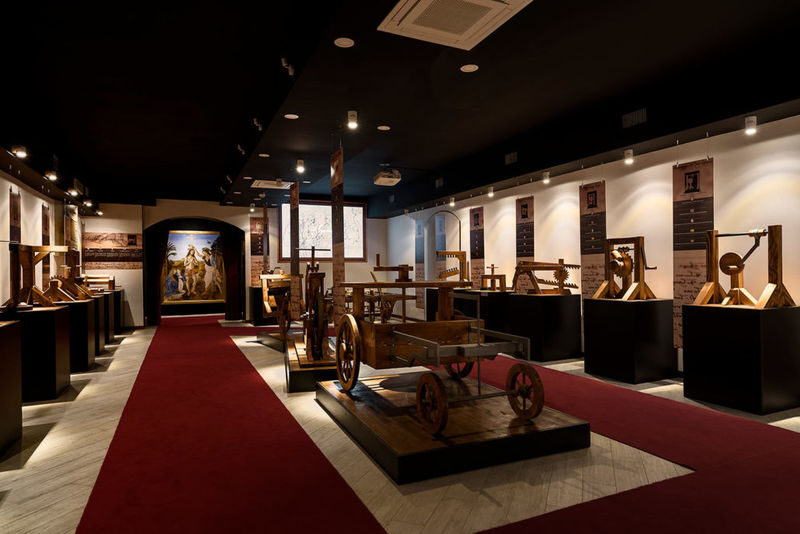
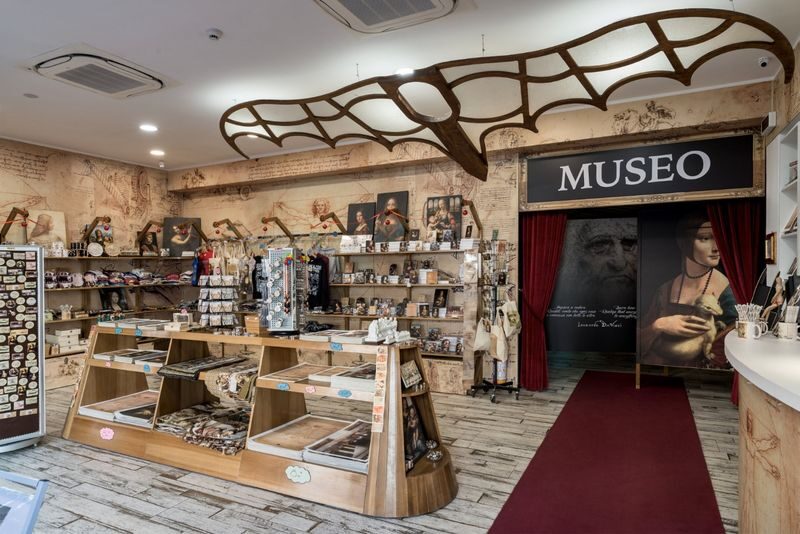
This is less a traditional art museum than a hands-on introduction to how Leonardo da Vinci thought. His drawings explored flight, warfare, engineering, optics and daily tools centuries before many of those ideas became familiar technology. Here, models put some of those sketches at eye level and within reach.
The exhibition is arranged across five rooms, with displays that combine machines, images, written material and audio. It is designed for a self-guided visit, so you can linger over a mechanism that catches your attention or move on when a display feels less compelling. That freedom is a real advantage if you are visiting with children or have limited time in Rome.
Keep your expectations in proportion. The museum is small, and many objects are reconstructions rather than original works by Leonardo. If you want to see famous paintings in their original form, this is not a substitute for major art collections. If you want a clear, approachable look at the range of his ideas, the format makes sense.
You can also read our reviews of more tours and experiences in Rome

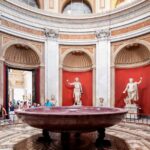
Room I: flying machines, the Mona Lisa and the Last Supper
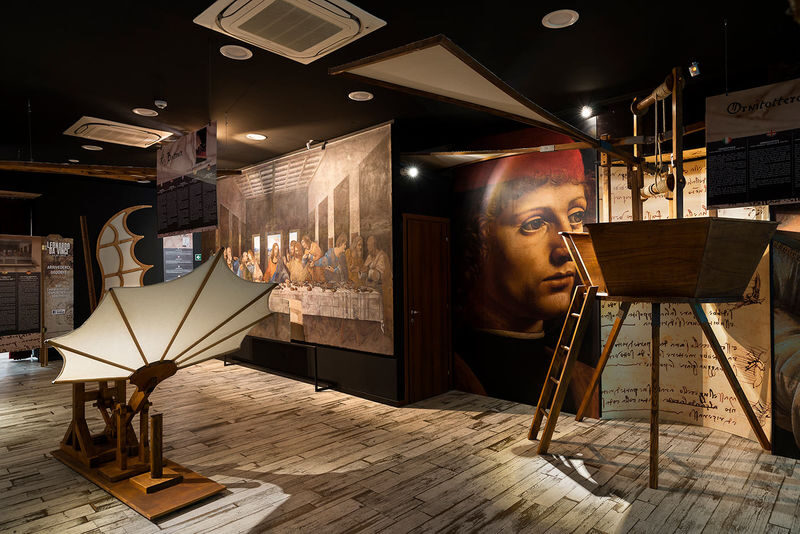
The first room introduces Leonardo’s attempts to understand flight, with models based on his designs for flying machines. It also includes life-size reproductions of The Last Supper and the Mona Lisa, giving you an immediate link between his engineering studies and his better-known art.
The reconstructed Last Supper offers a chance to consider the composition and the figures at a scale that small reproductions cannot match. Still, remember that it is a reproduction, not the original fresco in Milan. The same distinction applies to the Mona Lisa: useful for looking closely, but not a stand-in for the original in the Louvre.
This room sets the tone for the visit. Leonardo’s interests did not sit in separate boxes. His work as an artist and his study of movement, proportion and mechanics informed one another. The displays make that connection easier to see, even if the museum’s presentation is more compact than a large gallery’s.
Room II: military machines from the codices
The second room turns to war machines. Leonardo’s notebooks, including the Codex Arundel and Codex Atlanticus, contain studies of military devices and weapons. Reconstructed models help you picture how those ideas might work, while also showing the gap between a drawn concept and a practical machine.
The armored tank model is one of the more striking objects for a photo, and it gives the room a strong visual anchor. You may also find yourself looking at the designs less as weapons than as engineering puzzles: how gears, power and structure could be combined to move or protect a machine.
This section is interesting, but it can be less immediate than the hands-on mechanical displays. Some designs are easier to understand when the audio guide explains their parts and purpose. If your phone is low on battery, keep that in mind before relying on a phone-based audio guide for the whole visit.
Room III: light, perspective and music
In the third room, the focus shifts from machinery to optics and music. Leonardo studied light and perspective, and the exhibition uses displays to explain how those interests shaped the way he viewed images and space. The Room of Mirrors is the most distinctive feature here: it demonstrates how reflections and multiple angles can change what you see.
The room also connects Leonardo’s study of light with later developments in photography and projection. That does not mean he invented modern photography, but it does give you a way to follow the thread from his observations to later image-making tools. The point is the habit of close study, not a claim that every modern device began with one Renaissance sketch.
Music appears as another area of his curiosity. Leonardo called music the little sister of painting, and this room gives you a glimpse of how broadly he thought about art and sound. It is a welcome change of pace after the flight and war displays.
Room IV: springs, chains and the bicycle
Room four returns to practical mechanics. You’ll find designs involving springs, chains and other moving parts, including a bicycle concept and a spring studied in the Codex Madrid. These exhibits show how Leonardo paid attention to the basic principles behind machines, not just their finished shape.
This is where the interactive format can be most useful. When you can handle or operate a model, a drawing becomes easier to read: you see how one part moves another, and where force is applied. Some reproductions are designed to be touched or tested, though not every object should be assumed to be interactive. Follow the signs and staff instructions.
The museum also connects Leonardo’s mechanisms with familiar tools and machines, such as lifting and digging equipment and sewing machines. You may recognize ideas that have become ordinary parts of modern life. That comparison is one of the exhibition’s strengths: it makes a centuries-old study feel relevant without pretending every design was ready for a factory.
You can also read our reviews of more museum experiences in Rome
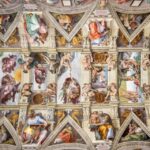



Room V: paintings and the case for copies
The fifth room is a gallery of paintings, with around 20 works in reproduction. The collection includes two versions of The Virgin of the Rocks, whose originals are held at the Louvre and London’s National Gallery, as well as The Lady with an Ermine. These reproductions let you compare compositions and details without visiting several museums across Europe.
The gallery is especially worthwhile if you want context for Leonardo beyond the Mona Lisa and The Last Supper. The Lady with an Ermine is notable for its portrait pose and sense of movement, while the different versions of The Virgin of the Rocks invite a closer look at changes in composition.
A reproduction cannot offer the texture, age or full presence of an original painting. But it can be a useful teaching tool, especially when the audio guide explains what to look for. Think of this room as an illustrated study collection, not a chance to see authentic Leonardo paintings.
Audio guide, pacing and the value of a self-guided visit
The ticket includes a digital audio guide, with commentary available in Chinese, English, Spanish, Portuguese, German, French and Italian. It helps connect objects to Leonardo’s life and ideas, and it can make the paintings more rewarding for visitors who do not already know the stories behind them.
You are not joining a guided group, so there is no fixed pace or guide to follow. That suits anyone who likes to choose what deserves extra attention. If you are especially interested in the machines, you can spend more time testing models; if you prefer the art, you can linger in the gallery.
Plan around one hour for a brisk visit, or up to two hours if you listen to the commentary and examine the displays closely. The stated visit duration is one to two hours, though some people finish in about an hour. The room count and compact size make it manageable between larger sights, but it is not an all-day museum.
Price, location and practical planning
The museum is at Via della Conciliazione, 19, near the Vatican area. Buses 23, 34, 40, 982 and N10 serve the Traspontina or Conciliazione stops. Its location makes it easy to pair with nearby sightseeing, but plan your route around the museum’s opening hours rather than assuming every posted schedule is the same. The available information gives two different schedules: 09:00 to 19:00 and 10:00 to 18:00. Check the current hours before setting out.
The advertised ticket price starts at $19.75. That is worth comparing with the price at the door: some visitors have found an adult walk-up price of €12, so advance booking may not be the cheapest choice. Prices can change, and currencies are not directly comparable, but if you are nearby, checking the current on-site rate is sensible. The ticket may be more appealing if you value advance purchase and a simple entry process.
You exchange your voucher for a physical ticket at the venue. The ticket is valid only on the selected date, and re-entry is not allowed after you leave. Children aged 0 to 4 enter free, but must still be included in the passenger headcount; children aged 0 to 17 need identification.
The activity is stroller-friendly but not wheelchair-accessible. There is no luggage storage, child seats are not available, and outside food and drinks are not allowed. Service animals with valid identification are permitted, while other pets are not.
Who will get the most from this visit?
I’d put this museum high on the list for families with school-age children, curious makers and visitors who want a short, interactive stop near the Vatican. The machines offer more to do than simply read labels, and the self-guided format lets you set the pace. It can also suit art lovers who want an accessible introduction to Leonardo’s range, as long as reproductions are an acceptable part of the experience.
It is less suited to anyone expecting a large collection of original art or a deep scholarly treatment of Leonardo’s work. The displays are compact, and the quality and maintenance of some models may not feel uniform. If you have only a short window, the best use of it is to focus on the interactive machines, the mirror room and the painting gallery rather than trying to give every display equal time.
Should you book it?
Book this ticket if you want a manageable, hands-on introduction to Leonardo’s inventions and are happy to see paintings as reproductions. The combination of interactive models, audio context and five distinct rooms makes it a useful one-hour stop, especially if you are already sightseeing near Via della Conciliazione.
Before paying, compare the online price with the current walk-up rate. If the difference is small, the convenience may be worth it; if it is substantial, buying at the door could be better value. Skip it if your priority is original Renaissance art or a large museum collection.
Leonardo da Vinci Experience Museum Ticket in Rome
“I spent quite a while here, I've been a big admirer of da Vinci since I could remember. the self guided tour was the best, I could take my time at…”
FAQ
How long should I allow for the museum?
Plan for one to two hours. A shorter visit may take about an hour, while listening to the audio guide and trying the displays can take longer.
What does the ticket include?
It includes admission to the Leonardo da Vinci Experience Museum, access to all galleries and exhibitions, a digital audio guide and free Wi-Fi.
What languages are available for the audio commentary?
The audio commentary is available in Chinese, English, Spanish, Portuguese, German, French and Italian.
Is the museum suitable for children?
Children aged 0 to 4 enter free, but they must be included in the passenger headcount. Children aged 0 to 17 need an identification card. The museum is stroller-friendly, but child seats are not available.
Is the museum wheelchair-accessible?
No. The activity is listed as not wheelchair-accessible.
Can I leave and come back in?
No. Re-entry is not allowed after you leave the venue.