Vienna’s grand sights are spread across the city, and Big Bus gives you a simple way to link them without puzzling over every tram connection. I like the contrast between the Red Route’s city landmarks, including the State Opera and MuseumsQuartier, and the Blue Route’s imperial palaces. I also like the freedom to get off, explore, then catch another bus.
The main catch is the timetable: a 24-hour ticket does not mean buses run around the clock. Service starts in the morning and ends in the late afternoon, so plan your stops around the last departure. Traffic can also slow the ride, and one rider reported abrupt braking, a point to keep in mind if you are traveling with a young child.
- Two routes, two sides of Vienna: The Red Route covers city sights such as the Vienna State Opera and MuseumsQuartier; the Blue Route links palace landmarks including Schönbrunn and Belvedere.
- A good first-day orientation: The full routes take about 2 hours 55 minutes in total if you ride them without getting off.
- Audio in 13 languages: Choose from English, German, Chinese, Spanish, and nine other languages.
- Watch the clock: Buses run every 20 to 30 minutes, but the service day ends in the late afternoon.
- Know what is not included: The standard 24-hour ticket covers both bus routes, not a river cruise, Ferris wheel ride, or live guided walk.
- Useful digital tools: The free Big Bus app offers stop directions and real-time bus tracking.
- Two bus routes for a first look at Vienna
- What you see from the Red Route
- The Blue Route and Vienna’s imperial palaces
- Audio commentary, headphones, and the app
- How to make a 24-hour pass work
- Is the price worth it?
- Comfort and practical details
- Who should book this Vienna bus tour?
- FAQ
- What is included in the 24-hour ticket?
- How long do the two routes take?
- How often do buses run?
- Which languages are available for the audio commentary?
- Is a river cruise or Ferris wheel ride included?
- Can I bring a stroller, luggage, or a dog?
- The Best Of Vienna!
- More Tours in Vienna
- More Tour Reviews in Vienna
- Not for you? Here's more nearby things to do in Vienna we have reviewed
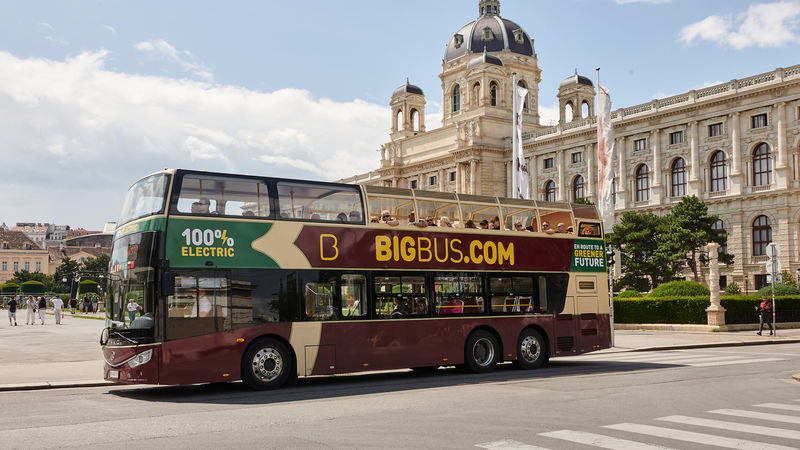
Two bus routes for a first look at Vienna
 1 / 2
 2 / 2
The Red Route is the City Route, and the Blue Route is the Palace Route. Together they give you a broad introduction to Vienna, from its central streets and cultural landmarks to its best-known imperial residences. If you are short on time, riding both lines end to end is a quick way to get your bearings before deciding where to spend more time.
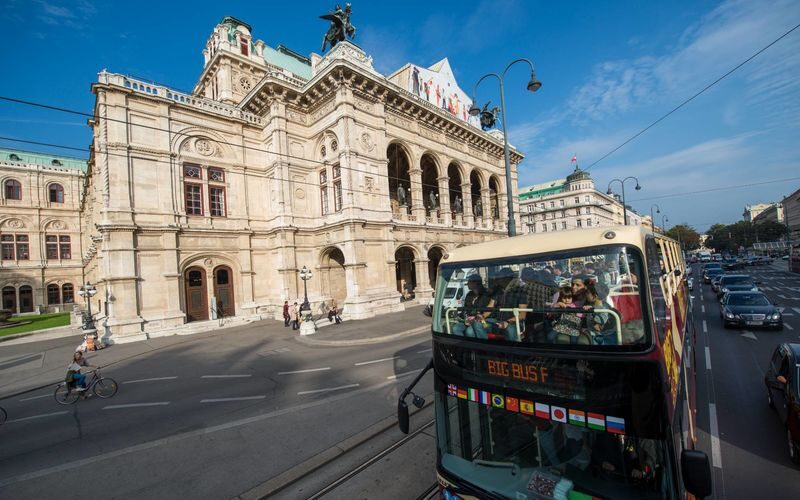
The Red Route takes about 1 hour 40 minutes for a full circuit. It passes landmarks such as Votivkirche, MuseumsQuartier, and the Vienna State Opera, with views along the Ring Street area. This route helps you see how Vienna’s grand public buildings fit into the wider city, rather than treating each as a separate visit.
The Blue Route takes about 1 hour 15 minutes and focuses on palaces, including Schönbrunn, Belvedere, and Hofburg. It is the more useful line if you want to connect Vienna’s imperial architecture with time at one or more of its palace sites. The bus gets you to the sights, but it does not replace the time needed to explore their interiors or grounds.
Both routes start near the central sights. The Red Route begins at Opera / Walfischgasse, at Walfischgasse 2. The Blue Route begins at Opera / Albertina, beside the Albertina Museum. The two starting points are close to the city center, but check the app or route map before setting out so you do not wait at the wrong stop.

👉 See our pick of the 11 Best Shopping Tours In Vienna
What you see from the Red Route
The Red Route is a useful overview of Vienna’s cultural center. The State Opera is one of the city’s most recognizable landmarks, while MuseumsQuartier brings you to a major concentration of museums and cultural spaces. Votivkirche adds a striking church to the mix. Even if you do not get off, the route gives you a sense of how much of Vienna’s identity is tied to music, art, and formal architecture.
Ring Street is another reason to take this line. The broad boulevard is associated with some of Vienna’s landmark buildings, and the bus lets you take in the scale of the area without walking the full stretch. That convenience matters on a hot day, after a long flight, or if you are saving your energy for a museum visit.
The trade-off is that sightseeing from a moving bus can feel brief. Traffic may slow the ride, and a landmark can pass before you have had much time to take it in. If a particular sight matters to you, get off and give it proper time rather than expecting the audio track to turn the whole circuit into a detailed visit.
You can also read our reviews of more tours and experiences in Vienna.


The Blue Route and Vienna’s imperial palaces
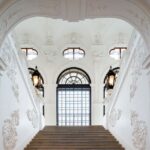
The Blue Route is the line to choose for Schönbrunn and Belvedere, with Hofburg also among the palace landmarks it serves. These places are central to Vienna’s image as an imperial capital, but they are not interchangeable stops. Each deserves time of its own, so avoid trying to fit every palace into a single rushed loop.
Schönbrunn is a major draw and a practical reason to use the bus: it connects a palace outside the central cluster with the city sightseeing network. The ride itself offers a look at Vienna beyond the inner center. Allow enough time at the palace for the visit you have planned, and check the bus schedule before you leave the stop.
Belvedere is another key palace stop, especially useful if it is on your must-see list. The Blue Route lets you add it to a broader city day without working out the transport links from scratch. Hofburg, by contrast, is close to the historic center, so you may find it easier to combine with nearby sightseeing on foot.
A bus stop is a starting point, not a guided palace visit. The ticket does not include a live guide, and palace admission is not listed among the inclusions. Check the details of any separate attraction ticket you plan to buy, and leave time for the walk between the stop and the part of the site you want to see.
Audio commentary, headphones, and the app
Headphones are included, and recorded commentary is available in 13 languages: Chinese, English, Spanish, Arabic, Hindi, Russian, Portuguese, German, Korean, French, Turkish, Italian, and Hebrew. This is handy if you want background as you ride, particularly on your first pass through the city. It is audio commentary, not a live guide, so you will not be able to ask questions or tailor the explanation to your interests.
The commentary may be less satisfying if you prefer a tightly focused history lesson. One rider found the narration too loose while the bus sat in traffic. That is a fair limitation of recorded audio: it plays at its own pace, while the road has its own plans. Treat it as context, not the main reason to buy the ticket.
Download the free Big Bus app before you go. It provides stop directions and real-time bus tracking, which can help you judge whether to explore a sight or wait for the next bus. Keep your ticket or redemption receipt accessible, too. The ticket is scanned when activated, and one rider who misplaced the receipt had trouble boarding again.
There is also a complimentary walking tour download through the Vox POPGuide app, with digital commentary about historic neighborhoods. That is different from a live guided walking tour, which is not included in the standard ticket. The 72-hour option is described as including a walking tour, so check the exact package details if that feature is important to you.
How to make a 24-hour pass work
The 24-hour ticket is best understood as a flexible sightseeing pass within the bus operating day, not a promise of service at every hour of the day or night. The first Red Route bus leaves at 9:30 a.m. from Walfischgasse 2. The first Blue Route bus leaves at 9:45 a.m. from beside the Albertina. Buses run every 20 to 30 minutes.
The full circuits take 1 hour 40 minutes on Red and 1 hour 15 minutes on Blue. Riding both without stops takes about 2 hours 55 minutes, though traffic can affect the actual time. You can use that as a rough planning guide, then add the hours you want for palace visits, museums, or meals.
The last buses reportedly finish around 5 p.m., and a rider who stopped to explore between bus connections missed the final Blue Route departure. Check the day’s schedule in the app, and aim to be at your stop well before the last bus. If you want to get off at several sights, the 48-hour ticket may be less stressful than trying to squeeze everything into one afternoon.
You can redeem a mobile or printed voucher with a Big Bus staff member at a stop. The ticket is described as flexible for changing the tour date, and valid for up to 14 days, but the voucher itself is also noted as valid only for the selected date. Confirm the terms shown for your specific booking before you travel. Once the voucher has been scanned and activated, it is non-refundable.
Is the price worth it?
The advertised starting price is $36.49, while the listed 24-hour option starts at $41.45. The 48-hour pass starts at $47.39, and the 72-hour pass with a walking tour starts at $57.49. Prices can vary by package and booking details, so check the amount shown for your date before you decide.
Value depends on how you use the bus. If you ride both routes, make several stops, and value saved walking time, the pass can be a practical purchase. It is especially useful for first-time visitors, anyone with limited time, and people who want a simple link between the city center and palace sights. Some riders also use it as transport to the stop nearest their hotel, though it is not a substitute for a citywide transit pass.
If you only want to travel between a few nearby places, compare the ticket with other transport options before paying. A hop-on, hop-off bus is designed for sightseeing, and traffic can make it slower than a direct journey. The strongest value comes from treating it as both an orientation tour and a way to reach sights you intend to visit.
The ticket includes Wi-Fi onboard and headphones. It does not include meals, hotel pickup, a river cruise, a Ferris wheel ride, tips, or other personal expenses. The product description mentions cruise and Ferris wheel experiences as possible additions, but they are not part of the standard 24-hour ticket. If you want one, check that your chosen package explicitly includes it.


Comfort and practical details
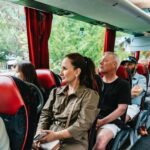
The buses are described as clean, and riders particularly value the convenience of seeing several parts of Vienna without walking between every sight. The open top gives you an unobstructed view in good weather; a covered lower deck is an option when the sun is strong or the weather turns. Rain can make views through windows less clear, so bring a light layer and keep expectations flexible.
There are no toilets or elevators on the buses, and there is no room for luggage or large bags. Leave suitcases at your accommodation or in your vehicle. Strollers and pushchairs must be folded and stored on the lower deck. The activity is listed as wheelchair-accessible, but the bus has no elevator, so contact the operator if you need details about boarding arrangements.
Children aged 0 to 4 ride free, and children aged 0 to 15 must travel with a paying adult. Dogs are allowed if muzzled and leashed. Smoking and drinking are not permitted onboard.
For families with small children, the practical question is how they will handle the ride and stops. One rider reported abrupt braking and no seatbelts, so keep children seated and secure, and ask staff about current onboard arrangements before boarding. That is sensible on any city bus, especially when traffic is uneven.
Who should book this Vienna bus tour?
I would consider this a strong first-day option if you want a broad look at Vienna before choosing which sights deserve a longer visit. Its two routes cover a useful mix of central landmarks and palace stops, and the app and multilingual audio make it straightforward to use without a live guide.
Choose the 24-hour pass if your plan is focused and you are willing to watch the timetable. The 48-hour option makes more sense if you want to visit several attractions at an unhurried pace, especially since the last buses run in the late afternoon. If your priority is an in-depth guided history, a river cruise, or a night tour, those are separate experiences to arrange rather than assume are part of this ticket.
Vienna Hop-On Hop-Off Bus by Big Bus
“bus is clean. good way to go around the city. very convenient”
FAQ
What is included in the 24-hour ticket?
It includes 24-hour hop-on, hop-off access on the Red and Blue Routes, onboard Wi-Fi, and headphones. It does not include a river cruise or live guided walking tour.
How long do the two routes take?
The Red Route takes about 1 hour 40 minutes, and the Blue Route about 1 hour 15 minutes. Riding both full circuits takes roughly 2 hours 55 minutes before stops or traffic delays.
How often do buses run?
Buses run every 20 to 30 minutes. The first Red Route bus departs at 9:30 a.m., and the first Blue Route bus departs at 9:45 a.m.
Which languages are available for the audio commentary?
Audio commentary is available in Chinese, English, Spanish, Arabic, Hindi, Russian, Portuguese, German, Korean, French, Turkish, Italian, and Hebrew.
Is a river cruise or Ferris wheel ride included?
Not in the standard 24-hour hop-on, hop-off ticket. Check the exact package details if you want to add a cruise or Ferris wheel experience.
Can I bring a stroller, luggage, or a dog?
Strollers and pushchairs must be folded and stored on the lower deck. Large bags and luggage cannot be stored onboard. Dogs are permitted if muzzled and leashed.