Zhuokeji Tusi Official Village brings together an old ruling family’s residence, Jiarong Tibetan architecture, and traces of the Red Army’s Long March. The main building dates to 1718, was rebuilt on its original site in 1938, and now anchors a cultural area in Malkang.
I like two things about this visit: you can see a distinctive architectural style in a protected historic building, and the displays connect local Tusi history with Jiarong customs and Long March events. The neighboring Xisuo Residential Complex is free, so you can add another cultural stop without buying another ticket.
The main consideration is that the ticket covers admission only. Transport, food, parking, guide services, and other personal costs are extra, and some rooms may close for maintenance. Plan for a self-guided visit unless you arrange a guide separately.
Key points
- A historic Tusi residence: The core building was first constructed in 1718 and rebuilt on the same site in 1938.
- Jiarong Tibetan design: Zhuokeji is recognized as a notable example of Jiarong Tibetan architecture.
- Several histories in one visit: The site presents Tusi history, local customs, and Red Army Long March connections.
- A specific Long March landmark: The former site of the Zhuokeji Conference is among the Red Army remains preserved here.
- A free nearby addition: Xisuo Residential Complex is adjacent and freely accessible.
- A date-specific ticket: Entry uses an electronic QR voucher and valid ID, and the ticket is limited to one use on the selected date.
- Key points
- Why Zhuokeji matters
- Reading the building as you explore
- Tusi history, local customs, and Long March traces
- Adding Xisuo Residential Complex
- Timing your visit in Malkang
- What the ticket costs and covers
- Getting in and planning around the rules
- Who should make time for Zhuokeji?
- Should you book?
- FAQ
- Where is Zhuokeji Tusi Official Village?
- How much does a ticket cost?
- What does the ticket include?
- Is transportation included?
- Are guide services included?
- What are the opening hours?
- How do I use the ticket?
- Is the ticket valid on another date?
- Who can enter free?
- Can I get a refund if plans change?
- More Tours in Ngawa
- More Tour Reviews in Ngawa
- Not for you? Here's more nearby things to do in Ngawa we have reviewed
Why Zhuokeji matters
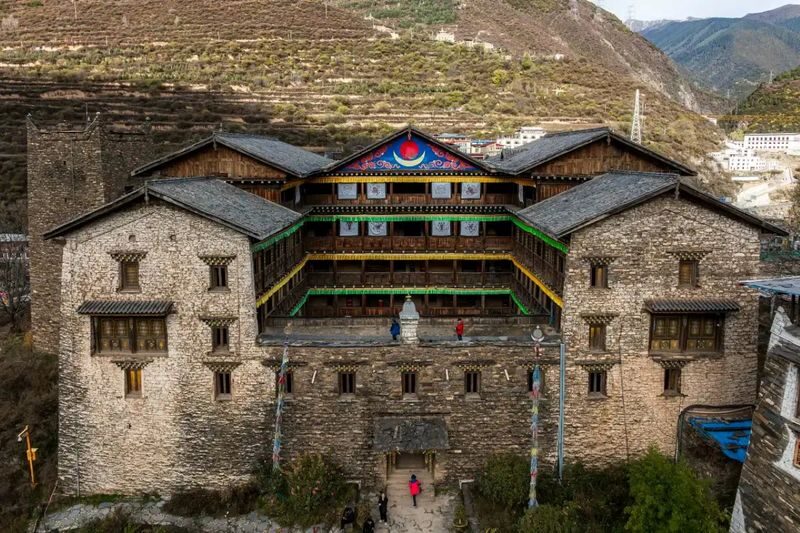
Zhuokeji Tusi Official Village is more than a striking old residence. It tells the story of the Tusi system, in which local hereditary leaders governed communities in parts of China, while also introducing Jiarong Tibetan culture and the region’s role in the Long March.
The village is a national key cultural relic protection unit and the wider scenic area has a national AAAA-level rating. Those designations signal that this is both a visitor attraction and a protected cultural site. You are not simply looking at a reconstructed themed village: the core residence was built on this site in 1718, then rebuilt here in 1938.
That distinction matters when you walk through the rooms. The building’s history is tied to the place itself, while its displays provide context for the people and events associated with it. The site is also known as the prototype for the story in the literary work Dust Settled. If you know the book, that connection may add another layer to the visit; if you do not, the architecture and historical exhibits still give you plenty to consider.
The area’s stories overlap rather than sit in separate boxes. Tusi history, Jiarong Tibetan customs, and Red Army history are all part of the cultural experience. That makes Zhuokeji especially worthwhile if you want more than a scenic photo stop. It offers a chance to understand the historical and cultural threads attached to Malkang and western Sichuan.
You can also read our reviews of more tours and experiences in Ngawa.


Reading the building as you explore
The official village is the central reason to buy a ticket. Its architectural style is associated with the Jiarong Tibetan people, and the building is described as an important example of that tradition. You can expect to spend time in the rooms and exhibition halls that are open on the day of your visit.
The structure’s dates help you make sense of what you see. The original residence was built in 1718, then rebuilt on its original site in 1938. The building you visit therefore represents a long local history, but it is important not to treat every part as untouched fabric from the eighteenth century. The rebuild is part of the site’s story too.
I would take a slow approach rather than rush from room to room. Look at the layout and details as well as the exhibits, and give yourself time to connect the residence with the history explained inside. The available information does not set out a required route or say how long a visit takes, so you can move at your own pace through the open areas.
The ticket includes admission to all open exhibition halls and rooms within the scenic area. That wording is useful: it does not promise that every room will always be accessible. Some exhibition halls may close for maintenance, and the notice posted on site that day takes precedence. If a particular display matters to you, check the current arrangements when you arrive.
This is a protected cultural site, not a place to handle the exhibits as you please. Defacing the buildings or touching exhibits is prohibited. The rule is simple, and it helps protect the architecture and objects that give the visit its value.
Tusi history, local customs, and Long March traces
Zhuokeji’s appeal comes from its mix of subjects. The Tusi story helps explain the official village’s original role, while displays about Jiarong Tibetan customs bring local culture into view. The Red Army connection adds a different chapter, with the former Zhuokeji Conference site among the preserved Long March-era remains.
That range is a strength, particularly if you are deciding whether to make a dedicated stop in Malkang. Rather than focus on just one period, the scenic area links local political history, cultural traditions, and a major moment in modern Chinese history. You may find that one part interests you more than the others, but the combination gives the visit a broader frame.
The site is also connected to Dust Settled, whose story uses Zhuokeji as its prototype. You do not need to know the work in advance, but its connection helps show how the village has entered the region’s cultural imagination as well as its historical record.
No tour guide, guided route, or scheduled talk is included with the ticket. If you want a guided explanation, guide services are a separate cost. That can be an important distinction: the ticket gives you access to the open halls and rooms, but you should not assume there will be a guide to interpret them for you.
For a self-guided visit, it helps to arrive with a little background on the Tusi system, Jiarong Tibetan culture, or the Long March. Even a basic sense of those subjects can help you connect the exhibits. If you prefer a more detailed explanation, budget for a guide separately and confirm availability before relying on one.
Adding Xisuo Residential Complex
Xisuo Residential Complex is adjacent to the scenic area and free to access. It is an easy way to extend your time in the area without adding another paid admission. The two sites make a natural pairing if you are interested in local residential culture and architecture.
Keep the distinction clear when planning your costs: the Zhuokeji ticket covers the official village scenic area, while Xisuo is freely accessible nearby. The ticket does not include transport between places, meals, or other personal expenses. Since no walking route or distance is specified, check local directions on arrival rather than assuming how long the connection will take.
Together, the sites offer more than one perspective on the area. Zhuokeji centers on the former Tusi residence and its exhibits; Xisuo gives you another nearby place to see local residential architecture. If your schedule is tight, you can prioritize the ticketed village. If you have more time, Xisuo is a sensible extra stop.
Timing your visit in Malkang
The scenic area is in Xisuo Village, Zhuokeji Town, Malkang City, in Aba Tibetan and Qiang Autonomous Prefecture, Sichuan Province. The listed address is V78R+6W3, Malkang City, postal code 624002. Use the full place name or address when arranging your own transport, since transport is not included in the ticket.
Opening hours change by season. From April through November, the stated hours are 08:30 to 17:30. From December through March, the hours are 09:00 to 17:00. The published schedule also gives 08:30 to 17:30 daily from June 25 to November 30, 2026, and 09:00 to 17:00 daily from December 1, 2026, to March 31, 2027.
Those hours tell you when the site is open, but they do not specify how long you should allow for the visit. If you want time for the official village, its open exhibition rooms, and nearby Xisuo, avoid arriving close to closing. Check for current notices before setting out, especially if your visit depends on seeing a particular hall.
Peak-season demand can affect how far ahead you should book. The suggested booking window is five to ten days ahead in peak season and one to three days ahead in the off-season. Booking may be available as late as the day before, with confirmation stated within 24 hours, but that is not the same as a guarantee that every date will be available.
The scenic area may close temporarily because of heavy rain, geological disasters, or other force majeure events. In that situation, the ticket is eligible for a full refund. Otherwise, the ticket is date-specific and single-use, so choose a day when you are confident you can make the visit.

What the ticket costs and covers
Prices start at $10.75 for one Zhuokeji Tusi Official Village Scenic Area ticket. The stated package includes access to all exhibition halls and rooms that are open within the scenic area. It does not include round-trip transport, dining, parking, guide services, self-funded entertainment, personal insurance, or other personal expenses.
For the price, the value depends on your interest in cultural history and architecture. If you only want a brief photo stop, the admission may feel less compelling than it would to someone who plans to spend time with the building and exhibits. If you are already in Malkang and want to understand the area’s history, the ticket combines several subjects at one site, while the neighboring Xisuo complex gives you a free addition.
The starting price should not be confused with every visitor’s final cost. Eligibility rules set different ticket categories: adults are aged 12 and above; child tickets cover ages 6 to under 12; and senior tickets cover ages 60 to under 65. Children no taller than 1.2 meters and seniors aged 65 or older are free under the stated conditions. Seniors need a senior citizen card or ID card to claim free entry.
Because parking, guides, meals, and transport are separate, include them in your budget. The low starting ticket price does not make the visit all-inclusive. It buys admission to the historic site and its open rooms, which is a fair value if that is what you came to see.
Getting in and planning around the rules
To enter, show the electronic voucher QR code and a valid ID at the main entrance. You do not need to exchange the voucher for a paper ticket. The voucher is valid only on the selected date, is limited to one use, and cannot be split into multiple admissions.
Cancellation terms are strict close to the visit date. If the ticket has not been exchanged or used, you can request a full refund more than 24 hours before the date of use. Within 24 hours, after exchange or admission, or once the ticket has expired unused, there is no refund or rescheduling.
Bring the ID needed for entry and, if claiming a senior concession or free admission, the required proof. Keep the QR voucher accessible so you can present it at the entrance. These small steps matter because the ticket is tied to a specific date and does not allow a second use.
Who should make time for Zhuokeji?
I would put Zhuokeji high on the list if you are interested in Tibetan and regional architecture, local political history, or the Long March. It is also a good fit if you want a cultural stop in Malkang that combines several subjects rather than focusing on a single display.
Families can use the age and height rules to check ticket costs in advance. Older visitors should note that free admission for people aged 65 and above requires a senior citizen card or ID card. The site may also suit visitors who prefer to explore at their own pace, since the ticket covers entry but does not require a guided format.
It may be less suitable if you need included transport, meals, or a guide, or if your schedule leaves little time to explore. Those services are not part of the ticket, and the published information gives no fixed visit duration. You will get more from the stop if you can allow time for the open rooms and, if it appeals, a visit to nearby Xisuo.
Should you book?
Book Zhuokeji if you want to see a protected Jiarong Tibetan architectural landmark and connect it with Tusi history, local customs, and the Red Army’s Long March. The $10.75 starting price covers admission to the open halls and rooms, while the free neighboring Xisuo complex helps make the outing more substantial.
Before you commit, check the date-specific ticket terms, seasonal hours, and any on-site notices about closed rooms. Make your own plan for transport, food, parking, and any guide service you want. If those details suit your day in Malkang, Zhuokeji is a worthwhile cultural stop with more to offer than a single historic building.
Zhuokeji Tribe Village Cultural Scenic Area
FAQ
Where is Zhuokeji Tusi Official Village?
It is in Xisuo Village, Zhuokeji Town, Malkang City, Aba Tibetan and Qiang Autonomous Prefecture, Sichuan Province, China. The listed address is V78R+6W3, postal code 624002.
How much does a ticket cost?
The listed starting price is $10.75 for one ticket. The final cost may depend on the ticket category.
What does the ticket include?
It includes entry to Zhuokeji Tusi Official Village Scenic Area and access to all exhibition halls and rooms that are open.
Is transportation included?
No. Round-trip transportation is not included.
Are guide services included?
No. Guide services are self-funded and are not part of the ticket.
What are the opening hours?
From April through November, the stated hours are 08:30 to 17:30. From December through March, they are 09:00 to 17:00.
How do I use the ticket?
Show the electronic voucher QR code and a valid ID at the main entrance. You do not need to exchange the voucher for a physical ticket.
Is the ticket valid on another date?
No. The voucher is valid only on the selected date and is limited to one use.
Who can enter free?
Children no taller than 1.2 meters are free. Seniors aged 65 or above are free with a senior citizen card or ID card.
Can I get a refund if plans change?
If the ticket is unused and has not been exchanged, you can request a full refund more than 24 hours before the visit date. Within 24 hours, after exchange or admission, or after the ticket expires unused, refunds and rescheduling are not available.