Wing Chun’s appeal is its practical logic: use posture, structure, and a clear line of attack rather than relying on size or brute force. In this Shanghai session, you learn the ideas behind the movements, then try basic forms and partner drills under an instructor described as a descendant of a Wing Chun family.
I like two things in particular: the emphasis on structure over strength, which gives beginners a useful way to think about martial arts, and the chance to try Chi Sau, or sticky hands, rather than only watching a demonstration. The session also connects practice to focus and calmness in daily life.
The chief caution is availability. A last-minute booking once ended with a late-night notice that the instructor could not teach. The customer received a full refund, but the change came too late to fit a replacement session into the trip. If your Shanghai schedule is tight, confirm the lesson before building plans around it.
- What to know before you book
- Wing Chun begins with structure, not muscle
- Starting with posture, breathing, and the centerline
- Learning Siu Nim Tao and generating power through form
- Trying Chi Sau with a partner
- A lesson that links martial arts to daily focus
- Finding the training room in Shanghai
- What the price may be worth
- The main concern: a late change to a booked class
- Who should book this Wing Chun session
- Should you book it?
- FAQ
- Where does the Wing Chun class meet?
- What will I learn during the session?
- Is the experience suitable for beginners?
- Is there an age limit?
- What should I wear?
- Are pets allowed?
- Is the class conducted in English?
- What is included in the price?
- How can I contact the organizer if I cannot find the meeting point?
- Can I get a refund if I cancel?
- The Best Of Shanghai!
- More Tours in Shanghai
- More Tour Reviews in Shanghai
- Not for you? Here's more nearby things to do in Shanghai we have reviewed
What to know before you book
 1 / 2
 2 / 2
- The instructor comes from a Wing Chun family. The experience describes a direct descendant of a renowned family, though it does not provide the instructor’s name or a detailed lineage.
- You work on technique, not strength. Expect basic stance, posture, breathing, hand forms, centerline theory, and the use of body structure to generate power.
- Chi Sau is part of the hands-on practice. This partner exercise trains sensitivity and response through touch, giving you a feel for a signature Wing Chun method.
- The meeting point is 新风邨. The training room is near Yan’an West Road Metro station, and the exact address and meeting-point photo arrive after booking.
- The listed prices differ. One price is US$101.59, while the package option starts at US$92.35. Check the final price for your date before paying.
- Tea and English-language support are included. Tips are not included, and the activity can be attended at any age.

👉 See our pick of the 25 Best Guided Tours In Shanghai
Wing Chun begins with structure, not muscle
This is a short introduction to a martial art built around efficiency. Wing Chun aims to make movement direct and economical: keep your balance, protect the centerline, and avoid adding force where good positioning can do the work. That makes the class interesting even if you have no plan to pursue martial arts beyond this one session.
The instructor is described as a direct descendant of a renowned Wing Chun family. That family connection is a meaningful part of the experience’s appeal, since the lesson is presented as instruction passed down through generations rather than a general fitness class with martial arts branding. Still, the instructor’s name and the details of the family lineage are not provided, so you should not expect a formal history lecture or a named grandmaster.
I would go in curious rather than expecting a complete course in self-defense. One session can introduce the principles and let you try several movements, but it cannot make you proficient. The more useful goal is to leave with a clearer sense of what Wing Chun trains: economy of movement, attention to the centerline, and calm responses under pressure.
You can also read our reviews of more tours and experiences in Shanghai.



Starting with posture, breathing, and the centerline
The lesson begins with fundamentals: stance, posture, and breathing. These may sound simple, but they are the base for the rest of the class. A stable posture helps you move without wasting effort, while attention to breathing can help keep your movements measured rather than tense.
The centerline theory gives those basics a practical frame. Wing Chun treats the direct line between you and your opponent as important, and the lesson explains how positioning and efficient movement relate to it. You are not just copying a pose; you are learning why the hands and body are arranged in a particular way.
For a first-timer, this is also where expectations need a little adjustment. The description promises beginner-friendly instruction, but martial arts terms and new body mechanics can still take time to absorb. You may find that a small correction to your balance or arm position changes how a movement feels. That kind of detail is part of the point.
Breathing is included as a technique, but no specific breathing method or length of practice is stated. Expect an introduction rather than a full meditation session. The larger idea is to connect calmness and control with physical practice, not to treat martial arts as a set of flashy moves.
Learning Siu Nim Tao and generating power through form
The class includes Siu Nim Tao, a core Wing Chun hand form. It is a chance to practise the shapes and sequence of the art at a basic level, with professional instructor guidance. The emphasis is on how the body is organized, not on moving quickly for its own sake.
That distinction matters if you are used to martial arts films, where speed and impact dominate. Here, you are asked to notice the mechanics: how posture supports the hands, how a direct movement can be efficient, and how structure can help produce power without relying only on physical strength. It is a more thoughtful approach than simply memorizing a string of motions.
The activity also includes footwork, though no particular drills or combinations are specified. You can expect to work on how movement supports balance and position, rather than assuming the lesson will include a full sparring sequence. The session is intended for beginners and people with some martial arts experience, so the instructor’s guidance should help make the basic material accessible at different starting points.
One practical benefit of a form-based lesson is that it gives you something to remember after class. You may not retain every detail, but you can leave with a few principles to practise: stay balanced, avoid excess movement, and pay attention to where your body is aligned. That is useful whether you continue with Wing Chun or simply want a better sense of how martial arts training develops control.
Trying Chi Sau with a partner
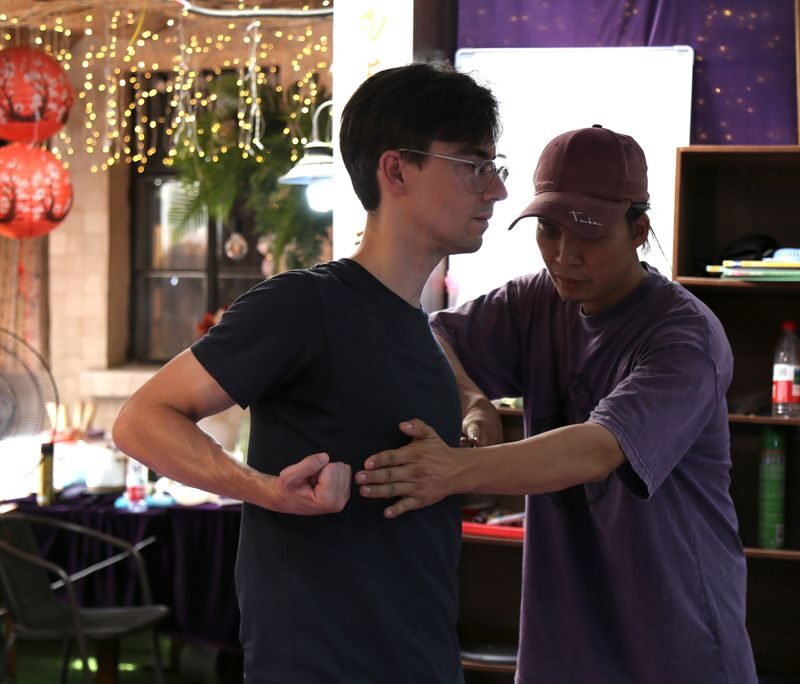
Chi Sau, often translated as sticky hands, is one of the session’s most distinctive elements. It is a Wing Chun sensitivity exercise in which partners use touch and movement to develop awareness of pressure and position. The activity includes hand drills and light partner exercises so you can feel how the concepts apply rather than hear about them only in theory.
This is not described as full-contact sparring. The focus is on sensitivity and response, with the instructor guiding the practice. If you are new to martial arts, that makes the session less intimidating than a class built around fighting. You still get a taste of interacting with another person, which can reveal why stance and attention matter in ways solo practice cannot.
The precise format and amount of time devoted to Chi Sau are not specified. You should expect an introduction, not mastery of a complex drill. The value is in experiencing the basic idea: stay attentive through contact, notice pressure, and respond with control rather than force.
Partner work also helps explain the experience’s broader theme of mental clarity. You have to pay attention to what is happening in front of you instead of simply thinking through a memorized sequence. That small shift from planning every movement to responding carefully is part of what makes this practice feel different from a standard exercise class.
A lesson that links martial arts to daily focus
The experience presents Wing Chun as self-cultivation as well as self-defense. Its stated themes include efficiency, economy of motion, and calmness under pressure. These ideas can be applied beyond the training room, though the class is not a substitute for a dedicated mindfulness course or a full martial arts program.
I like that the lesson makes room for this wider purpose. A beginner can understand why martial arts training might build confidence: you try unfamiliar movements, receive direct guidance, and see how a principle works in practice. That does not mean one class will transform your confidence overnight. It means the experience gives you a concrete way to explore the connection between attention and action.
The English-speaking guide and professional instructor guidance should help if you do not speak Chinese. WhatsApp and WeChat live support are also included, which is useful for practical coordination. Tea is part of the package, but the details of when it is served are not stated.



Finding the training room in Shanghai
The meeting point is 新风邨, and the training room is close to Yan’an West Road Metro station. After your booking is confirmed, the organizers send the detailed address and a photo of the meeting point by WhatsApp, WeChat, or email. This is worth keeping handy: the listed meeting point alone may not be enough to identify the exact room.
You can contact the organizer at +86 15021805915 by phone, WhatsApp, or WeChat if you cannot find the location. I would save the number and the meeting-point photo before setting off, rather than trying to sort out directions while standing outside with a low phone battery.
Casual clothing is recommended. No age limit is stated, and pets are allowed. The information does not specify the activity’s duration, class size, or any particular accessibility arrangements, so ask before booking if any of those details will affect your plans.
What the price may be worth
The supplied prices are not consistent: the overview gives a starting price of US$101.59, while the package option says from US$92.35. Since both are described as starting prices, the amount you pay may depend on the date or package. Check the total at checkout rather than assuming the lower figure applies to your session.
For that price, the package includes an English-speaking guide, a professional guide, professional instructor guidance, WhatsApp or WeChat live support, and tea. The main value is the direct instruction and the chance to try Chi Sau and basic forms with a specialist, rather than simply hearing about Wing Chun in a museum or watching a demonstration.
Whether it represents good value depends on what you want from the class. If you are curious about Wing Chun and want a guided, hands-on introduction, the combination of philosophy and practice could justify the cost. If you are looking for an extended course, advanced sparring, or a guaranteed deep study of family history, the available details do not promise those things.
Tips and gratuities are not included. No other additional charges are specified, but the different starting prices make it sensible to confirm the amount for your chosen date before you commit.
The main concern: a late change to a booked class
The clearest warning is that a booking made the night before was followed by a message at 00:30 saying the instructor was unavailable. The customer received a full refund, but the proposed alternative was after the Mid-Autumn holidays, too late for a visitor who planned to leave Shanghai sooner.
That is one reported case, not proof that cancellations are common. Still, it is a real planning risk, especially if you have only one free afternoon or are booking close to your departure. Contact the organizer after booking to confirm that the instructor and time are set, and avoid making the lesson the only activity in a tightly packed schedule.
Cancellation terms are more forgiving on your side: a full refund is available if you cancel at least 48 hours before the activity date, using local destination time. The voucher is valid only on the date and time specified, so a missed session should not be treated as an open-ended pass.
Who should book this Wing Chun session
This is best for a curious beginner who wants a practical introduction to Chinese martial arts, or for someone with some training who wants to compare Wing Chun’s approach with other styles. The class’s focus on posture, economy of movement, and partner sensitivity gives you more to take away than a photo opportunity.
It may also suit a traveler looking for a cultural activity with active participation. You will not just listen to an overview of Wing Chun; you are expected to practise forms, footwork, and light partner exercises. Casual clothes are enough, and there is no age limit stated.
I would hesitate if you need a guaranteed appointment at short notice or cannot adjust your plans if the instructor becomes unavailable. There is also no stated class duration, group size, or named instructor, so ask about those points if they are central to your decision.
Should you book it?
Book if learning a few core Wing Chun ideas from a family-lineage instructor sounds more appealing than watching a performance. The mix of Siu Nim Tao, footwork, and Chi Sau offers a useful first taste, and the emphasis on structure and calmness gives the lesson a thoughtful angle.
Before paying, confirm the final price, session time, and instructor availability. If those details are settled and your schedule has room for a change, this could be a rewarding way to spend part of a Shanghai visit. If your plans are fixed and a late cancellation would derail the day, choose a more dependable activity.
Wing Chun Experience: Discover the Art of Inner Power and Precision
FAQ
Where does the Wing Chun class meet?
The meeting point is 新风邨 in Shanghai. The training room is near Yan’an West Road Metro station, and the detailed address and a photo of the meeting point are sent after booking.
What will I learn during the session?
The class covers Wing Chun history and philosophy, basic stance, posture and breathing, core hand forms, footwork, and Chi Sau partner drills. It also introduces ideas such as the centerline and generating power through structure rather than strength.
Is the experience suitable for beginners?
Yes. The activity is described as suitable for beginners as well as people with some martial arts experience.
Is there an age limit?
No age limit is stated for this activity.
What should I wear?
Casual clothing is recommended.
Are pets allowed?
Yes. Pets are allowed.
Is the class conducted in English?
An English-speaking guide is included. Professional instructor guidance is also included.
What is included in the price?
The package includes an English-speaking guide, a professional guide, professional instructor guidance, WhatsApp or WeChat live support, and tea. Tips and gratuities are not included.
How can I contact the organizer if I cannot find the meeting point?
Call or message +86 15021805915. The number is available on WhatsApp and WeChat.
Can I get a refund if I cancel?
A full refund is available if you cancel at least 48 hours before the activity date, using local destination time. The voucher is valid only for the specified date and time.