At the Sheikh Mohammed Center for Cultural Understanding, lunch is the start of the conversation, not the whole point. You sit in a traditional wind tower house in Al Fahidi, taste Emirati dishes, and can ask an English-speaking host about greetings, customs, religion, and daily life. I like the open question-and-answer format and the chance to experience a historic courtyard setting rather than another modern hotel dining room.
The 90-minute meal includes local dishes, Arabic coffee, tea, and dates. Past hosts have included Khaled, Nasser, Ruqaya, and Moeen Murad, though you can’t count on a particular person leading your session. One consideration: food expectations may need a little flexibility, since the menu is a selection of local dishes rather than a guaranteed fixed menu.
Key points
- A meal in an Al Fahidi wind tower house: The center occupies a traditional home in the historic district’s old trading village.
- Questions are part of the experience: Ask about Emirati customs, Arabic expressions, Islam, and local values in an informal setting.
- Traditional hospitality comes with lunch: Expect local dishes, Arabic coffee or tea, and dates.
- The host can make the difference: Previous hosts have included Khaled, Nasser, Ruqaya, and Moeen Murad, but assignments may vary.
- Allow 90 minutes: The short format fits neatly into a day of exploring Dubai’s older quarter.
- Find House 26 carefully: The meeting point is on Al Musallah Road, beside the Ruler’s Court. Signage in the area can be confusing, especially when streets or paths are blocked by construction.

👉 See our pick of the 25 Best Shopping Tours In Dubai
- Key points
- A different kind of Dubai lunch
- Finding the center in Al Fahidi
- What happens over the 90-minute lunch
- Conversation is the main course
- What the food can and cannot promise
- Is fair value?
- Who should book this lunch
- Should you book?
- FAQ
- How long does the cultural lunch last?
- What is included in the price?
- What language does the host speak?
- Where is the meeting point?
- Is the venue wheelchair accessible?
- Can I cancel for a full refund?
- The Best Of Dubai!
- More Lunch Experiences in Dubai
- More Tours in Dubai
- More Tour Reviews in Dubai
- Not for you? Here's more nearby things to do in Dubai we have reviewed
A different kind of Dubai lunch
 1 / 3
 2 / 3
 3 / 3
Dubai’s glass towers and grand hotels can make it easy to miss the quieter parts of local life. This lunch offers a useful change of pace: you sit down to eat, but the meal also gives you a setting to ask questions that can be hard to raise in ordinary sightseeing.
The center’s purpose is to encourage cultural understanding between Emiratis and visitors. That shapes the experience. Rather than listening to a long, formal lecture, you share a meal and talk with a host about customs, beliefs, and everyday life in the UAE.
I like this format for a first visit to Dubai. A dish or greeting can lead to a question about hospitality, family, or religious practice, and the host can explain how local values shape what you see around you. The discussion is meant to be relaxed and open, not a test of what you already know.
The center’s motto is Open Doors, Open Mind. That is a good guide to what you should bring: curiosity, courtesy, and a willingness to ask direct questions. The host is there to help explain local perspectives, including the impact of Islam on values and sensitivities.
You can also read our reviews of more tours and experiences in Dubai


Finding the center in Al Fahidi
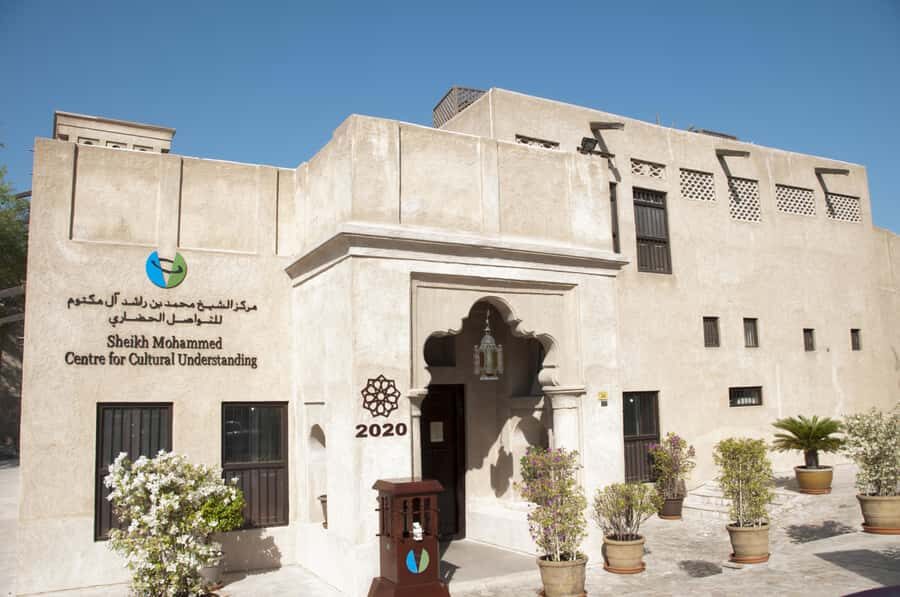
The Sheikh Mohammed Center for Cultural Understanding is at House 26 on Al Musallah Road in the Al Fahidi Historic District, adjacent to the Ruler’s Court. It sits within Al Bastakiya, the historic trading village named in the experience details, in a traditional wind tower house.
The building is part of the appeal. Wind towers were designed to draw air through traditional homes, and here the old architecture gives the lunch a clear sense of place. You are not simply being told about local culture in an anonymous dining room. The setting itself helps connect the meal to the older neighborhood around it.
Allow time to locate the entrance. The meeting point is specific, but the paths and doors around Al Fahidi can be confusing, and construction may block routes or make signs harder to spot. One practical tip: check carefully for House 26 and the entrance rather than stopping at the first door with a welcome sign. If you are unsure, ask for directions before your start time.
The venue is wheelchair accessible. The advertised language for the host or greeter is English, so you can expect the conversation to be conducted in English.
What happens over the 90-minute lunch
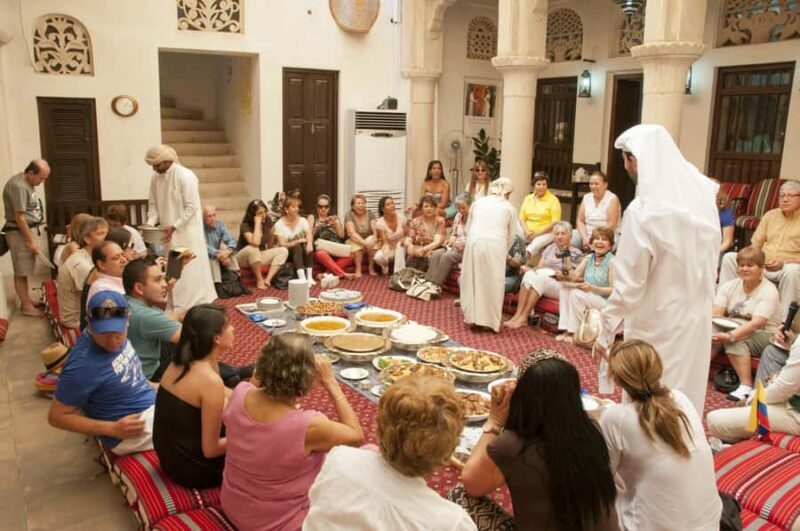
The experience lasts about an hour and a half. You meet at the center, settle into the traditional setting, and share a selection of Emirati dishes while your host introduces local customs and answers questions.
The meal is not just a tasting course. It gives everyone a reason to gather and talk, and the conversation can move naturally from food to greetings, local expressions, anecdotes, religious practice, and daily life. The exact discussion depends on what you ask, so it helps to arrive with a few questions in mind.
You’ll also be served Arabic coffee, tea, and dates. These are part of the hospitality, not just extras beside the meal. If you have never tried Arabic coffee, this is a comfortable place to do so: you can taste it and ask about its place in local customs without needing to know the etiquette beforehand.
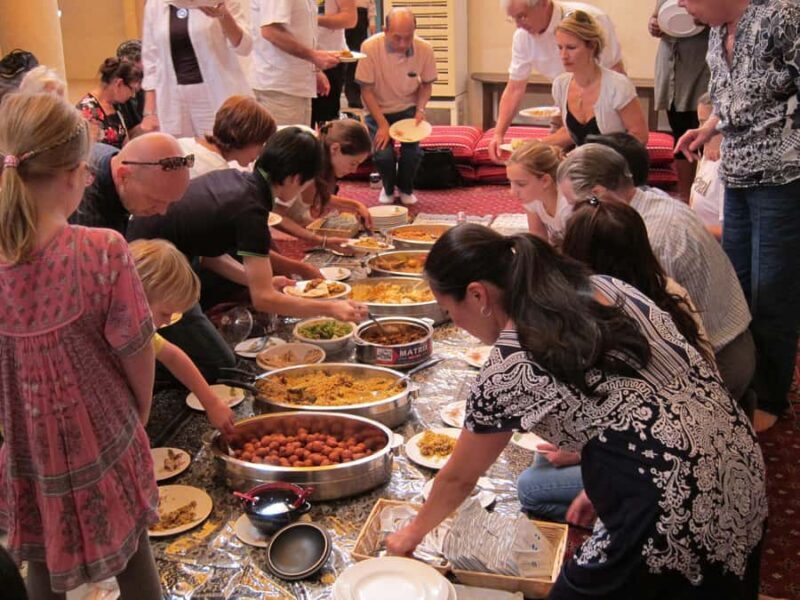
The center describes the food as a selection of local Emirati dishes, including dessert. A fixed menu is not provided, so don’t book expecting one specific dish. The meal is best approached as an introduction to local food and hospitality, with the conversation adding context to what is on the table.
You’ll sit on traditional floor cushions in the courtyard. If you are used to a standard restaurant table and chairs, this is a small but memorable change. The courtyard setting also makes the lunch feel more connected to the house and its architecture.
Conversation is the main course
The strongest reason to choose this activity is the chance to ask questions in an informal setting. You can ask about customs and traditions, Arabic greetings and expressions, the influence of Islam, and the values or sensitivities that shape local life. The host’s role is to make those topics easier to discuss.
The most useful questions are often specific. You might ask how a greeting is used, what a custom means, or how a religious practice affects everyday routines. You do not need to arrive as an expert. The point is to make room for a thoughtful exchange, and the host can respond to the interests of the people at the meal.
Several past hosts have been praised for combining clear explanations with warmth and humor. Names associated with the program include Khaled, Nasser, Ruqaya, and Moeen Murad. Since the host can vary, treat those names as examples of the center’s past team, not a promise about who will lead your lunch.
The format also allows for subjects that might feel awkward to raise in a more casual encounter. You can ask respectfully and listen to the answer, rather than relying on assumptions or generalizations. That makes the lunch a useful cultural introduction, though it is only a starting point. If you leave wanting to learn more, that is a good reason to keep exploring the district and the wider city.
More Great Tours NearbyWhat the food can and cannot promise
Food is one of the pleasures of the experience, but it is sensible to keep expectations broad. You are offered a selection of local dishes and dessert, along with coffee, tea, and dates. The available details do not name a set menu or promise that every dish will be familiar to you.
That flexibility is not a flaw. A cultural meal can introduce you to flavors and food customs without pretending that one lunch represents every Emirati kitchen. If you have a particular dish in mind, ask whether it will be served rather than assuming it is included.
The meal has received strong praise for taste and traditional character, and hospitality is a recurring strength. Still, this is not a cooking class or a food tour focused on multiple venues. You sit in one place and eat while the host leads a conversation. If your main goal is to sample a long list of dishes, this may feel modest; if you value context with your meal, it makes more sense.






Is $42 fair value?
At $42 per person, the price covers lunch, a selection of local Emirati dishes, Arabic coffee, tea, and dates, plus a 90-minute cultural program in a historic house. You are paying for the meal and the guided conversation together, not simply for a plate of food.
I think the value is strongest if this is your first introduction to Emirati customs. A good host can help you interpret what you are eating and answer questions that a restaurant menu cannot. The location adds something too: the experience takes place in a traditional wind tower house in Al Fahidi, rather than in a setting detached from the old district.
It is less compelling if you want a long, specialist discussion or a guaranteed menu of particular dishes. The session is brief, and the subject matter follows the questions and interests of the group. Think of it as a welcoming first conversation, not a complete course in UAE history or culture.
The activity offers free cancellation up to 24 hours ahead and a reserve-now, pay-later option. Those terms make it easier to fit into a changing itinerary. Check available start times before booking, since the schedule can vary.
Who should book this lunch
This is a strong choice for first-time visitors who want more than a quick look at Dubai’s modern side. It also suits curious eaters, families or small groups who enjoy asking questions, and anyone who wants a cultural activity that fits into half a day without taking over the schedule.
You may get the most from it early in your stay. A conversation about greetings, customs, or religious practice can give you helpful context for the rest of your time in the UAE. The relaxed meal also makes it easier to ask basic questions without feeling that you should already know the answers.
If you prefer a tightly scripted tour, a large meal with a fixed menu, or a long academic talk, this may not be the right fit. The discussion is informal, and its range depends partly on what you ask. Go in ready to listen and participate, and the short format can be surprisingly useful.
Should you book?
Book this lunch if you want a friendly introduction to Emirati food and customs, and if you are happy to make conversation part of the meal. The combination of an Al Fahidi courtyard, traditional dishes, Arabic coffee and dates, and an open question period gives you a grounded counterpoint to Dubai’s newer attractions.
Skip it if you mainly want a guaranteed dish list or an extended cultural seminar. For most curious visitors, though, the price is reasonable for a meal paired with direct conversation in a historic setting. Bring a few questions, leave room for answers you did not expect, and give yourself extra time to find House 26.
Dubai: Cultural Lunch at The Sheikh Mohammed Center
FAQ
How long does the cultural lunch last?
The activity lasts 1.5 hours.
What is included in the price?
The experience includes lunch at the center, a selection of local Emirati dishes, and Arabic coffee, tea, and dates.
What language does the host speak?
The host or greeter speaks English.
Where is the meeting point?
Meet at House 26, Al Musallah Road, in the Al Fahidi Historic District, adjacent to the Ruler’s Court.
Is the venue wheelchair accessible?
Yes, the activity is listed as wheelchair accessible.
Can I cancel for a full refund?
Yes. You can cancel up to 24 hours in advance for a full refund.
You can check availability for your dates here: