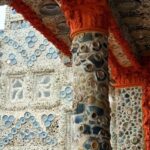
Tianjin’s Porcelain House takes an old French-style mansion and wraps it in an astonishing skin of ceramic: blue-and-white shards, colorful porcelain, bottles, plates, and carved details cover its walls, roof, railings, and courtyard. The result is part architectural oddity, part ceramic collection, and a striking stop in the city.
I like two things here: the building itself is the main exhibit, so you can appreciate the craft simply by looking closely, and the mix of Chinese porcelain with Western-style architecture gives the place a character you will not find in a standard museum. One consideration: the surfaces are crowded with detail, and the ceramic-tile floors can get slippery when wet, so this is a place to take your time and watch your step.
- What to Know Before You Go
- An Old Mansion with a New Ceramic Skin
- Read the Facade Like a Ceramic Collection
- Notice How the Pieces Were Arranged
- Inside the House and the Complimentary History Tour
- A Short Visit with Plenty to Look At
- Price and What the Ticket Gets You
- Practical Details for a Comfortable Visit
- Who Should Make Time for It?
- Should You Book the Porcelain House?
- FAQ
- How long should I allow for the Porcelain House?
- What are the opening hours?
- What does the ticket include?
- Is a tour included?
- How do I enter the venue?
- Is the ticket valid on any date?
- Can I cancel or change my booking?
- Do children need a ticket?
- What should I wear?
- Can I touch the porcelain decorations?
- The Best Of Tianjin!
- More Tickets in Tianjin
- More Tours in Tianjin
- More Tour Reviews in Tianjin
- Not for you? Here's more nearby things to do in Tianjin we have reviewed
What to Know Before You Go
 1 / 2
 2 / 2
- Millions of fragments shape the building: The renovation used about 1 million porcelain fragments and 13,000 complete pieces, along with more than 300 porcelain bottles.
- Look for contrasts in the decoration: Blue-and-white pieces form much of the exterior, with red and yellow famille rose accents.
- A former French-style mansion became a ceramic art museum: The building dates to the Republic of China era and has nearly a century of history.
- The courtyard has its own ceramic composition: Porcelain pieces form rockeries, with a Qing-dynasty blue-and-white vase at the top of one.
- A complimentary history tour is offered: It covers the building’s story, adding context to the striking exterior.
- Plan on 1 to 2 hours: The ticket is for the Porcelain House, not other Tianjin attractions.

👉 See our pick of the 5 Best Guided Tours In Tianjin
An Old Mansion with a New Ceramic Skin
The Porcelain House is not a traditional home today. It is a ceramic art museum formed by attaching ancient porcelain fragments and complete ceramic pieces to a French-style mansion from the Republic of China era. The renovation, led by Zhang Lianzhi’s team, turned a historic residence into a very unusual architectural project.
The scale is difficult to grasp until you know the numbers: the work used roughly 1 million fragments, 13,000 complete porcelain pieces, and more than 300 porcelain bottles, plus dozens of plates and bowls. These materials span periods from the Ming and Qing dynasties through the Republic era. The building’s nearly century-old history and more than a decade of careful renovation give the visit two layers: an older residence and a modern work of ceramic art.
The mansion’s Chinese and Western design is part of the appeal. Its original French-style form gives the ceramics an unexpected frame, while the porcelain brings color, pattern, and texture across almost every visible surface. This is not a quiet collection in glass cases. The architecture itself has been made into the display.
You can also read our reviews of more tours and experiences in Tianjin


Read the Facade Like a Ceramic Collection
As you approach, look across the exterior before focusing on individual pieces. Walls, columns, window frames, roof edges, and stair railings are all covered with ceramic decoration. In sunlight, the different colors and glazes catch the eye in shifting ways, though the sheer density of the work can feel busy if you prefer restrained design.
Then start picking out the materials. Blue-and-white porcelain provides much of the visual base, with red and yellow famille rose pieces set among it. The ceramic collection also includes celadon, underglaze red, Jun ware, Ru ware, and everyday folk blue-and-white fragments. Some pieces are worn, but patterns and fine workmanship remain visible.
That mix is important. The house is not decorated with one matching set of tiles; it draws on pieces from different eras and levels of ceramic production. The result places prized kiln wares beside familiar household porcelain. You can look at it as a bold architectural surface, but also as a display of changing tastes and craft traditions.
A useful way to visit is to take a wide view first, then choose a few spots to inspect closely. The density means you may not absorb every motif in one pass. If you are with someone who likes photography, allow time for them to stop often. The building offers plenty of close-up patterns, but the busy surfaces can make each image feel different.
Notice How the Pieces Were Arranged
The ceramics were not simply piled onto the building. Zhang Lianzhi’s team sorted pieces by color, era, and pattern, then arranged them according to the building’s structure and visual design. Knowing that makes the exterior easier to read: repeated colors and shapes are part of a plan, not random decoration.
The roof uses complete porcelain bottles arranged in a wave-like pattern, suggesting the rhythm of traditional roof tiles. On the exterior walls, blue-and-white fragments form a visual base, with brighter famille rose pieces adding contrast. These choices let you compare how different materials work at different scales: small shards create texture, while complete bottles and vessels make larger shapes.
In the courtyard, ceramic fragments build rockeries in layered forms. A Qing-dynasty blue-and-white vase sits at the top of one, acting as a focal point. It is worth pausing here rather than treating the courtyard as a quick passage. The arrangement shows how the project uses ceramics not just as surface covering, but to shape an imagined garden scene.
A few pieces are described as official-kiln porcelain from the Ming and Qing periods. Their age and wear make them especially interesting to inspect, though you must keep your hands off the walls and bottles. Look closely, but do not touch: the fragile materials are part of the building, not souvenirs to handle.
Inside the House and the Complimentary History Tour
The Porcelain House is presented as a ceramic art museum, not simply a decorated exterior. A complimentary tour covering the building’s history is offered, and that context can help connect the old mansion with its later transformation. No guide name or fixed tour schedule is specified, so check on arrival if you want to join.
The tour is especially useful if you want more than photographs. Without context, the building can read as an exuberant collection of decorative surfaces. A history explanation gives you a way to think about the mansion’s Republic-era origins, its later renovation, and the decisions behind assembling ceramics from several periods into one architectural work.
The ticket itself includes one admission to the Porcelain House. It does not include personal expenses or admission to nearby attractions. The visit is self-contained, so you can spend more time looking at details or keep the stop short if your schedule is tight. The stated visit length is 1 to 2 hours, a sensible range for seeing the exterior, courtyard, and interior exhibition areas without rushing.
A Short Visit with Plenty to Look At
This is a compact attraction, but it rewards a slower pace. From a distance, you get the full effect of a mansion covered in porcelain. Up close, the variety of eras, colors, and ceramic forms becomes more apparent. Inside and around the courtyard, the work shifts from broad architectural decoration to smaller arrangements.
The amount of visual detail is also the main drawback. If you like clean lines and minimal displays, the crowded surfaces may feel overwhelming. If you enjoy close observation, the variety gives you plenty to notice, and a second look can reveal arrangements you missed on the first circuit.
The visit also works well as a focused stop rather than a full day’s plan. At 1 to 2 hours, it can fit alongside other Tianjin sights, but the ticket covers only this attraction. The Porcelain House is near Heping Road commercial street, and the supplied location details give two address forms: 和平路368号 and 72 Chifeng Road, Xiaobailou Street, Heping District. Check the address shown on your voucher before setting off, as the details differ.





Price and What the Ticket Gets You
Tickets start at $7.75 for one admission. At that price, the value rests on whether you are interested in an unusual building, ceramic craft, or Tianjin’s architectural character. You are paying for a singular place to see, not a long guided excursion or a bundle of attractions.
The complimentary history tour adds value if it is running during your visit. It offers a way to understand how the building changed from a French-style mansion into a ceramic art museum, rather than simply viewing the ornament as decoration. Since no timetable is provided, do not plan your day around a particular tour departure without checking locally.
For families, children 1.2 meters tall and under enter free; children taller than 1.2 meters pay the adult price. The policy makes height, rather than age, the relevant detail to check before booking.
Practical Details for a Comfortable Visit
The Porcelain House is open daily from 09:00 to 19:00. Your voucher is valid only on the selected date, and entry is direct with the voucher. Changes made at least 24 hours before the activity are free, but the ticket is otherwise non-refundable and cannot be cancelled.
Wear flat shoes with non-slip soles. The interior exhibition floors are largely made from ceramic tiles and can be slippery in wet or humid weather. Older visitors, children, and anyone with mobility difficulties should be accompanied and walk slowly.
The rules protect the building’s fragile surfaces. Do not touch the walls or porcelain bottles, and do not climb the building or courtyard rockeries. Sharp objects such as scissors and nail clippers are prohibited in the exhibition hall, and loud noise, chasing, and horseplay are not allowed.
Who Should Make Time for It?
I would put this visit high on the list if you enjoy architecture, decorative arts, or places that combine several eras in one setting. The building has an immediate visual impact, but its greatest interest lies in the way ordinary fragments, prized ceramics, and complete vessels have been assembled into a single work.
It may be less satisfying if you want a large museum with clearly separated galleries, extensive interpretation, or a long, varied program. The main attraction is the house and its dense ceramic decoration. The optional history tour can add context, but the visit remains focused on one building.
For a quick Tianjin stop, the 1 to 2 hour duration is convenient. For photography, give yourself enough time to study the facade and courtyard rather than taking one picture and moving on. The crowds of detail are the point, and the careful arrangement becomes more legible when you slow down.
Should You Book the Porcelain House?
Book it if you want to see one of Tianjin’s most distinctive architectural sights and appreciate ceramic work beyond a conventional museum display. The ticket price is modest, the visit is manageable, and the complimentary history tour can make the building’s transformation clearer.
Skip it if ornate surfaces are not your thing or if you are looking for a full-day experience. Before booking, check the address on your voucher because the supplied location details list both 和平路368号 and 72 Chifeng Road. Wear shoes with grip, keep your hands off the porcelain, and give the details time to come into focus.
Tianjin Porcelain House Experience Ticket
“Very good complimentary tour provided by the Porcelain house that covered the history of the building.”
FAQ
How long should I allow for the Porcelain House?
Plan for 1 to 2 hours.
What are the opening hours?
The Porcelain House is open Monday to Sunday from 09:00 to 19:00.
What does the ticket include?
It includes one ticket to the Tianjin Porcelain House.
Is a tour included?
A complimentary tour covering the building’s history is offered.
How do I enter the venue?
Enter directly with your voucher.
Is the ticket valid on any date?
No. The voucher is valid only on the selected date, and time if applicable.
Can I cancel or change my booking?
Cancellations and refunds are not available. Changes made at least 24 hours before the activity are free.
Do children need a ticket?
Children 1.2 meters tall and under enter free. Children over 1.2 meters pay the adult price.
What should I wear?
Wear non-slip flat shoes. Ceramic-tile floors inside can be slippery when wet or humid.
Can I touch the porcelain decorations?
No. Touching the walls and porcelain bottles is prohibited, as is climbing the building or rockeries.