The most memorable thing about the Disgusting Food Museum is that it asks you to meet unfamiliar foods with more than your eyes. You can inspect unusual ingredients, test their smells, and, at the tasting bar, decide whether curiosity beats caution.
I like two things here: the exhibits connect strange-looking food to the cultures that eat it, and the tasting bar gives you a chance to turn the display into a real sensory test. The main catch is scale: the exhibition is compact, often takes around 25 to 30 minutes, and can feel crowded at busy times.
- Key points to know before you go
- A museum that makes food a sensory test
- Five zones, from old food wisdom to future meals
- The tasting bar is the big decision
- How long to allow, and when to visit
- Ticket prices and what you get for the money
- Who will enjoy this unusual stop
- Should you book the Disgusting Food Museum?
- FAQ
- Where is the Disgusting Food Museum Hong Kong?
- When is the exhibition open?
- How long does a visit take?
- Do I have to taste the food?
- Can children attend?
- Are pets allowed inside?
- The Best Of Hong Kong!
- More Food & Drink Experiences in Hong Kong
- More Tours in Hong Kong
- More Tour Reviews in Hong Kong
- Not for you? Here's more nearby things to do in Hong Kong we have reviewed
Key points to know before you go
 1 / 8
 2 / 8
 3 / 8
 4 / 8
 5 / 8
 6 / 8
 7 / 8
 8 / 8
- More than 80 unusual foods: Expect items such as fermented shark, maggot cheese, insects, and cultivated meat.
- Five themed zones: The route links traditional food practices with future foods and sustainability.
- A tasting bar at the end: Samples vary, and tasting is a choice, not a requirement.
- A short visit: Plan on about half an hour, though crowding may slow your progress.
- Weekday tickets cost less: Adult admission starts at HK$68, with early bird prices listed from HK$38.
- In AIRSIDE, Kai Tak: The venue is GATE33 Gallery, and animals are not allowed inside the exhibition.

👉 See our pick of the Best Historical Tours In Hong Kong
A museum that makes food a sensory test
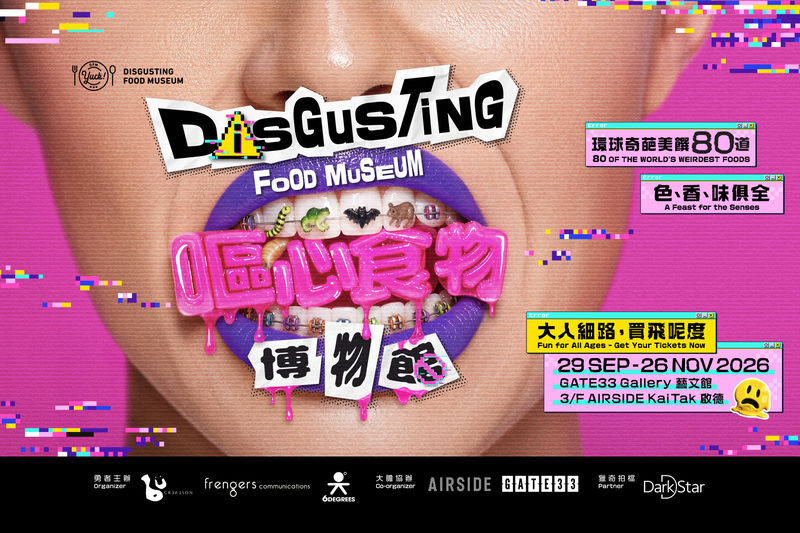
The Disgusting Food Museum began in Sweden and has appeared in the United States, France, Germany, and other countries. Its Hong Kong edition is a collaboration between the Swedish museum and a local team, with more than 80 food exhibits and a stated count of 85-plus in its highlights.
The word disgusting is part of the hook, but the exhibition has a broader point. Food that seems revolting to one person can be normal, prized, or practical in another culture. By asking you to look, smell, and possibly taste, the museum turns that idea into something more immediate than a label on a wall.
That cultural framing is what gives the visit value beyond the shock factor. You may recognize some items from online videos or everyday meals, while others may be new to you. The contrast can prompt a useful question: are you reacting to the food itself, or to the habits you grew up with?
This is a small exhibition rather than a full-day attraction. It works best when you arrive curious and ready to read the descriptions, rather than expecting a vast collection of increasingly extreme foods.
You can also read our reviews of more food & drink experiences in Hong Kong


Five zones, from old food wisdom to future meals
The exhibition is arranged in five themed zones. The precise titles and order of every display are not specified, but the overall path moves from traditional food knowledge toward future foods and sustainable development.
That broad structure matters. It lets you consider unusual foods not just as dare material, but as responses to local customs, available ingredients, and changing food needs. The museum’s central question is not simply what tastes unpleasant. It is also why people eat certain things, and what might appear on dinner tables in years to come.
Expect an assortment that includes fermented shark, live maggot cheese, insects, and cultivated meat. The displays are designed for close inspection, with descriptions that explain the items and their cultural context. Some displays are objects or props rather than food you can handle, so this is not a market or cooking class. It is a museum experience built around seeing, smelling, and learning.
The scent stations add another layer, but they may not all register equally. Some scent samples can be faint, and their smell may not match the real food’s full intensity. At the other end of the scale, fermented shark and canned herring have been described as particularly powerful. If strong odors bother you, take your time and remember that looking is enough.
The tasting bar is the big decision
The tasting bar is where the exhibition changes from observation to participation. You may get the chance to try samples such as crickets, ants, or other unusual foods. The exact selection can vary, so do not arrive expecting one particular item.
Some samples may be far less alarming once you taste them. Insects, for example, can sound more daunting than they are, while fermented foods may leave a stronger impression. One especially pungent taste can linger well after the visit, so think twice if you have a sensitive stomach or plan to eat immediately afterward.
You do not need to try anything to get value from the exhibition. The choice is part of the fun: inspect a sample, smell it, ask yourself what makes it unfamiliar, and then decide. If you are visiting with children, this can be a good way to talk about food customs without turning the outing into a test of bravery.
The tasting portion is limited, and it may be a small part of the overall visit. If your main goal is to sample a wide range of rare foods, the museum may not meet that expectation. If you want one or two genuine taste tests as part of a broader exhibition, it is more likely to satisfy.
How long to allow, and when to visit
Plan for roughly 25 to 30 minutes to walk through the exhibition at an ordinary pace. You may spend longer if you read each description, stop at the scent displays, or wait for a tasting station. The compact size is the chief limitation, especially if you expected to fill an hour.
Crowd levels can change the feel of the visit. Weekends and public holidays are the riskiest times for queues and slow movement between sections. At busy periods, people can bunch up at individual displays, and even a short exhibition may take longer than expected. Weekdays are the better bet if you want more room to read and smell at your own pace, though they are not guaranteed to be quiet.
The museum is at GATE33 Gallery in AIRSIDE, Kai Tak, Kowloon. Its scheduled exhibition dates are September 29 to November 26, 2026. Opening hours are noon to 8 pm Monday through Thursday, and 11 am to 9 pm Friday through Sunday and on public holidays.
You can enter at any time within your selected time slot, and there is no stated time limit once inside. That flexibility is useful, but it does not prevent queues at the entrance or inside during peak periods. Arrive with some slack if you have another timed plan afterward.
Ticket prices and what you get for the money
Standard adult tickets are listed at HK$68 Monday through Thursday and HK$88 Friday through Sunday and public holidays. Early bird prices are HK$38 and HK$58 respectively. Child, student, and senior tickets are HK$48 on weekdays and HK$68 on weekends or public holidays, with early bird rates of HK$28 and HK$48.
Family and group tickets can lower the per-person cost. A parent and child or student bundle is HK$98 on weekdays and HK$138 on weekends. Three adult tickets cost HK$168 or HK$228, while four adult tickets cost HK$224 or HK$304, depending on the day. The child, student, and senior ticket option is advertised from US$6.15, though the Hong Kong dollar prices are the clearer guide to the local ticket cost.
For a short, unusual outing, weekday early bird admission is strong value if you are interested in the subject. The price buys a compact exhibition, cultural explanations, scent stations, and the chance to sample a few foods. It is less compelling if you expect a large museum or a substantial tasting menu. Treat it as a short stop in a day around AIRSIDE, not the day’s main event.
Children aged three or younger may enter free with a paying adult. Children aged 12 or under must stay with a parent or legal guardian aged 18 or older. Each adult may accompany up to two children aged 12 or under. If you book a discounted age-based ticket, bring identification in case staff need to check eligibility.
You can also read our reviews of more tours and experiences in Hong Kong


Who will enjoy this unusual stop
This exhibition suits curious eaters, families who like hands-on outings, and friends looking for a shared challenge. You do not need to be an adventurous eater: the displays and explanations are part of the visit, and tasting is optional. A child who enjoys asking why people eat different foods may get more from it than one who only wants a fright.
It is also a good choice for people interested in food culture and sustainability. The move from traditional food practices to cultivated meat gives the exhibition a subject beyond shock. You can leave thinking about how customs shape appetite and how food choices may change as the future dining table evolves.
Skip it if you want a large collection, a long museum visit, or guaranteed access to a particular sample. The exhibition is compact, some items may be familiar, and the tasting selection is not a fixed menu. It is a focused, somewhat quirky stop, not an all-day attraction.
A few practical points are worth keeping in mind. Tickets are nonrefundable and nontransferable, so check the date and ticket category before confirming. The voucher is valid only on the specified date and, when applicable, time. Animals are not allowed in the exhibition area because of strong scents and fragile displays. In severe weather, including a typhoon signal No. 8 or above or a Black Rainstorm Warning remaining in effect three hours before the relevant slot, the event may be cancelled or postponed; check official channels for updates.
Should you book the Disgusting Food Museum?
Book if you like unusual food, want an outing that gives you something to talk about, or are interested in how cultures define what is edible. The strongest reasons to go are the combination of cultural context and sensory exhibits, plus the option to taste a few items without committing to a whole meal.
Choose a weekday, especially at the lower early bird price, if your schedule allows. Go with realistic expectations: the exhibition is short, the tasting range is limited, and weekend crowds may affect how comfortably you move through the displays. If those trade-offs work for you, this is a memorable half-hour of Hong Kong curiosity.
Hong Kong’s Most Exciting Experience of 2026 – The Disgusting Food Museum Hong Kong
“There were quite a lot of people during the visit, and I think it would be better to limit the number of visitors with timed entry. However, the ov…”
FAQ
Where is the Disgusting Food Museum Hong Kong?
It is at GATE33 Gallery in AIRSIDE, Kai Tak, Kowloon, Hong Kong.
When is the exhibition open?
The scheduled exhibition dates are September 29 to November 26, 2026. Hours are noon to 8 pm Monday through Thursday, and 11 am to 9 pm Friday through Sunday and public holidays.
How long does a visit take?
The exhibition is compact. Allow about 25 to 30 minutes, with extra time if you read the displays carefully or encounter queues.
Do I have to taste the food?
No. The tasting bar is an optional part of the visit. You can explore the displays and scent stations without sampling anything.
Can children attend?
Yes. Children aged 12 or under must be accompanied by a parent or legal guardian aged 18 or older. Children aged three or younger may enter free with a paying adult.
Are pets allowed inside?
No. Animals are not permitted in the exhibition area because it contains strong scents and fragile displays.