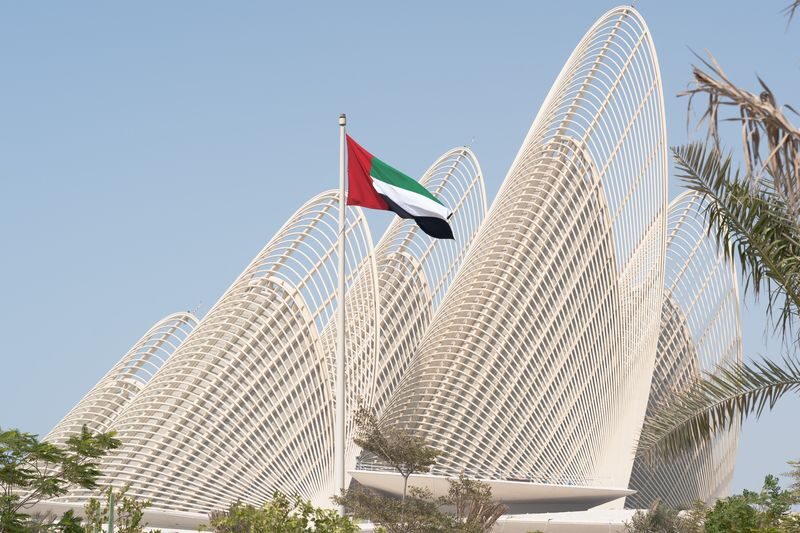
The museum’s five falcon-wing towers are the first clue that this is no ordinary history stop. Inside, six galleries connect 300,000 years of Emirati life with the country’s modern founding, while a reconstructed Bronze Age boat and the story of Sheikh Zayed give the past a human scale.
I like two things in particular: the architecture is part of the visit, not just a grand entrance, and the galleries use audio, film, and interactive displays to make national history easier to follow. The 600-meter Al Masar Garden adds a quieter outdoor chapter to the story.
One consideration: the museum is large, and the route can feel a little hard to follow. Some exhibits may also feel more modest than the building suggests, so this is a better fit if you enjoy context and design as much as a parade of famous objects.
- What to know before you go
- A national story beneath five falcon wings
- Six galleries trace the UAE from ancient times to the present
- Look for the pearl, manuscripts, and Bronze Age boat
- Sheikh Zayed’s story gives the museum its center
- Al Masar Garden adds an outdoor chapter
- Rooftop views and the building itself
- How the ticket price and packages compare
- Opening hours, access, and useful details
- Who should make time for this museum?
- FAQ
- How long should I plan for Zayed National Museum?
- Where is Zayed National Museum?
- What are the museum’s opening hours?
- What does a standard Zayed National Museum ticket include?
- Are there combo tickets for nearby museums?
- Is Zayed National Museum free for children?
- Is the museum wheelchair-accessible?
- Is parking available?
- Can I leave the museum and come back in?
- Can I bring food and drinks inside?
- The Best Of Abu Dhabi!
- More Tickets in Abu Dhabi
- More Tours in Abu Dhabi
- More Tour Reviews in Abu Dhabi
- Not for you? Here's more nearby things to do in Abu Dhabi we have reviewed
What to know before you go
- Six galleries cover 300,000 years, from early human history and ancient civilizations to maritime trade and the UAE’s founding.
- Five falcon-inspired towers shape the building, designed by Foster + Partners to suggest heritage, vision, and sustainability.
- More than 3,000 artifacts fill the museum, including the Abu Dhabi Pearl, ancient coins, Blue Qur’an folios, and a reconstructed Magan boat.
- Al Masar Garden extends the story outdoors along a 600-meter path through desert and oasis settings.
- Plan for two to three hours, with extra time if you want to see the garden, browse the shop, or stop at the café.
- Check the ticket you select: options may include the Natural History Museum or Louvre Abu Dhabi, but the attractions included vary by package.
👉 See our pick of the 4 Best Shopping Tours In Abu Dhabi
A national story beneath five falcon wings
Zayed National Museum sits in Abu Dhabi’s Saadiyat Cultural District, near Louvre Abu Dhabi and the planned Guggenheim Abu Dhabi. Its five slender towers, inspired by falcon wings, are the signature of a building designed by Foster + Partners. They frame the museum as a national landmark before you even reach the exhibits.
That scale sets expectations. The museum covers 88,870 square meters, with six permanent galleries and research spaces. But its aim is not simply to fill a grand building with objects. It tells the story of the land and its people across a long span of time, then shows how Sheikh Zayed bin Sultan Al Nahyan helped shape the modern UAE.
The building’s design also has a practical side. Sustainable features include geothermal cooling, solar panels, and radiant floor technology. In Abu Dhabi’s heat, these systems matter beyond their engineering interest: they help make a large cultural complex more comfortable while linking modern design to the region’s climate.
Allow two to three hours for a first visit. You could move faster, but that would leave little room to follow the displays, pause at the larger objects, or walk through Al Masar Garden. If you are combining the museum with another Saadiyat attraction, keep a close eye on the clock.
You can also read our reviews of more tours and experiences in Abu Dhabi



Six galleries trace the UAE from ancient times to the present
The six galleries span about 300,000 years of Emirati history, culture, and innovation. That sweep helps explain why the UAE is more than a story of rapid growth in recent decades. The galleries place the modern country in a longer account of people adapting to a demanding environment, building communities, and connecting with the wider world.
Expect a mix of artifacts and modern presentation. Audio and visual elements, interactive displays, and immersive exhibition techniques help make the material accessible to visitors who might not normally choose a history museum. The subject matter includes ancient civilizations, trade by sea, the country’s natural resources, and the formation of the UAE.
The founding story is a central thread. Sheikh Zayed’s life and legacy appear throughout the museum, with displays explaining his role in bringing seven emirates together and his ideas about leadership and development. If you know little about the country’s political history, this gives you useful context for what you see elsewhere in Abu Dhabi.
The exhibits are generally well organized, but a very large museum can make navigation less obvious than it should be. Some objects may be harder to identify at a glance, especially when labels are not easy to spot. Take a moment to read the gallery introductions before moving on; they help you see how each room fits into the larger story.
Look for the pearl, manuscripts, and Bronze Age boat
More than 3,000 artifacts give the galleries their physical anchor. Among the objects highlighted are the Abu Dhabi Pearl, ancient coins, and rare folios from the Blue Qur’an. These are the kinds of exhibits that reward a slower look, especially if you want to connect the broader historical account to objects made, traded, or valued by real communities.
The reconstructed Bronze Age Magan boat is another natural stopping point. A boat makes the region’s maritime history tangible: trade and travel were not side notes to life here, but a way to connect people and places. The reconstruction is made from natural resources, offering a different kind of encounter than a small object in a display case.
Not every gallery is likely to have the same visual impact. A large ship reconstruction or a dramatic architectural space catches the eye quickly; a manuscript or coin asks for more patience. I’d treat the museum as a sequence of stories rather than a checklist of headline artifacts. The objects gain meaning when you understand the trade, beliefs, and daily life around them.
Sheikh Zayed’s story gives the museum its center
The museum honors the late Sheikh Zayed bin Sultan Al Nahyan, the UAE’s founding father. His life and vision are not confined to a single biographical room. Instead, they help connect the country’s older history to its modern development, giving the galleries a clear through-line.
This focus is useful even if you have already visited other museums in Abu Dhabi. You get a closer look at the ideas and choices associated with the country’s formation, rather than only a timeline of dates. The story also helps make sense of the museum’s emphasis on heritage, education, sustainability, and national identity.
Some displays use photographs and audiovisual presentations to explain economic development and the country’s resources. These can be a welcome change of pace from reading labels, though the amount of screen-based material may not suit everyone. If you prefer objects to media, balance those displays with time at the artifacts and the garden.
Al Masar Garden adds an outdoor chapter
Al Masar Garden is a 600-meter outdoor gallery that follows Sheikh Zayed’s life through desert and oasis settings. It gives you space to walk after the indoor galleries, while continuing the museum’s account beyond the walls. The garden also makes the visit feel less like a long stretch of indoor viewing.
Interactive activities add another layer to the outdoor route. For families, or anyone who learns better by doing than by reading, this can make the museum’s themes easier to absorb. It is also a good place to pause and take in the building from a different angle.
The garden is not just a shortcut between galleries. Give it time as part of the visit, particularly if the weather is comfortable. If you are trying to fit several museums into one day, remember that a 600-meter route adds real walking, even if it looks modest on a map.
You can also read our reviews of more museum experiences in Abu Dhabi






Rooftop views and the building itself
The architecture deserves time of its own. The five towers are the headline feature, but the museum’s interior design and open spaces also play a role in how the visit feels. The building is modern, spacious, and designed to make its structure part of the experience.
A rooftop or open-air platform may offer broad views of the surrounding area, and it is worth checking whether access is available during your visit. Access can vary, and the route down from the platform may take you outside the museum. There is no re-entry after you leave, so ask staff before heading out if you are unsure where a path leads.
This is a practical point, not a small-print detail. Some visitors may naturally follow a path outside without realizing it is one-way. Finish the indoor galleries first, then confirm the rooftop route and exit before going up. The rooftop can be a lovely final stop, but do not let a scenic detour end your museum visit early.
How the ticket price and packages compare
Admission starts at $20.99. For that price, you are paying for more than a building tour: the ticket covers six galleries, thousands of artifacts, the museum’s national history narrative, and access to Al Masar Garden. If you enjoy architecture, archaeology, and cultural history, two to three hours gives the price a reasonable return.
The value is less clear if you mainly want a quick look at the exterior or expect every room to be packed with blockbuster objects. Some of the museum’s appeal lies in its interpretation and design, not just in rare or spectacular artifacts. If that sounds like your kind of visit, the admission is easier to justify.
Ticket options can combine Zayed National Museum with the Natural History Museum, Louvre Abu Dhabi, or both. A three-day pass is also listed for the three museums. Read the package title and inclusions closely before booking: the attractions covered depend on the option you choose, and the basic Zayed National Museum ticket should not be assumed to include every nearby museum.
Free admission is available for children aged 0 to 18. Visitors aged 18 and over pay the adult rate. A special notice also states that museum access is free from May 16 to 18 for International Museum Day; check the museum’s current information before planning around those dates.
Opening hours, access, and useful details
The museum is at Al Saadiyat Island Cultural District in Abu Dhabi. Opening hours are listed as 10:00 to 18:30 Monday through Friday, and 10:00 to 20:30 on Saturday and Sunday. A weekend visit gives you more time in the building, but it may also make sense to arrive early if you want a quieter start.
Free parking is available, and Wi-Fi, cloakrooms, restrooms, an ATM, and prayer rooms on the first floor are listed among the facilities. Food and drinks from outside are not allowed inside. Café and restaurant options are available in the museum, though the range of places to eat may feel limited if you want a long meal or many choices.
The museum is wheelchair-accessible, with wheelchair routes, braille materials, sensory maps, and sign-language tours listed for People of Determination. Staff assistance is available, and visitors using wheelchairs or mobility equipment should be accompanied. For specific access needs, check the museum’s official information before your visit.
Booking is listed as instant confirmation with entry by voucher. The voucher is valid on the selected date and through December 31, 2026, but the activity is nonrefundable. That makes it important to choose your date and package carefully before paying.
Who should make time for this museum?
I’d put Zayed National Museum high on the list if you want to understand how the UAE came together, or if you enjoy seeing how architecture can shape a museum visit. It also suits families and curious first-time visitors, thanks to the interactive displays, visual storytelling, and outdoor garden.
It is a natural pairing with Louvre Abu Dhabi, Manarat Al Saadiyat, or Saadiyat Beach Club for a full day on the island. But do not assume you can rush through all of them. The museum alone can take two to three hours, and crossing between attractions adds time.
If you prefer a museum visit built around a few famous masterpieces, this may not be your best match. Its strength is the combination of national history, design, and interpretation. Book it if you want context, not just a photo of the building. If you do go, leave time for the garden and check the rooftop route before you head outside.
Zayed National Museum Ticket in Abu Dhabi
“It's a good museum with a good history and good ships. Everything is good, you can visit. Abu Dhabi is also good. I recommend it to everyone.”
FAQ
How long should I plan for Zayed National Museum?
Plan for about two to three hours. Add time if you want to walk the 600-meter Al Masar Garden or visit the café and shop.
Where is Zayed National Museum?
It is on Al Saadiyat Island in Abu Dhabi’s Cultural District, near Louvre Abu Dhabi and Guggenheim Abu Dhabi.
What are the museum’s opening hours?
The listed hours are 10:00 to 18:30 Monday through Friday and 10:00 to 20:30 Saturday and Sunday.
What does a standard Zayed National Museum ticket include?
The standard option includes admission to Zayed National Museum. Check the package details if you want to add another museum.
Are there combo tickets for nearby museums?
Yes. Options include combinations with the Natural History Museum and Louvre Abu Dhabi, as well as a three-day pass for all three. Inclusions depend on the package selected.
Is Zayed National Museum free for children?
Admission is free for children aged 0 to 18. Those aged 18 and over are charged the adult rate.
Is the museum wheelchair-accessible?
Yes. Wheelchair routes, braille materials, sensory maps, and sign-language tours are listed. Staff assistance is available, and visitors using wheelchairs or mobility equipment should be accompanied.
Is parking available?
Yes. Free parking is listed among the museum facilities.
Can I leave the museum and come back in?
No. Re-entry is not allowed after you leave the venue, so check the route before heading to an outdoor platform or exit.
Can I bring food and drinks inside?
No. Outside food and drinks are not allowed inside the venue.