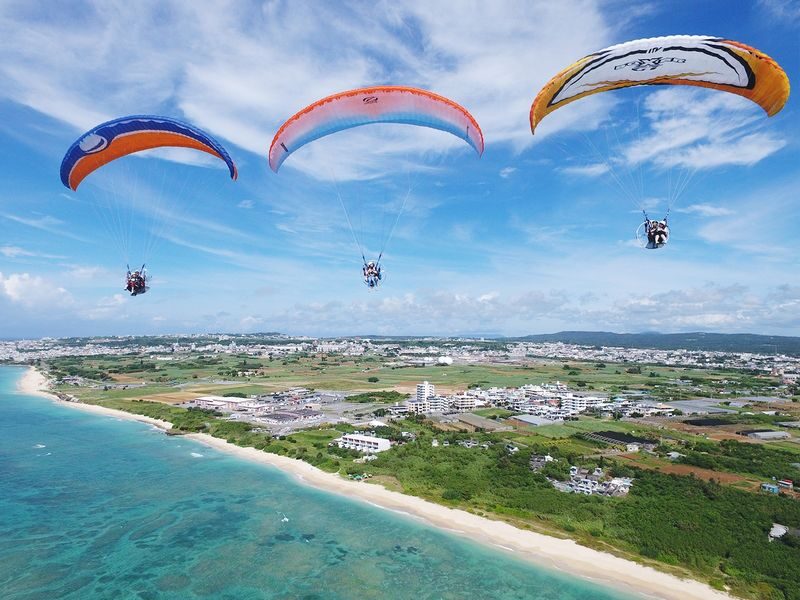
Okinawa looks different from the air: a patchwork of pale coastline and sea that shifts through several shades of blue and green. On this powered-paragliding flight, you ride with an instructor who handles the controls, leaving you free to watch the shore unfold below.
I like two things in particular: the instructor-guided flight makes this an accessible first taste of paragliding, and the parent-and-child option gives families a way to share the view. The main trade-off is the weather. Wind can change the launch site or cancel a flight, even on a clear day, so keep your schedule flexible.
- At a glance: coast views, short flight, changeable winds
- A powered paraglider, not a high-altitude sightseeing plane
- Getting to the take-off site from Midtown Mall
- From check-in to take-off: the part where you need to help
- In the air: a short window for Okinawa’s coast
- Family flights: check the combined weight rule
- Safety and weather: sensible expectations matter
- What the price covers, and what costs extra
- Who will enjoy this flight most
- Should you book the Okinawa powered-paragliding flight?
- FAQ
- How long is the flight?
- Where does the flight take off?
- Is transport included?
- Can a parent and child fly together?
- What should I wear?
- What happens if the weather is unsuitable?
- The Best Of Okinawa!
- More Tours in Okinawa
- More Tour Reviews in Okinawa
- Not for you? Here's more nearby things to do in Okinawa we have reviewed
At a glance: coast views, short flight, changeable winds
 1 / 7
 2 / 7
 3 / 7
 4 / 7
 5 / 7
 6 / 7
 7 / 7
- Expect 10 to 15 minutes in the air, with some flights reported as shorter. The full visit takes longer, as you may wait for your turn.
- The instructor steers the paraglider. Your main job is to run during take-off when instructed, then enjoy the flight.
- Launch sites vary with the wind. They are usually in Nakagusuku, Uruma, or Yomitan, around 40 to 60 minutes by car from Naha.
- Families can fly together in one arrangement: a parent and child must weigh under 65 kg combined, and each person pays separately.
- Transport is not included. Plan to drive or arrange your own way to the confirmed meeting location.
- Budget extra if you want video. A 360-degree video service costs ¥3,000 per person, paid on site.

👉 See our pick of the 5 Best Tours In Okinawa
A powered paraglider, not a high-altitude sightseeing plane
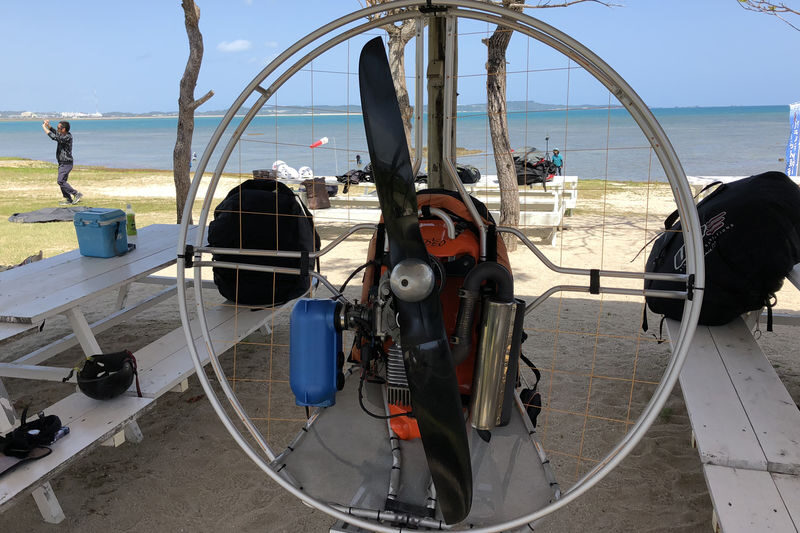
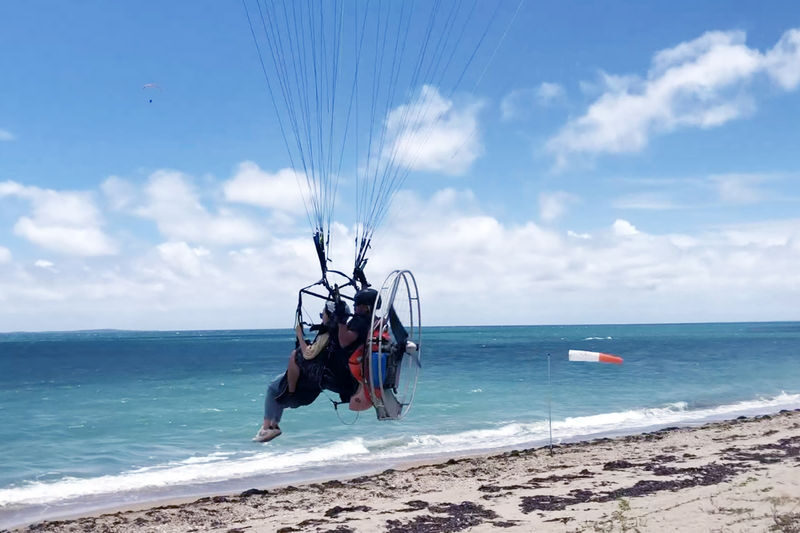
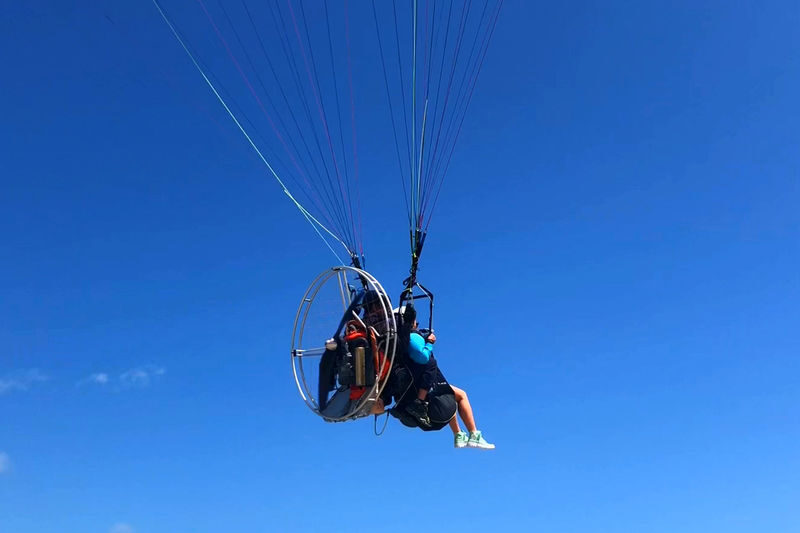
Powered paragliding combines a paraglider wing with an engine unit. You fly with an instructor, who controls the direction, while you sit back and look out over the coast. It is a different feel from parasailing behind a boat: the flight is more open, and the scenery is not framed by a tow line and a boat deck.
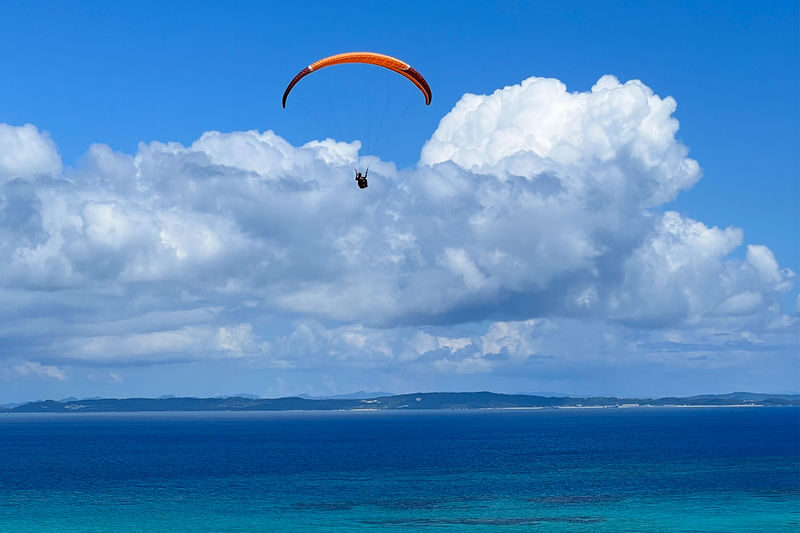
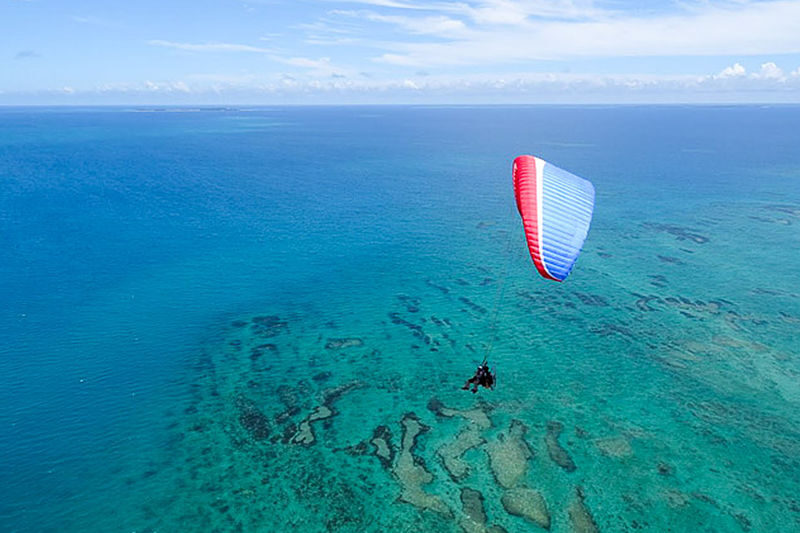
The experience is short, but it offers a view that is hard to get from shore. You may see the coastline and bay spread out beneath you, with Okinawa’s pale beaches and changing sea colors making the strongest impression. The exact view depends on where the wind allows the team to launch that day.
It is worth setting expectations about height. A paraglider does not climb like an airplane. It can gain height by catching rising warm air, called thermals, but those currents are intermittent and vary in strength. The instructor may want to climb higher, but no one can promise a particular altitude or flight path.
You can also read our reviews of more tours and experiences in Okinawa.


Getting to the take-off site from Midtown Mall
Midtown Mall is the listed meeting point, but it is not necessarily where you will take off. The launch area is usually in Nakagusuku, Uruma, or Yomitan, about 40 to 60 minutes by car from Naha. The operator adjusts the site to suit the wind, then confirms the time and location before the flight.
That makes having your own transport a real advantage. There is no pick-up or drop-off service, and a changing launch location can complicate a tightly planned day if you rely on public transport or a taxi. If you are driving around Okinawa, this activity fits more naturally into your plans.
Keep your phone available for messages before the flight. The location and schedule can shift as the wind forecast develops. A contact named Frank has been noted for prompt replies and clear directions, though you should not assume he will be your instructor or contact on the day.
From check-in to take-off: the part where you need to help
At the site, expect to check in, confirm your weight, put on the flight equipment, and receive instructions from the team. There may be other groups ahead of you, so allow extra time beyond the flight itself. One person reported having time to watch other take-offs while waiting, which can make the instructions easier to picture.
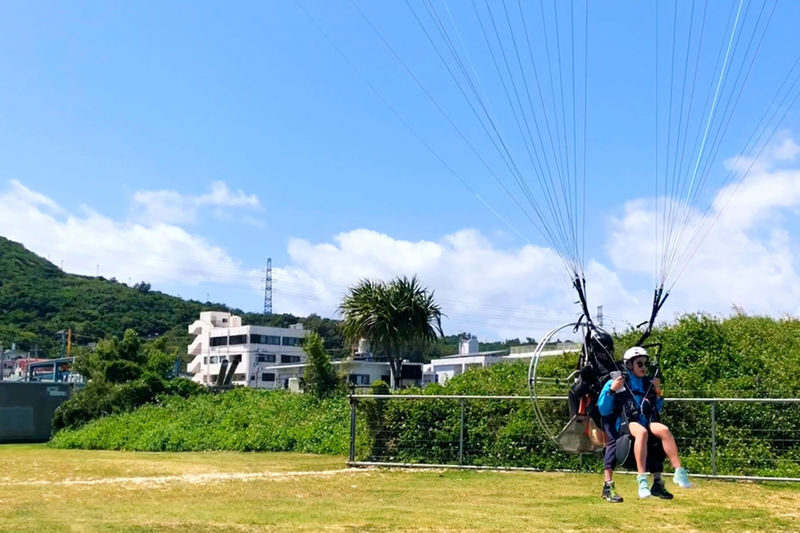
Take-off is the one phase that calls for active cooperation. Wear shoes you can run in. When the instructor tells you to run, take big steps and keep going until you have cleared the take-off area and are airborne. The operator specifically cautions against sitting down if your feet lift briefly and then touch the ground again. Keep your feet pointed down and be ready to run again.
That advice matters because the instructor cannot simply pull a passenger into the air. If you stop running or sit down, the take-off may fail. If you are nervous, tell the instructor before you begin and listen closely to the briefing. The flight itself is instructor-controlled, but a steady, committed run helps get it started.
In the air: a short window for Okinawa’s coast
Once airborne, the instructor controls the direction and you can focus on the view. The scheduled flight time is about 10 to 15 minutes, though some people have described flights closer to 5 or 10 minutes. Treat the stated duration as an approximate window, not a guaranteed time in the air.
From above, the coast and bay are the main event. Clear weather can bring out the sea’s many colors and the long white line of shoreline. Several people have described the view as the highlight, and it is easy to see why: the height gives you a broader sense of Okinawa’s coast than you get from a beach or roadside viewpoint.
The flight is not necessarily a fast, plunging thrill ride. It can feel calm and steady, and some people find it relaxing once they are airborne. That is useful to know if you are curious but wary of dramatic drops. Still, this is an outdoor flight, not a fixed-route attraction: the wind shapes the take-off conditions, altitude, and flight.
Landing is handled by the instructor. A smooth landing has been reported, but conditions vary, and it is best to follow the pilot’s directions rather than assume every flight will feel identical.
Family flights: check the combined weight rule
Children must be at least 3 years old. Children aged 3 to 6 need to fly with a paying adult, while children aged 7 and older may fly unaccompanied. The parent-and-child arrangement has a separate combined-weight limit: the adult and child together must weigh less than 65 kg, and both are charged separately.
For an individual flight, the stated weight range is 20 to 75 kg. The operator also says people weighing 75 to 80 kg may be considered depending on local wind conditions, with an extra ¥3,000 cash fee. That is a conditional exception, not a dependable way around the standard limit. If your weight is near the cutoff, check with the operator before booking and give an accurate figure. If the on-site measurement exceeds 75 kg and you cannot fly, a refund is not available.
Participants must be under 70. The activity is not recommended for people with high blood pressure, epilepsy, or heart disease, for pregnant women, or for infants. You must sign a liability waiver. The activity is not wheelchair- or stroller-accessible.


Safety and weather: sensible expectations matter
The flight is tandem, with a professional instructor controlling the paraglider. The operator describes modern paragliding equipment as including a reserve parachute and cushioning beneath the seat, along with a wing designed to recover from some turbulence-related folds. This is reassuring context, but it is not a reason to ignore the risks. Read the waiver, follow the instructor’s directions, and consider accident or travel insurance.
Weather is the biggest practical uncertainty. A sunny sky does not guarantee a flight: the wind may be unsuitable, or there may be too little wind. The team can move the launch site, reschedule, or cancel based on conditions. If severe weather or another unforeseen event leads the operator to cancel, you may request a full refund.
Build flexibility into your Okinawa plans. Avoid booking this as the last activity before a fixed departure or an important appointment. A weather-related cancellation can be disappointing, but flying in unsuitable conditions would be the worse bargain.
What the price covers, and what costs extra
The experience starts at US$117.55. That includes insurance provided by the operator, flight-equipment rental, an instructor who speaks Japanese or English, and Chinese customer service. For a short flight, it is not a low-cost activity, but the price covers the specialized equipment and instructor-led flight rather than just access to a viewpoint.
Transport and personal expenses are extra. Video is optional at ¥3,000 per person, paid directly to the coach. One person described receiving a one-minute video, but the length and delivery details should be confirmed on site. Bring your own camera only if the operator allows it and you can use it safely; do not assume you can handle a device during take-off or flight.
One person reported finding a lower price by booking on site, but that is not a reliable guarantee of availability or current pricing. Compare the total cost, including transport and any video fee, and consider the risk of arriving without a confirmed place. Booking ahead may suit a fixed itinerary; asking the operator about current direct rates may suit a flexible, self-driving visit.
Who will enjoy this flight most
This works best for people who want an unusual coastal view and are comfortable with a short, weather-dependent activity. Couples and friends can share the outing, while families can consider the paired flight if they meet the age and combined-weight rules. It is also a good choice if you are curious about paragliding but prefer an instructor to handle the controls.
It may not suit you if you need a guaranteed start time, cannot run at take-off, or have little room to adjust your plans. The flight is brief, and you may spend more time travelling and waiting than in the air. For anyone expecting a long aerial tour or a guaranteed climb to great height, this is likely to feel too short and unpredictable.
Should you book the Okinawa powered-paragliding flight?
Book it if the idea of seeing Okinawa’s coast from above appeals to you, you can travel to a changeable launch site, and your schedule can absorb a delay or cancellation. The most useful preparation is simple: confirm the meeting point close to the date, arrange your own transport, wear running-friendly shoes, and check the weight rules carefully.
Skip it if you need a firm timetable or want a long flight for the price. For a flexible day and a first powered-paragliding experience, though, those 10 to 15 minutes can offer a memorable view that a beach stop cannot.
Okinawa Powered Paragliding Experience (Family Flights Available)
“although I couldn't fly due to weather, they were extremely friendly. I enjoyed their company and they drove me to my next activity, which they did…”
FAQ
How long is the flight?
The stated flight time is 10 to 15 minutes. Actual flights may be shorter, and the full activity takes longer if you need to wait for your turn.
Where does the flight take off?
Take-off is usually in Nakagusuku, Uruma, or Yomitan, around 40 to 60 minutes by car from Naha. The exact site depends on the wind and will be confirmed before the activity.
Is transport included?
No. Pick-up and drop-off are not available, so you need to arrange your own transportation.
Can a parent and child fly together?
Yes. The parent and child must weigh less than 65 kg combined, and each pays separately. Children aged 3 to 6 must be accompanied by a paying adult.
What should I wear?
Wear pants and sneakers or sandals that are suitable for running. You need to run during take-off when instructed.
What happens if the weather is unsuitable?
The launch site may change, or the activity may be canceled because of wind or other weather conditions. If the operator cancels due to extreme weather or an unforeseen event, you may request a full refund.