Münster’s old town packs a striking mix of stories into a short walk: the 1648 Peace of Westphalia, the grim tale of Anabaptist King Jan van Leiden, and elegant gabled houses along Prinzipalmarkt. This tour gives you a guide to connect those landmarks rather than leaving you to piece together the city’s past on your own.
I like that the route pairs major sights with human stories, especially at Lambertikirche, and that the guide explains Münster’s history in an entertaining, clear way. I also like the practical 90-minute length: you get a useful introduction without giving up half a day.
One consideration is that the tour is in German only. It also runs rain or shine, so you’ll want suitable clothes and shoes for an outdoor walk.
- What makes this Münster walk worth your time
- Starting at the Peace of Westphalia town hall
- Prinzipalmarkt’s gables, arcades, and shops
- Münster Cathedral as a quieter pause
- Lambertikirche and the unsettling Anabaptist story
- The Dominican Church and a modern art surprise
- A guide-led introduction in just 90 minutes
- Is a fair price?
- Weather, timing, and a few practical notes
- Who should book this old-town tour?
- FAQ
- How long is the Münster old-town tour?
- What language does the guide speak?
- Where is the meeting point?
- Which sights are included?
- Is the tour wheelchair accessible?
- What happens if it rains?
- The Best Of Munster!
- More Tours in Munster
- More Tour Reviews in Munster
- Not for you? Here's more nearby things to do in Munster we have reviewed
What makes this Münster walk worth your time
- The Peace of Westphalia starts the story: Meet at the town hall associated with the 1648 peace agreement, a natural place to begin understanding Münster’s role in European history.
- Prinzipalmarkt is more than a pretty street: Look up at the gabled houses, then notice the shops beneath the arcades and the way historic architecture sits alongside everyday city life.
- Lambertikirche has a dark chapter: The church’s Anabaptist cages connect the city’s skyline with the unsettling story of Jan van Leiden.
- The cathedral offers a pause: Its setting makes a quieter stop amid the activity of market days.
- There is modern art in the old town, too: The Dominican Church contains a multi-layered work by Gerhard Richter, a surprising counterpoint to the older buildings.

👉 See our pick of the 2 Best Tours In Munster
Starting at the Peace of Westphalia town hall
The meeting point is the Chillida sculpture, described as two steel benches, in the lowered area of Westphalian Peace Square. Look for a guide wearing a Lupe Münster name tag. It’s a specific landmark, but the square’s lowered layout means it helps to check the area carefully rather than waiting at a nearby street entrance.
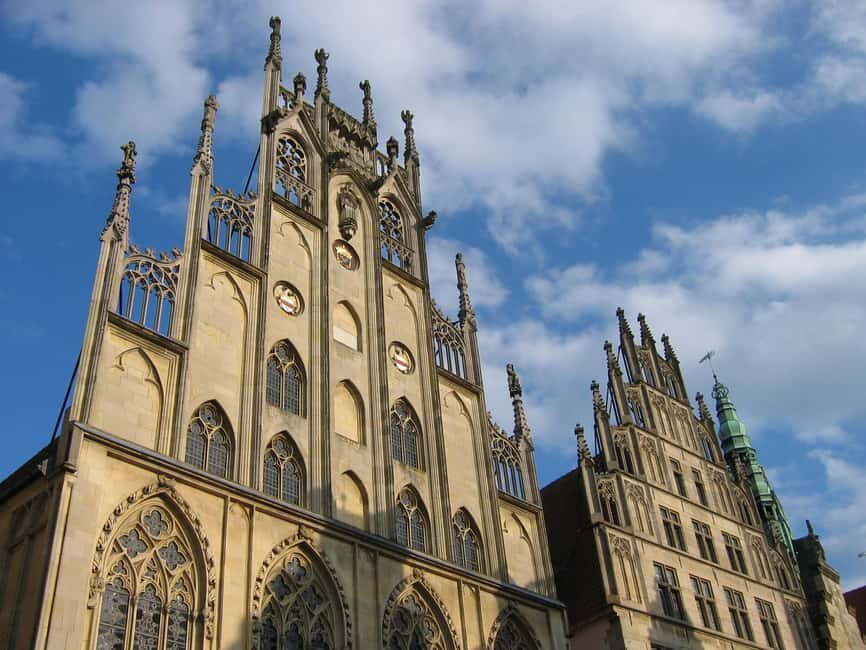
From there, the tour begins at the historic town hall associated with the Peace of Westphalia in 1648. That date gives the walk a strong first chapter: instead of treating the building as a handsome façade, your guide can set it within the events that made Münster an important place in European history.
The town hall is also a good example of what a guided walk does well. You can photograph a historic building on your own, but a guide can give you the context that turns a quick look into a reason to remember it. The emphasis here is on stories and explanation, not simply ticking off landmarks.
You can also read our reviews of more tours and experiences in Munster.



Prinzipalmarkt’s gables, arcades, and shops
The Prinzipalmarkt is one of the old town’s most distinctive sights. Its gabled houses create a memorable street front, while the shops beneath the arches keep the space tied to modern daily life. Look up at the façades, then look under the arcades: the contrast is part of the appeal.
This is a useful stop for anyone who wants more than a checklist of monuments. The buildings are historic, but the street is also a place where people shop and meet. Your guide can help you notice how the old town works as a living part of Münster, rather than as a preserved set piece.
The area may be busier on market days, so keep in mind that a walk through a popular central spot can feel lively rather than hushed. That energy is part of its character, but it can make it harder to linger or take photographs without people in the frame. If you prefer quieter streets, ask about the day’s conditions when you arrive.
Münster Cathedral as a quieter pause
St. Paul’s Cathedral is another major stop, and the tour presents it as a calm spot amid the movement of market days. That contrast gives the walk a change of pace: after the active streets and commercial arcades, the cathedral offers a chance to take in a substantial historic building at a slower speed.
The information provided doesn’t specify whether the tour goes inside, so plan on the exterior and setting as the confirmed part of the experience. If entering the cathedral matters to you, ask the guide on the day rather than assuming it is included. Either way, the stop helps you see how Münster’s religious landmarks fit into the old town’s everyday rhythm.
A guided visit is especially useful here if you want to understand what you’re looking at without preparing a long reading list in advance. You’ll hear stories about the city’s past along with details about its present-day character, making the cathedral one piece of a broader picture.
Lambertikirche and the unsettling Anabaptist story
Lambertikirche brings a darker tone to the walk. The church is linked to the history of Jan van Leiden, the Anabaptist king, and the Anabaptist cages are a stark reminder of that chapter. The tour describes this part of the story as creepy, and the setting gives the history a concrete focus.
This is a powerful stop because it avoids reducing Münster’s past to grand buildings and peace treaties. The cages invite questions about power, belief, and punishment, while the guide’s account can put the episode into context. It is the kind of place where a short explanation matters: without one, you may notice the unusual objects but miss why they are there.
The story may feel grim, especially for younger children. Families can decide how much detail is right for their group, and preschool children can join for free when accompanied by an adult. The walk itself is not described as a children’s tour, so don’t assume the history will be softened for young listeners.
More Great Tours NearbyThe Dominican Church and a modern art surprise
The Dominican Church adds a different kind of discovery. It features a multi-layered work by Gerhard Richter, placing a modern artistic statement within a historic religious building. That contrast broadens the tour beyond medieval and early modern history.
If you’re used to walking tours that focus only on old stones, this stop offers a welcome change of subject. It gives your guide room to talk about how Münster’s cultural life continues to develop, and it may appeal especially to anyone interested in art as well as architecture.
The details supplied don’t specify how long the group spends at the church or whether the artwork is viewed from a particular position. Treat it as a stop for an introduction, rather than expecting a full art lecture or extended time inside. The value is in seeing a surprising work in context and having a guide point out why it belongs on an old-town route.





A guide-led introduction in just 90 minutes
The walk lasts 1.5 hours, or 90 minutes. That’s enough time to cover several of Münster’s best-known sights and hear stories that connect them, while leaving the rest of your day open for museums, cafés, or a return visit to a place you liked.
The guide is qualified and speaks German. The strongest feature of the guiding style is the combination of clear explanations and entertaining delivery. You can expect historical facts, anecdotes, and observations about everyday life, rather than a dry recital of dates. If German is not a language you understand comfortably, this may not be the right tour for you, since no other language is listed.
The route is a walking tour of the old town’s top sights, and the activity is marked wheelchair accessible. If you have particular access needs, it’s still sensible to confirm the route details with the provider before booking, since the information here does not specify surfaces, distances between stops, or facilities.
Is $16 a fair price?
At $16 per person, the tour is a practical way to get an organized introduction to several central sights in one sitting. The price buys more than a route between buildings: the guide’s explanations are the main reason to go, especially at the town hall and Lambertikirche, where context makes the landmarks more meaningful.
It is also a reasonable choice if you have limited time in Münster. You won’t need to plan your own sequence of sights or research every stop beforehand, and a 90-minute walk is short enough to fit around other plans. Preschool children accompanied by an adult join free, which makes the cost easier for families with very young children.
The price is less compelling if you already know the old town well or cannot follow German. In those cases, you may get more from visiting the sights independently or choosing an activity in a language you understand. The tour’s value depends on whether its guided storytelling is useful to you.
Weather, timing, and a few practical notes
The walk takes place rain or shine. Dress for the season and check the forecast before setting out, since the experience is outdoors. Comfortable walking shoes and a weatherproof layer are sensible choices, particularly if the day looks changeable.
Starting times vary, so check availability for the date you want. The meeting point is the Chillida sculpture in the lowered area of Westphalian Peace Square, and the guide’s Lupe Münster name tag should help you identify the group.
You can cancel up to 24 hours in advance for a full refund, and the reserve-now, pay-later option lets you keep plans flexible without paying at the time of booking. These terms are useful if your schedule is still taking shape, though you should confirm the current conditions when reserving.
Who should book this old-town tour?
I’d choose this walk if you want a short, guided orientation that balances Münster’s best-known buildings with stories that are stranger and darker than a standard architecture stroll. The town hall, Prinzipalmarkt, cathedral, Lambertikirche, and Dominican Church make a varied set of stops, and the guide’s lively explanations are central to the experience.
It suits first-time visitors who want a clear introduction, as well as residents who would like to hear more about familiar streets. The compact duration is another plus if you have only part of a day. Families can bring preschool children at no charge with an adult, but should be ready for a historical account that includes unsettling material.
I’d skip it if you need an English-language tour, want to spend a long time inside each building, or prefer a self-paced visit. For German speakers who enjoy history told through both impressive landmarks and uncomfortable episodes, $16 is a fair price for a focused 90-minute walk. Book it if you want a guided introduction, and bring a layer for the weather.
Münster: Old Town Tour with Qualified Guides
FAQ
How long is the Münster old-town tour?
The walk lasts 1.5 hours, or 90 minutes.
What language does the guide speak?
The live tour guide speaks German. No other tour language is specified.
Where is the meeting point?
Meet at the Chillida sculpture, described as two steel benches, in the lowered area of Westphalian Peace Square. The guide wears a Lupe Münster name tag.
Which sights are included?
The tour covers old-town sights including the historic town hall, Prinzipalmarkt, St. Paul’s Cathedral, Lambertikirche, and the Dominican Church.
Is the tour wheelchair accessible?
The activity is marked wheelchair accessible. Specific route surfaces and access details are not provided.
What happens if it rains?
The tour runs rain or shine. Dress for the weather and season, since it is an outdoor walking activity.
You can check availability for your dates here: