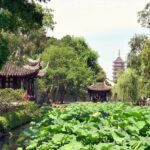
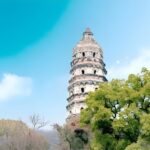
Chongyuan Temple’s most striking claim is easy to picture: inside its grounds stands a 33-meter indoor Guanyin statue, described as the tallest of its kind in China. The temple sits on the Yangcheng Lake Peninsula, and its scale gives this visit a different feel from a quick stop at a small neighborhood shrine.
I like two things here: the contrast between the temple’s centuries-old origins and its rebuilt, monumental spaces, and the simple entry process, which uses a QR code rather than a ticket exchange. One consideration is that the ticket covers admission only. You need to arrange your own transport, meals, and any paid activities, and you cannot re-enter after leaving.
- At a glance
- A large temple with a long past
- The Guanyin statue and the Daxiong Hall
- What the temple’s history adds
- Planning your visit on Yangcheng Lake Peninsula
- Ticket value and what the price covers
- Respectful conduct and small practical details
- Who should make time for Chongyuan Temple?
- Should you book Chongyuan Temple?
- FAQ
- Where is Chongyuan Temple?
- What are the temple’s opening hours?
- Does the temple open earlier on certain days?
- What is included in the ticket?
- Does the ticket include transportation or meals?
- How do I use the voucher?
- Is the ticket valid on any date?
- Can I leave and re-enter the temple?
- The Best Of Suzhou!
- More Tours in Suzhou
- More Tour Reviews in Suzhou
- Not for you? Here's more nearby things to do in Suzhou we have reviewed
At a glance
- A 33-meter indoor Guanyin: The temple’s headline feature is an unusually large statue and a central reason to make the visit.
- A vast Daxiong Hall: Chongyuan Temple is also known for what is described as China’s largest single Daxiong Hall.
- A long past, a rebuilt present: Founded in 503 AD, the temple has more than 1,500 years of history, though today’s site is rebuilt.
- A date-specific entry ticket: Scan the QR code on your official electronic voucher at the East Gate ticket office.
- A clear budget entry point: Adult admission starts at $3.49, while transport, dining, and other spending are extra.

👉 See our pick of the 3 Best Guided Tours In Suzhou
A large temple with a long past
Chongyuan Temple was first built in 503 AD, during the Southern and Northern Dynasties, under Emperor Wu of Liang. It was completed one year after Hanshan Temple, another of Suzhou’s best-known Buddhist sites. That date gives Chongyuan a substantial historical pedigree, but it is worth keeping the distinction clear: the temple you visit today is rebuilt.
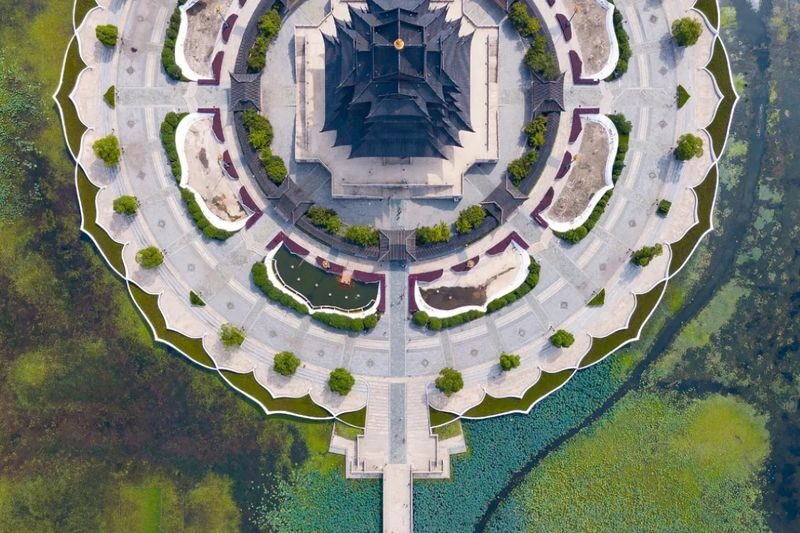
Its present setting is the Yangcheng Lake Peninsula, at No. 333 Yangcheng Ring Road in Suzhou Industrial Park. The site is presented as a Buddhist holy place shaped around the ideas of a lotus Buddhist kingdom and a Guanyin Bodhimanda. Those terms point to a devotional setting, not simply a collection of oversized structures. If you visit, approach it as a place of worship as well as a scenic area.
The temple is associated with ten national records. Two are especially easy to grasp as a visitor: the 33-meter indoor Guanyin and the size of the single Daxiong Hall. Those claims tell you what kind of visit to expect. This is not a ticket for an intimate, quiet historic interior alone. The rebuilt complex also makes a strong impression through its monumental scale.
You can also read our reviews of more tours and experiences in Suzhou.


The Guanyin statue and the Daxiong Hall
The 33-meter indoor Guanyin is the clearest focal point to plan around. Its height is the sort of detail that makes this temple distinct among Suzhou’s cultural stops, and the fact that it is indoors matters: you are coming to see a major religious image within a temple building, not a statue set in an outdoor park.
The Daxiong Hall is the other major feature. It is described as China’s largest single Daxiong Hall, a claim that signals the size of the structure, though no exact dimensions or interior details are provided. Give the hall time rather than treating it as a corridor between photo stops. Its scale is part of the experience, and the setting asks for a quieter pace than a standard sightseeing attraction.
There is no guided tour or named guide included with this ticket. You can visit independently, which suits anyone who prefers to set their own pace, but you should not expect an included guide to explain the symbolism or history. If you want detailed interpretation, consider arranging that separately before you go.
The available information does not prescribe a route through the grounds, list specific exhibits, or give a visit duration. I would avoid planning around a tightly timed sequence. Instead, allow room to see the main hall and Guanyin without rushing, then explore the rest of the temple at a respectful pace.
What the temple’s history adds
The 503 AD founding date gives Chongyuan Temple a place in Suzhou’s long religious past. It was established during the Southern and Northern Dynasties under Emperor Wu of Liang, and its completion just one year after Hanshan Temple helps place it in the same broad period as a landmark many visitors already know.
Still, history here needs a little context. A long founding history does not mean every building on the site is original. The present temple has been rebuilt, so the appeal lies in the combination of an old religious lineage and a modern, large-scale complex. If you expect an untouched ancient structure, adjust that expectation before you arrive.
That mix can be rewarding in its own right. The old date gives the site historical weight, while the present-day scale makes the religious focus immediately visible. The key is to appreciate both without confusing the age of the institution with the age of every building you see.
Planning your visit on Yangcheng Lake Peninsula
The admission address is No. 333 Yangcheng Ring Road, Suzhou Industrial Park, Jiangsu Province. Entry is through the ticket office at the East Gate of Chongyuan Temple. That precise gate detail is useful: set your map destination to the East Gate or ticket office rather than assuming any entrance will work.
Round-trip transportation is not included. You will need to plan how to reach the peninsula and back, and the ticket does not cover meals or personal insurance. No transport method, travel time, parking detail, or shuttle service is specified, so check those arrangements separately before setting out.
The temple is open daily from 7:30 a.m. to 5 p.m., with last entry at 4:30 p.m. On the first and fifteenth days of each lunar month, it opens earlier, at 6:30 a.m., and closes at 4:30 p.m. If you are visiting on one of those lunar dates, note that the usual closing time does not apply.
The hours make an earlier arrival the sensible choice if you want an unhurried visit. Arriving near last entry leaves little margin, especially when you have not confirmed the route around the grounds. There is no stated visit duration, so plan according to your own pace rather than assuming you can see everything in a fixed amount of time.
Ticket value and what the price covers
Adult admission starts at $3.49, and the same price applies to all ages. At that starting price, the ticket can be an economical way to see a temple whose main draws include a very large indoor Guanyin and a nationally notable hall. It is particularly good value if you are already in the area or can combine the stop with other plans in Suzhou.
The low entry price does not make this an all-in outing. The ticket includes one Chongyuan Temple Scenic Area entrance ticket. It does not include transport, food, personal insurance, paid entertainment facilities, secondary purchases, or other expenses not named as included. Budget the visit as an admission cost, not a package with travel and extras bundled in.
The ticket is sold as an adult package, but the stated eligibility rule says the same price applies to all ages. The voucher is valid only for the selected date, and entry is by QR verification on the official electronic voucher. There is no need to exchange it for a paper ticket.
If price is your main concern, the value is straightforward: you pay a modest amount to enter a large temple complex and see its headline religious features. If you need a guide or transport arranged for you, this ticket will not meet that need by itself.


Respectful conduct and small practical details
Chongyuan Temple is a Buddhist site, so dress with care. The stated rules ask visitors not to wear clothing that leaves the shoulders or back bare. Keep your voice low, and do not touch Buddhist statues or ritual instruments.
You also cannot re-enter after leaving the venue. That rule is easy to overlook when planning a meal or a break, so settle those plans before you exit. Since dining is not included and no facilities are specified, do not assume you can leave and come back later on the same ticket.
During peak season, booking five to ten days ahead is recommended. In the off-season, the suggested lead time is one to three days. The ticket becomes effective once payment succeeds, but its use remains tied to the selected date. Because it is non-changeable, check your date and plans before you pay.
Cancellation is conditional. If it is more than 24 hours before the visit date and the ticket has not been exchanged or used, a full refund can be requested. Within 24 hours, after exchange or admission, or after the ticket expires unused, refunds and rescheduling are not available.
Who should make time for Chongyuan Temple?
I would put Chongyuan Temple on your list if you are interested in Buddhist architecture, religious art, or the scale of major temple complexes. The indoor Guanyin and large Daxiong Hall give you two clear reasons to visit, while the site’s 503 AD founding provides a useful historical frame.
It is also a sensible choice for independent visitors who are comfortable arranging their own transport and exploring without a guide. The QR entry is uncomplicated, and the low starting price keeps admission accessible. But if you need an organized excursion, transport, or detailed on-site interpretation, this ticket alone is not a complete solution.
The temple may be less satisfying if your main goal is to see untouched ancient architecture. Chongyuan’s present complex is rebuilt, and its defining features are monumental rather than described as original historic interiors. Go for the religious setting, the large-scale halls, and the Guanyin, while keeping that distinction in mind.
Should you book Chongyuan Temple?
Book if the 33-meter indoor Guanyin, the enormous Daxiong Hall, and a temple with roots in 503 AD sound worth a stop in Suzhou. The entry price is low, and the date-specific QR voucher keeps admission simple. Just arrange your own transport, dress respectfully, and allow enough time before the 4:30 p.m. last entry.
Skip it if you are looking for a guided tour, included transportation, or a fully planned day out. This is a temple admission ticket, not a complete excursion. For independent visitors with an interest in Buddhist sites, it offers a focused and reasonably priced visit.
FAQ
Where is Chongyuan Temple?
It is at No. 333 Yangcheng Ring Road, Suzhou Industrial Park, Suzhou, Jiangsu Province. The admission point is the ticket office at the East Gate.
What are the temple’s opening hours?
It is open daily from 7:30 a.m. to 5 p.m., with last entry at 4:30 p.m.
Does the temple open earlier on certain days?
Yes. On the first and fifteenth day of each lunar month, it opens from 6:30 a.m. to 4:30 p.m.
What is included in the ticket?
The ticket includes one Chongyuan Temple Scenic Area entrance ticket.
Does the ticket include transportation or meals?
No. Round-trip transportation and dining are not included. Personal insurance, paid entertainment facilities, and other unlisted expenses are also excluded.
How do I use the voucher?
Show the QR code on your official electronic voucher for verification. You do not need to exchange it for another ticket.
Is the ticket valid on any date?
No. It is valid only on the selected date, and time if a time is specified.
Can I leave and re-enter the temple?
No. Re-entry is not allowed after you leave the venue.