
Thai dance is less about mastering a difficult routine than learning how movement, music, and meaning fit together. In this 50-minute class at Dee Village in Samut Prakan, an instructor guides you through traditional hand and foot movements, then leads several dances to songs with translations.
I like two things in particular: you can borrow a Thai costume at no extra charge if you want to wear one, and the music comes with translations that give the steps cultural context. The routines are taught gradually, so you can join in without dance experience.
One consideration: the studio is outside the Siam area, so plan your route rather than assuming it is a central Bangkok activity. Costume sizes may not suit everyone, and the school can be hard to spot from the street.
- The class at a glance
- Thai dance taught one movement at a time
- From traditional gestures to a livelier workout
- Deciding whether to wear the Thai costume
- Finding Dee Village on Thepharak Road
- What the price buys you
- Who will enjoy this class most
- Should you book TICER’s Thai Fun Dancing?
- FAQ
- How long is TICER’s Thai Fun Dancing?
- Where does the activity take place?
- Is a Thai costume included?
- Do I need dance experience?
- Which days and times can I book?
- Can I take photos during the class?
- More Tours in Samut Prakan
- More Tour Reviews in Samut Prakan
- Not for you? Here's more nearby things to do in Samut Prakan we have reviewed
The class at a glance
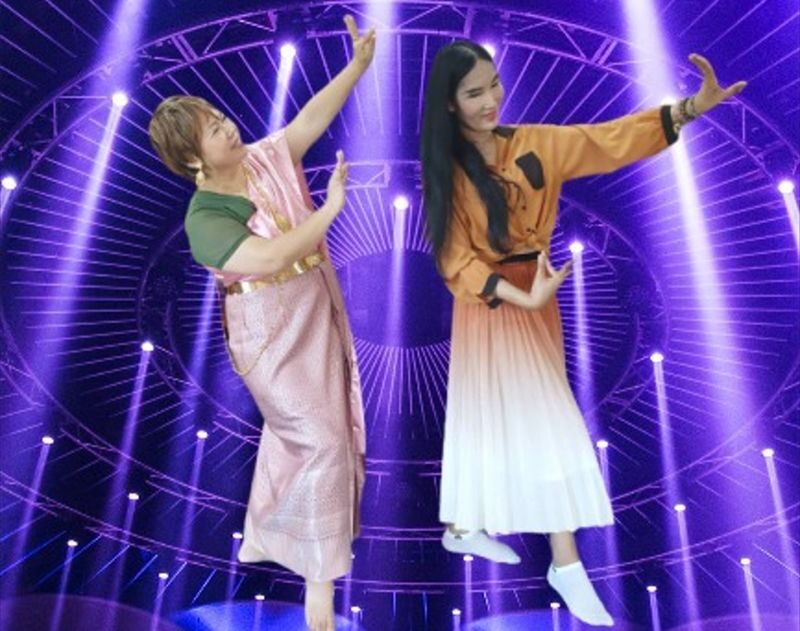
- Start with Thai dance basics: Your instructor introduces the movements, the occasions when dances are used, and the songs you will hear.
- Borrow a costume if you like: Traditional clothing is available free to use, but wearing it is optional.
- Learn through translated songs: The music helps explain the meaning behind the dances, not just the rhythm.
- Expect more than one style: The class combines traditional dance with livelier routines, including Thai aerobic-style movement.
- Allow 50 minutes: It is a compact activity that can fit into a half-day in Samut Prakan.
- Find the studio at Dee Village: The address is on Thepharak Road. Look for the dance school entrance and check the second floor if you do not see a clear sign.
Thai dance taught one movement at a time
The session begins with an introduction to Thai dance basics, the occasions associated with the dances, and the songs chosen for the class. That context matters. Thai dance can look formal from the outside, with precise hand positions and deliberate gestures, but a brief explanation helps you understand that movement is meant to express something, not simply decorate the music.
The instructor then teaches the steps in manageable parts. You follow hand movements, body positions, and footwork, with guidance to help you find the rhythm. No dance background is listed as a requirement, and the class is designed for people to follow along step by step. If you are shy about performing, remember that this is a participatory lesson, not a stage audition.
Several songs with different beats are used. Their translations give you another way into the experience: you can pay attention to the words and mood as well as the choreography. The combination makes this more engaging than a short dance demonstration, because you are asked to try the movements yourself and connect them to the music.
The teaching is in English, with one account of the class describing simple English and Thai. That is a practical fit for an international group: the movements can be shown as well as explained, and you do not need advanced language skills to copy a sequence. No instructor name is provided, so you cannot request a particular teacher when booking.
You can also read our reviews of more tours and experiences in Samut Prakan.

From traditional gestures to a livelier workout
The class does not stick to one pace or style. You start with traditional movement and later work through livelier choreography. The session has included modern music and Thai aerobic-style dancing, which feels more like an easy group workout than a formal cultural lesson.
That shift is useful if you are unsure whether you will enjoy a full class of careful hand positions. The traditional section offers a window into a dance form and its music; the faster part gives you room to loosen up and move more freely. The choreography is described as simple enough to follow, though you will still need to pay attention to the instructor’s cues.
Think of the class as a cultural activity with a bit of exercise, rather than a complete course in Thai dance. In 50 minutes, you can learn a few movements and try several routines, but you should not expect detailed training in dance technique. For most people, that short format is a plus: it gives you a taste without taking over the day.
The class is recommended for solo participants, families, and groups of friends. That range makes sense here. You can take part on your own without needing a partner, while a group can share the fun of learning the same steps. Children and adults of different sizes can participate, though a suitable costume may not be available for everyone.
Deciding whether to wear the Thai costume
A costume is provided for free, and changing into it is optional. It can make the session feel more connected to the dance and adds a visual touch to photographs. If you would rather stay in your own clothes, you can still take part in the full class.
Wear casual clothing, as advised for the activity. If you plan to borrow a costume, choose something you can change out of easily. The venue says children and adults who are larger or smaller than the available costume sizes can still participate, but should not count on finding a suitable fit. That is worth bearing in mind if wearing traditional clothing is a major reason for booking.
Photos are allowed. You may want to ask the staff about the best time to take them so you do not miss the instructor’s directions. The class has included photos in costume, but the details of any staff photography are not guaranteed, so bring your own phone or camera if you want pictures.
Storage is available at the venue, but rates are set by the on-site staff. If you are carrying bags, check the cost before leaving anything there. The supplied details do not describe changing-room facilities or other storage arrangements, so keep your expectations modest and ask when you arrive.
Finding Dee Village on Thepharak Road
The class takes place at Dee Village, at 219 Moo 3, Thepharak Road, Bang Muang, Mueang Samut Prakan. The activity information gives the venue as a studio in the village. Directions from people who have attended describe it as close to an MRT station, with the school on the second floor and the words THAI DANCE SCHOOL visible on the glass door. They also note that there may not be a prominent sign outside.
Since the exact station name is not specified, check your route to the full Dee Village address before setting out. One attendee found the area easy to reach by BTS, while another described the studio as right by the MRT. These are useful indications, but the address and current transit directions are the safest guide. The location is a little way from the Siam area, so allow time for the journey.
You can book a departure at 10:00, 11:00, 13:00, 14:00, or 15:00. The session lasts 50 minutes, and the available return time depends on your chosen start. The listed operating days are Monday through Thursday, from 10:00 to 18:00, with last admission an hour before closing. The venue is closed Friday through Sunday.
Arrive ready to give your booking name or show identification, such as a passport, to enter the session. The activity details say the schedule can change due to traffic and weather, though the class itself is at the venue. Confirm your selected time and the meeting instructions on your booking before you go.
What the price buys you
The advertised price starts at US$16.39, while the 50-minute English session is also shown from US$14.89. Prices can vary, so check the total for your date and package before paying. The stated inclusions are admission, English-speaking staff, tax, and free use of a Thai costume. Personal expenses are extra.
For a short activity, that is a sensible package if you value hands-on participation. You are paying for a guided lesson, several dance styles, translated music, and the option of wearing traditional clothing, rather than simply watching a performance. It may be especially good value if you are curious about Thai culture but have limited time for a longer class or workshop.
The value depends partly on what you want. If your priority is a detailed dance course, 50 minutes will feel brief. If you want a friendly introduction and a chance to move along with the music, the compact session makes it easy to fit between other plans. It is also a different kind of outing from a museum visit or a costume rental, because the main activity is learning and dancing.
You can cancel for a full refund if you do so at least 24 hours before the activity date, based on the destination’s local time. Changes are allowed until 24 hours before the start, subject to the stated exceptions for certain passes, presale bookings, freebies, and vouchers that have not yet been issued. The voucher is valid only for the booked date and time.




Who will enjoy this class most
I would pick this activity if you want to do something participatory and distinctly Thai without committing to a long lesson. It suits solo visitors who like trying new activities, families looking for something active, and friends who are happy to laugh their way through unfamiliar steps. The English instruction and step-by-step approach make it approachable even if you have never danced.
It also works well near the end of a trip. You can finish with a cultural activity that asks you to do more than look and listen, and the costume option gives you a memorable photo opportunity. If you are heading toward the airport afterward, one attendee found it convenient as a final stop, but do not assume the class is at the airport or that your transfer is included. Check your own route and leave enough time.
This is not the right choice if you need a full-length dance workshop, expect a guaranteed costume fit, or want an activity in central Bangkok. The short duration is its strength and its limit. For a small dose of Thai dance, music, and movement, it is an appealing way to spend 50 minutes.
Should you book TICER’s Thai Fun Dancing?
Book it if you are curious about Thai dance and would rather learn a few steps than sit through a performance. The mix of traditional gestures, translated songs, and a more energetic final section gives you a useful introduction, while the free costume keeps the activity accessible. Check the route to Dee Village, confirm your time, and treat the costume as an option rather than a guarantee of fit. If those details suit your plans, this is a lively, low-commitment cultural stop.
TICER’s Thai Fun Dancing
“I was worried because there were no Korean reviews, but the instructor was so kind and taught me well, and it was fun to learn traditional dance! I…”
FAQ
How long is TICER’s Thai Fun Dancing?
The English session lasts 50 minutes.
Where does the activity take place?
It takes place at Dee Village, 219 Moo 3, Thepharak Road, Bang Muang, Mueang Samut Prakan, Thailand.
Is a Thai costume included?
Yes. You can use a Thai costume for free, but wearing it is optional. A suitable size may not be available for every participant.
Do I need dance experience?
No dance experience is specified as a requirement. The instructor introduces the basics and guides participants through the movements step by step.
Which days and times can I book?
The activity is listed Monday through Thursday, from 10:00 to 18:00, with last admission one hour before closing. Departure times offered are 10:00, 11:00, 13:00, 14:00, and 15:00, depending on availability.
Can I take photos during the class?
Yes. Photo-taking is allowed.