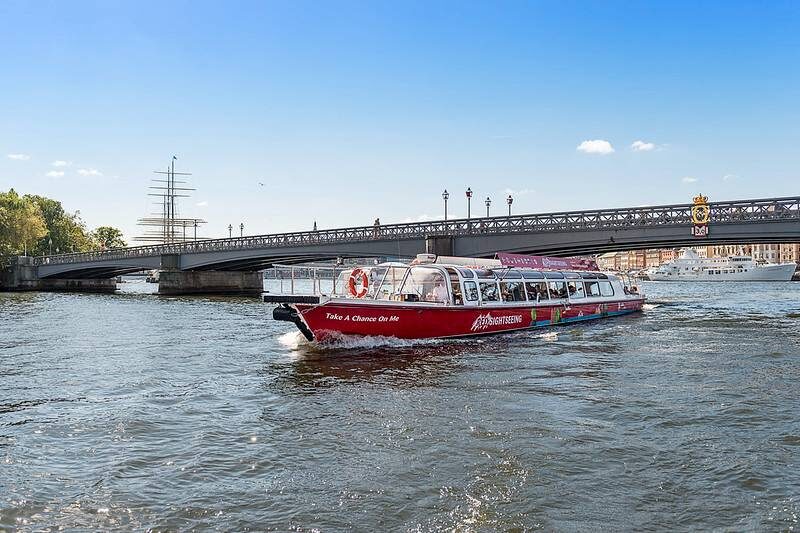
Stockholm’s sights sit across islands and waterways, so this hop-on, hop-off service gives you two useful ways to get around: a bus route through the city and a boat route between waterfront stops. Choose one, or combine them to see the capital from both street level and the water.
I like the choice of routes, especially if you want to link Old Town with Djurgården’s museums without planning every connection yourself. I also like the daytime frequency: buses depart every 45 minutes, and boats run hourly, with an audio guide available in 14 languages.
The main catch is that the pass is not a substitute for all-day public transport. Both routes operate only between 10:00 and 16:00, and the boat’s hourly schedule leaves less room for a missed departure. Check which ticket you are buying, too: some options cover only the boat or only the bus.
- Key points before you choose
- A bus and boat pass for an island city
- Starting in the center: Tegelbacken and the Royal Opera
- Djurgården: Vasa Museum, Skansen, and ABBA The Museum
- City Hall, central Stockholm, and the longer bus loop
- What the schedule means for your day
- Audio, app, and practical details
- Is the pass worth the price?
- Should you book it?
- FAQ
- What ticket options are available?
- How often do the bus and boat depart?
- Does the pass include admission to museums and attractions?
- Which languages are available for the audio guide?
- Are the buses and boats wheelchair accessible?
- Do children need a ticket?
- The Best Of Stockholm!
- More Tours in Stockholm
- More Tour Reviews in Stockholm
- Not for you? Here's more nearby things to do in Stockholm we have reviewed
Key points before you choose
 1 / 9
 2 / 9
 3 / 9
 4 / 9
 5 / 9
 6 / 9
 7 / 9
 8 / 9
 9 / 9
- Two views of Stockholm: The bus links central streets and major attractions; the boat connects waterfront stops and offers a different view of the city.
- Pick the pass that fits: Options include 24-hour bus, boat, or combined tickets, plus 72-hour boat and combined passes.
- Plan around the operating window: Buses depart every 45 minutes and boats every hour, both from 10:00 to 16:00.
- The headline attractions are stops, not admissions: Your pass covers transport, not entry to places such as the Vasa Museum, Skansen, or ABBA The Museum.
- Use the app to track service: The Red Sightseeing app shows stop locations and real-time bus and boat positions.
- The boat is not wheelchair accessible: Most buses are accessible, but passengers must be able to board and leave independently for safety.

👉 See our pick of the 25 Best Guided Tours In Stockholm
A bus and boat pass for an island city
Stockholm’s geography makes this service more useful than a simple loop around a compact city center. The bus route calls at central points, museum areas, cruise terminals, and places such as City Hall, while the boat route links several of the same sights by water.
That means you can use the pass as a sightseeing framework, not just a ride. Start with a broad look at the city, get off where you want to spend time, then pick up the route again. The combined ticket makes most sense if you want both the land and water views; if you only need one type of transport, the separate bus and boat tickets let you avoid paying for the other.
The fare starts at $24.75, though the exact price depends on the ticket option. Think about what you will realistically use. A combined pass has better value if you plan to make several stops and take at least one boat leg. If you intend to walk around central Stockholm and only want a short water outing, a boat-only ticket may suit you better. The pass does not include attraction admission, so budget separately for museums and other paid sights.
You can also read our reviews of more tours and experiences in Stockholm.



Starting in the center: Tegelbacken and the Royal Opera
The bus route begins at Tegelbacken, then calls at Gustav Adolfs Torg and the Royal Opera House. These central stops are handy if you want to start near the heart of the city rather than making your first destination a museum or island.
From there, the route heads to Old Town and Slussen. Old Town is one of the key stops for exploring Stockholm on foot, while Slussen is a useful link between the city’s central areas and southern stops. I would use the bus here to get oriented, then allow time to walk around the places that interest you. The bus is a way to connect sights, not a replacement for exploring them at street level.
The boat route also calls at the Royal Palace and Nybroplan. That overlap gives you some flexibility: you can see central sights by land or use the water route to connect them with Djurgården and other waterfront stops.
Djurgården: Vasa Museum, Skansen, and ABBA The Museum
Djurgården is the busiest cluster of named attractions on the routes. The bus stops by Skansen, Gröna Lund, ABBA The Museum, the Vasa Museum, the Nordic Museum, and Junibacken. The boat also calls at the Vasa Museum and at Gröna Lund and ABBA The Museum.
This is where the combined ticket can earn its keep. You can reach the island by bus, spend time at one or more attractions, and return by boat rather than repeating the same route. The waterfront approach is a good reason to include a boat ride even if you mainly plan to visit museums.
Be clear about what the pass buys. It takes you to the stops, but admission to attractions is not included. If you have a particular museum in mind, check how much time you want there before deciding how many other stops you can fit into the service’s 10:00 to 16:00 operating window.
The boat also serves Skeppsholmen, another island stop, and the Museum of Photography near Slussen. Its route has eight listed stops, although the Cruise Berth S167 is not in operation during the winter season. A stop can also be affected by construction, so check the app on the day rather than assuming every listed dock is operating.
City Hall, central Stockholm, and the longer bus loop
The bus route includes City Hall and Rådhuset, as well as Tegelbacken, City Terminalen, Central Station, Hötorget Concert Hall, Stureplan, and Karlaplan. These stops can help you connect major sights with central transport and shopping areas, or simply get back toward the middle of town after a visit elsewhere.
The route also reaches Medborgarplatsen, Southern Heights, Kungsträdgården, Nybroplan and the Dramatic Theatre. From central Stockholm, it continues to the Viking Line and cruise terminals, including S167 and S160, and to Frihamnen’s cruise terminals F634, F638, and F650. That terminal coverage may be useful if your visit begins or ends near a cruise port, but check the route and your exact berth before relying on it.
There are many stops, which is helpful for a broad sightseeing circuit but can make a short visit feel like a race. Pick a few priorities rather than trying to get off everywhere. City Hall, Old Town, and the Djurgården museums make a sensible shortlist if you want a mix of central sights and island attractions.
What the schedule means for your day
A 24-hour ticket sounds like it might offer round-the-clock use, but the stated departures run from 10:00 to 16:00. In practice, treat it as a one-day sightseeing pass with a limited daytime service, not as transport you can count on late in the evening.
Buses depart every 45 minutes, while boats leave once an hour. That bus frequency gives you a little more flexibility, but you will still want to check the next departure before getting off. Missing a boat can mean a longer wait, so avoid timing a short connection too tightly.
The 72-hour boat and combined options are available for people spreading their sightseeing across several days. The product details describe those passes, but the listed daily departure window still matters. Check the selected ticket’s validity carefully: the voucher is valid on the chosen date, and its stated one-day validity expires at the same participation time the following day.






Audio, app, and practical details
The digital audio guide is downloaded to your phone and is listed in Chinese, English, Spanish, Arabic, Hindi, Russian, Portuguese, Japanese, German, French, Italian, Hebrew, Finnish, and Swedish. That gives you a useful range of language choices, but remember to download the guide before you set off and have your phone ready to use.
The Red Sightseeing app shows stop locations and can track buses and boats in real time. I would use it to check where the service is and whether a particular stop is active, especially if you are planning around the hourly boat. Wi-Fi is listed on both the bus and boat, and there is a cafe onboard the boat.
For boarding, have your mobile voucher ready. A practical point worth knowing: the QR code can be presented directly to board, so you should not need to make an extra trip to Central Station to exchange it. Still, make sure you are at the Red Sightseeing service and have the correct ticket type, especially if you have bought a boat-only pass. The bus, boat, and combined options are easy to confuse when you are in a hurry.
Most buses are wheelchair accessible, but the boats are not. Anyone using a wheelchair or mobility equipment should be accompanied, and passengers with reduced mobility must be able to get on and off the bus independently for safety. Strollers are allowed, but must be folded on the bus. Children aged 0 to 6 ride free and do not need a ticket, but they must be with a paying adult; children aged 16 and older pay the adult rate. Pets are not permitted, except service animals with valid identification.
Is the pass worth the price?
At a starting price of $24.75, the value depends on how much you use it. If you take several bus rides, add a boat leg, and visit stops spread across central Stockholm and Djurgården, the combined pass can save planning time and give you two distinct views of the city. If you only want to travel between a couple of places, walking or other transport may be a better fit.
The boat-only ticket deserves particular care. It covers the boat route, not the bus, and the hourly departures mean you should be comfortable building your day around a slower schedule. The water trip offers a different perspective from the street route, but it is not a fast way to tick off every attraction.
I would treat this as a sightseeing tool rather than a bargain transit pass. Its best use is linking attractions that you already want to see, with the added pleasure of viewing Stockholm from the water. It is less compelling if you plan to walk most of the day or want to visit places outside the stated route.
Should you book it?
Book the combined bus and boat pass if you have a full sightseeing day, want to visit more than one part of Stockholm, and will make use of both routes. It is a practical choice for first-time visitors who want the Royal Palace, Old Town, Djurgården’s museums, and a water view without organizing every connection themselves.
Choose the bus-only option if the boat schedule does not suit your plans, or boat-only if the waterfront route is your main interest. Before paying, check the package name, service hours, and any seasonal stop changes. If you are happy to walk and only need one or two transfers, you may get better value elsewhere.
Stockholm Hop-On Hop-Off Bus by Red Sightseeing
“I originally thought I'd have to take the QR code to the central station to exchange it for a train ticket, but it turns out I just needed to show…”
FAQ
What ticket options are available?
You can choose a 24-hour bus ticket, a 24-hour boat ticket, or a 24-hour combined bus and boat ticket. There are also 72-hour boat and combined bus and boat options.
How often do the bus and boat depart?
Buses depart every 45 minutes, and boats depart every hour. Both services operate daily between 10:00 and 16:00.
Does the pass include admission to museums and attractions?
No. The pass covers transport on the selected route. Admission to attractions and other personal expenses are not included.
Which languages are available for the audio guide?
The downloadable audio guide is available in Chinese, English, Spanish, Arabic, Hindi, Russian, Portuguese, Japanese, German, French, Italian, Hebrew, Finnish, and Swedish.
Are the buses and boats wheelchair accessible?
Most buses are wheelchair accessible, but the boats are not. Passengers with reduced mobility must be able to board and leave the bus independently, and people using wheelchairs or mobility equipment should be accompanied.
Do children need a ticket?
Children aged 0 to 6 ride free and do not need a ticket, but they must be accompanied by a paying adult. Children aged 16 and older are charged the adult rate.