Sanxingdui’s bronze masks look as if they came from another world, but they belonged to a real civilization in Sichuan more than 3,000 years ago. This half-day tour gives you 2.5 hours with a professional guide to connect the striking objects in the museum with the ancient Shu society that made them.
I like two things here: the guide can explain why Sanxingdui matters beyond its unusual art, and the tour offers English, Chinese and Thai options. A Chinese-language guide named Teacher Du has been praised for an engaging, cultured presentation, though you should not assume you’ll have the same guide.
The main consideration is practical: the schedule and duration are described in more than one way, and the English ticket-included option costs much more than the lowest advertised price. Check your selected language, ticket inclusion and meeting time before you book.
- Key points before you book
- Why Sanxingdui deserves more than a quick look
- From accidental find to major archaeological site
- A 2.5-hour route through the museum
- What the objects reveal about ancient Shu
- Choosing a language and ticket package
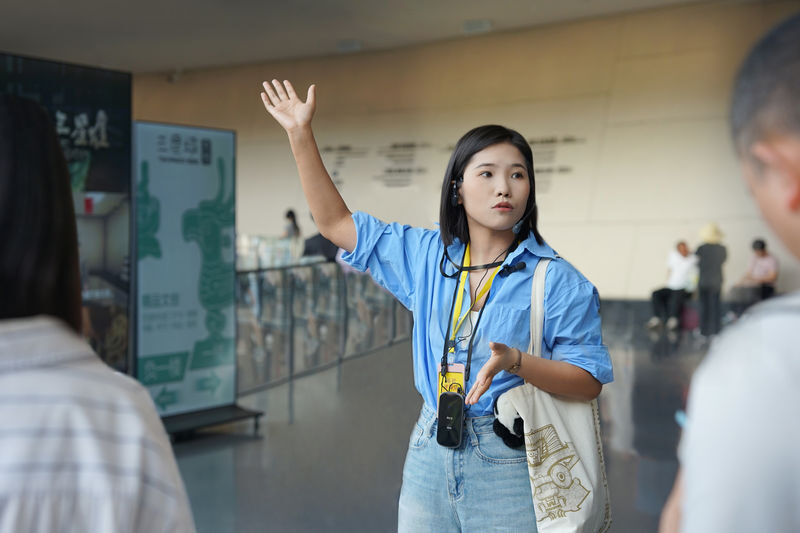
- What the guide can add
- Timing, location and small practical details
- Who should book this Sanxingdui tour?
- FAQ
- How long is the guided tour?
- What languages are available?
- Where is the meeting point?
- Are museum tickets included?
- Is there an age limit?
- When will I receive the guide’s contact information?
- The Best Of Chengdu!
- More Guided Tours in Chengdu
- More Tours in Chengdu
- More Tour Reviews in Chengdu
- Not for you? Here's more nearby things to do in Chengdu we have reviewed
Key points before you book
 1 / 4
 2 / 4
 3 / 4
 4 / 4
- Expect a full 2.5-hour guided visit. The tour description promises no less than 2.5 hours of explanation, even though the experience is also labeled as a two-hour activity.
- Meet outside Sanxingdui Visitor Center. The listed sessions are 10:00 AM and 1:30 PM, while the sample schedule gives a 9:50 departure for the morning group.
- Ticket inclusion depends on the package. Some Chinese options exclude admission, while the English and Thai options listed include it.
- The guide adds context to unfamiliar objects. Bronze masks, gold artifacts and the divine tree are more compelling when you understand their role in ancient Shu beliefs and power.
- The lowest price is not the English-tour price. Prices vary by language and ticket choice, so compare the exact package rather than relying on the starting figure.
- Leave room for schedule changes. Traffic and weather may affect the timing.

👉 See our pick of the 11 Best Shopping Tours In Chengdu
Why Sanxingdui deserves more than a quick look
Sanxingdui is in Guanghan, in Deyang, Sichuan Province, rather than in central Chengdu. The site was once a capital and sacrificial center of the ancient Shu State, active during the Shang and Zhou periods. Its remains date to roughly 4,500 to 3,200 years ago.
That timeline matters because Sanxingdui is not simply a museum of curious objects. Its finds show a complex ancient society in the upper Yangtze region, with its own visual language, religious practices and skilled metalworkers. The site also challenges the old idea that early Chinese civilization developed only around the Yellow River. Sanxingdui offers important physical evidence for a broader picture, with distinct regional cultures taking part in a shared history.
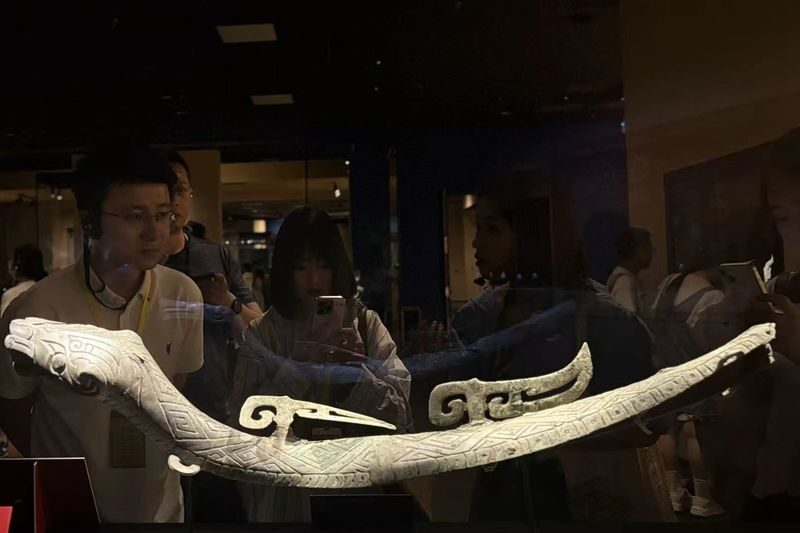
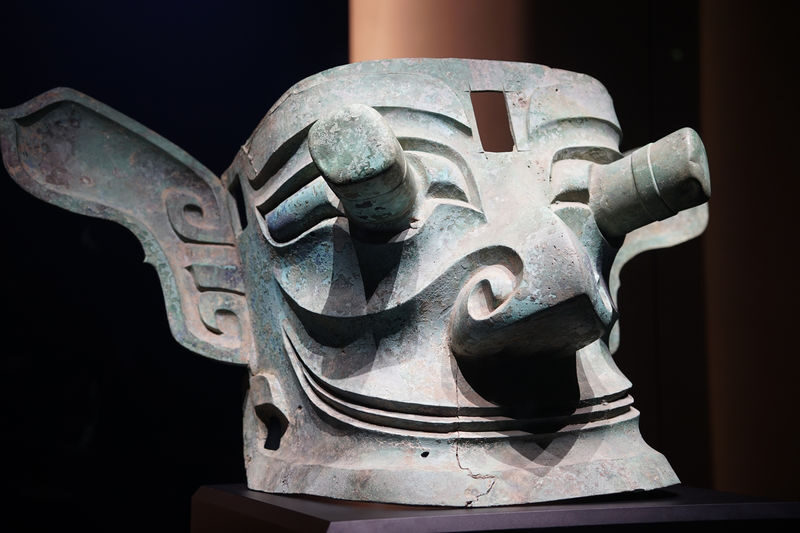
The museum’s most memorable objects are strange in the best sense. A bronze mask with greatly enlarged eyes, a standing bronze figure, a large bronze tree, a gold scepter and a sun-shaped disc all point to a world of ritual and symbolic power. The figures and designs do not look like ordinary household goods. They invite questions: who used them, what did they represent, and how did the people who made them understand the forces around them?
That is where a guide can make a real difference. You can admire an object on your own, but a good explanation helps you connect its form to beliefs about heaven and earth, the sun and moon, and ancestral spirits. It also helps you see how royal authority and religious authority may have been joined.
You can also read our reviews of more guided tours in Chengdu



From accidental find to major archaeological site
Sanxingdui’s modern story began in 1929, when local farmers accidentally uncovered jade objects. The discovery put the site on the map, but major finds came later. In 1986, excavations of sacrificial pits No. 1 and No. 2 brought bronze and gold artifacts to light and drew worldwide attention.
Excavations from 2020 to 2022 uncovered six more sacrificial pits and tens of thousands of objects. Those newer finds have added to what researchers can study about the site and its people. The discoveries also help explain why Sanxingdui can feel like an ongoing archaeological story, rather than a settled chapter from the distant past.
The guided visit is not an excavation tour, and you should not expect to watch archaeologists at work. You’ll be looking at objects and learning about their context in the museum. But knowing that major discoveries have continued into recent years gives the displays a useful sense of momentum. The museum is showing a culture whose story is still being pieced together.
A 2.5-hour route through the museum
The core of the experience is a guided museum visit lasting at least 2.5 hours. The stated schedule shows a 10:00 AM start, a 2.5-hour visit and a 1:00 PM return. The activity is also described as a two-hour experience, so the clearest practical expectation is the detailed guided-tour duration: plan for about 2.5 hours, and confirm the meeting time for your chosen session.
You meet outside the Sanxingdui Visitor Center. The available sessions are listed at 10:00 AM and 1:30 PM. For the morning tour, the schedule separately gives a 9:50 departure. That ten-minute difference is worth checking with the local contact before the day, rather than arriving at the last moment and hoping the group is still there.
Once the visit begins, the guide’s role is to explain the site and its signature finds. The experience is not just a parade of cases. Sanxingdui’s objects are visually arresting, but their scale and style can be hard to interpret without context. A guide can help you understand why the mask’s exaggerated eyes, the standing figure and the bronze tree matter as cultural objects, not merely as unusual works of art.
You can also expect discussion of the civilization’s craftsmanship. Sanxingdui’s bronze workers used large-scale segmented casting, while artisans worked thin gold foil by hammering it. The number of gold objects and human figures from the same period is described as exceptionally rare worldwide. Those details make the craft itself part of the story: these were not simple objects produced with simple tools.
The itinerary gives no detailed stop-by-stop route inside the museum, so I would not expect a guaranteed sequence of galleries or a fixed amount of time at each artifact. The value lies in the guided explanation across the museum, not in a promise that you’ll linger for a set number of minutes before every display.
What the objects reveal about ancient Shu
Sanxingdui’s art has a distinctive ancient Shu style, but the finds also show connections with other regions. Objects include jade zhang blades and bronze zun vessels associated with Central Plains traditions. Indian Ocean seashells and elephant tusks from the south point to exchange beyond the immediate area.
For you, that mix makes the museum more interesting than a simple story of an isolated kingdom. Sanxingdui had a strong identity of its own, while also taking part in wider networks of contact. The objects suggest that ideas and goods moved between the Yangtze basin, the Yellow River basin and places farther south.
The ceremonial objects are particularly useful for understanding how belief and government could overlap. The bronze figures, divine tree and gold scepter are linked to worship of the natural world and ancestors, as well as to political authority. The guide can help you keep those themes in view as you move between objects that may otherwise seem strange or disconnected.
I would go in ready to look closely rather than expecting every object to explain itself. The art is often unlike what you might expect from an ancient Chinese collection. That difference is part of the pleasure, but it also makes a clear spoken explanation valuable.
Choosing a language and ticket package
The tour is offered in Chinese, English and Thai. Minimum group sizes differ: Chinese tours can run with one person, while English and Thai tours require at least three. That matters if you are planning around a specific date. The available language is not simply a preference; it may affect whether a group can operate.
The package choices also vary. The Chinese guided tour is offered with or without admission, while the English and Thai options listed include tickets. Make sure you select the package that matches what you need. A low headline price may refer to a Chinese tour without admission, not the English ticket-included experience.
The supplied prices show a wide range: a Chinese tour without tickets starts at US$10.99, the Chinese tour with tickets at US$24.15, the English tour with tickets at US$67.99, and the Thai tour with tickets at US$64.35. The experience is also presented with a general starting price of US$12.65. These are not interchangeable prices; check the current cost for your date, language and ticket option.
Value depends on what you want from the visit. If you can follow a Chinese-language tour, the Chinese options cost less, with the ticket-included package still clearly priced separately from the no-ticket version. If you need English, the price is much higher, but it includes admission and a guided explanation in your language. For a museum with unfamiliar objects and a complex story, that explanation may be the main reason to choose a tour rather than visit independently.
The tour description says admission is included in the package covered here, but admission is not included in every package. It also says infants and children must be counted in the passenger headcount, and there is no age limit. If you are booking for someone over 60, check the admission rules directly before paying. A Chinese-language tour attendee reported being surprised that admission was free for people over 60, which is a useful reminder that ticket eligibility can affect the value of a ticket-included package.
You can also read our reviews of more museum experiences in Chengdu




What the guide can add
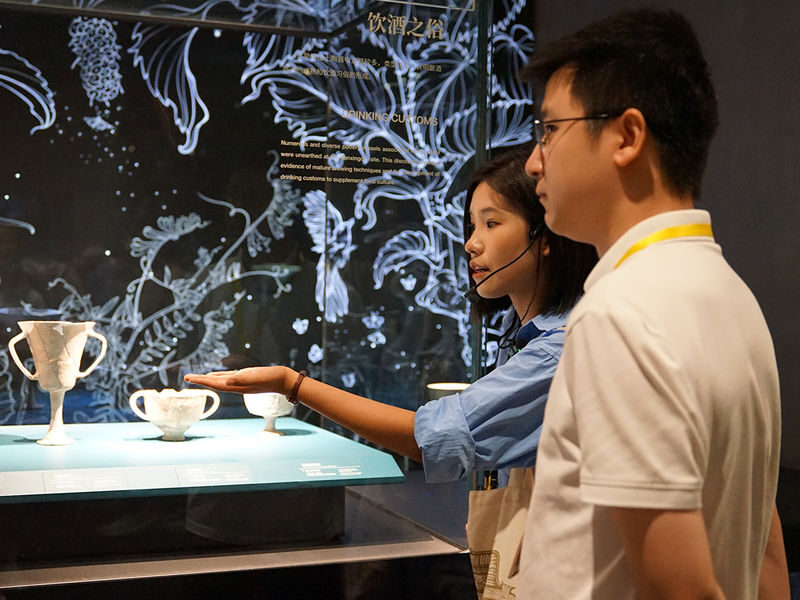
The strongest praise for this experience centers on the guide’s presentation. Teacher Du has been described as professional, cultured and engaging. That kind of delivery suits Sanxingdui: the museum’s objects are compelling at a glance, but the details about ritual, craft and regional exchange are what make a long visit worthwhile.
Teacher Du is not guaranteed for your tour, and the praise relates to a Chinese-language package. Still, it gives you a fair sense of what a good guided visit can offer: an informed explanation that holds your attention rather than a quick list of artifact names. The tour promises professional guides, but no specific person is named for the English or Thai sessions.
There is also a caution worth taking seriously. One person had trouble finding the guide and could not get a timely response from customer service, then paid separately for another guide. That appears to be an individual problem, not a stated feature of the tour, but it makes advance coordination important. Keep the contact details sent before the trip and verify exactly where outside the Visitor Center your group will meet.
Staff are supposed to contact you within one business day after booking. The guide or staff contact information is then sent one day before departure through WeChat, WhatsApp, email or another channel. Confirmation is expected 48 hours before departure. Since a missed connection can waste the whole visit, watch for those messages and follow up if the details have not arrived.
Timing, location and small practical details
The meeting point is outside the Sanxingdui Visitor Center in the Chengdu area given for the booking, but the museum itself is in Guanghan, Deyang. Keep that distinction in mind when planning your day. The information provided does not specify the transport arrangement, so do not assume the tour includes a ride from central Chengdu just because Chengdu appears as the city location.
The sample morning schedule runs from a 9:50 departure to a 1:00 PM return, with the museum visit listed from 10:00 AM to 12:30 PM. The tour also offers a 1:30 PM session. Traffic and weather may change the schedule, so avoid making tight plans immediately afterward.
Your voucher is valid only for the selected date and time. Cancellation for a full refund is available if you cancel at least 48 hours before the activity date, using local time at the destination. These terms are worth checking when choosing a date, especially if your travel plans are still unsettled.
Who should book this Sanxingdui tour?
I’d consider this tour if you want a guided introduction to one of Sichuan’s most unusual archaeological sites and prefer not to piece together the meaning of the objects alone. It is especially useful if you want the explanation in English, Chinese or Thai, and you are comfortable meeting at the Visitor Center rather than relying on an unspecified pickup service.
It may be less suitable if you need a guaranteed guide by name, a fully confirmed transport plan from central Chengdu, or a tightly timed visit with no room for changes. The schedule’s two-hour and 2.5-hour descriptions do not match exactly, and the morning meeting details vary slightly. Those are manageable questions, but worth resolving before you set your day around the tour.
For the best value, compare the price of the exact language and ticket package you need. If you book the English tour, you are paying far more than the lowest advertised starting price, but the admission and guided explanation are included. If you are comfortable with Chinese, check whether the lower-cost option includes entry and whether a minimum group size applies.
I would book if the guide’s context is important to you and the package price fits your budget. I would pause if the meeting instructions remain unclear or if you expect transportation from Chengdu to be included. Sanxingdui is worth giving time to; make sure the practical details are as clear as the ancient bronze.
Chengdu Sanxingdui Museum + Half-Day Guided Tour with Live Guide
“a very good tour. very organised amd knowledgeable guide”
FAQ
How long is the guided tour?
The guided visit is stated to last no less than 2.5 hours. The activity is also labeled as two hours, so check the duration for your selected session.
What languages are available?
Group tours are offered in Chinese, English and Thai. Chinese tours require at least one person, while English and Thai tours require at least three people.
Where is the meeting point?
The meeting point is outside the Sanxingdui Visitor Center. The listed sessions are 10:00 AM and 1:30 PM.
Are museum tickets included?
Ticket inclusion depends on the package. The Chinese tour is available with or without admission, while the listed English and Thai options include tickets.
Is there an age limit?
No. The activity has no age limit, and infants and children must be included in the passenger headcount.
When will I receive the guide’s contact information?
Staff are expected to contact you within one business day after booking. Contact information is sent one day before departure through WeChat, WhatsApp, email or another channel, and confirmation is expected 48 hours before departure.